9 Red Flags of Jealousy-Driven Emotional Abuse

9 Red Flags of Jealousy-Driven Emotional Abuse
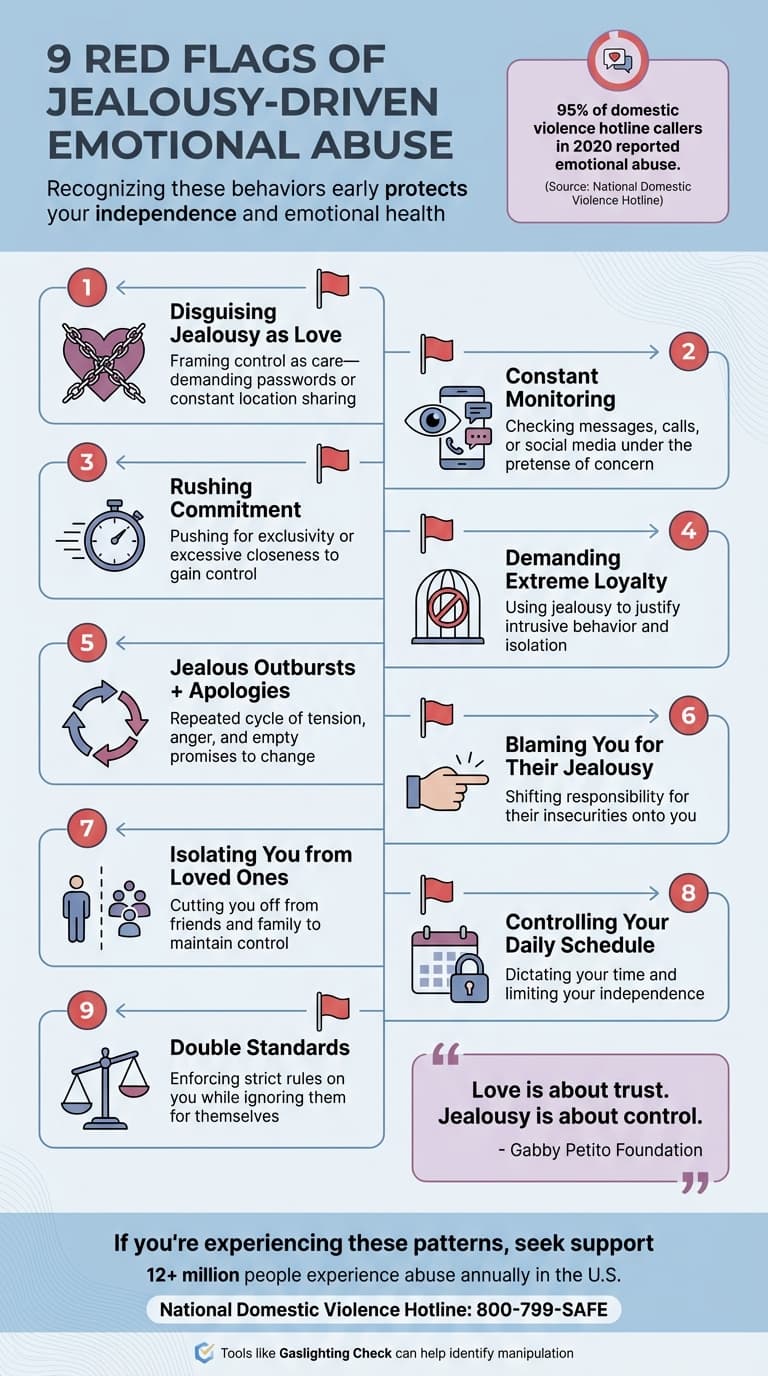
Jealousy-driven emotional abuse often starts small - like frequent "check-ins" - but can escalate into control, isolation, and manipulation. Recognizing these behaviors early is key to protecting your independence and emotional health. Here are nine warning signs to watch for:
- Disguising Jealousy as Love: Framing control as care, like demanding passwords or constant location sharing.
- Constant Monitoring: Checking your messages, calls, or social media under the pretense of concern.
- Rushing Commitment: Pushing for exclusivity or excessive closeness to gain control.
- Demanding Extreme Loyalty: Using jealousy to justify intrusive behavior and isolation.
- Jealous Outbursts Followed by Apologies: A repeated cycle of tension, anger, and empty promises.
- Blaming You for Their Jealousy: Shifting responsibility for their insecurities onto you.
- Isolating You from Loved Ones: Cutting you off from friends and family to maintain control.
- Controlling Your Daily Schedule: Dictating your time and limiting your independence.
- Double Standards: Enforcing strict rules on you while ignoring them for themselves.
If you're experiencing these patterns, tools like Gaslighting Check can help identify manipulation by analyzing conversations for abusive behaviors. Protect your emotional well-being by recognizing these signs and seeking support. If you are worried about someone else, it helps to understand why they stay and how to offer help. For immediate help, contact the National Domestic Violence Hotline at 800-799-SAFE.
::: @figure
5 Abuse Red Flags Hiding Behind Jealousy
Detect Manipulation in Conversations
Use AI-powered tools to analyze text and audio for gaslighting and manipulation patterns. Gain clarity, actionable insights, and support to navigate challenging relationships.
Start Analyzing Now1. Disguising Jealousy as Love
When someone insists on checking your phone or constantly questions your whereabouts, they might frame it as care or love with phrases like, "I just care a lot" or "I'm only doing this because I love you." But let’s be clear: this is jealousy, not love. Rebekah Barton, a writer for the Gabby Petito Foundation, highlights this confusion perfectly:
"Jealousy is often misinterpreted because it can look intense and emotionally charged - qualities many people associate with love."
True love thrives on trust and respects personal independence. In contrast, jealousy often manifests as control, with behaviors like demanding passwords or live location sharing. The Gabby Petito Foundation emphasizes this distinction:
"Love is about trust. Jealousy is about control."
Another red flag to watch for is love bombing. This involves excessive compliments, extravagant gifts, or rushing exclusivity - all designed to justify constant monitoring under the pretense of "protection."
Dani Bostick, a counselor and member of the American Counseling Association, points out a key warning sign:
"A huge red flag is when the partner who is being abused starts defending, explaining and accommodating the other partner. If you're using sentences that start with 'I was just …' that's generally a sign of abuse and control."
If your privacy is being violated, it’s essential to set firm boundaries. Pay attention to how you feel - if you find relief when they’re not around or experience anxiety during interactions, it’s a sign that something isn’t right.
Next, we’ll explore how constant monitoring can escalate these controlling behaviors.
2. Constantly Monitoring Your Messages and Calls
If your partner regularly checks your social media, texts, or call logs, it’s not about care - it’s surveillance [4]. This behavior isn’t harmless curiosity; it’s a way to control you and cut you off from your support system.
It often starts with intrusive calls, emails, or texts [5]. Over time, it can escalate to constant demands about your whereabouts or even actions like hiding or destroying your phone to limit your independence [6].
The Department of Justice describes emotional abuse as:
"Emotional abuse happens when a person uses words or actions to control, frighten, or isolate someone or take away their self-respect." [6]
In 2020, 95% of individuals who contacted the National Domestic Violence Hotline reported experiencing emotional abuse tied to this kind of surveillance [4]. These controlling behaviors undermine your autonomy, often forcing you to self-censor to avoid triggering anger [7].
Such invasive tactics can strip away your sense of freedom, making it crucial to take steps to protect your digital privacy.
If you suspect your device is being monitored, you can take precautions like clearing your browser history or using exit buttons to leave websites discreetly [5]. If you believe you’re being tracked, reach out for help by calling the National Domestic Violence Hotline at 800-799-SAFE [3].
3. Pushing for Commitment Too Fast
Rushing into a relationship can sometimes be a way for someone to take control before red flags have a chance to surface [5][8]. This approach often prioritizes power over building a genuine connection.
Abusers might use tactics like love bombing - where excessive attention and affection are showered on you - to establish control quickly. Texas therapist Melissa Stringer, LPC, NCC, B-TMH, explains:
"When manipulative behavior is used to avoid vulnerability and establish power over others, it becomes unhealthy." [8]
One major warning sign is when a partner ignores your request to slow things down and pressures you to abandon your boundaries. They might insist on spending all your time together, push you to give up hobbies, or even discourage you from staying in contact with friends and family. They may frame this behavior as wanting you "all to themselves", but it’s often a tactic to isolate you and prevent others from noticing troubling signs.
Pay attention to how your partner reacts when you express a need for space or a slower pace. A healthy partner will respect your boundaries, prioritizing mutual trust over control. On the other hand, someone motivated by jealousy or control might respond with anger, guilt-tripping, or even more pressure. If constant flattery starts to feel like a substitute for real emotional connection, listen to your instincts.
This kind of pressure and dismissal of boundaries often signals deeper control issues and can pave the way for more overt attempts at isolation.
4. Demanding Extreme Loyalty
After initial pressures to commit quickly, another troubling sign is the expectation of absolute loyalty at all costs.
Jealousy often fuels these demands, disguising control as concern. You might hear things like, "I only do this because I care about you", or, "If you have nothing to hide, why would you need privacy?" While these statements may seem caring at first, they are often used to justify intrusive behavior that erodes your independence.
Author Latrice Perez highlights the danger of this dynamic:
"A thin line separates devotion from domination. When care turns into control, it's no longer about love; it's about ownership." [9]
This mindset can manifest in various ways: constant demands for location updates, requests for passwords, monitoring your social media interactions, using tools for detecting gaslighting and manipulation, or even isolating you from friends - especially those of the opposite gender.
One case study described a young woman whose boyfriend controlled nearly every aspect of her life. He became angry whenever she spoke to other men, dictated what she could wear, and discouraged workplace friendships. She felt "suffocated" and "guilty" because he framed his actions as a sign of love, claiming she was his "whole world." This emotional manipulation left her feeling isolated and unable to seek help [7].
Leah Zeiger, founder of The Sunflower Project, offers this perspective:
"Jealousy does not prove that your significant other loves you. A jealous partner is an insecure partner who will use their insecurities as a way to excuse manipulative and controlling behavior." [10]
If you're constantly changing how you dress, who you talk to, or how you spend your time just to avoid upsetting your partner, it’s a red flag for an unhealthy relationship dynamic [7].
True loyalty thrives on trust and mutual respect - not on surveillance or isolation. A supportive partner will celebrate your achievements, encourage your friendships, and honor your privacy. Extreme loyalty demands only serve to perpetuate a cycle of control and jealousy-driven abuse.
5. Repeating Jealous Outbursts Followed by Apologies
Jealousy-fueled emotional abuse often traps victims in a relentless three-phase cycle. It starts with tension building, where you feel constantly on edge, like you're "walking on eggshells", trying to avoid triggering your partner's jealousy [11]. During this phase, the abuser scrutinizes your actions and interactions, actively seeking reasons to spark conflict. This growing tension eventually leads to an emotional explosion.
The next phase brings explosive outbursts, which can include accusations, angry interrogations, and verbal attacks [7]. After the outburst comes the so-called "honeymoon phase." Here, the abuser apologizes, showers you with gifts, or makes grand promises to change. Karen Salerno, a social worker at Cleveland Clinic, explains:
"Typically, there's not going to be an isolated incident. There will be multiple things that come up" [11].
This fleeting period of remorse and affection gives just enough hope to make you believe the "good side" of your partner is back [1]. But the reality is stark: the behavior doesn’t change permanently. The cycle repeats, each time breaking down your boundaries further and tightening the abuser’s control [7]. This pattern underscores how jealousy-driven emotional abuse can escalate over time.
In 2020, 95% of callers to the National Domestic Violence Hotline reported experiencing emotional abuse [4], with over 12 million people facing abuse annually in the U.S. [11]. These statistics reveal the widespread impact of such behavior. If you find yourself constantly altering your actions to avoid triggering another outburst, you're stuck in a harmful cycle. True change requires consistent actions, not empty apologies, often supported by AI self-help modules for emotional healing. When apologies are used merely to reset the tension without addressing the underlying issues, they become a tool of manipulation within the abuse itself.
6. Blaming You for Their Jealousy
When someone blames you for their jealousy, they're refusing to take responsibility for their own feelings. Instead of acknowledging their insecurity, they shift the blame onto you. As the National Network to End Domestic Violence puts it:
"Takes no responsibility for their behavior and blames others for the harm or pain they're causing. Often, the other person they're going to blame is you" [5].
This tactic creates a no-win situation. If you deny their accusations of flirting or cheating, they call you a liar. If you admit to something you didn’t do just to end the argument, they use that false confession as fuel for more anger and control [2]. Author Michael Samsel highlights how dangerous this dynamic can be, explaining that "Infidelity in our culture is still considered justification for extreme acts, and so mere accusations often allow the primary aggressor to justify his abuse" [2]. This blame-shifting often works hand-in-hand with other controlling behaviors rooted in jealousy.
Over time, you may find yourself changing the way you dress, who you talk to, or even your daily routines just to avoid triggering their jealousy. This pattern is a clear sign of emotional manipulation in personal relationships. Even innocent social interactions can be twisted into "evidence" of betrayal, forcing you to withdraw from others simply to maintain peace [2].
Ironically, the person accusing you of infidelity is often the one engaging in an affair themselves [2]. This projection of guilt allows them to deflect attention from their own actions while keeping control over you. Dr. Robin Stern, Co-founder and Associate Director of the Yale Center for Emotional Intelligence, explains this behavior: "When a person who gaslights feels their identity or power threatened, they need you to believe and support their version of events in order to maintain their sense of control" [12].
If you notice yourself constantly adjusting your behavior to soothe their jealousy, it’s time to recognize the manipulation at play. Their jealousy is their issue to handle - not yours to fix. Don’t let their insecurities dictate the size of your world.
7. Cutting You Off from Friends and Family
Jealousy-fueled abuse often involves isolating you from friends and family, a tactic designed to tighten control. This isolation is one of the clearest abusive tactics [13]. By distancing you from your support network, the abuser removes the people who might notice the harm and step in to help. The National Network to End Domestic Violence sheds light on this approach:
"Insists that you stop spending time with friends or family members, often framed as 'wanting you all to themselves.' This is especially true if you have friends or family members who might notice that something is wrong and try to help you" [5].
This method chips away at your external support, making it easier for the abuser to assert dominance. It often begins subtly, with criticisms of your relationships, until you start pulling away to avoid arguments [1]. Dr. Daphne King, a social worker at George Mason University, underscores how isolating behavior is a major warning sign:
"If someone is trying to keep you from spending time with your family or friends or constantly calls or texts you when you are spending time with others, that is a red flag" [13].
The control doesn’t stop with your social life. Abusers may also limit your access to activities that promote independence, such as education, work, or hobbies [5]. These restrictions are aimed at breaking down your financial or social autonomy. Georgia, a 32-year-old survivor, shared how this made her feel:
"I became less of myself. My light had dimmed because it seemed every little thing I did annoyed him. I was confused and I felt worthless. Like I was nothing" [1].
If you find yourself retreating from loved ones to keep the peace or being interrogated about every interaction, these are not signs of love - they are deliberate efforts to control. Staying connected to your support network is essential for your well-being and safety.
8. Controlling Your Daily Schedule
When jealousy fuels emotional abuse, controlling your daily schedule becomes a powerful tool in the abuser's arsenal. This isn't about casual suggestions or shared planning - it’s about dictating every aspect of your time. They decide who you can meet, where you’re allowed to go, and even when you’re permitted to rest. The result? A gradual erosion of your independence [4]. What starts as subtle interference often escalates into outright domination.
For example, an abusive partner might demand you follow their sleep schedule, even if it disrupts your responsibilities. Imagine being forced to stay awake until 3:00 AM, despite having work or childcare obligations early the next day. As SOS violence conjugale describes:
"The abuser may also demand that his partner conform to their sleep schedule, without regard for the victim's reality" [14].
Some abusers take control further by pretending to be incapable of managing basic tasks. This tactic forces you into carrying an unequal share of the workload, leaving little time for yourself [14]. Others impose rigid rules, such as insisting dinner be ready at a specific time or threatening self-harm if you make plans to leave the house. These actions reduce you to a servant, trapped in a cycle of meeting their demands [14][15].
The ultimate goal of this control? Isolation. By restricting your movements and limiting your social interactions, the abuser ensures they become your sole source of interaction and influence. SOS violence conjugale highlights this dynamic:
"Social restriction enables the aggressor to become the victim's only point of reference, amplifying their hold on them" [14].
This tight grip on your schedule does more than dictate your daily activities - it reinforces the isolation and dependence that are hallmarks of abusive relationships. If your partner constantly questions your outings, forbids you from seeing friends, or creates conflict whenever you make plans without them, these are clear warning signs of a controlling boyfriend or spouse. They are deliberate attempts to control. A healthy relationship respects your autonomy, but if you are struggling to maintain yours, you may need to set boundaries with a controlling spouse to reclaim your freedom.
9. Increasing Control with Double Standards
Double standards are another way jealousy-driven abuse takes hold, amplifying control and manipulation. In this dynamic, the abuser sets one set of rules for themselves while enforcing stricter, more demeaning rules on you. As Dan Neuharth, PhD, MFT, puts it:
"Emotionally abusive people, by definition, hold double standards in intimate relationships. They justify and excuse their actions but hold their partners to standards that demean and control" [16].
These double standards can show up in countless ways. For example, your partner might openly flirt with others and dismiss it as "harmless", but accuse you of infidelity for something as innocent as chatting with a coworker. They might demand full access to your phone, emails, and schedule while keeping their own finances and whereabouts completely hidden. They could withhold affection when upset but expect you to remain loving and sexually available at all times, regardless of your feelings. Even decision-making becomes one-sided - they might make major life choices, like moving or changing jobs, without consulting you, yet expect you to "check in" before making even minor decisions.
The imbalance extends to emotional accountability, too. They might blame you for their bad moods or outbursts through blame shifting, yet dismiss your feelings as unimportant or "your problem." Public humiliation is another cruel example - they may criticize or embarrass you in front of others but become enraged if you fail to shower them with praise in public. They scrutinize your actions with a critical eye while brushing off any feedback or concerns you raise.
None of this is accidental. These behaviors are deliberate tactics designed to maintain power and keep you off balance. Such patterns are disturbingly common in emotionally abusive relationships [4]. Over time, the stress and confusion caused by these double standards can contribute to serious mental health issues, including PTSD, complex PTSD, and major depression [17].
When you're constantly held to rules that your partner ignores, it highlights the deep imbalance of power and emotional control in the relationship. A healthy partnership thrives on mutual respect and shared accountability - not on shifting rules that only serve one person’s interests.
How Gaslighting Check Helps Detect Jealousy-Driven Abuse

Jealousy-fueled abuse often clouds reality, making it hard to trust your own perceptions. Gaslighting Check cuts through this confusion by identifying manipulation tactics that abusers use to distort your sense of reality.
Through advanced text and voice analysis, Gaslighting Check pinpoints behaviors like "twisting" (shifting blame onto you), "rewriting history" (denying past statements), "reality questioning", and "scapegoating." It also tracks emotional cues, such as dismissive tones or outbursts of anger. By objectively documenting your conversations, the tool creates a timeline of events, giving you concrete evidence of abusive patterns.
Voice analysis takes this a step further by detecting emotional signals in speech. As Newport Institute explains, "Gaslighting is a form of psychological abuse or manipulation in which the abuser attempts to sow self-doubt and confusion in their victim's mind" [18]. By monitoring these vocal patterns over time, Gaslighting Check highlights ongoing emotional manipulation, revealing it as a calculated strategy rather than isolated incidents.
The platform generates detailed reports to document these behaviors, breaking the cycle of self-doubt where you might think, "Maybe I imagined it." This is critical, as research shows that 74% of women who experience domestic violence report being gaslighted [18]. These reports expose patterns of coercion and control, showing that the abuse is not accidental but a deliberate choice.
For deeper insights, the Premium Plan offers tools like conversation history tracking for $9.99/month. This feature helps you spot escalation patterns, such as the cycle of tension-building (often tied to jealousy and possessiveness), abusive incidents, and the "honeymoon" phase of apologies. By mapping these behaviors, Gaslighting Check confirms your experiences, providing validation and clarity. With these tools, you can better understand the dynamics of abuse and take steps to protect yourself.
Gaslighting Check Pricing Plans
Gaslighting Check offers plans designed to help you document and confront emotional manipulation effectively. Whether you're an individual or part of an organization, there's an option to suit your needs.
Three plans are available:
- Free Plan ($0): This plan provides basic text analysis, making it a good starting point for identifying manipulative language. However, it doesn't include voice analysis or conversation history tracking.
- Premium Plan ($9.99/month): Aimed at individuals, this plan adds voice analysis, detailed reports, and conversation history tracking. It's especially useful for identifying and documenting patterns of emotional abuse.
- Enterprise Plan (custom pricing): Designed for organizations like therapists, domestic violence shelters, or HR departments. It includes all Premium features plus additional customization tailored to professional use.
Here’s a quick comparison of the plans:
| Plan | Price | Best For | Key Features |
|---|---|---|---|
| Free | $0 | Basic conversation testing | Text analysis, limited insights |
| Premium | $9.99/month | Individuals tracking abuse patterns | Text and voice analysis, detailed reports, conversation history |
| Enterprise | Custom pricing | Professionals and organizations | All Premium features plus customization |
Each plan prioritizes your privacy. With end-to-end encryption and automatic data deletion, your information stays secure as you work to address manipulation.
Conclusion
Jealousy-driven emotional abuse rarely begins with outright violence. Instead, it often starts with actions that seem caring but are rooted in control. Spotting these nine warning signs early can help you maintain your independence and avoid becoming isolated from your support systems. According to the National Coalition Against Domestic Violence, more than 12 million people in the U.S. experience abuse each year [11].
"Ultimately, if you find yourself changing your behaviour so that the person you're dating doesn't become angry, that is a clear sign of an unhealthy relationship."
– The Handy Guide [7]
If a relationship feels stifling or something seems off, trust your instincts. Stay connected with friends and family - they can often recognize manipulative patterns before you do.
These red flags point to a cycle of abuse, but there are tools available to help you identify and address them. For example, Gaslighting Check offers a way to document and analyze conversations for abusive patterns. The Premium Plan, priced at $9.99/month, includes features like text and voice analysis, detailed reporting, and conversation tracking. With end-to-end encryption and automatic data deletion, your privacy is protected while you uncover patterns you might not have noticed.
Recognizing these signs early and using resources like Gaslighting Check can help you regain control over your life. Protecting your emotional health is essential to breaking free from abuse and reclaiming your autonomy.
If you need immediate help, reach out to the National Domestic Violence Hotline at 800-799-SAFE.
FAQs
How can I tell jealousy from genuine care?
Jealousy and genuine care are worlds apart in both intention and effect. Genuine care thrives on support, respect, and trust, creating a healthy and nurturing dynamic. On the other hand, jealousy often stems from insecurity and can manifest in controlling or manipulative behaviors.
Signs of unhealthy jealousy might include constant monitoring, unwarranted suspicion, or attempts to restrict someone’s actions. When jealousy crosses into controlling behavior or gaslighting, it’s no longer about care - it’s a warning sign of emotional abuse. Genuine care, by contrast, is built on open communication and a mutual respect for boundaries.
What should I do if my partner is monitoring my phone or location?
If your partner is tracking your phone or location without your permission, it’s a clear warning sign of emotional abuse. Your safety comes first. Start by changing your passwords, restricting access to your devices, and identifying a secure place where you feel safe. Reach out to trusted friends, family, or professionals for support, and explore local domestic violence resources for assistance. If you ever feel at risk or in immediate danger, don’t hesitate to call 911. There are people and resources ready to help you stay safe.
How can Gaslighting Check help me document emotional abuse safely?
Gaslighting Check is a tool designed to help you track and document emotional abuse by analyzing conversations for manipulation tactics, including gaslighting. It offers features like real-time audio recording, text analysis, and conversation history tracking. To protect your privacy, all data is encrypted, and automatic deletion policies ensure your records stay secure and confidential.