Ultimate Guide to Workplace Gaslighting Prevention

Ultimate Guide to Workplace Gaslighting Prevention
Workplace gaslighting is a subtle form of psychological manipulation that can damage confidence, distort reality, and harm mental health. It often involves behaviors like denying past conversations, shifting blame, or dismissing concerns. Here's what you need to know:
- Key Signs: Self-doubt, reliance on verbal-only communication, and phrases like "You're too sensitive."
- Common Behaviors: Denying events, withholding information, excluding from meetings, and taking credit for others' work.
- Impact: Leads to anxiety, depression, and high turnover rates in organizations.
- Prevention for Employees: Document interactions, set boundaries, and build support networks.
- Prevention for Organizations: Train staff, create reporting systems, and enforce accountability.
- Tools: Platforms like Gaslighting Check use AI to detect and combat workplace manipulation in communication.
Taking action against gaslighting helps protect mental health, improve workplace morale, and prevent toxic environments. Both individuals and organizations play a role in addressing this issue effectively.
::: @figure
How to Recognize Gaslighting in the Workplace
Warning Signs for Employees
A major clue that you might be facing gaslighting at work is a growing sense of self-doubt. You might leave meetings feeling unsure about what was discussed or start questioning your memory constantly. Dr. Elizabeth Lombardo highlights this dynamic:
"If you're overwhelmed with self-doubt after a meeting with a coworker and find yourself second-guessing your version of events, you're probably being gaslighted." [5]
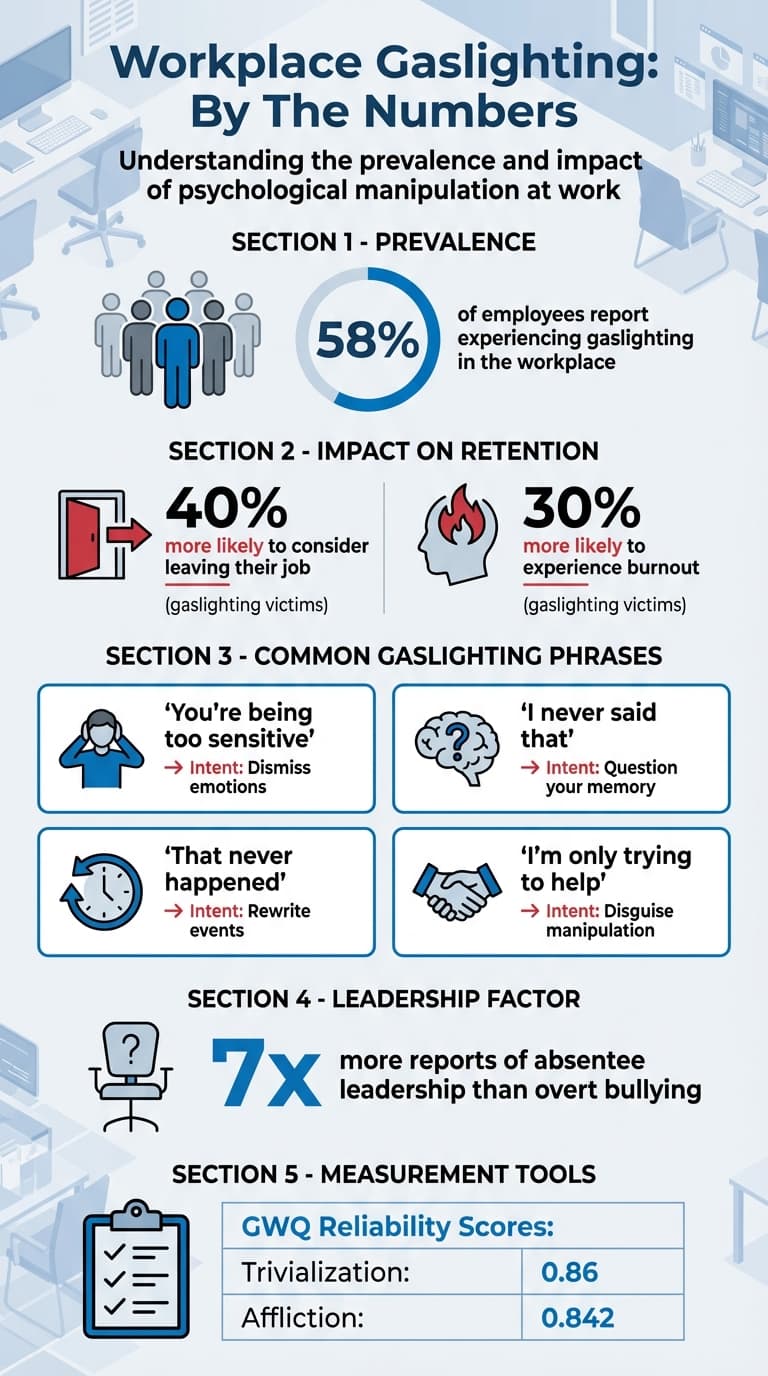
Shockingly, about 58% of employees report experiencing gaslighting in the workplace [5]. The effects can be both mental and physical, ranging from confusion and anxiety to stress-related symptoms. You may notice a growing reliance on the gaslighter's approval to feel confident or find that your concerns are dismissed with phrases like "You're too sensitive" or "You're overreacting." Another subtle but telling sign is a reliance on verbal-only communication. Without documentation, gaslighters can conveniently deny previous conversations. Insisting on written follow-ups can help counter this tactic.
Spotting these signs early can help you take steps to protect yourself before the situation escalates. Beyond personal experiences, gaslighting often reveals itself through specific behaviors from managers or colleagues.
Red Flag Behaviors in Managers and Colleagues
Gaslighting tends to follow a pattern, with gaslighters strategically altering reality to suit their narrative. They may deny past conversations, misrepresent events, or manipulate facts to shift blame. Mary Abbajay, President of Careerstone Group, LLC, explains:
"Gaslighters know how to fly under the radar. They are adept at undermining an employee's self-esteem, confidence, and sense of reality in subtle ways." [7]
Some common behaviors include managers offering inconsistent feedback, such as complimenting your work privately but criticizing you in front of others. They may also exclude you from important meetings, withhold critical information, or assign tasks designed to waste your time and hinder your progress. Another frequent tactic is taking credit for your ideas or backtracking on promises of professional opportunities, often with flimsy excuses.
| Common Gaslighting Phrases | The Gaslighter's Intent |
|---|---|
| "You're being too sensitive." | To dismiss and minimize your emotional response. |
| "I never said that." | To make you question your memory and doubt the facts. |
| "That never happened." | To rewrite events and avoid accountability. |
| "I'm only trying to help." | To disguise manipulation as good intentions. |
To counteract these behaviors, documenting your experiences is crucial. Keep a private, dated record of specific interactions, including phrases that stood out and how they made you feel. If possible, verify your recollections with trusted colleagues who were present. If others confirm your version of events, it’s a strong indication that your concerns are valid and not imagined.
Detect Manipulation in Conversations
Use AI-powered tools to analyze text and audio for gaslighting and manipulation patterns. Gain clarity, actionable insights, and support to navigate challenging relationships.
Start Analyzing NowHow Employees Can Prevent and Address Gaslighting
Document Interactions and Set Boundaries
Keeping detailed records of workplace interactions is a powerful way to counteract gaslighting. After significant conversations or meetings, send a follow-up email summarizing the key points. For instance, you could write something like, "To confirm my understanding, we discussed X and agreed on Y." This not only reinforces clarity but also creates a reliable paper trail.
When documenting, include specifics like the date, time, location (e.g., "Conference Room B" or "Zoom call"), and the names of everyone involved. Describe the events factually, noting any direct quotes and how the interaction impacted you. Ensure these records are stored securely - preferably on a personal device or another safe location - so you can access them even if your work system becomes unavailable.
Setting boundaries is equally important. Use calm and assertive communication to establish expectations. For example, if your supervisor frequently changes instructions, request that all assignments and feedback be provided in writing. When faced with vague criticism, ask for clarification and steer the conversation toward facts. These steps not only protect you but also help maintain professionalism.
While documentation and boundaries are essential, your well-being also relies on having a strong support system - something we'll explore further in the next section.
Build Support Systems and Practice Self-Care
In addition to keeping records, building a strong support network is crucial. Gaslighters often thrive by isolating their targets, so connecting with trusted colleagues can be a game-changer for your mental and professional health. Discreetly reach out to coworkers you trust to see if they've noticed similar behaviors or experienced comparable issues. As Mark Travers, Ph.D., explains:
"By leaning on your trusted circle, you can reaffirm your reality and build the resilience needed to reject the gaslighter's attempts to diminish your worth." [8]
Take advantage of workplace resources like Employee Assistance Programs (EAPs), which offer confidential counseling. If you're part of a trade union, seek their guidance as well. For more specialized support, consider consulting a therapist who focuses on workplace trauma, especially since prolonged exposure to gaslighting can lead to chronic stress, anxiety, or depression.
Daily self-validation is another critical tool. Remind yourself regularly that your feelings and memories are legitimate. Reviewing your documentation can help ground you in the facts when self-doubt creeps in. Reframe gaslighting incidents as external challenges rather than personal failings; this shift in perspective can create emotional distance and safeguard your self-esteem. It's important to remember that gaslighting reflects the gaslighter's issues, not your worth or abilities.
Workplace Gaslighting: How to Spot It and Stop It
How Organizations Can Prevent Gaslighting
Organizations can take proactive steps to protect employees from gaslighting, building on individual strategies with systemic measures that promote a supportive and respectful workplace.
Training and Awareness Programs
Mandatory training programs are a critical starting point. Gaslighting education should be incorporated into existing initiatives on mental health, harassment, and discrimination. These programs need to go beyond basic definitions, teaching employees how to identify gaslighting in everyday conversations and its two main workplace forms: trivialization (dismissing or undermining someone's perspective) and affliction (causing emotional distress through manipulative behaviors) [2].
Effective training should also shed light on specific tactics like withholding vital information, frequently shifting expectations, and avoiding formal documentation. Additionally, fostering psychological safety is essential. Employees must feel safe to voice their concerns without being labeled as "too sensitive" or "irrational" [1]. Dr. Chivonna Childs, a psychologist at Cleveland Clinic, emphasizes:
"Gaslighting is a form of emotional manipulation to make you feel as if your feelings aren't valid, or that what you think is happening isn't really happening." [10]
Once employees are educated, the next step is to ensure they have clear channels to report incidents.
Create Reporting Mechanisms
Clear and accessible reporting systems are vital for holding individuals accountable. Organizations should establish anonymous reporting options within HR systems to encourage employees to come forward without fear of retaliation [1].
A formal grievance procedure should also be in place, including the appointment of independent investigators to ensure claims are handled impartially [6]. The National Bullying Helpline highlights the seriousness of gaslighting:
"Gaslighting is classic abuse of power. It is bullying. It's a manipulative power-game, which individuals or groups of individuals play within a workplace with deliberate intent to control an individual or control a situation." [6]
Policies must explicitly address gaslighting as a form of workplace harassment, aligning with U.S. federal law, which recognizes it as psychological abuse. Employers who ignore such behaviors risk legal consequences, including claims of discrimination or breach of duty of care. Offering Employee Assistance Programs (EAPs) can provide victims with confidential counseling and mental health support throughout the investigation process.
Build Accountability and Transparency
Accountability and transparency are essential to creating a workplace free from gaslighting. This starts with thorough documentation. Organizations should require official minutes for key meetings to prevent "he-said-she-said" scenarios [6][9].
Leadership plays a pivotal role as well. Research shows that absentee leadership - where leaders fail to provide clear direction or support - is reported seven times more often than overt bullying [4]. Dr. Laura McHale, a leadership psychologist, cautions:
"Gaslighting is a canary in the coal mine." [4]
To address this, organizations should prioritize hiring and promoting leaders who demonstrate self-awareness and a commitment to ethical behavior. Regular team meetings and one-on-one check-ins can encourage open communication and deter manipulative actions [1]. Managers must also be trained to recognize and document recurring patterns of gaslighting, such as spreading gossip or negative narratives. When a manager is found guilty of gaslighting, the organization should support the affected employee by offering a new assignment or team placement to safeguard their career [3].
Using Technology to Detect Workplace Gaslighting
Technology is reshaping how companies identify and address gaslighting in the workplace. Modern tools can now monitor conversations across emails, chat platforms like Slack and Microsoft Teams, and even video calls to spot subtle patterns of manipulation that might otherwise go unnoticed. By leveraging Natural Language Processing (NLP), these systems analyze both the content and context of messages, identifying language that may indicate bullying or manipulation. Additionally, sentiment analysis dives deeper, examining the emotional undertones of communication to detect negativity or aggression - even when the words themselves seem neutral. These advancements have paved the way for specialized tools like Gaslighting Check.
The U.S. Department of Justice's 2024 Corporate Compliance Evaluation highlights the growing importance of using data analytics and AI-driven behavioral monitoring to address toxic workplace behaviors. Machine learning now makes it possible to uncover manipulation patterns that were once difficult to detect. These tools complement existing training programs and reporting systems by providing objective data to validate employee experiences and assist HR in handling investigations.
Among these tools, Gaslighting Check stands out as a prime example of how technology can actively combat emotional manipulation in real time.
How Gaslighting Check Helps Prevent Workplace Gaslighting

Gaslighting Check provides employees with an objective way to validate their concerns when they suspect manipulation. The platform uses advanced analysis of both text and voice to detect common tactics of emotional manipulation. For text, it identifies phrases and behaviors like blame-shifting, reality distortion, and emotional invalidation across emails and chat messages. The voice evaluation feature goes a step further, analyzing live or recorded audio for tone, rhythm, and stress indicators that might reveal aggression not apparent in written transcripts.
The tool produces detailed, actionable reports, giving users clear insights into whether a conversation involved manipulative behavior. For premium users, the platform also offers conversation history tracking, allowing them to compile a timeline of interactions. This feature helps determine whether the behavior is an isolated incident or part of a broader pattern, providing valuable documentation for HR investigations or mediation efforts.
Privacy is a key focus of Gaslighting Check’s design. The platform uses end-to-end encryption and implements automatic data deletion policies to ensure user communications are not stored long-term or shared with third parties. Users maintain full control over their data, with the option to save conversations only when necessary. Future updates are expected to expand detection capabilities, including support for analyzing PDFs, screenshots, and direct exports from other messaging platforms.
Gaslighting Check Pricing and Plans
Gaslighting Check offers three pricing tiers to cater to both individual employees and organizations, ensuring flexibility based on different needs:
| Plan Name | Price | Features | Scope |
|---|---|---|---|
| Free Plan | $0 | Text analysis, limited insights | No voice analysis, no history tracking |
| Premium Plan | $9.99/month | Text and voice analysis, detailed reports, conversation history tracking | None |
| Enterprise Plan | Custom Pricing | All premium features, plus additional customization options | None |
The Free Plan offers basic text analysis for users who want to explore the platform’s capabilities without any financial commitment. For $9.99 per month, the Premium Plan unlocks the full suite of features, including voice analysis and conversation history tracking. Organizations looking for broader implementation can opt for the Enterprise Plan, which offers custom pricing and tailored solutions to meet specific workplace requirements.
Measuring and Maintaining Prevention Efforts
Track Workplace Culture Improvements
After implementing preventative measures, it's essential to keep tabs on their effectiveness. One way to do this is by using the Gaslighting at Work Questionnaire (GWQ). This validated tool measures two critical aspects: trivialization (minimizing employee perspectives) and affliction (causing emotional distress). The GWQ has proven reliable, with internal consistency scores of 0.86 for trivialization and 0.842 for affliction [2].
In addition to the GWQ, monitoring key HR metrics can reveal shifts in workplace culture. Pay close attention to morale, engagement, turnover rates, role conflicts, and job satisfaction. Studies highlight that gaslighting victims are about 40% more likely to think about leaving their jobs, and employees experiencing it are 30% more likely to feel burned out [11].
| Metric Category | Key Indicators to Track |
|---|---|
| Psychological Safety | GWQ Trivialization and Affliction scores, Burnout rates |
| Retention & Loyalty | Turnover intention rates, Employee Net Promoter Score (eNPS) |
| Workplace Stress | Role conflict levels, Job satisfaction, Absenteeism rates |
| Operational Transparency | Gaps between verbal promises and written records |
| HR Responsiveness | Retaliation reports, Percentage of issues resolved via mediation |
Another area to watch is managerial transparency. Regularly review meeting minutes, file notes, and adherence to change-management policies to prevent shifting objectives [6]. Anonymous pulse surveys and 360-degree feedback can also help identify early warning signs of toxic behavior.
When these metrics flag potential problems, it's crucial to act quickly and methodically.
Respond to Incidents and Update Policies
Once a potential issue is identified, take decisive action. Engage independent investigators to ensure grievances are handled impartially [1][6].
Provide support to affected employees through Employee Assistance Programs (EAPs) and enforce appropriate disciplinary actions against those responsible [1]. Policies and training should be regularly updated based on feedback from incidents and input from stakeholders to align with current laws and best practices [1]. To combat issues like fact denial or distortion, require written summaries of performance meetings [6]. Additionally, make sure all updated HR policies are stored on an accessible online platform to promote transparency and ensure consistent application across the organization [1].
Conclusion: Creating a Gaslighting-Free Workplace
Eliminating gaslighting from the workplace isn’t just a moral responsibility - it’s crucial for maintaining trust, fostering creativity, and ensuring a healthy team environment. With a notable percentage of employees reporting experiences of gaslighting, organizations that ignore this issue risk eroding trust, stifling ideas, and creating a toxic atmosphere that can spread across teams [1].
To tackle this challenge, both leaders and employees need to take proactive, actionable steps. For leadership, this means implementing transparent reporting systems, offering regular training on understanding the root causes of gaslighting - such as trivialization and manipulation - and ensuring HR policies are clear and accessible to everyone. On the other hand, employees can protect themselves by documenting interactions, building supportive networks, and speaking up when manipulation occurs. Gaslighters often work subtly, chipping away at confidence and distorting reality in ways that are hard to pinpoint, making these measures vital.
Technology can also play a key role in addressing workplace gaslighting. Tools like Gaslighting Check give employees an objective way to analyze conversations, providing clarity when self-doubt arises. With features like detailed reports and conversation tracking, these tools empower workers to gather the evidence they need to counteract the isolation and confusion that gaslighting can create.
Creating a workplace free from gaslighting isn’t a quick fix - it’s an ongoing process. It requires consistent updates to policies, regular training, and a culture where employees feel safe to raise concerns without fear. By prioritizing transparency, accountability, and open communication, organizations can dismantle the conditions that allow manipulation to thrive and create an environment where everyone’s experiences and perspectives are valued.
FAQs
What’s the best way to document workplace interactions to address gaslighting?
To document workplace interactions effectively and address gaslighting, focus on creating a clear, factual record. Begin by recording the date (MM/DD/YYYY), time (hh:mm AM/PM), and location immediately after an incident. This ensures the details are fresh and accurate. Include the names and roles of everyone involved, including any witnesses, and describe only what you observed. Stick to exact quotes and actions - avoid adding personal interpretations.
Preserve any relevant digital evidence, such as emails, text messages, or screenshots, and store them securely in an encrypted folder. If allowed, consider recording conversations and using tools like Gaslighting Check to analyze and verify interactions. This tool provides detailed reports while maintaining data privacy with encryption and automatic deletion features. Keep your records well-organized and ready to share with trusted HR representatives, managers, or legal counsel if necessary. A thorough, detailed record can help ensure manipulation doesn’t go unnoticed.
What can organizations do to prevent gaslighting in the workplace?
Preventing gaslighting in the workplace starts with recognizing its damaging impact on trust, mental health, and overall productivity. It’s essential for organizations to treat gaslighting as a form of psychological abuse and address it through clear policies, education, and a supportive work environment.
One of the first steps is to implement a written anti-gaslighting policy. This policy should clearly define what gaslighting is and outline the consequences for engaging in such behavior. Leaders should also receive training to help them identify and address manipulative behavior effectively. At the same time, employees need education on recognizing gaslighting and documenting incidents when they occur. Confidential reporting systems and impartial investigations are critical to ensuring fairness and accountability. Tools like Gaslighting Check can also be valuable for analyzing conversations for signs of manipulation while respecting privacy.
To create a healthier workplace, organizations should prioritize psychological safety. Offering resources like counseling and keeping a close eye on workplace dynamics can go a long way toward fostering an environment where respect and well-being are the norm.
How can tools like Gaslighting Check help identify gaslighting in the workplace?
Gaslighting Check leverages cutting-edge technology to spot emotional manipulation in workplace interactions. It examines conversations using tools like real-time audio recording, text analysis, and voice analysis, pinpointing patterns that could signal gaslighting behaviors.
The platform doesn’t stop there - it offers detailed reports and keeps a history of conversations, giving users a clearer understanding of potential manipulation tactics. Prioritizing privacy, all data is encrypted and automatically deleted, ensuring sensitive information stays secure. Gaslighting Check serves as a helpful resource for creating a more open and respectful work environment.