Gaslighting vs. Constructive Criticism at Work

Gaslighting vs. Constructive Criticism at Work
Gaslighting and constructive criticism may feel similar, but their intent and impact are vastly different. Gaslighting manipulates and distorts your reality, leaving you doubting your abilities. Constructive criticism, on the other hand, focuses on specific behaviors, offering clear, actionable feedback to help you improve.
Here’s a quick breakdown:
- Gaslighting: Undermines confidence, twists facts, and creates confusion. It’s manipulative and emotionally harmful.
- Constructive Criticism: Targets actions, not character, and provides specific, fact-based suggestions for growth.
Key takeaway: Gaslighting erodes trust and self-esteem, while constructive criticism builds clarity and fosters improvement. Understanding the difference is essential for maintaining your mental health and professional growth.
122 - Gaslighting vs Honest Feedback: How to Tell the Difference
What Is Workplace Gaslighting?
Workplace gaslighting is a manipulative tactic aimed at making you question your memory, judgment, or perception of events. It’s not just a disagreement or a tough day at work; it’s a calculated pattern of behavior, often used to maintain control in environments where power dynamics are skewed. Gaslighters exploit their authority to convince you that you are the problem. Recognizing these tactics is essential to protecting your mental health and professional confidence. Below, we explore the signs to watch for.
"Gaslighting is underreported in the workplace, because gaslighters who are particularly adept at manipulation may make the victim feel as if it was all his or her fault." - Stephanie Sarkis, PhD, Author of Gaslighting: Recognize Manipulative and Emotionally Abusive People [5]
Gaslighters often oscillate between supportive and dismissive behavior, creating a confusing "warm-cold" dynamic that leaves you second-guessing yourself [5].
Common Signs of Gaslighting at Work
Gaslighting in the workplace often follows specific patterns. For example:
- Denial: A manager might claim, "I never said that", even when you clearly remember the conversation.
- Changing Expectations: After revising project requirements without telling you, they might blame you for failing to meet the new standards.
- Exclusion: You might be left out of important meetings or decisions, only to be criticized later for lacking the necessary context.
- Trivializing Concerns: When you raise valid issues, they dismiss you as being "too sensitive" or "overreacting."
These behaviors - denying, excluding, trivializing, and shifting expectations - work together to create a narrative that undermines your confidence and leaves you feeling powerless.
How Gaslighting Affects Employees
The consequences of workplace gaslighting go far beyond emotional discomfort. A 2024 study involving over 410 nurses found that employees subjected to gaslighting were 30% more likely to experience burnout and nearly 40% more likely to consider leaving their jobs [6]. The effects also include chronic stress, anxiety, and a sharp decline in self-esteem [5][7].
On a day-to-day level, victims often become overly cautious, scrutinizing every word or decision out of fear it might be used against them later. This constant self-monitoring drains mental energy, lowers productivity, and ironically gives the gaslighter more ammunition. Beyond the individual impact, gaslighting erodes team trust and creates a culture where truth feels negotiable, further damaging the workplace environment [6].
These harmful effects highlight the importance of addressing gaslighting and fostering healthier workplace dynamics.
What Is Constructive Criticism?
Constructive criticism zeroes in on behaviors and outcomes, offering clear, actionable suggestions while respecting the individual. The word "constructive" comes from the Latin construere, meaning "to build" [10]. And that's exactly its purpose: to build skills, boost confidence, and enhance performance over time.
The key difference between constructive criticism and harmful feedback lies in intent. Constructive criticism aims to support improvement and foster growth, while harmful feedback - like gaslighting - distorts reality and undermines self-confidence.
"I'm giving you these comments because I have very high expectations and I know that you can reach them." - Adam Grant, Author and Organizational Psychologist [8]
Here’s what makes feedback truly constructive.
Key Elements of Constructive Criticism
Constructive criticism stands out because it’s specific, evidence-based, actionable, and private.
- Specific: It targets actions or behaviors, not personality traits.
- Evidence-based: It’s rooted in observable facts, not assumptions.
- Actionable: It provides concrete suggestions for improvement instead of vague complaints.
- Private: Delivered one-on-one, not in public settings [3][8][11].
A popular approach is the SBI model - Situation, Behavior, and Impact. For example, instead of saying, "You're disorganized", a manager using SBI might say, "During last Tuesday's client call, the unfinalized slides delayed our meeting by ten minutes." This method ensures feedback is fair, clear, and focused on improvement.
How Constructive Criticism Helps Employees
Constructive feedback is a catalyst for career growth. Surveys reveal that 72% of employees see critical feedback as essential for their development, and 63% want more frequent feedback [9]. Timeliness also matters - feedback delivered within 2 to 7 days of an event is far more likely to inspire action [3].
On a broader scale, constructive criticism creates psychological safety - a workplace where employees feel comfortable admitting mistakes, asking questions, and taking risks without fear [8][11]. This environment contrasts sharply with the damaging effects of gaslighting, which erodes trust and confidence. Learning to trust yourself again is the first step in recovery.
"Honest, critical feedback can actually strengthen your bond rather than degrade it." - Justin Rosenstein, Co-Founder, Asana [3]
Gaslighting vs. Constructive Criticism: Side-by-Side
::: @figure
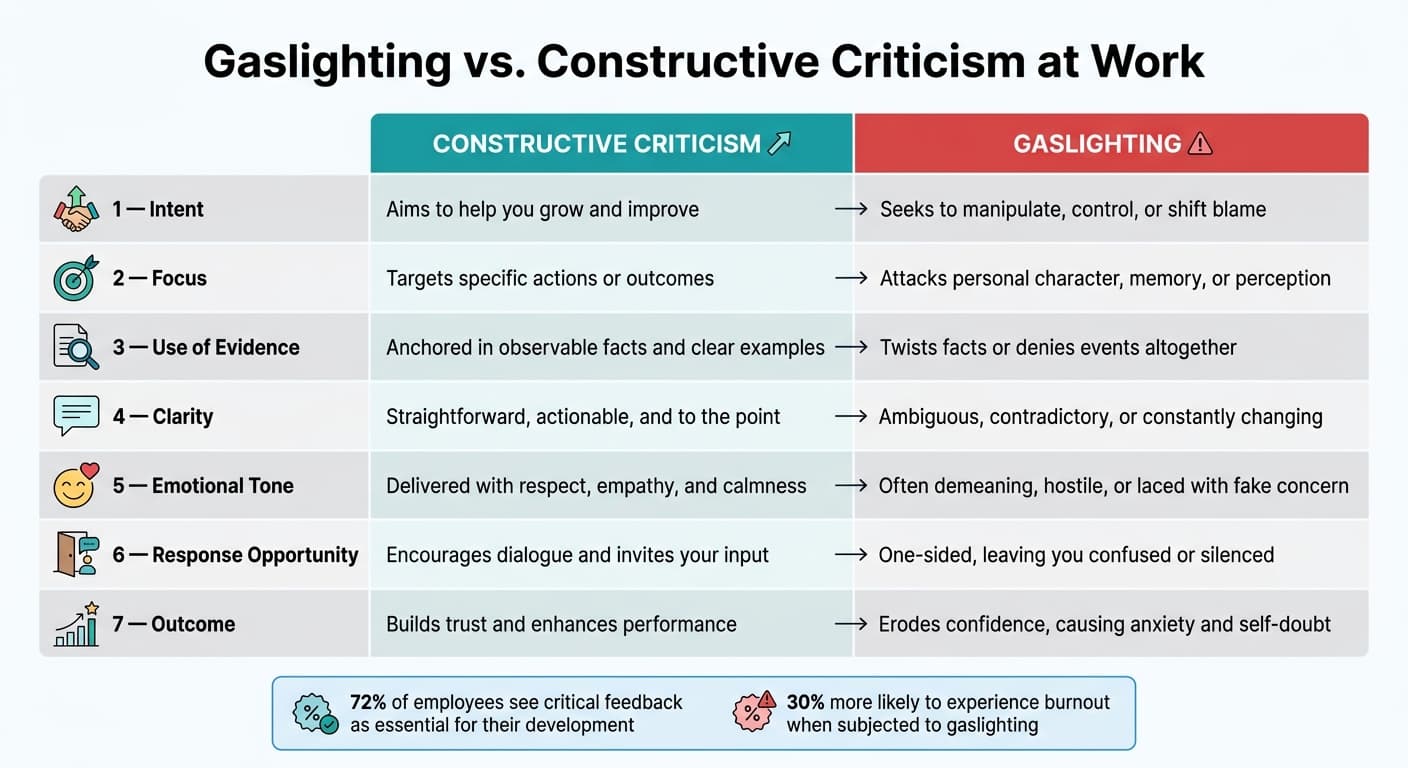
Building on these definitions, let’s dive into a side-by-side comparison of these two feedback styles. While both may feel uncomfortable at times, their differences - especially in intent, focus, and impact - are striking.
Comparison Table
Here’s a breakdown of how gaslighting and constructive criticism differ across seven key factors:
| Factor | Constructive Criticism | Gaslighting |
|---|---|---|
| Intent | Aims to help you grow and improve | Seeks to manipulate, control, or shift blame |
| Focus | Targets specific actions or outcomes | Attacks personal character, memory, or perception |
| Use of Evidence | Anchored in observable facts and clear examples | Twists facts or denies events altogether |
| Clarity | Straightforward, actionable, and to the point | Ambiguous, contradictory, or constantly changing |
| Emotional Tone | Delivered with respect, empathy, and calmness | Often demeaning, hostile, or laced with fake concern |
| Response Opportunity | Encourages dialogue and invites your input | One-sided, leaving you confused or silenced |
| Outcome | Builds trust and enhances performance | Erodes confidence, causing anxiety and chronic self-doubt |
Your gut reaction can often help you tell the two apart. Constructive criticism, while it might sting initially, typically provides a clear path forward. Gaslighting, on the other hand, leaves you second-guessing yourself and the entire conversation.
Gray Areas: When Feedback Feels Confusing
Not all feedback falls neatly into one category. Sometimes, there’s a blend of constructive critique and manipulation, making it harder to identify what’s really happening.
One common gray area is harsh but valid feedback. In high-pressure settings - like a fast-paced startup or a competitive sales team - feedback might be delivered bluntly. Even if the tone feels harsh, feedback that’s rooted in facts and offers actionable steps is still constructive.
Another tricky situation involves gaslighting mixed with valid criticism. For instance, a manager might call out a real mistake, like missing a deadline, but then use that as a springboard to question your overall abilities. That small “grain of truth” can make the manipulation harder to spot. As Shonna Waters, VP of Strategic Alliance at BetterUp, explains:
"You're going into this feedback [session] because you have a perspective on what this person can do to be more effective... But leave open the possibility that there are other things that you can't see going on in the situation."
When feedback feels off but you can’t quite put your finger on why, focus on the specifics. Ask yourself: Does the feedback address a particular action, or is it targeting your character? This simple question can help you figure out whether the feedback is meant to help you grow - or tear you down.
How To Tell Gaslighting Apart from Constructive Criticism
Distinguishing between gaslighting and constructive criticism in real-life situations isn't always straightforward. Even with clear guidelines, feedback often comes wrapped in nuance, especially in high-pressure environments where blunt communication is the norm. Recognizing the difference is crucial to responding effectively.
Questions To Ask Yourself
If feedback leaves you feeling uneasy, take a moment to reflect before reacting. It's natural for criticism to trigger strong emotional responses [10]. To evaluate whether the feedback is constructive or manipulative, ask yourself these key questions:
-
Is the feedback specific? Constructive criticism focuses on clear, actionable points about a behavior or result. Gaslighting, on the other hand, often relies on vague remarks like "everyone thinks this" or "you're overreacting" [1][3].
-
Does it address actions or attack character? Feedback aimed at improving a specific action or outcome is typically well-intentioned. If it questions your character, memory, or judgment, it’s a warning sign [3].
-
Can they provide examples? Ask for concrete examples to back up the feedback. As Julia Martins from Asana puts it:
"Constructive criticism is feedback that's specific, actionable, and designed to help someone improve." [3]
If the person giving feedback becomes defensive or struggles to provide examples, that speaks volumes. -
Does it include a path forward? Genuine feedback often comes with suggestions for improvement. Interestingly, 78% of negative feedback lacks actionable guidance [4]. If there's no way forward, consider whether the intent was to help or harm.
-
Is this a one-time occurrence or a pattern? A single tough conversation doesn’t necessarily mean manipulation. Gaslighting tends to occur repeatedly, marked by cycles of invalidation and shifting expectations [1].
By reflecting on these questions, you can gain clarity and better understand the nature of the feedback.
Why Documenting Conversations Matters
When feedback feels inconsistent or unclear, keeping a record can be invaluable. Documentation helps you preserve your perspective and protects against manipulation. Gaslighting often involves rewriting events or denying previous agreements, making your memory a potential target. A written record ensures your version of events stays intact.
After a feedback session, jot down details like the date, time, attendees, and the content and tone of the conversation. Over time, these notes can uncover patterns, such as shifting expectations or inconsistent standards [1][2].
Consider this: 67% of employees report receiving feedback they felt was false or unfair [4]. If you ever need to escalate your concerns to HR, having detailed records with specific quotes and dates strengthens your case far more than vague recollections.
Written documentation also ensures that your progress is recognized and protects you during performance reviews. If constructive feedback is misrepresented, your clear notes can help set the record straight.
If you're unsure whether a conversation crosses the line into manipulation, tools like Gaslighting Check can analyze recorded or written interactions for emotional manipulation patterns, offering an objective perspective to help you make sense of the situation.
How To Respond to Each Type of Feedback
Understanding the difference between gaslighting and constructive criticism is only part of the challenge. How you respond can shape both your professional reputation and your emotional well-being.
Responding to Gaslighting
When feedback feels manipulative, staying calm is essential. Emotional reactions can be used against you, so aim for a neutral tone and stick to facts that can be verified.
If someone’s feedback seems questionable, try asking specific questions like: "Can you provide an example?" or "Can we review the email thread together?" This approach helps ground the conversation in evidence. When someone can't back up their claims, it often reveals more about their intentions. To protect yourself, confirm conversations in writing to create a clear record. Stephanie Sarkis, PhD, explains:
"Gaslighting is underreported in the workplace, because gaslighters who are particularly adept at manipulation may make the victim feel as if it was all his or her fault." [5]
If the manipulative behavior persists, bring your documented evidence to HR. Before doing so, review your company’s harassment policies to ensure you can present your case clearly and confidently. If you're uncertain whether a conversation crossed the line, tools like Gaslighting Check can help analyze written or recorded exchanges for signs of emotional manipulation, offering an objective perspective.
On the other hand, constructive criticism requires a completely different approach - one that fosters growth and collaboration.
Responding to Constructive Criticism
Even well-meaning feedback can be hard to hear. It’s natural for criticism to trigger a defensive reaction, but taking a moment to pause and breathe can help you respond more thoughtfully.
Once you’ve composed yourself, focus on active listening. Instead of preparing a counterargument, aim to fully understand the feedback. Afterward, paraphrase what you’ve heard to confirm clarity: "It sounds like you’re saying my project updates haven’t been timely - is that correct?" This not only shows you’re engaged but also ensures you’re addressing the right issue. Expressing genuine thanks, even for tough feedback, fosters a culture of openness. As Justin Rosenstein, co-founder of Asana, points out:
"Honest, critical feedback can actually strengthen your bond rather than degrade it." [3]
Next, propose a follow-up discussion to align on actionable steps. Documenting the agreed plan is crucial - studies show that 50% of employees don’t act on the feedback they receive [9]. A written record ensures accountability on both sides and transforms a challenging conversation into an opportunity for meaningful improvement. These strategies lay the groundwork for resilience and growth, which we’ll explore further in the following section.
Recovering and Building Resilience After Workplace Gaslighting
Recovering from gaslighting isn't just about healing - it's about regaining confidence in your ability to distinguish between manipulative behavior and genuine feedback. While responding to gaslighting in the moment is crucial, the process of recovery takes time. The self-doubt caused by gaslighting requires intentional steps to overcome.
Personal Recovery Steps
The first step in recovery is rebuilding self-trust. Gaslighting works by making you question your own reality, so part of healing involves learning to trust your perceptions again. Psychologist Mark Travers, Ph.D., explains:
"Your instincts are often accurate, even when someone tries to make you feel otherwise." [7]
Therapy can be an invaluable resource during this time. A licensed therapist can guide you through the stress, anxiety, or lowered self-esteem that often comes with prolonged manipulation. Additionally, confiding in a trusted peer - someone outside your immediate work environment, like a friend, mentor, or colleague - can provide much-needed validation of your experiences.
Daily practices like cognitive restructuring can also help. This involves reframing the gaslighting as an external issue you're working through, rather than a reflection of your professional abilities. Activities like journaling, mindfulness, and regular exercise can help combat emotional fatigue. And, most importantly, practicing self-compassion is key - remember, gaslighting is a reflection of the manipulator's actions, not your worth.
In addition to personal strategies, practical tools can play a significant role in protecting your mental well-being.
Using Tools to Stay Aware and Protected
Keeping a detailed record of interactions is one of the most effective ways to maintain clarity during and after gaslighting. Documenting dates, times, and specific quotes provides a tangible reference point when self-doubt arises. As Mark Travers, Ph.D., advises:
"Keeping detailed records will help you stay grounded in your reality and give you evidence should you need it." [7]
For this, tools like Gaslighting Check can be incredibly useful. This platform offers text and voice analysis to identify manipulative patterns in conversations. Its Premium Plan, available for $9.99/month, includes features like conversation history tracking, which lets you create a timeline of interactions. This makes it easier to spot recurring tactics and harder for a gaslighter to dismiss their behavior as a "misunderstanding." Plus, the platform ensures privacy with end-to-end encryption and automatic data deletion.
Having a solid, documented record not only supports potential HR actions but also helps rebuild your trust in your own perceptions. It's a practical step toward regaining control and confidence in your workplace interactions.
Conclusion: Spotting Manipulation and Using Feedback Well
The line between gaslighting and constructive criticism comes down to intent. Psychologist Brad Brenner, Ph.D., explains it best:
"The key distinction lies in the intent: constructive criticism seeks to build up, while gaslighting aims to tear down and control." [12]
Constructive feedback focuses on specific behaviors and offers actionable steps for improvement. Gaslighting, on the other hand, is often vague, attacking your character or memory in ways that leave you feeling unsettled and doubting yourself. If feedback consistently makes you question your abilities without offering clarity or direction, it’s a warning sign of manipulation.
When done right, feedback is incredibly impactful. In fact, research shows that 85% of employees who received regular, meaningful feedback felt they had equal opportunities for growth compared to their peers [2]. Constructive criticism - even when it’s tough to hear - can foster trust and open doors for development. Gaslighting, however, does the opposite, stifling growth and eroding confidence. Understanding these distinctions is key to navigating professional relationships effectively.
To safeguard yourself, focus on three strategies: ask for specifics, use tools for detecting gaslighting to keep a record of interactions, and seek a third-party perspective. These steps can help you stay grounded and respond thoughtfully in challenging situations.
FAQs
Is my manager gaslighting me or just being blunt?
Your manager's behavior can be either blunt or gaslighting, depending on their intent and actions. Bluntness refers to straightforward communication that might come across as harsh but isn’t meant to deceive. On the other hand, gaslighting involves deliberate efforts to make you question your own memory, perceptions, or feelings. If their feedback regularly invalidates your perspective or erodes your confidence without offering constructive input, it may fall into the category of gaslighting. Reflect on whether their goal seems to be helpful or manipulative.
What should I say in the moment if I think I’m being gaslit?
If you think you’re being gaslighted, it’s important to trust your instincts and acknowledge your feelings. You can calmly assert your perspective with phrases like, "That’s not how I remember it" or "I experienced it differently." Staying composed is key to preventing the situation from escalating.
Consider keeping detailed notes of conversations or incidents. Documenting these interactions can help you stay grounded in your reality. Sharing your concerns with trusted friends or family members can also provide clarity and support, reinforcing your confidence in your own experiences.
When should I document feedback and involve HR?
Properly document any significant, ongoing, or serious issues, such as misconduct or behavior that might result in legal or compliance concerns. Involving HR in these situations is crucial. Keeping detailed records not only ensures accurate documentation but also safeguards both you and the organization in the event of disputes or investigations.