AI-Powered Self-Help for Anxiety

AI-Powered Self-Help for Anxiety
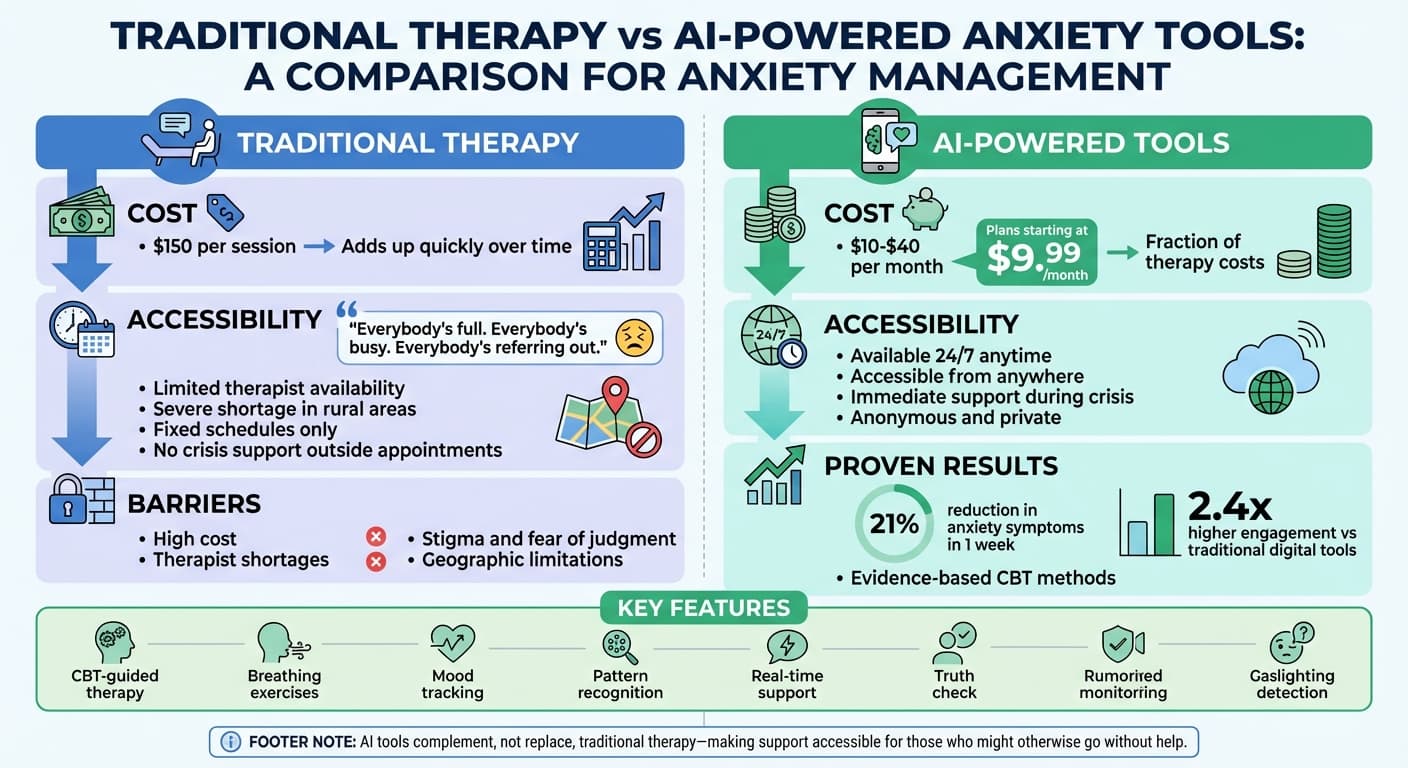
AI tools are offering a new way to manage anxiety - affordable, accessible, and available anytime. With therapy costs averaging $150 per session and limited availability of therapists, many people struggle to get help. AI-powered apps provide a cost-effective alternative, ranging from $10 to $40 per month, and have shown promising results, such as reducing anxiety symptoms by 21% in just one week.
Key Highlights:
- Why Anxiety is Hard to Treat: Symptoms affect emotions, physical health, and behavior, while barriers like cost, stigma, and therapist shortages prevent many from seeking help.
- How AI Helps: Tools use evidence-based methods like Cognitive Behavioral Therapy (CBT), breathing exercises, and mood tracking to help users manage anxiety.
- Gaslighting Support: Features like Gaslighting Check analyze conversations for real-time emotional manipulation detection, offering clarity and confidence in relationships. This helps users in mapping manipulative patterns across both personal and professional environments.
- Affordability: Plans start as low as $9.99/month, making these tools a fraction of the cost of therapy.
AI tools don’t aim to replace therapy but to complement it, making support more accessible for those who might otherwise go without help. Consistent use of these tools can lead to long-term emotional resilience and reduced anxiety.
::: @figure
What is Anxiety and Why is it Hard to Treat?
Anxiety Symptoms and Effects
Anxiety becomes a diagnosable condition when intense fear or worry persists even in situations where there’s no real danger. The National Institute of Mental Health explains:
"Anxiety disorders involve more than occasional worry or fear. For people with these disorders, anxiety does not go away, is felt in many situations, and can get worse over time." [6]
The symptoms of anxiety show up in multiple ways. Emotionally, people may feel constant worry, dread, or restlessness. Physically, it can lead to a racing heart, shortness of breath, sweating, tremors, or even fatigue. On a cognitive level, it might involve racing thoughts, difficulty focusing, or catastrophic thinking. Behaviorally, it often results in avoidance or isolation [6] [7] [8]. These symptoms can interfere with nearly every aspect of life - work, school, and personal relationships all suffer [6] [7] [8]. This widespread impact makes managing and treating anxiety particularly challenging.
Why People Avoid Traditional Therapy
For many, the symptoms of anxiety are only part of the struggle. Getting help comes with its own set of hurdles, leaving a significant number of people untreated [7].
Cost is a major barrier. Traditional therapy sessions often cost around $150 each, which adds up quickly. On top of that, there’s a severe shortage of therapists, especially in rural areas, making it even harder to access care [1] [9] [10] [11]. Thomas Plante, a psychologist and ethicist at Santa Clara University, sums it up:
"Everybody's full. Everybody's busy. Everybody's referring out." [11]
Stigma also plays a big role. Many avoid therapy because they fear being judged or feel they should manage their problems alone [1] [4] [10]. Then there’s the issue of timing - traditional therapy operates on fixed schedules, leaving people without support during moments of crisis. For some, the idea of sharing personal struggles face-to-face feels overwhelming, making the anonymity of AI self-help modules and other digital tools more appealing.
These challenges highlight the need for alternatives that are more accessible and flexible. Technology-driven solutions offer a way to bridge these gaps, providing mental health support that’s easier to access and tailored to the needs of those who might otherwise go without help. This includes using the top tools for detecting gaslighting and other forms of emotional manipulation that contribute to chronic anxiety.
Detect Manipulation in Conversations
Use AI-powered tools to analyze text and audio for gaslighting and manipulation patterns. Gain clarity, actionable insights, and support to navigate challenging relationships.
Start Analyzing NowThe Mental Health AI Chatbot Made for Real Life | Alison Darcy | TED
How AI Tools Help Manage Anxiety
AI-powered mental health tools offer therapy-based support right on your phone, making anxiety management accessible anytime. These tools combine evidence-backed methods, like cognitive behavioral therapy (CBT), with real-time tracking and personalized recommendations. The goal? To not just ease symptoms but also help build long-term emotional strength.
AI-Guided Cognitive Behavioral Therapy
One of the standout features of these tools is their ability to guide users through CBT techniques. They help identify and challenge negative thought patterns or signs of emotional abuse. For example, when you're stuck in catastrophic thinking or rigid all-or-nothing beliefs, the AI analyzes your input and points out cognitive distortions you might not notice on your own.
A study conducted in January 2026 by Jessica McFadyen and Limbic Limited tested a generative AI-enabled CBT app with 540 adults dealing with heightened anxiety. Results showed participants using the AI tool engaged 2.4 times more often compared to those using traditional digital workbooks. Those who used the app's personalized features saw a stronger reduction in anxiety symptoms over six weeks [3].
These tools often include guided thought logs where you record situations, automatic thoughts, and emotional responses. The AI then helps you reframe those thoughts into more balanced perspectives. One user shared how the AI highlighted their limiting beliefs and guided them to create more realistic interpretations [5].
Beyond cognitive restructuring, AI tools encourage behavioral activation by prompting users to plan enjoyable activities that break avoidance patterns. Some apps even assist in creating "fear ladders" for exposure therapy, helping users gradually face anxiety-inducing situations [13].
Breathing and Grounding Techniques
When panic strikes, AI tools offer instant, interactive support with breathing exercises and grounding techniques. Many platforms provide visual or audio cues to help regulate your breathing and calm your nervous system.
In 2024, a study on a ChatGPT-based chatbot revealed that users experienced a 21.15% improvement in anxiety symptoms after just one week of AI-guided interventions. These included diaphragmatic breathing and progressive muscle relaxation [2]. The real advantage here is timing - these tools provide help exactly when you need it, not just during scheduled therapy sessions.
AI platforms excel at just-in-time interventions, offering techniques tailored to your current state. Whether it's deep breathing to slow racing thoughts, progressive muscle relaxation to ease tension, or calming visualizations, the AI adapts to your needs [2][12][14]. Many also integrate emotional tracking, ensuring more personalized support over time.
Tracking Moods and Anxiety Triggers
Using advanced pattern recognition, AI tools track your emotions, triggers, and coping methods to uncover trends. By logging details like emotional intensity and specific triggers, these tools create a comprehensive map of your anxiety patterns.
Between March and July 2020, a study led by Ashish Mehta at Stanford University analyzed 4,517 Youper app users. Results showed significant anxiety reduction within the first two weeks. The findings supported the "cumulative regulation hypothesis", which suggests that repeatedly managing emotions through AI-guided sessions leads to long-term symptom improvement [12][15].
AI tools also identify hidden behavioral patterns and limiting beliefs. One user, KHWhitey, remarked:
"The AI features are accurate but still personable. Many times with the insightful questions I've thought 'wow, you really get it' and to someone with anxiety that can be invaluable."
Most platforms include trend visualization features, which let users review daily highlights and spot recurring patterns over time. By identifying factors like work stress, sleep issues, or social interactions as frequent triggers, users can make informed adjustments to their routines [5][12].
Gaslighting Check: Support for Manipulation-Related Anxiety

Gaslighting Check is designed to support individuals dealing with the anxiety caused by emotional manipulation. This type of anxiety often stems from relentless self-doubt and confusion about what’s true, fueled by tactics like memory questioning, blame-shifting, or dismissing feelings. These behaviors chip away at confidence and create a cycle of worry. Gaslighting Check steps in by analyzing conversations for manipulation tactics, helping users regain clarity and control in their relationships.
The platform uses AI-powered tools to examine both text and voice cues for signs of manipulation. For text, it scans for language patterns such as invalidation or shifting blame. Voice analysis focuses on tone, stress, and dismissive intonations. Whether you upload a conversation or record one in real time, the system provides insights like, “This phrase diminishes your perspective,” paired with actionable advice for responding more effectively.
How Gaslighting Check Works
Gaslighting Check evaluates both the content and delivery of conversations. For text-based interactions - like emails, chat logs, or messages - it flags patterns that may include denying past events, contradicting reality, or repeatedly questioning your memory. Voice analysis adds another layer by identifying shifts in tone, pitch, and speech patterns that suggest aggression or control.
The real-time recording feature is particularly helpful during live interactions. For example, if someone frequently denies events you clearly recall, the system might highlight, “Memory questioning detected in 65% of interactions.” This kind of objective feedback can validate your feelings and provide clarity in situations clouded by doubt. By combining these insights with AI-driven guidance, Gaslighting Check helps users navigate emotionally charged conversations with greater confidence.
Features and Privacy Safeguards
Gaslighting Check offers a range of tools to help users better understand their relationship dynamics:
- Detailed reports: Breakdowns of manipulation tactics, complete with specific examples from your conversations.
- Secure conversation tracking (Premium): Weekly summaries that highlight recurring patterns, such as “Blame-shifting detected in 40% of interactions.”
- Real-time monitoring: Alerts during live conversations to identify manipulation tactics as they happen.
Privacy is a top priority. The platform uses end-to-end encryption to ensure that only you can access your data. Recordings are automatically deleted after 30 days (or a timeframe you choose), reducing the risk of data retention. These robust privacy measures make it possible to analyze sensitive relationship dynamics with confidence. By offering clear insights alongside strong security, Gaslighting Check empowers users to take meaningful steps toward emotional well-being.
Plans and Pricing
| Plan | Price | Key Features |
|---|---|---|
| Free | $0/month | Basic text analysis, one weekly report, 7-day conversation history, community access |
| Premium | $9.99/month | Real-time voice analysis, unlimited detailed reports, full conversation history, pattern recognition, priority support |
The Premium plan provides deeper insights, like tactic probability scores - for example, identifying an 85% likelihood of gaslighting in specific exchanges. Both plans include the same rigorous privacy protections, ensuring that your data remains secure and in your control. With accessible pricing, Gaslighting Check offers an essential tool for building emotional clarity and resilience.
Making AI Tools Part of Your Daily Routine
Turning AI-driven insights into meaningful emotional resilience isn't just about using the tools - it’s about sticking with them. Consistency and habit formation play a huge role in making these tools work for you. For example, in Fall 2024, a randomized controlled trial by Flourish Science studied 486 college students across three U.S. campuses using the "Flourish" AI app. On average, participants engaged with the app 3.49 days per week over six weeks. This steady use - fueled by a mix of AI-guided conversations, science-backed activities, and gamified rewards - resulted in noticeable improvements in resilience and social well-being compared to those who didn’t use the app [17].
Tracking Your Progress Over Time
Many AI tools rely on clinically validated scales, like the GAD-7 (Generalized Anxiety Disorder), to track anxiety levels objectively. These scales, combined with visual dashboards showing streaks, mood trends, and milestones, make progress easy to monitor. For instance, between March and July 2020, Stanford researcher Ashish Mehta analyzed data from 4,517 Youper users. The findings? Those who used emotion regulation strategies during AI-guided conversations saw anxiety symptoms drop significantly within just two weeks (effect size d = 0.57) [12].
These tools also go a step further by analyzing journal entries and conversations to spot recurring patterns or triggers. This helps you prepare proactive strategies when similar situations arise. With clear, measurable progress on display, it becomes easier to cement daily habits that support long-term emotional well-being.
Creating Daily Habits
Once you see progress, the next step is to lock in those gains with daily routines. Building habits is simpler than it sounds - it starts with clear triggers and small, manageable actions. Here’s an example of a 7-day starter plan:
- Day 1: Download the app
- Day 2: Set a 3-minute micro-meditation reminder
- Day 3: Start a nightly 5-minute AI journaling session
- Day 6: Review AI-generated patterns and pick one habit to adjust [16]
Even quick breaks - just 1 to 5 minutes - can help you recharge before stress builds up. Using "if-then" rules, like “If I finish 90 minutes of work, then I’ll take a 2-minute breathing break,” can make these routines second nature [16].
Gamification elements, such as streaks, badges, and personalized nudges, further encourage consistency. Plus, AI tools that remember your past interactions make it easy to pick up where you left off, so you’re not starting from scratch every time. In fact, a 2026 randomized controlled trial showed that therapy powered by generative AI boosted user engagement by 2.4 times and session durations by 3.8 times compared to traditional digital workbooks [3]. This shows how adaptive, evolving content can keep you motivated and engaged as your needs change.
Conclusion
AI-powered tools are reshaping how we manage anxiety by offering support that's more accessible, immediate, and budget-friendly. With traditional therapy sessions often exceeding $150 each, these digital options provide on-demand assistance at a fraction of the cost. And the results are promising: studies report a 21.15% reduction in anxiety symptoms within just seven days and a 2.4-fold increase in engagement when using generative AI guidance [2][3].
These advancements also tackle anxiety caused by manipulation. For example, tools like Gaslighting Check are designed for individuals dealing with emotional manipulation or gaslighting. By analyzing conversations in real time - whether through text or voice - this tool identifies manipulation tactics that might otherwise slip under the radar. It prioritizes privacy with features like encrypted data storage and automatic deletion policies, while also providing detailed reports for clarity. Premium plans start at just $9.99 per month, making it an affordable choice for ongoing support.
The real secret to success with these tools lies in consistency. Spending just a few minutes each day on AI-guided exercises - like breathing techniques, journaling prompts, or conversation analysis - can gradually strengthen emotional resilience. Research even shows that regular use leads to lasting benefits, with users maintaining reduced anxiety levels weeks after starting [12][18].
FAQs
Can AI tools replace therapy for anxiety?
AI tools, such as chatbots and digital programs, can provide self-help exercises and help ease anxiety symptoms. However, they aren't a complete replacement for traditional therapy. Experts point out that AI struggles with complex emotional challenges or crises because it lacks the empathy and nuanced decision-making that only humans can offer. While these tools can improve access to mental health resources, they work best as supplements to professional therapy - particularly when dealing with more severe situations.
How do I know an AI anxiety app is actually evidence-based?
When evaluating an AI anxiety app, it's crucial to ensure it's grounded in scientific evidence. This means the app should have undergone thorough testing through methods like randomized controlled trials or meta-analyses. Look for research that highlights how effective it is in real-world scenarios, such as studies on app-based treatments for generalized anxiety or government-backed reviews of digital mental health tools. Peer-reviewed research is another strong indicator of its reliability and effectiveness.
Is it safe to upload texts or recordings to Gaslighting Check?
Gaslighting Check places a strong emphasis on user privacy by employing encrypted data handling and implementing automatic deletion policies. This makes it a relatively safe option for uploading texts or recordings. That said, it’s always a good idea to review the platform’s specific data practices to ensure you feel secure sharing sensitive information.