
10 Signs of Sibling Gaslighting
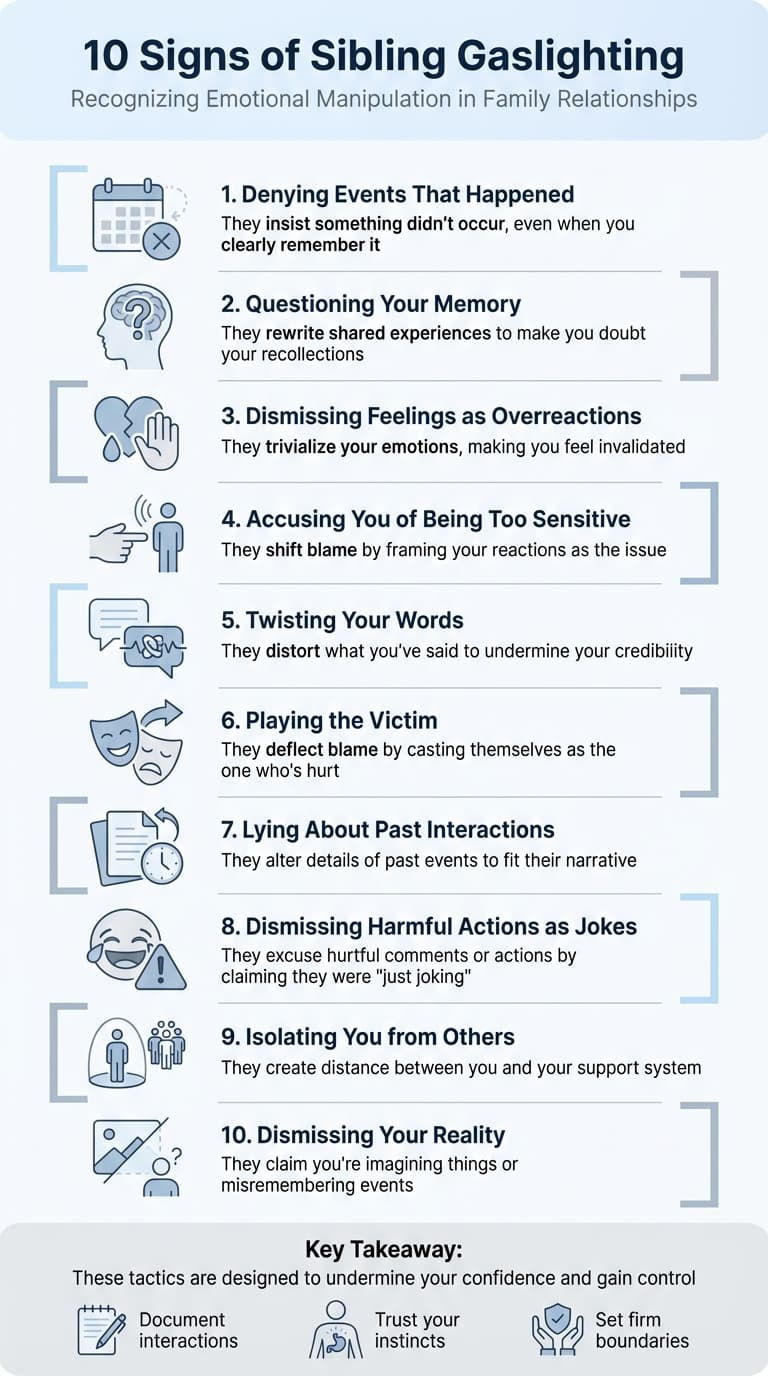
Sibling gaslighting is a subtle yet harmful form of emotional manipulation where one sibling makes another doubt their memories, feelings, or reality. This behavior goes beyond typical disagreements, often leaving lasting mental and emotional scars. Reviewing a gaslighting triggers checklist is the first step to protecting your well-being and setting boundaries. Here are the 10 key signs to watch for:
- Denying Events That Happened: They insist something didn’t occur, even when you clearly remember it.
- Questioning Your Memory: They rewrite shared experiences to make you doubt your recollections.
- Dismissing Feelings as Overreactions: They trivialize your emotions, making you feel invalidated.
- Accusing You of Being Too Sensitive: They shift blame by framing your reactions as the issue.
- Twisting Your Words: They distort what you’ve said to undermine your credibility.
- Playing the Victim: They deflect blame by casting themselves as the one who’s hurt.
- Lying About Past Interactions: They alter details of past events to fit their narrative.
- Dismissing Harmful Actions as Jokes: They excuse hurtful comments or actions by claiming they were “just joking.”
- Isolating You from Others: They create distance between you and your support system.
- Dismissing Your Reality: They claim you’re imagining things or misremembering events.
Key Takeaway: Look for a repeated pattern that undermines your ability to trust your own perceptions. A disagreement, imperfect memory, or hurtful remark alone does not establish gaslighting or reveal intent. Keep accurate notes, seek perspective, and set firm boundaries. Journaling and communication tools can support reflection; they cannot independently verify what happened.
::: @figure
Gaslighting and Sibling Estrangement
Detect Manipulation in Conversations
Use AI-powered tools to analyze text and audio for gaslighting and manipulation patterns. Gain clarity, actionable insights, and support to navigate challenging relationships.
Start Analyzing Now1. Denying Events That Clearly Happened
A gaslighting sibling often relies on flat-out denying events you know took place. They might confidently say, "That never happened" or "I never said that", even when you have a vivid memory of the event [9]. A vivid memory can still differ from another person’s recollection. The concern is a repeated pattern of denial or dismissal that prevents a fair discussion of what happened, not the disagreement alone.
Psychologist Chivonna Childs, PhD, explains:
"Gaslighting is a form of emotional manipulation to make you feel as if your feelings aren't valid, or that what you think is happening isn't really happening" [8].
Your sibling might deny actions like reading your private texts, breaking something of yours, or making a hurtful comment. They could even accuse you of "imagining things again" or "making stuff up as usual" [6][7].
Repeated denial can have the effect of undermining confidence and avoiding accountability [9]. By rewriting shared history - whether it's about past arguments or family events - they can portray themselves as calm and rational while painting you as unreasonable or overly emotional [7].
Repeated lies can also lead to something called the illusory truth effect. This psychological phenomenon makes repeated falsehoods feel true over time. As a result, you may find yourself doubting your own memories, constantly second-guessing yourself, and feeling like you're "walking on eggshells" around them.
To protect your mental health, document interactions whenever possible - note dates, times, and exact quotes. When faced with denial, calmly respond with, "I remember it differently." If the denial persists, it’s often best to step away from the conversation.
2. Questioning Your Memory of Shared Experiences
A gaslighting sibling doesn’t just deny events - they actively work to make you question your own memory. Instead of simply saying, "That didn’t happen", they might say something like, "In your mind, I’m sure that’s how it felt" [12]. Natural differences in recall are common. Pay attention when your sibling repeatedly dismisses your account, attacks your ability to remember, or refuses to consider available context; the wording alone does not establish intent.
This pattern can involve repeated changes to an account of shared experiences. For instance, your sibling might recount a childhood memory with such vivid detail and certainty that their version begins to overshadow your own. They could even paint themselves as the hero in a situation where they were actually the cause of harm - claiming they were protecting you when, in reality, they were the aggressor. Hearing their version over and over can start to wear down your trust in what you know to be true.
Some might dismiss this by saying, "Everyone remembers things differently" [12]. Different recollections are possible. The concern is using that difference to dismiss you repeatedly, rather than allowing both people to discuss what they remember. Over time, constant dismissal of your memories can leave you feeling confused and disconnected from your own sense of reality.
To counter this, try documenting key details of shared experiences as soon as possible. If your sibling challenges your memory, you can calmly state, "I remember it differently, and I trust my memory." If the discussion becomes dismissive or circular, you can pause it. Notes and saved messages may help clarify details, while still leaving room for uncertainty or mistakes in either person’s memory.
3. Dismissing Your Feelings as Overreactions
A gaslighting sibling often downplays your emotions, calling them overreactions. Psychotherapist Niro Feliciano, LCSW, explains that this tactic works to "minimize a victim's feelings and reality to make the victim feel insignificant" [13]. Repeatedly dismissing an emotional response can leave you doubting yourself. The effect matters even when intent is unclear; disagreement alone is different from an ongoing refusal to take your concerns seriously.
Trivializing your feelings can shift attention away from the concern you raised. You might hear phrases like "You always exaggerate", "Don't be so dramatic", "It's not a big deal", or "Can't you take a joke?" [5][8]. These comments shift the focus away from their behavior and onto you, painting you as overly sensitive while they avoid accountability [13].
Repeated emotional invalidation from family members can be distressing and contribute to self-doubt. For further discussion, see this overview of emotional abuse [15]. It does not establish what is happening in your family; consider the pattern and its effect on your well-being.
It’s important to remember that your feelings are valid. Licensed psychologist Jonice Webb, PhD, emphasizes:
"Having natural, human feelings is not a form of drama" [14].
When your sibling dismisses your emotions, try responding with a clear statement like, "I feel disrespected when my concerns are dismissed." If they continue to invalidate your experiences, consider setting boundaries and limiting how much emotional vulnerability you share. Your feelings are real and don’t need external approval to matter.
4. Accusing You of Being Too Sensitive
When a sibling says something like, "You're too sensitive" or "Can't you take a joke?", they're often using a classic gaslighting tactic to sidestep accountability. Instead of addressing their behavior, they shift the focus onto you, making your sensitivity seem like the problem. Julie L. Hall, author and founder of The Narcissist Family Files, explains:
"Telling other people they are overreacting when they're being victimized is the most common form of gaslighting that narcissistic abusers and their enablers engage in." [16]
This kind of remark invalidates your emotions and can make you second-guess yourself. It’s a way for the gaslighter to control the narrative, setting their own standard for what’s considered a "normal" reaction, while undermining your confidence. You cannot determine their insecurities or motives from the remark; focus on whether they address your concern and respect your boundaries. By labeling you as overly sensitive, they further erode your trust in your instincts.
Repeated sibling abuse can affect mental health and behavior [3]. Repeatedly dismissing someone’s concerns can deepen self-doubt and make it harder to speak up.
If you're accused of being too sensitive, avoid trying to justify your emotions. Instead, respond with a concise statement like, "That comment leaves me feeling dismissed", or "I would like to stay with the concern I raised." Then, make it clear you're setting boundaries if the behavior continues.
5. Twisting Your Words Against You
Building on earlier tactics like denial and memory manipulation, another red flag is when your sibling twists your words to undermine your credibility. This happens when they take what you've said out of context or claim you said something completely different. An isolated misunderstanding is different from a repeated pattern of misquoting you after you have clarified your meaning. Focus on that pattern and its effect rather than assuming the motive. Bonnie Mitchell, Clinical Director at Healthy Life Recovery, explains:
"The ultimate goal is to gain power and control by making the victim dependent on the gaslighter's version of events." [18]
This tactic works similarly to denying events or questioning your memory. By twisting your words, your sibling chips away at your ability to trust your own judgment. For example, they may flat-out deny making hurtful comments or insist you said something you didn’t, conveniently molding the story to suit their agenda [5][18]. If you confront them, they might deflect with questions like, "Why are you stuck in the past?" or even accuse you of twisting their words - a classic projection technique meant to shift the blame back onto you [9][18][8].
Here’s a breakdown of some common tactics they might use:
| Tactic | Common Phrases Used by Siblings | Possible Effect in a Repeated Pattern |
|---|---|---|
| Diverting | "Where did you get a crazy idea like that?" | May undermine your credibility [9] |
| Denial | "I never made that comment." | May create doubt about your memory [1][5] |
| Blame-Shifting | "I only did that because you..." | May divert discussion from responsibility [5] |
These tactics are especially harmful in sibling relationships because they exploit your shared history. When a sibling "rewrites" the past, it can leave you questioning your own memories of events you both experienced [5]. Over time, this can lead to self-doubt, making you wonder if you’re overreacting or imagining things. This spiral of second-guessing yourself is a dangerous form of self-gaslighting [1].
To counter this, stand firm in your recollection. Use calm, assertive responses like, "I experienced that differently" or "I remember it this way" [9][5]. Staying grounded in your version of events helps you maintain your boundaries and trust in yourself.
6. Playing the Victim to Shift Blame
When you confront a gaslighting sibling about their behavior, they often flip the script by casting themselves as the victim. This tactic shifts attention away from their actions and redirects guilt onto you. Dr. Chivonna Childs, a psychologist at Cleveland Clinic, describes this dynamic perfectly:
"Gaslighting can be a form of projection, particularly when the perpetrator is called out on their actions. This allows them to deflect and blame others. It's like a magic trick: They make you look to the left so you don't see what's going on to the right." [8]
Repeatedly redirecting a concern toward their own distress can make it harder to resolve the original issue. Resources such as AI self-help modules are optional reflection aids, not a requirement for recovery or a substitute for personal support.
A common strategy they use is recounting personal struggles or unrelated hardships to excuse their actions. Author Bill Eddy, who specializes in high-conflict personalities, explains this mindset:
"They mistakenly believe that all their problems just happen to them - as if they dropped from the sky - and that there's nothing they can do about it. They chronically feel like a victim in life." [19]
This behavior often overlaps with earlier tactics like denial and blame-shifting, further eroding your confidence in what’s real.
To protect yourself, it helps to use neutral "I" statements, such as, "I feel upset when plans are changed without notice", to avoid sounding accusatory. Detach emotionally from their victim narrative, and if they persist in portraying themselves as the victim, you might say, "Let’s agree to disagree." This approach can help you maintain your sense of reality without escalating the conflict.
7. Lying About Past Interactions
Gaslighting siblings don’t just manipulate conversations in the moment - they often rewrite the history of past interactions to fit their narrative. They might deny a heated argument ever took place, claim you agreed to something you actually refused, or exaggerate their actions to make you feel indebted. For instance, they might say, "I sacrificed everything to take care of you", when the reality was far less dramatic [20].
This tactic is especially unsettling because it’s subtle. Instead of outright denying an event, they tweak small details each time they recount it, gradually erasing their bad behavior from the story [12]. They might even admit to something like pushing you but reframe it as an attempt to "steady" you after a "stumble" [11]. This mix of truth and lies makes their version sound plausible, leaving you doubting your own memory.
Watch out for hidden gaslighting examples like selective memory. They’ll vividly recall details that paint them in a good light but suddenly develop "brain fog" when confronted about broken promises or hurtful actions [12]. If you bring up a past incident and they immediately shift focus to criticize your "tone" or "timing" instead of addressing the issue, that’s another red flag [12]. A recurring refusal to address the issue can prevent accountability, but uneven recall alone does not establish a strategy.
Repeatedly changing an account of past interactions can leave you questioning your judgment and can shift attention away from the original concern. Over time, repeated falsehoods can make their version of events feel real, undermining your confidence and leaving you emotionally reliant on them for clarity.
To protect yourself, respond with firm but neutral statements like, "I remember it differently" or "I know what I saw", and disengage from the argument [1][9]. You do not need to keep arguing when a conversation becomes circular. Keep dates, exact wording, and relevant context, including details that might challenge your first interpretation. Tools for detecting gaslighting may help organize a review, but cannot establish which account is true.
8. Dismissing Harmful Actions as Jokes
A gaslighting sibling might hurt you and then brush it off with, "I was just joking." This phrase is often used to downplay your feelings and avoid taking responsibility for their actions [13].
This behavior doesn’t just dismiss your emotions - it also shakes your confidence in your own reactions. They may accuse you of being "too sensitive" or claim you lack a sense of humor, leaving you questioning yourself. You might start wondering, "Am I overreacting?" or "Maybe I really can't take a joke?" - which can leave you less confident in raising a concern [1][3].
"If you feel fearful or on guard, or as if you're often the target of that sibling's anger or the butt of their jokes, you're likely responding to toxic behavior." - Dr. Jamie Huysman, trauma-certified therapist [17]
Pay attention to patterns. A sibling like this might repeatedly mock your career choices, point out insecurities about your appearance, or make sarcastic remarks about your relationships - especially in front of others [17][21]. If you finally confront them about these comments, they may act surprised by your reaction and insist it was "just humor" [22][23]. Repeated belittling that continues after you have explained its impact can be harmful, whether or not you can determine the speaker’s intent [21][23].
If someone dismisses a cruel comment as "just a joke", try asking them what exactly makes it funny. This can expose the underlying cruelty and shift the dynamic. You can also assert boundaries with a statement like, "I will not tolerate being belittled. If you continue, I will end the conversation." Trust your instincts - if a comment feels hurtful or mean-spirited, it probably is, no matter how it’s framed [22][23][24].
9. Isolating You from Family and Friends
Gaslighting siblings don’t just manipulate you directly - they often work to isolate you from those who might validate your experiences. By creating distance between you and your support system, they gain more control over your reality. This tactic, like others in gaslighting, erodes your sense of stability and self-trust.
One way they achieve this is by spreading rumors or lies to turn family members against you. They might twist events, reveal private conversations, or share negative stories to shift blame onto you. These actions create division and make it harder for you to find support within your family.
Another strategy is fostering dependency by saying things like, "No one else cares about you", or "I'm the only one who truly understands you." They may even go so far as to threaten others in the family, warning that supporting you could lead to their own isolation. The silent treatment is another weapon in their arsenal - prolonged emotional withdrawal leaves you feeling abandoned, anxious, and desperate for their approval. These patterns can reduce access to outside perspective. Human support matters; AI-assisted conversation review is optional and cannot verify events or replace a trusted support network.
Estrangement and sibling conflict are discussed in this overview [25], but a population statistic cannot tell you whether your own family relationship involves gaslighting. Build connections with people who listen carefully, consider what personal information feels safe to share, and use specific statements such as, "I feel hurt when you stop talking to me for weeks." An outside support network can help you maintain perspective.
10. Dismissing Your Reality as Imagination
When a sibling says things like, "You must have dreamed that" or "You're imagining things", they aren't just disagreeing with you - they're actively chipping away at your trust in your own reality. This tactic reframes your real memories as fantasies or misunderstandings. Clinical psychologist Craig Malkin, PhD, a lecturer at Harvard Medical School, describes this as "story-rewriting." He explains that it happens when "a child might remember things a certain way and the parent [or sibling] changes the story and tries to convince the child it happened their way" [10]. This kind of manipulation, much like outright denial, can leave you doubting your perceptions and memories.
In the digital world, gaslighting can take on new forms. A sibling might delete messages or call logs, then insist that you "imagined" the entire conversation [7]. Even when digital records back you up, they might dismiss them outright. Over time, this repeated invalidation can make you question your own feelings, brushing them off as overreactions [1].
| Gaslighting Phrase | What It Does |
|---|---|
| "You must have dreamed that." | Turns a real memory into a supposed fantasy. |
| "You're imagining things." | Dismisses your concerns as baseless or unreal. |
To protect yourself, consider keeping a private journal where you document events with dates, screenshots, or other evidence [7][8]. If a sibling denies an obvious fact, it might be best to step away from the conversation - there’s no point arguing with someone who refuses to acknowledge reality [8][4]. If you feel disoriented or unsure during these interactions, grounding techniques can help you refocus and stay present [7].
This form of gaslighting is particularly harmful because it attacks your sense of self, making you doubt your own mind [10]. Recognizing a repeated pattern can help you seek support and make decisions about your boundaries, without needing to establish another person’s motive.
How Gaslighting Check Can Help

When a sibling frequently changes an account of the past or dismisses your experiences, Gaslighting Check can help you review conversation language for possible signs of manipulation. You choose the material to submit. Its AI suggestions can be wrong or miss context; they do not independently verify memories, decide who is telling the truth, or establish a sibling’s intentions.
For text analysis, provide the actual exchange where possible, label the speakers, and add relevant context without unnecessary identifying details. Audio input is transcribed for review; check the transcript for errors before interpreting a result. A generated interpretation is not proof of an insincere apology, emotional state, or abuse.
Use the output to revisit the original wording and consider what information may be missing. Notes about dates and recurring interactions can support your own review, but the tool does not independently observe family events or continuously monitor calls. You do not need an AI result to decide that a boundary matters to you.
Here is a practical way to review an interaction. For current allowances and prices, consult the pricing page.
| Review step | What you provide or check | Limit to keep in mind |
|---|---|---|
| Text | The relevant exchange and speaker labels | A short excerpt can omit important context |
| Audio | Audio you have permission to submit | Check the transcript for errors |
| Context | What happened before and after | The tool cannot observe events outside your submission |
| AI output | Compare flagged wording with the original | A flag is a suggestion, not a verified finding |
| Patterns over time | Your own dated notes or saved messages | Repetition needs context; memory and records can be incomplete |
| Next step | Your needs, boundaries, and available support | Decisions remain yours; AI is not a diagnosis |
Use these tools as fallible aids for reflection, not independent verification. Read the privacy policy before submitting sensitive material: the service processes submitted content through third-party providers and retention varies by plan and data type. Content is not promised to disappear immediately after analysis. Remove unnecessary identifying details and submit only material you are permitted to share. You can start by reviewing the current options on the pricing page.
Conclusion
Gaslighting in sibling relationships can have a profound impact on your mental health. Dr. Chivonna Childs explains:
"Gaslighting is a form of emotional manipulation to make you feel as if your feelings aren't valid, or that what you think is happening isn't really happening. Over time, you start to question your self-worth, self-esteem and mental capacity." [8]
Recognizing gaslighting early is key to protecting your sense of self and validating your emotions [8][1]. This acknowledgment allows you to maintain trust in your own perceptions.
Listen to your instincts and keep a record of interactions. Journals or saved messages can act as a reality check when someone tries to distort your experiences [5][8]. Tools like Gaslighting Check can suggest language patterns to review, but they cannot confirm memories or offer an objective verdict. When considering AI vs. human emotional tone, check the original wording and context and leave room for the tool to be wrong.
Setting clear boundaries is crucial to taking back control of your reality. Dr. Childs emphasizes:
"Calling out gaslighting behaviors helps set boundaries and change the power dynamic. It puts the other person on notice that you will no longer accept this type of treatment." [8]
You don’t need their acknowledgment to move forward.
Your emotional well-being is non-negotiable. Whether it means establishing firm boundaries, reducing contact, or stepping away from the relationship entirely, prioritize your mental health. Surround yourself with people who validate your experiences and support your truth [2].
FAQs
Is it gaslighting or just normal sibling conflict?
Gaslighting involves a repeated pattern of undermining someone’s trust in their perceptions or memories. Ordinary sibling conflict can include disagreement, mistakes, and different recollections without that pattern. A single hurtful remark, guilt trip, or dispute does not establish gaslighting. Consider whether your sibling repeatedly dismisses your account, refuses to consider context, and makes it difficult to discuss concerns respectfully.
How can I set boundaries with a gaslighting sibling?
To navigate a relationship with a gaslighting sibling, it's crucial to prioritize your well-being by setting clear boundaries. Start by building internal boundaries - this means trusting your instincts and keeping notes of interactions to maintain clarity. For communication boundaries, limit conversations that feel manipulative and avoid sharing too much personal information. When it comes to physical and digital boundaries, consider reducing in-person contact and take steps to safeguard your online presence. Lastly, focus on recovery boundaries by dedicating time to your healing process and determining how much contact, if any, feels healthy for you. Consistency and firmness are key.
What evidence should I document to stay grounded?
Keep accurate records that help you review what happened, not only material that confirms your first interpretation. Save messages you received and notes about dates, exact words, and relevant context; mark uncertainty when you are relying on memory. Record how an interaction affected you separately from assumptions about intent. Use only material you are permitted to access, and consider whether storing or sharing it is safe for you.