Nonverbal Dominance in Relationships

Nonverbal Dominance in Relationships
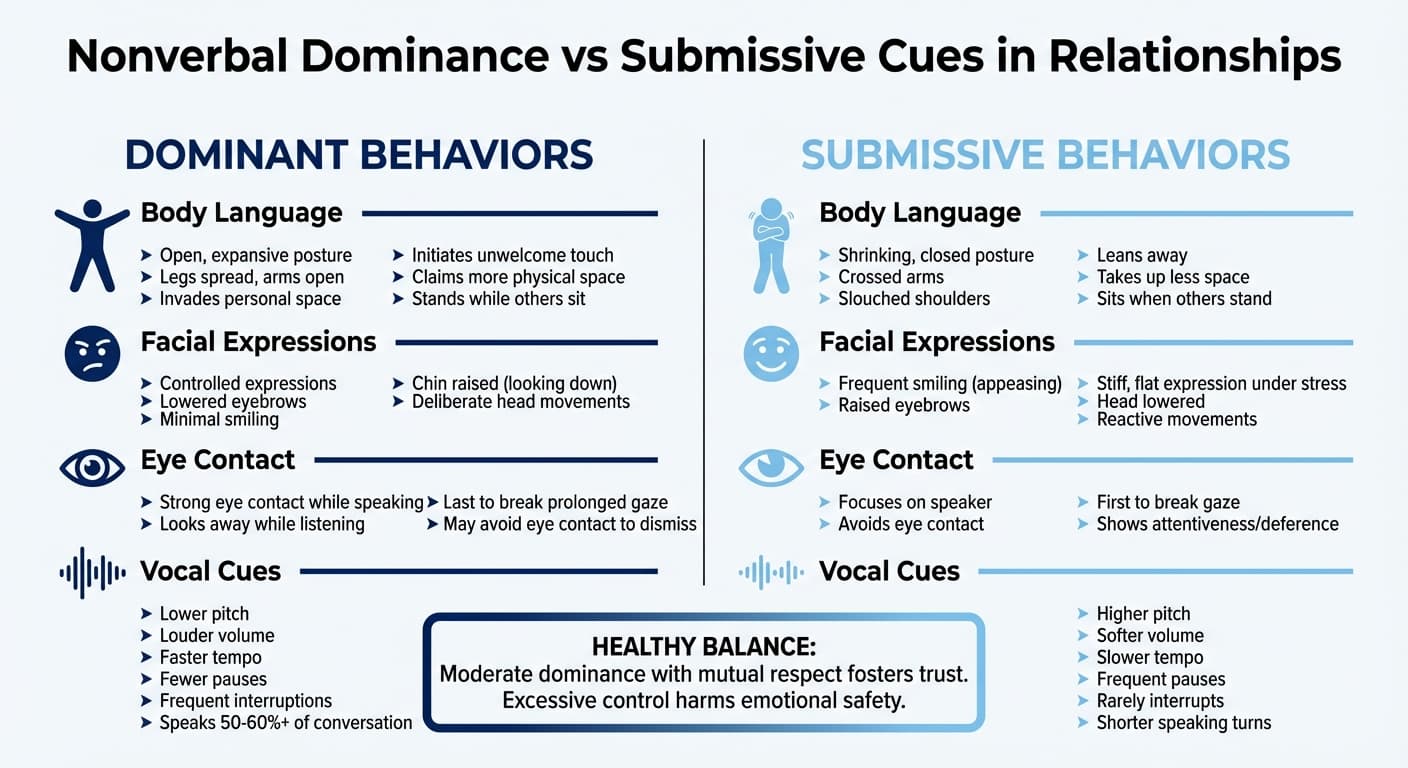
Nonverbal dominance shapes relationships through unspoken cues like posture, eye contact, and tone of voice. These signals influence dynamics, trust, and power in both personal and professional interactions. Dominant behaviors - such as occupying more space, maintaining strong eye contact, or speaking louder - can assert control, while submissive cues like avoiding eye contact or shrinking posture indicate deference.
Key points include:
- Body language: Dominant individuals use open postures and invade personal space, while submissive ones shrink or lean away.
- Facial expressions: Controlled expressions and deliberate head movements project authority, while frequent smiling suggests submission.
- Eye contact: Dominance is shown through prolonged gaze while speaking; breaking eye contact while listening signals control.
- Vocal cues: Lower pitch, louder volume, and faster tempo convey dominance; softer tones and frequent pauses suggest submission.
- Impact on relationships: Healthy dominance fosters respect, but excessive control can harm trust and emotional safety.
Balancing these cues promotes respectful communication. Tools like Gaslighting Check can analyze patterns to identify manipulative sentiment in messages and improve interactions.
::: @figure
Reading body language like an expert – the science of non-verbal communication (full documentary)
Detect Manipulation in Conversations
Use AI-powered tools to analyze text and audio for gaslighting and manipulation patterns. Gain clarity, actionable insights, and support to navigate challenging relationships.
Start Analyzing NowTypes of Nonverbal Dominance Cues
Nonverbal dominance shows itself mainly through three key areas: the body, the face, and the eyes. Each of these sends clear signals about power and influence in a relationship - often without a single word being exchanged. Let’s break down how these cues work.
Posture and Body Language
The way someone carries themselves says a lot about their confidence. For example, an expansive posture - legs spread, arms open, and a straight back - exudes control and authority [4]. Dominant individuals often push boundaries by standing closer than socially comfortable or initiating touch without invitation. Hanan Parvez, Founder of PsychMechanics, explains:
"The person who touches has more power than the one who is touched. Dominant people are always finding an excuse to invade your personal space and touch you" [4].
On the flip side, submissive body language tends to shrink. Crossed arms, slouched shoulders, or leaning away can make someone seem smaller, signaling insecurity or defensiveness. Dominant individuals also claim more space - spreading their belongings across a table or choosing to stand while others sit - to assert control [4]. These physical behaviors play a big role in shaping power dynamics, which can sometimes escalate into emotional abuse warning signs in personal interactions.
Facial Expressions and Head Movements
Facial expressions and head movements can project authority - or submission - without a word. Dominant people often keep their expressions controlled, with lowered eyebrows and minimal smiling that may come across as dismissive [4]. Their head movements are deliberate, like raising their chin to give the impression of "looking down" on someone, which can also signal fearlessness by exposing their neck.
In contrast, submissive individuals tend to smile more, often as a way to appease others [1]. They may also exhibit raised eyebrows or a stiff, flat expression when under stress [1]. Interestingly, technology like automated facial recognition can even measure dominance by analyzing the intensity of 17 specific facial movements on a scale of zero to five [1]. These expressions can deeply impact how comfortable others feel in expressing themselves. Understanding the difference between gaslighting and healthy conflict is essential when these nonverbal cues create a climate of fear.
Eye Contact and Gaze Patterns
Eye contact is one of the most telling indicators of dominance. A concept called the "visual dominance ratio" measures how much someone looks at others while speaking versus while listening [3]. Dominant individuals often maintain strong eye contact when they’re talking but may look away when the other person speaks. They’re usually the last to break prolonged eye contact, signaling control [4].
Submissive individuals, on the other hand, tend to focus more on the speaker, showing attentiveness and deference. Sometimes, dominant people deliberately avoid eye contact altogether to convey that the other person isn’t worth their attention. Interestingly, studies show that even a silent 30-second video can reveal someone’s social dominance level just based on their gaze patterns [3]. These subtle behaviors help establish hierarchies in both personal and professional settings.
Vocal Behaviors That Signal Dominance
Your voice communicates more than just words; it reveals power and influence in subtle yet impactful ways. From pitch to speaking tempo, these vocal cues often work beneath our awareness but play a big role in shaping relationships.
Tone and Volume
Pitch is a key indicator of dominance. Research has shown that individuals who lower their pitch early in group settings are often perceived as higher-ranking, while raising one's pitch conveys submission. Joey T. Cheng, a psychology professor at York University, highlights this phenomenon:
"deepening one's pitch predicted higher emergent rank", while "raising one's pitch early in the course of an interaction predicted lower emergent rank" [6][7].
Volume also signals authority. Louder voices are typically associated with both actual and perceived dominance, projecting confidence and control [2][8]. On the other hand, softer voices often suggest nervousness, withdrawal, or submission. Those with high status tend to speak with varied pitch and expressiveness, while nervous individuals sound more monotone and tense [2].
Speaking speed further reveals confidence. A faster tempo with fewer pauses suggests dominance and competence, whereas frequent pauses and shorter speaking turns are linked to anxiety or lower status [2][8]. These elements - pitch, volume, and tempo - work together to establish control over the conversational flow.
Interruptions and Speaking Time
Beyond tone and volume, how someone manages speaking turns also reflects dominance. Judee K. Burgoon, a communication expert from the University of Arizona, describes dominance as:
"a relational, behavioral, and interactional state that reflects the actual achievement of influence or control over another via communication actions" [2].
Dominant individuals often take the lead by speaking more frequently and for longer periods [2][1]. They interrupt to steer conversations toward their preferences, asserting their role as the central figure in the interaction [2]. For example, a study involving 97 couples found that people who felt more powerful used dominant behaviors like interruptions during problem-solving discussions [9].
However, dominance has its limits. Speaking for more than 50–60% of a conversation can come across as overbearing, potentially undermining authority [2][1]. Submissive individuals, by contrast, take fewer turns, speak for shorter durations, and rarely interrupt. Instead, they follow the lead of others, signaling a lower position in the relationship hierarchy [2][1].
Together, these vocal behaviors - tone, volume, tempo, and turn-taking - paint a clear picture of who holds influence in any interaction.
How Nonverbal Dominance Affects Relationships
Nonverbal dominance plays a crucial role in shaping trust and emotional safety within relationships. How dominance is expressed can either strengthen bonds or create distance by mapping manipulative patterns that erode connection.
Effects on Emotional Closeness
Dominance can either foster trust or undermine emotional security. Confident nonverbal cues - like upright posture, steady eye contact, and fluent speech - are often interpreted as signs of reliability and competence [1][2]. On the flip side, dominance rooted in intimidation rather than mutual respect can erode emotional safety and drive partners apart [5].
Interestingly, dominant individuals often maintain eye contact while speaking but look away when listening, signaling a lack of openness to their partner’s input [3]. This subtle behavior speaks volumes about hierarchy and power dynamics. In fact, research has shown that people can accurately gauge someone’s socio-economic status from just one minute of video, highlighting the profound impact of these nonverbal cues [3].
Composure also plays a key role in relationship satisfaction. Being engaged yet relaxed fosters trust and commitment, while nervous or rigid body language can spark suspicion and hinder communication [1][2]. As Judee K. Burgoon, a communication expert at the University of Arizona, explains:
"balance between being active and engaged but also preserving a degree of comfort that requires some holding back" [1].
These nonverbal signals not only influence intimacy but also set the tone for how conflicts develop and are resolved.
Conflict Patterns and Resolution
Nonverbal cues can either help resolve conflicts or make them worse. Moderate dominance - such as a firm tone, upright posture, and steady eye contact - can enhance persuasiveness and facilitate resolution [3]. However, extreme dominance often backfires. Behaviors like clenched fists, a fixed stare, or crossing one’s arms tightly signal aggression and can escalate tensions [10].
Even subtle gestures like the "rooster stance" - chin up, chest thrust forward - can provoke conflict, regardless of the speaker’s tone [11]. Shifting to a 45-degree angle instead of directly facing someone reduces perceived threats, creating a more open space for resolution [11].
Mixed signals can undermine trust. For example, saying "I understand" while crossing arms or clenching the jaw sends conflicting messages that can breed distrust [11]. As conflict researcher Kenneth Thomas warns:
"one unresolved conflict episode can easily set the stage for a second episode" [12].
This highlights the importance of aligning nonverbal cues with genuine openness rather than defensive or aggressive dominance.
| Escalating Behavior | De-escalating Behavior |
|---|---|
| Fixed stare or "hard" gaze | Soft, natural eye contact |
| Squarely facing the person | Standing at a 45-degree angle |
| Finger-pointing or clenched fists | Open palms and visible hands |
| Rapid, loud, or sharp tone | Low, calm, and modulated volume |
Using Gaslighting Check to Detect Manipulative Patterns

Manipulative behaviors often operate on a subtle level, making them difficult to spot right away. Gaslighting Check uses automated tools to identify these hard-to-detect cues and detecting emotional shifts in conversations.
The platform starts by analyzing vocal behaviors. Its voice analysis examines factors like loudness, pitch variation, and speaking tempo. It also tracks "interactional control", which refers to behaviors such as frequent interruptions, dominating conversations, or excessive speaking. Research shows that when someone’s vocal activity exceeds 50–60%, it can undermine the composure of others involved in the interaction [1][2][3].
Gaslighting Check also evaluates text for inconsistencies between words and tone. For example, it flags situations where written messages like "I'm fine" contradict vocal cues, exposing potential manipulation [2].
The platform provides detailed reports that help distinguish between healthy assertiveness and manipulative patterns. It identifies signs like vocal tension, overly long speaking turns, or rigid communication styles. For users who opt for the Premium plan ($9.99/month), the tool also tracks conversation histories to highlight recurring behaviors [2][13].
Automated tools like these can pick up on behaviors that are often missed by human observation. For instance, a January 2021 study using similar technologies (such as OpenFace and OpenSmile) found that dominant individuals tend to initiate more turns in conversations and speak with higher volume and greater pitch variation [1][2].
Conclusion: Managing Nonverbal Dominance in Your Relationships
Nonverbal dominance often reveals itself through posture, eye contact, voice, and control over conversations [1][2]. Pay attention if someone frequently adopts expansive postures, maintains unbroken eye contact, speaks louder than necessary, or interrupts others to assert control [1][2].
To address this, start by observing speaking patterns. If one person dominates over 50–60% of the conversation, it can disrupt group harmony and erode trust [1][2]. Look for additional signs like excessive talking, invading personal space, or unwelcome physical contact - these can all signal an imbalance [1][2][4].
"When you submit to a dominant person, you confirm their dominance. If you don't respond with submissive or complying behaviors, you leave them in their dust."
- Hanan Parvez, Founder of PsychMechanics [4]
To counteract dominance, maintain a neutral posture and a steady gaze. These subtle actions can assert your independence without escalating tension [1][4].
For a deeper dive into conversational dynamics, platforms like Gaslighting Check analyze voice and text to identify manipulative patterns. This tool provides an objective lens to complement your understanding of nonverbal cues, emphasizing how awareness can help you navigate power dynamics. By staying mindful of these signals, you can promote more balanced and respectful interactions.
FAQs
How can I recognize signs of nonverbal dominance in my behavior?
To spot nonverbal dominance in yourself, focus on body language that reflects confidence and authority. This can include standing tall, maintaining an open posture, using deliberate gestures, taking up space, and holding steady eye contact. These actions often signal control and a strong social presence.
Other important cues to watch for are a calm, steady voice, smooth and relaxed movements, and steering clear of nervous habits like fidgeting. Paying attention to these signals can help you fine-tune how you present yourself or better interpret the balance of power in your interactions, whether at work or in personal situations.
What are the negative effects of excessive dominance in relationships?
Excessive control in relationships often creates unhealthy dynamics where one partner dominates or overpowers the other. This kind of imbalance can chip away at emotional intimacy, trust, and mutual respect, leaving the connection strained and unbalanced.
When this dynamic persists, it can lead to resentment, emotional detachment, and heightened stress levels. Over time, these issues not only lower relationship satisfaction but can also take a toll on mental health. A relationship lacking trust and emotional safety can amplify stress and anxiety. Maintaining a balanced dynamic is key to building trust, nurturing respect, and supporting emotional well-being in any relationship - whether personal or professional.
How can Gaslighting Check help identify manipulative behaviors in relationships?
Gaslighting Check is a tool designed to help users spot manipulative behaviors by analyzing conversations for signs of emotional manipulation. With features like real-time audio recording and both text and voice analysis, it examines tone, language, and even nonverbal cues to identify patterns that could indicate gaslighting or controlling behavior.
By diving into speech patterns, vocal tones, and subtle nonverbal signals, this tool offers detailed insights into potential dynamics of dominance or emotional abuse. Its goal is to empower users to recognize harmful behaviors early, enabling them to take action to protect themselves in personal and professional settings.