How Manipulated Media Fuels Gaslighting

How Manipulated Media Fuels Gaslighting
Manipulated media can fuel gaslighting when someone repeatedly uses altered or misleading material to make me doubt what I remember or perceive. A single edit does not establish gaslighting or intent; context, repetition, and responses to correction matter.
I can start by separating what the media shows from what someone says it means, then compare the disputed item with its source and surrounding context. My safety comes before checking a file. If reviewing it could expose me to threats or surveillance, I can skip that step and seek support without first resolving every disputed detail.
Research on Belief, Uncertainty, and Trust
Studies measure different outcomes, including belief, uncertainty, memory, and self-trust. A finding about one does not establish the others.[1] Altered images and videos can affect each outcome differently.
Belief and Cumulative Effects
Gaslighting builds over time, so researchers should not treat a single exposure as the full pattern.[1]
False Beliefs, Doubt, and Self-Trust
Outside suggestions can change how people recall events. Edited media may therefore plant doubt that surfaces later.[1] Repeated manipulation may weaken self-trust when a trusted person’s account takes the place of direct experience, and that doubt may spread to other judgments.[1]
Study Results and Research Limits
Studies using U.S. samples have linked reported manipulation with more depressive symptoms and poorer relationship quality.[2] Brief experiments measure short-term effects, not the repeated relationship pattern that defines interpersonal gaslighting.[3] This limits what those experiments can tell us about manipulated media in relationships.
How Misleading Media May Support Gaslighting
Misleading media can support gaslighting when someone uses it as proof, selective context, or false consensus to weaken another person’s confidence in their memory and perception. Misleading media alone does not prove gaslighting. Repetition, power imbalance, and intent still matter. [1][3]
It helps to distinguish false context, false labels, and record tampering.
Deepfakes, Simple Edits, and False Context
| Manipulation | Effect in a relationship or conflict | Research limit |
|---|---|---|
| False context: genuine media presented with misleading metadata | Gives an event a different meaning [1] | Memory research does not establish intent [1] |
| False label: genuine media called fake | Distorts reality and creates doubt about verified evidence [1] | Intent is hard to prove without a record of repeated behavior [2] |
| Record tampering: altered messages, records, or screenshots | Creates false proof that contradicts someone’s recollection [1] | One incident does not establish a gaslighting pattern [1][3] |
The same file could reflect manipulation or an error. Access to the original, the response to corrections, and repetition help distinguish the two.
Recurring Manipulation Versus an Editing Mistake
Recurring manipulation may involve blocked access to the original, dismissed corrections, and repeated use of misleading media to maintain control. [1]
An isolated editing error involves an available original, an acknowledged error, and a corrected mistake.
Neither scenario proves gaslighting. If reviewing the material feels safe, check the complete recording and note exactly what is visible. [2] Keep what the media shows separate from what someone claims it means before drawing conclusions.
Why Visual Checks and Warning Labels Have Limits
::: @figure
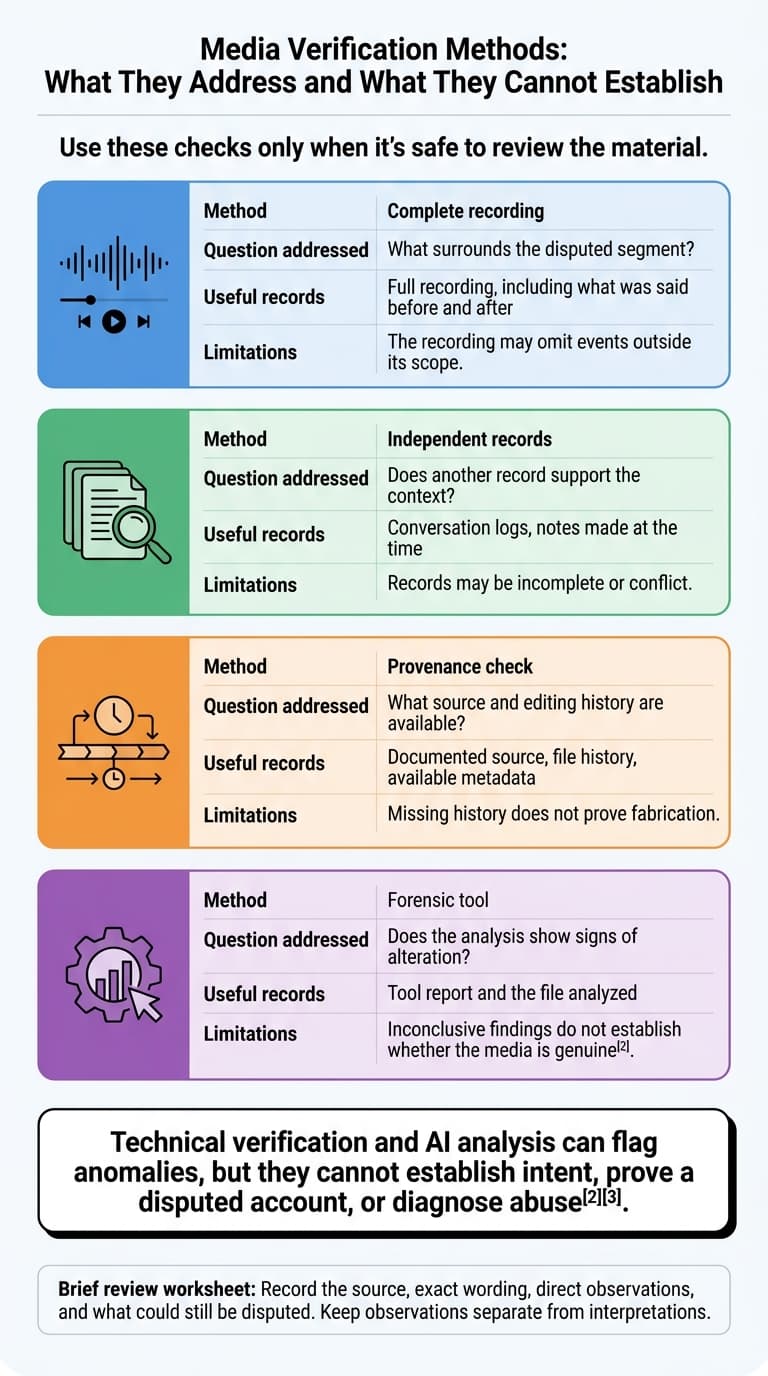
Having the original file does not remove every limit on verification. Warning-label studies test whether labels reduce false belief in manipulated media; they do not establish whether the media is genuine[2]. Manipulators can exploit that uncertainty.
What Detection Studies Measure
Detection studies distinguish accuracy from confidence: whether viewers judged correctly and how certain they felt. Results vary with viewing conditions and prior experience, so they do not measure intelligence[1]. Being susceptible to manipulation is a predictable response, not a character flaw[1].
Checking Original Files, Context, and Source History
When reviewing disputed media in a relationship or conflict, avoid relying on a single verdict about whether it is genuine or altered. Technical verification and AI emotional manipulation detection can flag anomalies, but they cannot establish intent, prove a disputed account, or diagnose abuse[2][3].
Use targeted checks to answer specific questions.
| Verification method | Question addressed | Useful records | Limitations |
|---|---|---|---|
| Complete recording | What surrounds the disputed segment? | Full recording, including what was said before and after | The recording may omit events outside its scope. |
| Independent records | Does another record support the context? | Conversation logs, notes made at the time | Records may be incomplete or conflict. |
| Provenance check | What source and editing history are available? | Documented source, file history, available metadata | Missing history does not prove fabrication. |
| Forensic tool | Does the analysis show signs of alteration? | Tool report and the file analyzed | Inconclusive findings do not establish whether the media is genuine[2]. |
Rather than expecting certainty from one tool, use these checks to document what is known and what remains unknown.
Brief review worksheet: Record the source, exact wording, direct observations, and what could still be disputed. Keep observations separate from interpretations.
Reviewing Media Safely
Use these checks only when it’s safe to review the material. Do not risk your safety to collect evidence or record secretly. Recording laws vary by jurisdiction, so check local law before recording. This review is for reflection - not legal advice or evidence.[3] The aim is to examine disputed media without adding to coercion or pressure.
Separating Observations From Interpretations
Note the date and time, source, what you directly observed, and the surrounding context. Include the claim made, your recollection, any supporting records or accounts, unresolved questions, repeated incidents, and responses to correction.
Label each note as an observation, recollection, or outside record. Look for repetition, contradictions, and warning signs of emotional abuse in how the person responds to correction.
An editing clue shows a discrepancy; it does not establish intent.[2][3] If it’s safe, you can say you want to review the complete recording before deciding what it means.[3]
Optional Tools and Personal Support
After logging what you saw, use tools only for a second review.
Gaslighting Check is an optional tool for reviewing conversations. It can help organize your review, but it cannot determine intent or prove abuse.[2][3] Compare its output with the original exchange. Before uploading anything, read its privacy page and limit identifying details, such as names and addresses.[3]
If coercion, threats, or surveillance are present, seek support instead of confronting the person. A trusted person, qualified professional, or domestic-violence advocate can help you consider next steps. If keeping notes or using a tool could put you at risk, skip it. You do not need a complete record before seeking support.[3]
Conclusion: What the Research Can and Cannot Show
Research shows that manipulated media can affect belief, uncertainty, and trust. But direct evidence connecting these effects to interpersonal gaslighting - a sustained pattern, not a single edit - remains limited. [1][3]
Verification tools can reduce uncertainty, not settle it. No single clip, warning label, or AI tool can prove abuse or establish intent. These tools can flag concerns, but they cannot resolve conflicting accounts or show the full context of a relationship. [2][3]
If reviewing the material is safe, focus on comparison rather than proof. Compare the item with the original and its surrounding context. Separate what you can observe from how you interpret it, noting what the comparison shows and what remains unclear. [3]
For example, omitted words may be observable, while why they may be missing remains unclear. [3]
FAQs
What if I can’t access the original media?
Keep a private, dated log of events, conversations, and observations as they happen, rather than relying on memory later [1]. Note what was said or done separately from how you felt or what you think it meant.
Gaslighting Check can analyze available text logs, emails, or audio to help identify possible manipulation patterns, such as reality distortion or blame-shifting [2][3]. Treat its output as one perspective, not proof of someone’s intent. A single exchange does not establish a pattern.
For an independent perspective, consider speaking with a trusted friend, therapist, or domestic abuse resource [1].
How can I rebuild trust in my memory?
Keep a private, dated journal of interactions as they happen. Write down what was said and what you observed, separating those details from your interpretations. This gives you a record to refer to when you’re unsure about your recollection [1][2][3].
Gaslighting Check is described as analyzing text and audio for possible manipulation patterns, including denial or reality distortion [4][5]. Its output is not proof of someone’s intent, and a single exchange does not establish a pattern. Reviewing your records with a therapist or a trusted person who isn’t involved may help you rebuild confidence in your memory [1][6].
How can I seek help if my devices are monitored?
Put your physical safety first. If someone is monitoring you, take steps that won’t alert them. Secure your accounts and devices when it’s safe to do so, make an emergency plan with trusted friends, shelters, or legal professionals, and keep documentation somewhere the person can’t access [1].
If you’re in immediate danger, contact local emergency services or a domestic abuse hotline [2]. For further support, consider trauma-informed therapists or organizations that specialize in coercive control [3].