
Gaslighting vs. Unconscious Bias in Mediation
Gaslighting and unconscious bias are two distinct challenges in mediation. Gaslighting is intentional manipulation, designed to make someone question their reality, often used to gain control or avoid accountability. In contrast, unconscious bias is unintentional and stems from automatic mental shortcuts that distort judgment without awareness.
Key differences:
- Gaslighting: Deliberate, manipulative, erodes trust, and destabilizes participants.
- Unconscious Bias: Automatic, unintentional, skews neutrality, and creates hidden unfairness.
Both disrupt mediation but in different ways. Gaslighting damages trust through overt manipulation, while unconscious bias subtly impacts decision-making. Addressing these requires recognizing their patterns and applying targeted strategies, like documenting evidence to counter gaslighting and using effective ways to respond and slowing down decisions to mitigate bias.
Definitions and Main Characteristics
What Gaslighting Looks Like
Gaslighting is a form of psychological manipulation designed to make someone question their reality, memories, or mental stability. It is often used intentionally to assert power, avoid accountability, and maintain control over another person [5][7].
The methods used by gaslighters are both deliberate and consistent. They might deny that specific events ever happened, dismiss concerns as overreactions, or shift blame onto the victim using tactics like DARVO (Deny, Attack, and Reverse Victim and Offender) [5]. Robin Stern, PhD, Co-founder of the Yale Center for Emotional Intelligence, explains the distinction between gaslighting and other behaviors:
Gaslighting is often used in an accusatory way when somebody may just be insistent on something, or somebody may be trying to influence you. That's not what gaslighting is [5].
The effects of gaslighting can be devastating. In a study of 2,875 individuals who had experienced intimate partner violence, 85.7% reported being labeled as "crazy" by their partner, and 73.8% believed their partner intentionally acted in ways to make them feel as though they were losing their sanity [6]. Over time, victims start doubting their own perceptions and become reliant on the gaslighter to define what is "true" [5][7]. Melissa Spino from Merriam-Webster highlights how gaslighting operates:
Gaslighting can be a very effective tool for the abuser to control an individual. It's done slowly so the victim writes off the event as a one off or oddity and doesn't realize they are being controlled and manipulated [7].
Unlike gaslighting, which is intentional, unconscious bias operates automatically and without deliberate effort.
What Unconscious Bias Looks Like
Unconscious bias stems from mental shortcuts, known as heuristics, that help the brain process information quickly [2]. Unlike the calculated manipulation of gaslighting, unconscious bias occurs without awareness and can influence decisions, even when neutrality is the goal [1][2].
Some common examples include confirmation bias, where individuals interpret information in ways that reinforce their existing beliefs while ignoring contradictory evidence; reactive devaluation, where ideas are dismissed simply because they come from an opposing party; and fundamental attribution error, which attributes an adversary's actions to their character rather than situational factors [2]. Historian James Harvey Robinson captured this human tendency well:
Most of our so-called reasoning consists in finding arguments for going on believing as we already do [2].
For mediators, unconscious bias poses a significant challenge. Professor Carol Izumi describes it as creating an "unacceptable gap between the vision of mediator neutrality and the realities of biased mediator thoughts, behavior, and judgment" [1]. These biases are persistent, influencing decisions at every turn, yet they often remain unnoticed by the very people they affect [2].
What's wrong with me? The Power of Gaslighting to Confuse and Control
Main Differences Between Gaslighting and Unconscious Bias
::: @figure
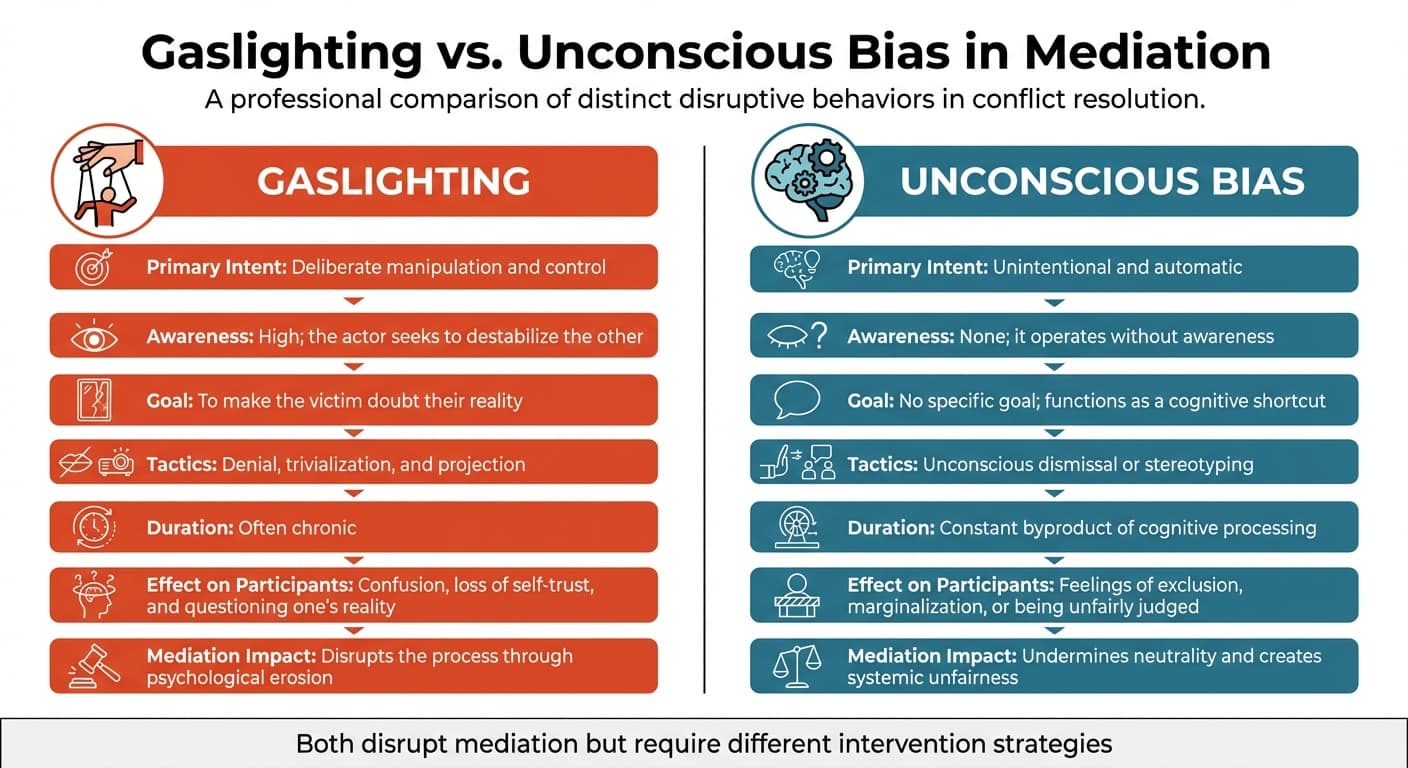
Gaslighting involves intentional manipulation, while unconscious bias operates as an automatic mental shortcut. Chelsea Cassel from Healing Hearts of Indy highlights this distinction:
Gaslighting is rooted in a desire to control or manipulate [8].
On the other hand, Dawn Grzena explains:
Unconscious bias (also known as implicit bias) occurs automatically and without conscious awareness, activated involuntarily without an individual's intentional control [4].
Gaslighting is designed to undermine a person's perception of reality, while unconscious bias stems from unintentional mental processes and lacks deliberate intent [1][9]. In mediation settings, gaslighting damages confidence, whereas unconscious bias affects neutrality [1][8].
Here’s a side-by-side breakdown of the key differences:
Side-by-Side Comparison
| Feature | Gaslighting | Unconscious Bias |
|---|---|---|
| Primary Intent | Deliberate manipulation and control [8][9] | Unintentional and automatic [4] |
| Awareness | High; the actor seeks to destabilize the other [9] | None; it operates without awareness [4] |
| Goal | To make the victim doubt their reality [9] | No specific goal; functions as a cognitive shortcut [1] |
| Tactics | Denial, trivialization, and projection [8] | Unconscious dismissal or stereotyping [4] |
| Duration | Often chronic | Constant byproduct of cognitive processing |
| Effect on Participants | Confusion, loss of self-trust, and questioning one's reality | Feelings of exclusion, marginalization, or being unfairly judged |
| Mediation Impact | Disrupts the process through psychological erosion [8] | Undermines neutrality and creates systemic unfairness [1] |
There are instances where these behaviors intersect. For example, unconscious bias might lead someone to dismiss another person’s valid experience of discrimination as an "overreaction." This dismissal can cause the individual to question their own reality, echoing the effects of gaslighting [4]. Such overlaps highlight the challenges in conflict resolution and emphasize the importance of impartial and thoughtful mediation.
How Each Affects Mediation
Let’s take a closer look at how gaslighting and unconscious bias disrupt mediation in their own ways. Both can derail the process, but they operate very differently. Gaslighting involves deliberate manipulation, making participants question their own reality. On the other hand, unconscious bias skews the process unintentionally, creating what seems like neutrality but is anything but.
How Gaslighting Disrupts Mediation
Gaslighting chips away at trust by making participants second-guess their own experiences. When one party flat-out denies events or twists the truth, it forces others to question their memory or judgment. Victims often feel compelled to keep detailed records because gaslighters frame them as irrational or unstable. This dynamic creates a significant power imbalance and adds emotional strain to the process, making fair mediation nearly impossible [10].
While gaslighting directly undermines trust, unconscious bias takes a more subtle - yet equally damaging - route by eroding the fairness of the process itself.
How Unconscious Bias Creates Problems
Unconscious bias sneaks into mediation under the guise of neutrality. Even mediators who aim to be impartial can unknowingly let their hidden biases affect their decisions [1]. These biases are hard to spot and even harder to correct in real time. Ironically, the presence of a neutral third party can sometimes amplify these hidden assumptions [3]. This often results in dismissive communication that invalidates or ignores one party’s feelings. Research shows that certain groups, such as Asian Americans, may feel this impact more acutely [1][10]. Such biases not only silence voices but also perpetuate systemic unfairness, undermining the entire mediation process.
Carol Izumi, a Professor of Law, sums it up perfectly:
There is an unacceptable gap between the vision of mediator neutrality and the realities of biased mediator thoughts, behavior, and judgment [1].
How to Detect and Address Each Issue
Spotting and addressing gaslighting and unconscious bias is crucial because each affects mediation in distinct ways. Gaslighting relies on overt manipulation, while unconscious bias operates subtly, often masked by a neutral facade. Recognizing these patterns is the first step toward ensuring fairness during mediation.
Spotting Gaslighting
Gaslighting often reveals itself through manipulative communication. Look for behaviors like consistently denying past conversations or agreements, dismissing the other party as "too sensitive" or "crazy", or making them question their own memory [10][12]. Keeping detailed records of events, agreements, and discussions is essential. These records provide a reliable reference point when someone tries to distort the truth [10].
For extra support, tools like Gaslighting Check (https://gaslightingcheck.com) can be invaluable. This platform offers real-time conversation analysis, encrypted reports, and conversation history tracking for $9.99/month. With both text and voice analysis, it helps uncover patterns you might not notice on your own.
Spotting Unconscious Bias
Unconscious bias often manifests as subtle mental shortcuts that skew judgment. Examples include anchoring (placing too much weight on the first offer), confirmation bias (favoring evidence that supports preexisting beliefs), and reactive devaluation (dismissing ideas purely because they come from the opposing party) [2][13]. Laura Athens, an attorney and mediator, explains:
Cognitive biases involve a tendency to be inclined in favor or against something. When they are at play, a person lacks a neutral viewpoint [13].
Mediators can benefit from training designed to help identify these biases in themselves and others. Conducting regular audits of mediation outcomes can reveal patterns of demographic disparities. Additionally, feedback systems allow participants to share when they feel their views have been dismissed or stereotyped. Awareness is the foundation for addressing bias - without recognizing it, solutions remain out of reach.
Solutions for Each Problem
Once these issues are identified, mediators can take targeted action.
To counter gaslighting, set firm boundaries and rely on documented evidence. Phrases like "Let's agree to disagree" or "You're distorting what I said" can help disengage from manipulative tactics [11]. Trust in your documented records to avoid falling into self-doubt [10].
For unconscious bias, slowing down is key. Use evidence charts to break down beliefs by listing supporting and contradicting evidence, which can help counter confirmation bias [13]. Standardize evaluation criteria and assemble diverse decision-making panels to minimize affinity bias. Mediators can also present ideas as their own rather than attributing them to the opposing party to reduce reactive devaluation [2]. Leigh Thompson, a professor at Kellogg School of Management, emphasizes:
Identifying and challenging these biases can do much to effectively resolve disputes and conflicts of interest [3].
Conclusion
Addressing the challenges in mediation requires a clear understanding of the distinct effects of gaslighting and unconscious bias. Gaslighting is a deliberate act of manipulation designed to make someone doubt their own reality, while unconscious bias operates automatically, shaped by mental shortcuts [11][16]. As Dawn Grzena puts it:
When gaslighting overlaps with unconscious bias, it deepens manipulative practices, undermining trust and fairness [4].
The overlap of these issues creates confusion, making it harder to identify signs of manipulation accurately [14]. This can lead mediators to unintentionally dismiss valid concerns about bias, effectively gaslighting participants by implying they’re "imagining things" [4].
Tackling each issue requires tailored strategies. For gaslighting, it’s essential to establish firm boundaries and hold manipulators accountable , often by recognizing verbal abuse patterns early [11][4]. On the other hand, addressing unconscious bias involves fostering self-awareness, slowing down decision-making processes, and implementing standardized procedures to counteract automatic assumptions [2][15]. These strategies align with earlier recommendations for setting clear boundaries and using consistent evaluation criteria. By recognizing these patterns and applying specific solutions, mediators can create an environment that supports honest communication and fairness.
Awareness is the first step toward progress. Acknowledging the intentional harm caused by gaslighting alongside the unintentional effects of unconscious bias enables mediators to strive for outcomes that respect each individual’s reality. With vigilance and thoughtful strategies, mediators can safeguard fairness and emotional safety for all participants.
FAQs
How can mediators recognize gaslighting during mediation?
Gaslighting can often be spotted through specific communication patterns and emotional signals that point to manipulation. Common tactics include denying previous conversations, invalidating someone's emotions by labeling them as irrational, or making a person doubt their own memory or perception. These actions can leave the affected individual feeling confused, uncertain, or emotionally distressed.
Mediators can identify gaslighting by practicing active listening, paying close attention to inconsistencies between verbal statements and documented facts, and being alert to signs of emotional manipulation. Establishing a safe and neutral space where everyone feels heard is key to uncovering any power imbalances or deliberate distortions. By staying sensitive to these dynamics, mediators can build trust and guide the process with greater effectiveness.
How can unconscious bias be addressed during mediation?
Dealing with unconscious bias in mediation calls for deliberate efforts to maintain fairness and objectivity. One effective method is through awareness training, which equips mediators to identify their own biases and understand how those biases might subtly shape their decisions.
Practices like mindfulness and self-reflection play a key role too. These techniques encourage mediators to pause, examine their assumptions, and ensure they’re not letting personal perspectives cloud their judgment during interactions.
Another practical approach is implementing structured processes - such as using standardized questions or checklists. These tools help ensure consistency and minimize the risk of individual bias creeping into the process. By integrating these strategies, mediators can work toward fostering a fairer and more balanced space for everyone involved.
Can gaslighting and unconscious bias happen together in mediation, and how can they be addressed?
Yes, gaslighting and unconscious bias can happen at the same time during mediation, complicating the process and making it harder to maintain fairness. Gaslighting is a form of psychological manipulation aimed at distorting someone's perception of reality, while unconscious bias involves subtle, often unintentional prejudices that shape behavior. When these two forces intersect, they can create a challenging environment that erodes trust and fairness.
To navigate this, mediators need to remain vigilant for signs of gaslighting, such as dismissing or invalidating someone’s experiences. At the same time, they must actively foster a safe and respectful space for all participants. It’s equally important for mediators to examine and manage their own biases. Though often unconscious, these biases can be addressed through self-reflection and deliberate effort. Practical approaches like reframing discussions, affirming all perspectives, and encouraging open communication can help minimize the influence of both gaslighting and bias, paving the way for a more equitable resolution process.