Gaslighting vs. Constructive Criticism: Key Differences

Gaslighting vs. Constructive Criticism: Key Differences
Gaslighting and constructive criticism may seem similar, but their intent and impact are vastly different. Gaslighting manipulates your sense of reality to control or undermine you, often leaving you confused and doubting yourself. Constructive criticism, however, is aimed at helping you improve through respectful and actionable feedback.
Here’s what you need to know:
- Gaslighting: Focuses on control and power, often using vague, dismissive, or invalidating language. It creates doubt and dependency.
- Constructive Criticism: Aims to help you grow by addressing specific behaviors with clear, supportive suggestions. It builds confidence and trust.
Quick Comparison
| Feature | Gaslighting | Constructive Criticism |
|---|---|---|
| Intent | Control and manipulation | Growth and improvement |
| Tone | Sarcastic, dismissive | Respectful, empathetic |
| Specificity | Vague or contradictory | Clear and actionable |
| Focus | Attacks character | Targets behaviors |
| Emotional Outcome | Confusion and self-doubt | Clarity and empowerment |
To protect yourself, pay attention to how feedback is delivered and how it makes you feel. If you’re unsure, tools like Gaslighting Check can help analyze conversations for manipulative patterns, starting at $9.99/month. Recognizing the difference between these two types of feedback is essential for maintaining mental clarity and healthy relationships.
::: @figure
122 - Gaslighting vs Honest Feedback: How to Tell the Difference
Detect Manipulation in Conversations
Use AI-powered tools to analyze text and audio for gaslighting and manipulation patterns. Gain clarity, actionable insights, and support to navigate challenging relationships.
Start Analyzing NowIntent: Manipulation vs. Growth
The key difference between manipulation and growth lies in intent: one type of feedback is aimed at control, while the other fosters development. Recognizing this distinction is essential because it shapes how you interpret and respond to feedback. Understanding intent can shield you from emotional harm and help you identify when feedback genuinely serves your best interests.
Gaslighting: Control Through Confusion
Gaslighting in relationships is a tactic rooted in control. The person employing it aims to dominate the situation - whether to avoid conflict, reduce their own anxiety, or assert authority. This is common in professional settings, where workplace gaslighting is used to maintain power dynamics. By distorting your sense of reality, they make you question your sanity, memory, and judgment. This creates a dependency, where you begin to rely on them to define what’s "real" or "true."
"The goal of the gaslighter is control. One way to gain control is to cause the victim to no longer trust themselves, to no longer trust their view of reality." - Marge Moon, Investigator
Gaslighting often serves as a way for the manipulator to avoid accountability for their own actions or abusive behavior. It thrives on power imbalances - whether social, political, or economic - between the manipulator and the victim, reinforcing the dynamics of control.
Constructive Criticism: Support and Growth
On the other hand, constructive criticism is aimed at helping you improve. Its purpose is to strengthen your skills and confidence by providing actionable, supportive feedback. This type of feedback is offered in a way that values your perspective and encourages progress, rather than undermining your self-esteem.
"The key distinction lies in the intent: constructive criticism seeks to build up, while gaslighting aims to tear down and control." - Therapy Group of DC
Constructive criticism focuses on specific, observable actions - not on attacking your character or questioning your competence. It often includes suggestions or solutions, giving you a clear direction for improvement. Delivered in a respectful and collaborative manner, it fosters trust and mutual growth.
Comparison Table: Intent Behind Each
Here’s a side-by-side look at the intent behind gaslighting and constructive criticism:
| Feature | Gaslighting Intent | Constructive Criticism Intent |
|---|---|---|
| Primary Goal | Control and domination | Support and growth |
| Effect on Recipient | Undermines confidence and creates doubt | Builds skills and encourages empowerment |
| Relationship Dynamic | Exploits power imbalances to assert control | Promotes mutual respect and collaboration |
| Focus | Targets character and distorts reality | Addresses specific, observable actions |
| Outcome Sought | Confusion and dependence | Clarity and actionable improvement |
This comparison highlights how intent shapes the nature and impact of feedback, helping you discern whether it's meant to hinder or help you.
Behavioral Differences: Spotting the Patterns
Recognizing specific behaviors and triggers is key to distinguishing genuine support from manipulative tactics - exactly what Gaslighting Check aims to help with. While intent explains why feedback is given, behavioral patterns show how it’s delivered. These patterns, reflected in tone, clarity, and emotional outcomes, serve as practical clues for identifying whether you're dealing with manipulation or constructive support.
Tone and Delivery
Gaslighting often comes wrapped in a harsh, sarcastic, or dismissive tone [5] [8]. Statements like "Are you crazy?" or "You're way too sensitive" are designed to invalidate your feelings entirely [5] [1]. This tactic might also involve erratic "Dr. Jekyll and Mr. Hyde" behavior, where someone alternates between kindness and cruelty to keep you confused and off-balance [4].
By contrast, constructive criticism uses a respectful and empathetic tone. It’s designed to encourage growth, not tear you down [3] [9]. Those offering this type of feedback often rely on "I" statements - like "I noticed" or "I suggest" - to express their observations without sounding accusatory. This approach fosters collaboration and reduces defensiveness.
Specificity and Clarity
Manipulative feedback thrives on vagueness and contradictions. A gaslighter might say things like "That never happened" or "You're remembering it wrong", making you doubt your own experiences [4] [6]. They often avoid giving specific details, shift topics when pressed, and use sweeping generalizations like "You always" or "You never" to attack your character [4] [9].
Constructive feedback, on the other hand, is clear and actionable. It’s rooted in specific, observable facts [9]. Many professionals use the SBI model (Situation, Behavior, Impact) to structure their feedback. For example: "In yesterday's meeting [Situation], when you interrupted Sarah [Behavior], it prevented her from finishing her proposal [Impact]." This level of detail not only helps you verify the feedback but also provides a clear path for improvement. If someone refuses to provide examples when asked, it’s a warning sign [7].
Emotional Impact and Outcome
The emotional aftermath of feedback often reveals its true purpose. Gaslighting leaves you feeling uneasy, doubting your own memory and judgment [4] [1]. You may feel like you’re "walking on eggshells", constantly second-guessing yourself - even when the criticism is unrelated to any real mistake [6].
"When you deal with someone who never acknowledges your thoughts, feelings, or beliefs, you may begin to question them yourself."
– Sherri Gordon, Certified Professional Life Coach [4]
Constructive criticism, however, fosters clarity and confidence. It’s focused on helping you grow, not tearing you down. The emotional outcome is often one of empowerment, as the feedback is rooted in mutual respect and shared understanding.
Behavioral Markers at a Glance
Here’s a quick comparison to help you assess the nature of the feedback:
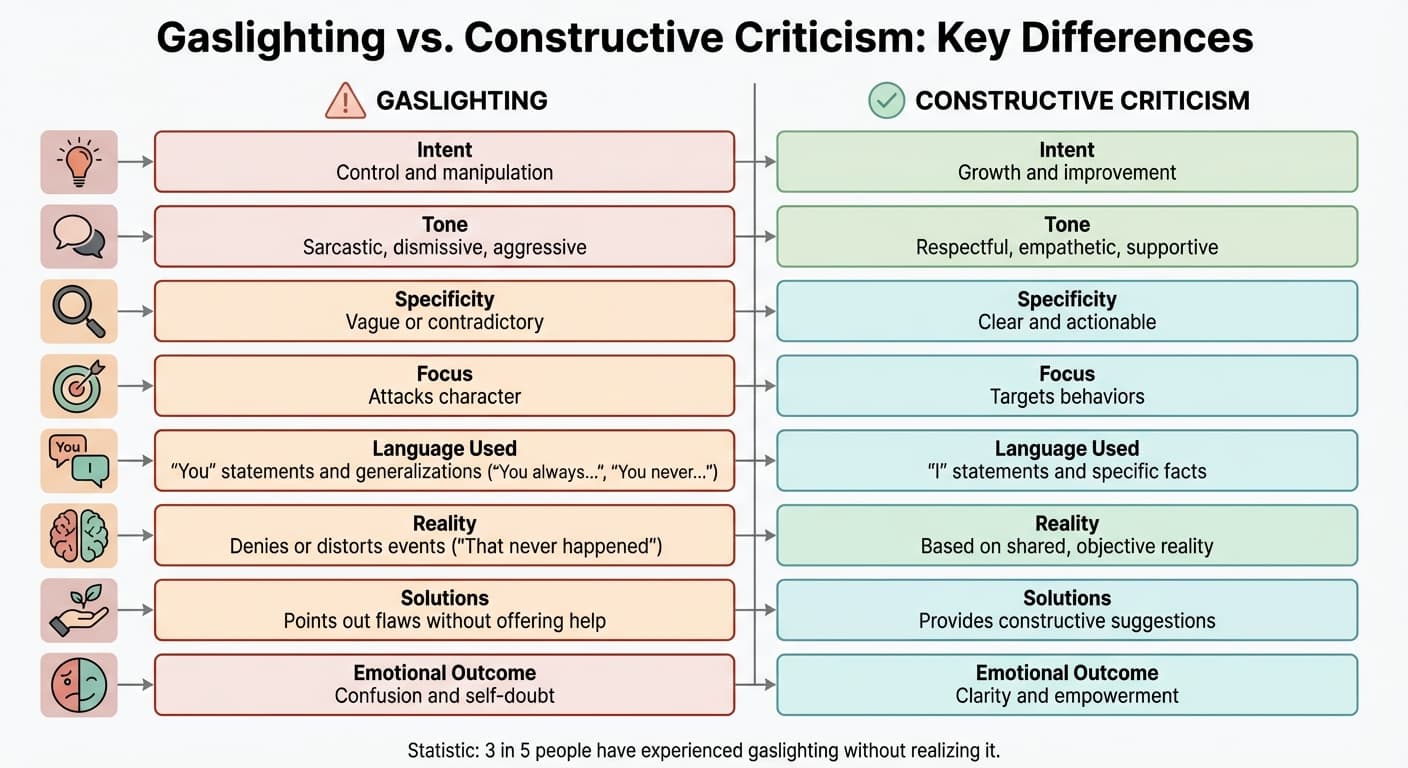
| Feature | Gaslighting | Constructive Criticism |
|---|---|---|
| Tone | Sarcastic, aggressive, or undermining [5] [10] | Respectful, direct, and supportive [2] [8] |
| Language | "You" statements and generalizations [9] | "I" statements and specific facts [9] |
| Reality | Denies or distorts events ("That never happened") [4] | Based on shared, objective reality [3] |
| Specificity | Vague and contradictory [4] | Clear, actionable, and detailed [9] |
| Focus | Attacks personality or character [1] [11] | Targets specific behaviors [9] [11] |
| Solutions | Points out flaws without offering help [3] | Provides constructive suggestions [3] |
| Emotional Outcome | Confusion and self-doubt [4] | Clarity and autonomy [9] |
If you notice that a conversation feels more like a battle for control than an exchange of ideas, you’re likely dealing with manipulation [6]. Pay attention to how the interaction makes you feel - your emotional response is often the clearest sign of whether the feedback is constructive or manipulative.
Examples: Gaslighting vs. Constructive Criticism
Breaking down examples can help highlight the differences between gaslighting and constructive criticism. These scenarios build on earlier points about intent and behavior.
Workplace Example
Imagine you interrupted a colleague during a team meeting. A gaslighting response might sound like:
"You always mess up in meetings. You're just not capable of working with a team."
This kind of feedback targets your character and uses sweeping, negative generalizations.
Now compare that to constructive criticism:
"In yesterday's meeting, when you interrupted Sarah, it prevented her from finishing her proposal. Following the SBI model we discussed earlier, try pausing to let others complete their thoughts."
Here, the focus is on a specific behavior, paired with practical advice for improvement.
Personal Relationship Example
The stakes can feel even higher in personal relationships. Imagine feeling hurt by a lack of communication. A gaslighting response might dismiss your feelings with:
"You're too sensitive. I never said that - you're making things up again."
This type of response invalidates your emotions and shifts the blame onto you.
A constructive approach, on the other hand, might sound like:
"It upset me when you didn’t communicate about your plans. Let’s talk about how we can both work on keeping each other informed."
This uses "I" statements to express feelings and encourages a conversation aimed at mutual understanding and improvement [2].
How Gaslighting Check Can Flag Manipulation

Gaslighting Check is a tool designed to detect manipulation patterns in both text and voice conversations. It identifies markers like denial phrases (e.g., "That never happened"), trivializing language (e.g., "You're too sensitive"), and blame-shifting structures [4]. The voice analysis feature also evaluates tone, noting harsh deliveries that might reinforce power imbalances [5].
When you upload a conversation, the tool generates detailed reports highlighting manipulative language. For example, it flags repeated use of phrases like "You always" or "You never", which were discussed earlier as vague and demeaning. In contrast, it recognizes "I" statements as part of healthier communication patterns [9].
For those seeking deeper insights, the Premium Plan ($9.99/month) includes a history tracking feature. This allows users to review conversation patterns over time, helping to distinguish between isolated incidents and recurring manipulation.
Using Gaslighting Check to Tell Feedback Types Apart
Features for Detecting Gaslighting
Gaslighting Check helps you separate manipulative feedback from genuine, constructive criticism by analyzing text and voice for specific patterns. It flags behaviors like blame-shifting, trivializing concerns, and vague generalizations - hallmarks of harmful communication. The voice analysis feature goes a step further, identifying tones associated with toxic criticism, such as aggression or dismissiveness, while recognizing the empathetic and neutral tones that typically accompany healthy feedback [3][13].
Another key feature is its ability to assess how specific the feedback is. Constructive criticism focuses on clear, actionable points, whereas manipulation often leans on vague, repetitive statements [8][3][13]. Additionally, Gaslighting Check automatically saves evidence, giving you a secure record when past interactions are questioned later [4]. All of this is designed to help you navigate feedback confidently, while keeping user safety a top priority.
Privacy and User Control
Your privacy is protected through end-to-end encryption, ensuring your conversations remain secure. Gaslighting Check also employs automatic data deletion policies, giving you control over your information. Whether you’re analyzing personal or workplace interactions, this feature ensures your data is handled with care.
Affordable Solutions for Emotional Clarity
Gaslighting Check offers flexible pricing to meet your needs. The Free Plan provides basic analysis tools, while the Premium Plan, priced at $9.99/month, unlocks advanced features like voice analysis and the ability to track conversation history for spotting patterns over time.
Dr. Stephanie A. Sarkis emphasizes the importance of tools like this:
"Identifying gaslighting patterns is crucial for recovery. When you can recognize manipulation tactics in real-time, you regain your power and can begin to trust your own experiences again." [12]
Given that 3 in 5 people have experienced gaslighting without realizing it [12], tools like Gaslighting Check can be a valuable resource for distinguishing between constructive feedback and manipulative behavior.
Conclusion: Recognizing and Responding to Gaslighting
Understanding the difference between harmful manipulation and constructive feedback is vital for emotional well-being. Gaslighting twists your perception of reality, while constructive criticism offers clear, actionable advice aimed at helping you grow [1].
If you often feel disoriented or anxious after receiving feedback, it might be a sign of manipulation rather than genuine guidance [6]. Recognizing this is the first step to regaining control. As Robin Stern, Ph.D., describes:
"Gaslighting is an insidious and sometimes covert form of emotional abuse, repeated over time, where the abuser leads the target to question their judgments, reality, and, in extreme cases, their own sanity" [6].
To protect yourself, it’s important to take proactive steps to respond. Document conversations, save messages, and avoid engaging in power struggles. If an interaction leaves you feeling unsettled or attacked, trust that instinct and step away [6].
Using tools to validate your experiences can also be a game-changer. For example, Gaslighting Check offers an analytical approach to identify manipulation patterns in conversations. Starting at $9.99/month for the Premium Plan, it provides clarity and helps you separate harmful behavior from constructive input.
Trust in your own perceptions and memories. You deserve feedback that uplifts rather than undermines. By learning to identify manipulation, you take back your power and safeguard your emotional health.
FAQs
How can I tell if someone is gaslighting me or just giving feedback?
Gaslighting involves manipulative strategies designed to make you question your reality. This often happens through denial, distortion of facts, or making you feel as though your thoughts and feelings are irrational. The goal is typically to gain control or exert power over you. In contrast, constructive criticism targets specific actions or behaviors and aims to support improvement without attacking your sense of reality. If feedback feels consistently harmful, distorts facts, or leaves you doubting yourself, it might be gaslighting rather than genuine, helpful critique.
What should I say in the moment if feedback feels manipulative?
If feedback comes across as manipulative, it’s important to calmly express your viewpoint while holding firm boundaries. You might say something like, "I understand your perspective, but I see it differently," or "That doesn’t align with my experience." Be alert to signs of gaslighting - such as feeling confused or doubting yourself - and stay anchored in your own reality. If the manipulation continues, it may be necessary to step back or seek support from someone you trust. Remaining composed and assertive can help safeguard both your confidence and your sense of clarity.
How does Gaslighting Check analyze texts or voice for gaslighting?
Gaslighting Check leverages AI-driven algorithms to scrutinize texts, pinpointing patterns of manipulation and offering instant feedback. When it comes to voice analysis, the tool evaluates vocal characteristics such as tone, pitch, and tempo to identify signs of emotional pressure or manipulation in conversations. This platform equips users to recognize subtle indicators of gaslighting in both written and spoken communication.