
Gaslighting in Relationships: Behavioral Cues to Identify
Gaslighting is a manipulation tactic used to make you question your reality, memory, and emotions. It often happens in relationships where one partner seeks control through denial, blame-shifting, and dismissing your feelings. These behaviors can lead to confusion, anxiety, and self-doubt, leaving you reliant on the abuser to define what’s real. Recognizing gaslighting involves spotting verbal and non-verbal cues like:
- Denial: "I never said that", or "That never happened."
- Trivializing: Labeling you as "too sensitive" or "overreacting."
- Blame-shifting: "I wouldn’t have to yell if you weren’t so annoying."
- Non-verbal manipulation: Smirking, avoiding eye contact, or mismatched body language.
Gaslighting can deeply impact your emotional and mental health, causing self-doubt, withdrawal, and even physical symptoms like fatigue or insomnia. Tools like keeping a journal or using top conversation analysis tools can help validate your experiences and rebuild confidence. If you feel unsafe, contact the National Domestic Violence Hotline at 800-799-SAFE.
Understanding these signs and seeking support from trusted individuals or professionals is the first step toward regaining clarity and control.
8 Clear Signs Someone Is Gaslighting You (with examples)
Detect Manipulation in Conversations
Use AI-powered tools to analyze text and audio for gaslighting and manipulation patterns. Gain clarity, actionable insights, and support to navigate challenging relationships.
Start Analyzing NowWhat Gaslighting Is and How It Appears in Relationships
Gaslighting is a manipulation tactic that messes with your perception of reality, memories, and self-confidence, all to make you question your own judgment. The goal? To destabilize your trust in yourself and hand over control to the abuser. This works by creating a clash between your own experiences and the distorted version of events presented by the abuser. Understanding how this manipulation operates sheds light on its deep emotional toll.
"Gaslighting is an insidious and sometimes covert form of emotional abuse, repeated over time, where the abuser leads the target to question their judgments, reality, and, in extreme cases, their own sanity."
– Dr. Robin Stern, Co-founder and Associate Director of the Yale Center for Emotional Intelligence [8]
This manipulation often leaves victims feeling disoriented, anxious, and increasingly reliant on the abuser to define what’s real and what isn’t.
Where the Term Gaslighting Comes From
The term "gaslighting" has its roots in the 1938 British play Gas Light by Patrick Hamilton, later adapted into films in the 1940s. The story revolves around a husband who secretly dims the gas-powered lights in their home and denies the change when his wife notices. His goal? To make her believe she’s losing her mind so he can steal her inheritance. Fast forward to 2022, and the term gained significant traction - Merriam-Webster even named it Word of the Year after a 1,740% spike in lookups [7]. This origin story provides a perfect metaphor for how gaslighting operates in real-life relationships by subtly warping reality.
Typical Situations Where Gaslighting Occurs
Gaslighting doesn’t just happen in extreme scenarios; it shows up in everyday interactions, often during arguments or conflicts. For example, an abuser might outright deny past conversations or events with phrases like, “I never said that,” or accuse you of inventing things. In cases of infidelity, they might deflect by calling you “paranoid” or “crazy,” shifting focus away from their actions. Your emotions might be dismissed as “too sensitive” or “overdramatic.” Even in decision-making, they might undermine your confidence, suggesting you’re too stressed or confused to make sound choices.
Here are some common gaslighting tactics and their intended effects:
| Gaslighting Tactic | Common Phrase Used | Intent of the Abuser |
|---|---|---|
| Trivializing | "You're just being too sensitive." | To dismiss your emotions as invalid. |
| Denial | "I never said that; you're imagining things." | To make you question your memory. |
| Shifting Blame | "I wouldn’t have to yell if you weren’t so annoying." | To avoid accountability. |
| Withholding | "I’m not listening to this again." | To shut down communication and maintain control. |
These phrases are more than just words - they’re tools of gaslighting and manipulation, setting the stage for deeper patterns of control and emotional abuse.
Behavioral Signs That Point to Gaslighting
::: @figure
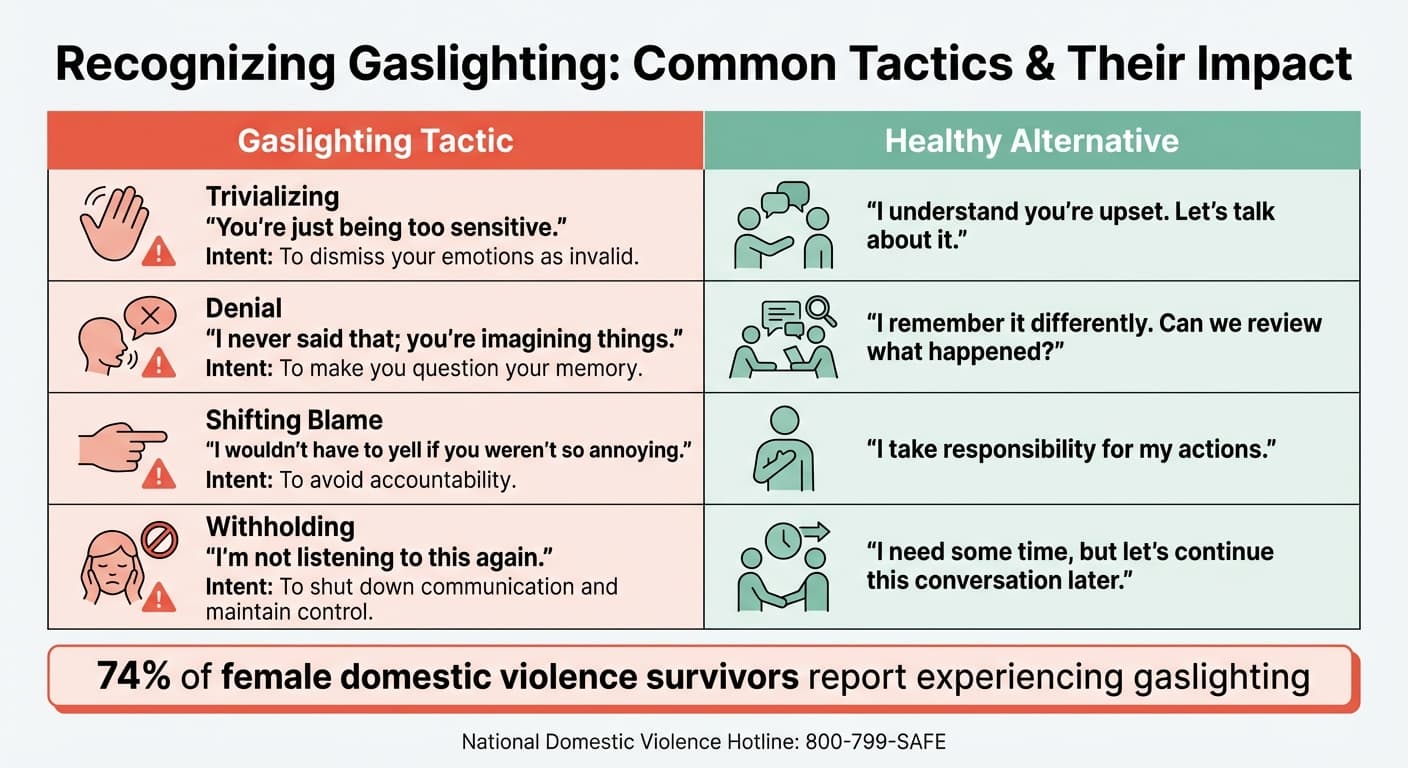
Recognizing gaslighting means identifying specific verbal tactics manipulators use to undermine your sense of reality. These actions go far beyond simple disagreements - they are deliberate attempts to make you doubt your memory, emotions, and judgment. Let’s break down some of the most telling behaviors.
Denying Events or Conversations Happened
One of the gaslighter's go-to tactics is outright denial. They’ll insist events or conversations you clearly remember never occurred, using phrases like "I never said that" or "That never happened." This isn't about differing perspectives; it’s about erasing your version of reality. Even when presented with evidence, they’ll continue to deny, doubling down to make you question your own recollection. The aim? To shake your confidence so thoroughly that you start relying on them to define what’s real. Reviewing a gaslighting triggers checklist can help you identify these patterns before they escalate.
Dismissing Feelings and Blaming the Victim
Gaslighters often dismiss your emotions, labeling you as "too sensitive" or "overreacting." When you bring up concerns, they trivialize your feelings, making you doubt their validity. As psychologist Dr. Chivonna Childs explains:
"Gaslighting is a form of emotional manipulation to make you feel as if your feelings aren't valid, or that what you think is happening isn't really happening" [4].
They'll also shift blame onto you, implying their harmful actions are somehow your fault. This tactic is especially insidious for women, minorities, and marginalized groups, who are often stereotyped as "unstable" to discredit their experiences [2]. By dismissing your feelings and shifting responsibility, they tighten their grip on control while leaving you emotionally disoriented.
Creating False Versions of Events
Gaslighters are masters at rewriting history. They’ll retell stories with altered details, twisting the narrative to suit their agenda. For example, a physical shove might be reframed as an attempt to "help you after you stumbled." Promises they made last week suddenly "never happened." When you challenge these distortions, they’ll accuse you of "imagining things" or "making stuff up." These changes don’t happen all at once - they’re subtle and gradual, chipping away at your confidence in your own memory over time.
Refusing to Communicate or Share Information
Another common tactic is withholding information or abruptly cutting off communication. Gaslighters might end conversations with phrases like "Just stop talking!" or deploy the silent treatment to create anxiety and confusion. They may also withhold critical details - like financial information or plans - leaving you dependent on them for basic knowledge about your own life. This isn’t about needing space; it’s a calculated move to control the flow of information, ensuring you remain off-balance and unsure of what’s really going on.
Non-Verbal Signs of Gaslighting
Gaslighting isn’t just about words - it’s also about the subtle, physical cues that manipulators use to keep you off-balance. These non-verbal actions often go hand-in-hand with verbal manipulation, amplifying the control they exert. By learning to recognize these behaviors, you can better identify when someone’s actions don’t align with their words, helping you regain confidence in your own perceptions. Modern tools for real-time gaslighting detection can also help validate your experiences.
Mismatched Body Language and Facial Expressions
When a gaslighter’s expressions or movements don’t match their words, it can create a sense of unease, making you question your reality. For example, they might smile while dismissing your feelings or laugh when you’re expressing hurt. This incongruence isn’t accidental - it’s meant to confuse you. Michelle C. Brooten-Brooks, LMFT, explains:
"Gaslighting can also manifest as a kind of cognitive dissonance, or holding two beliefs at the same time that don't fit. This creates strong feelings of confusion, anxiety, discomfort, or powerlessness." [2]
Dr. Chivonna Childs of Cleveland Clinic likens this to a sleight of hand:
"It's like a magic trick: They make you look to the left so you don't see what's going on to the right." [4]
These subtle actions - like scoffing, shaking their head, or smirking - are designed to make you doubt your version of events. Over time, this mismatch between what you see and what they say erodes your trust in your own instincts.
Avoiding Eye Contact and Defensive Body Posture
Gaslighters often avoid eye contact or adopt closed-off postures when confronted, which can make you feel dismissed or unimportant. They might cross their arms, turn their body away, or refuse to meet your gaze, creating a barrier that stifles meaningful communication. Robin Stern, Ph.D., Co-founder of the Yale Center for Emotional Intelligence, explains:
"In a genuine conversation, both people are listening to and addressing each other's concerns, even if they get emotional at times. If you are not arguing about an actual incident, you can be sure you are enmeshed in a power struggle." [8]
This defensive stance isn’t about resolving conflict - it’s about maintaining control. Their withdrawal leaves you feeling as though you’re constantly walking on eggshells, unsure of how to approach them. These tactics also shift the focus away from their behavior, allowing them to avoid accountability.
Manipulating Personal Space and Physical Affection
Control over physical closeness can also be a tool for manipulation. Gaslighters might withhold affection as punishment or invade your personal space to intimidate, keeping you on edge. This back-and-forth between warmth and distance creates a cycle of confusion and dependency. They may initially draw you in with charm, only to withdraw affection once they feel you’re emotionally attached [5].
This manipulation of physical space mirrors their verbal tactics, leaving you constantly guessing about their intentions. Whether through a sudden lack of warmth or an imposing presence, these behaviors reinforce their dominance and keep you in a state of anxiety. Combined with their dismissive words and altered narratives, these non-verbal cues work to undermine your confidence and sense of reality.
How Gaslighting Affects Victims Emotionally and Mentally
Gaslighting can cause deep emotional and mental harm. One of its most damaging effects is how it gradually undermines self-trust, leaving victims doubting their memory, judgment, and intuition [1][2]. Dr. Chivonna Childs, PhD, captures this perfectly:
"Over time, you start to question your self-worth, self-esteem and mental capacity." [4]
This manipulation often creates lasting inner turmoil. Victims experience cognitive dissonance - holding two conflicting beliefs, like remembering an event one way but being told it happened differently. This mental conflict can lead to anxiety and even physical symptoms such as headaches, fatigue, and insomnia [3].
The process often unfolds in three stages. At first, the behavior might seem harmless or be brushed off. Then, victims may try to validate their own experiences. Finally, worn down by constant doubt, they may begin to accept the abuser's version of reality [6].
Common Symptoms of Being Gaslit
The effects of gaslighting show up in clear and often painful ways. Victims may frequently second-guess their memories and decisions, apologize excessively - even for things like their feelings - or feel small and insignificant. Other signs include making excuses for the abuser's actions, withdrawing from social activities, and feeling constantly anxious or on edge. Simple decisions may feel overwhelming as self-trust diminishes. Alarmingly, 74% of female domestic violence survivors report experiencing gaslighting, often used to cut them off from their support networks [9].
Normal Relationship Concerns vs. Gaslighting Effects
It’s important to understand the difference between typical relationship issues and the manipulation involved in gaslighting. The table below highlights some key distinctions:
| Normal Relationship Concerns | Gaslighting Effects |
|---|---|
| Disagreeing on the details of a past argument | Being told an event you clearly remember "never happened" |
| Feeling hurt by a partner's insensitive joke and discussing it | Being told you're "too sensitive" or "overreacting" when expressing hurt |
| Taking responsibility for your own mistakes | Being blamed for the abuser's actions, like "I only cheated because you ignored me" |
| Occasionally forgetting a conversation detail | Being labeled as having a "terrible memory" to undermine your confidence |
| Making decisions together or independently with confidence | Struggling to make even simple choices due to self-doubt |
| Both partners apologize when wrong | Constantly apologizing for things you didn’t do or for simply being yourself |
The key difference? The intent behind the interaction. In healthy relationships, both partners actively listen and work through concerns, even during emotional moments. Robin Stern, PhD, Co-founder of the Yale Center for Emotional Intelligence, explains:
"In a genuine conversation, both people are listening to and addressing each other's concerns, even if they get emotional at times." [8]
If these patterns sound familiar, consider keeping a record of your interactions - whether in a journal, through saved messages, or voice memos. Instead of focusing on proving what’s "true", pay attention to how these interactions make you feel. If you often feel attacked, confused, or emotionally drained, it’s a strong indicator that the relationship dynamic is unhealthy.
Recognizing the hidden effects of gaslighting is a critical step in rebuilding self-trust and protecting your well-being.
How Gaslighting Check Helps Detect Manipulation

Gaslighting can warp your sense of reality, making it essential to evaluate situations objectively. Gaslighting Check steps in by analyzing your conversations to uncover subtle manipulation tactics that might otherwise go unnoticed. By leveraging technology, it offers a systematic way to identify and understand these behaviors.
What Gaslighting Check Does
This tool works by analyzing both text and voice interactions. You can upload text messages, emails, or chat logs for instant review, or even capture live audio. Using Natural Language Processing (NLP), it examines sentence structure to highlight linguistic signs of manipulation, while voice analysis focuses on pitch, tone, and stress patterns to detect inconsistencies between what’s said and how it’s delivered. Additionally, it uses T-pattern analysis to identify recurring manipulation patterns. The result? Detailed reports with annotated transcripts that flag common gaslighting phrases like "Blame Shifting" and assign severity scores [10].
Why Gaslighting Check Helps
Gaslighting Check doesn’t just identify manipulation - it validates your experiences. By providing clear, objective reports, it helps rebuild confidence in your perception. As Skywork AI explains:
"The tool acts as a neutral third party, an anchor of objectivity when your own reality feels off-balance" [10].
These reports offer more than personal reassurance. They can serve as unbiased documentation for HR teams, therapists, or legal professionals if needed. Summaries of recurring patterns make it easier to spot how manipulation escalates over time. For Premium users, the conversation history feature allows you to track behavioral shifts, providing a long-term perspective on gaslighting’s impact.
Privacy is a top priority, with end-to-end encryption and automatic data deletion ensuring your information stays secure.
Plans and Pricing
Gaslighting Check is available in two options:
| Plan | Monthly Cost | Key Features |
|---|---|---|
| Free Plan | $0 | Basic text analysis with limited insights |
| Premium Plan | $9.99/month | Text and voice analysis, detailed reports, and history tracking |
Both plans are designed with strong encryption and privacy protections in place, ensuring your data remains secure.
Conclusion: Taking Steps to Recognize and Address Gaslighting
Recognizing gaslighting begins with trusting your gut. If you often feel confused, overly sensitive, or unsure of your own memory after certain interactions, those emotions might be signaling that something is off. Patterns like persistent lying, denying events, shifting blame, or even nonverbal behaviors like withholding affection or stonewalling can slowly chip away at your sense of reality.
To break free, start with practical steps. Keep a private journal or save messages to create a record of interactions - this can help you verify your memory when it’s questioned. Set clear boundaries by using direct language, such as saying, "I remember it differently," and avoid getting drawn into endless, unproductive arguments [11]. As psychologist Chivonna Childs, PhD, explains:
"A fire cannot burn if there's no fuel. They can't fight if there's no one to fight with."
Beyond documenting and setting boundaries, focus on building emotional safety through a strong support system. Reach out to trusted friends, family, or colleagues who can offer an outside perspective. Therapist Jill Daino, LCSW‑R, emphasizes the importance of seeking support:
"Gaslighting takes many forms in a relationship and leads to self-doubt and confusion. It's crucial to reach out to friends, colleagues, family, or a licensed mental health professional for support and to get another perspective."
You can also use tools like Gaslighting Check to objectively review conversations and identify manipulation patterns that may not be immediately obvious. By providing detailed reports with clear evidence, tools like this can help validate your experiences and rebuild trust in your own perceptions. Whether you're still trying to make sense of the situation or ready to take action, having documented evidence can empower you to reclaim your sense of reality.
If you feel unsafe, don’t hesitate to seek immediate help by contacting the National Domestic Violence Hotline at 800-799‑SAFE or texting "SMART" to 88788. Recognizing the signs is a critical first step to regaining clarity and control.
FAQs
How can I tell gaslighting from a normal disagreement?
Gaslighting stands apart from a typical disagreement because it involves manipulative tactics designed to make you question your memory, perception, or even your sanity. A person engaging in gaslighting might outright deny things that happened, alter details of past events, or dismiss your feelings entirely to distort your sense of reality. On the other hand, a regular disagreement is simply a clash of opinions or perspectives, without any intent to deceive or control.
The hallmark of gaslighting is the repeated invalidation of your experiences. This isn't about resolving a conflict - it's about exerting control over you by undermining your trust in yourself.
What should I do if my partner denies things I clearly remember?
If your partner denies events or details you clearly recall, it might be an effort to make you doubt your own reality. Trust in your memory and emotions - they are legitimate. Keeping a journal or maintaining records can be a practical way to document your experiences. It's also crucial to set boundaries and calmly stand by your perspective. If this behavior is causing you significant stress, reaching out to a therapist or confiding in trusted friends can provide the support you need to safeguard your mental health.
Is using Gaslighting Check private and secure?
Gaslighting Check takes your privacy seriously. It uses encrypted data to keep your information secure and implements automatic deletion policies to ensure your details aren’t stored longer than necessary. This way, you can trust that your experience remains both safe and private.