
AI Resilience Simulations for Trauma Recovery
AI tools are transforming trauma recovery by offering personalized support, real-time feedback, and 24/7 availability. These systems help individuals practice emotional resilience, manage PTSD symptoms, and track progress through data-driven insights. Key developments include:
- AI-Guided Therapy Tools: Platforms like Stanford’s TherapyTrainer simulate patient interactions, allowing therapists to refine trauma-informed techniques.
- Emotional Analysis: Tools like ANTIDOTE use physiological signals (e.g., pupil size) and language patterns to measure emotional responses and reduce intrusive memories.
- Personalized Recovery Plans: Systems like TraumaTest.org create tailored strategies based on user assessments, offering coping techniques such as mindfulness and journaling.
- Real-Time Manipulation Detection: Apps like Gaslighting Check analyze conversations to identify emotional manipulation and provide actionable coping strategies.
AI simulations are not replacements for therapists but valuable supplements, offering secure, private, and accessible solutions for trauma recovery.
Can AI Help Prevent PTSD? | Katharina Schultebraucks, PhD
How AI Simulations Work in Trauma Recovery
::: @figure
AI-Powered Emotional Analysis
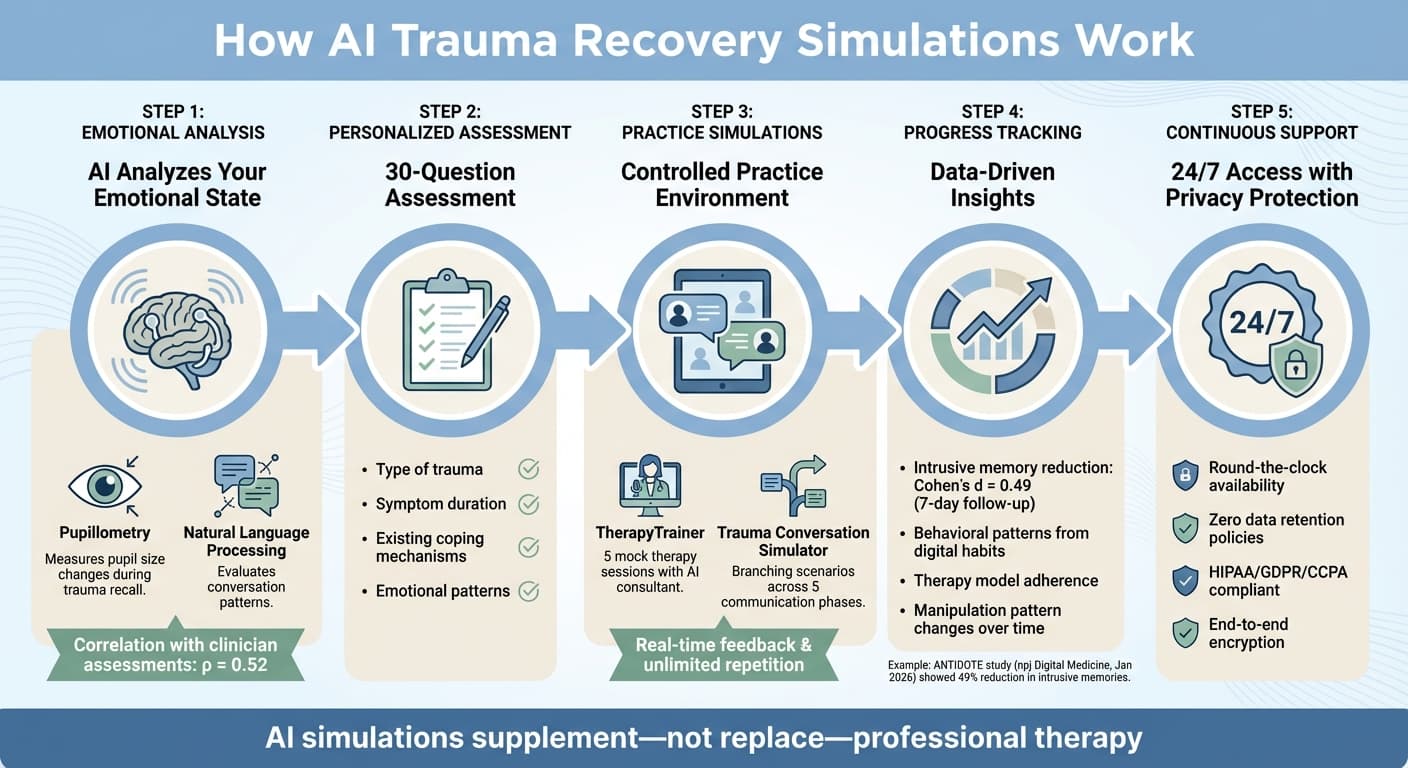
AI systems analyze emotional states by combining physiological signals and language patterns. One key method is pupillometry, which measures changes in pupil size to assess cognitive and emotional effort during trauma recall. For example, when someone revisits a distressing memory, pupil dilation changes can indicate the intensity of their emotional response.
In a January 2026 study published in npj Digital Medicine, researchers tested the ANTIDOTE system. This system paired AI-guided conversations with pupillometry during a visuospatial game. By monitoring pupil size, the system ensured participants engaged enough cognitive effort to disrupt traumatic memory formation. The results? Participants reported significantly fewer intrusive memories over the next seven days (Cohen's d = 0.49)[1]. The study highlighted:
Pupil size tracked intervention engagement and was associated with symptom reduction, providing a candidate biomarker[1].
In addition to physiological monitoring, AI uses natural language processing to detect emotional shifts in conversations. In the same study, the system graded participant interactions and found a strong correlation (Spearman's ρ = 0.52) with assessments by trained clinicians. This ensured users properly applied techniques aimed at building resilience[1].
These detailed measurements lay the groundwork for targeted simulation exercises.
Practice Scenarios for Building Resilience
Using insights from emotional analysis, AI simulations create controlled environments where users can practice resilience skills. These simulations are tailored to individual emotional assessments, making them highly effective for training.
For instance, Stanford's TherapyTrainer, launched in March 2026 by Professor Debra Kaysen and Dr. Elizabeth Stade, uses GPT-based models to simulate various patient profiles - such as a combat veteran or someone recovering from intimate partner violence. Users participate in five mock sessions, receiving real-time feedback from an "AI consultant." Professor Kaysen explains:
This offers real-time feedback from the AI consultant, and therapists can try again if they want more practice. Such repetition is unfeasible with actual patients[2].
Another example is the Trauma Conversation Simulator (TCS), developed by the University of Strathclyde in October 2025 using GPT-4o-mini. This tool generates branching conversation scenarios, allowing users to practice trauma-informed dialogue. It provides reflective feedback across five communication phases, helping users refine their empathy and emotional regulation skills. A panel of five mental health professionals reviewed the tool and described its AI-generated dialogue as:
emotionally attuned and realistic[3].
These simulations not only reinforce effective techniques but also identify and discourage counter-productive strategies, like avoidance-based coping. Users can repeat scenarios until they confidently master evidence-based approaches[2].
Benefits of AI Resilience Simulations
Personalized Support for Trauma Recovery
AI simulations excel at tailoring support to an individual’s emotional patterns, offering a highly customized approach to recovery. For example, TraumaTest.org explains how their system works:
The AI personalized trauma report analyzes the patterns across all your answers... to generate specific text-based insights about potential challenges, coping styles, strengths, and impacts, offering a more individualized reflection than the score alone. [5]
This process starts with a 30-question assessment that gathers detailed context, such as the type of trauma, symptom duration, and existing coping mechanisms. From there, the system creates personalized learning plans, which might include self-care suggestions like mindfulness exercises or journaling.
The personalized approach doesn’t stop with individual users - it also enhances clinical resource management. For instance, a metamodel-based simulation used in emergency departments reduced door-to-doctor times by 24.82%. This improvement came from dynamically aligning healthcare staff expertise with specific patient needs. Researchers Zoi Lygizou and Dimitris Kalles from Hellenic Open University explain:
By integrating computational trust models with AI-driven predictive techniques, it becomes possible to dynamically adapt the distribution of staff and tasks to match the evolving needs of specific patients. [4]
By combining these insights with continuous, secure support, AI simulations provide a more effective path to recovery.
24/7 Access and Privacy Protection
One of the standout benefits of AI resilience tools is their availability. Unlike traditional therapy, which often involves scheduling challenges, these tools offer round-the-clock expert consultation. Dr. Elizabeth Stade from the Stanford Institute for Human-Centered AI highlights this advantage:
The purpose of TherapyTrainer is to develop an app that can provide 24/7 access to the same type of expert consultation and clinical practice that can be hard to accommodate with real providers alone. [2]
This constant access allows users to practice resilience skills at their own pace, receive immediate feedback, and build confidence through repetition in a safe environment.
Privacy is another key strength of these tools. Many platforms prioritize user confidentiality by implementing zero data retention policies. For example, ClinicTracker ensures:
Clinical Scribe does not store any patient data, session recordings, or raw data. Once data is processed by the AI, it is permanently deleted to ensure complete privacy. [6]
These tools also comply with regulations like HIPAA, GDPR, and CCPA by using strong encryption and formal agreements, such as Business Associate Agreements. For added flexibility, users can choose to skip background questions, ensuring their analysis remains anonymous.
For those seeking help with specific challenges, like identifying gaslighting vs. healthy conflict in relationships, tools like Gaslighting Check provide real-time conversation analysis. They pair this functionality with robust privacy measures, including encrypted storage and automatic data deletion. This ensures users can access help 24/7 without sacrificing confidentiality.
Practical Uses of AI Resilience Simulations
Tracking Progress with AI Reports
AI tools are transforming how we monitor emotional and mental health progress by turning everyday interactions into measurable data. For example, electronic symptom logs allow users to track intrusive memories or emotional triggers, while AI systems analyze these entries to identify patterns and map out recovery progress [1]. Some advanced tools even use pupillometry - monitoring changes in pupil size - to measure cognitive effort and engagement during resilience exercises. This provides an objective look at how hard your brain is working to process challenging emotions [1].
Platforms like TherapyTrainer take this a step further by offering real-time feedback on how closely users stick to therapy models. These systems track progress through objective metrics, helping users stay on course [2]. Similarly, Stanford's open-source "screenome" platform collects data from smartphone usage, allowing users to see how their digital habits - like app usage or exposure to stressful content - affect their emotional well-being [2]. By analyzing these patterns, individuals can identify potential triggers and make adjustments to their routines.
This kind of data-driven insight makes it easier to spot unhealthy behavioral patterns and take corrective action.
Detecting and Recovering from Emotional Manipulation
AI is also playing a crucial role in helping trauma survivors recognize and respond to emotional manipulation. Using tools like natural language processing, voice analysis, and pattern recognition, these systems can detect behaviors such as blame-shifting, reality distortion, and memory manipulation. What might take years to uncover on your own can now be identified much faster with the help of these technologies.
For instance, Gaslighting Check offers real-time analysis of conversations - both text and voice - flagging manipulation tactics as they happen. It generates timestamped records and detailed reports, providing users with concrete validation of their experiences. This can be a game-changer for trauma recovery, as it helps rebuild self-trust. The Premium plan, priced at $9.99/month, even enables users to track changes in manipulation patterns over time and assess whether their responses are becoming more assertive. The tool also suggests practical coping strategies, such as grounding exercises when reality distortion is detected, journaling prompts to strengthen self-awareness, and templates for assertive communication to set boundaries.
Privacy remains a top priority, with features like end-to-end encryption and automatic data deletion ensuring sensitive conversations stay secure. By combining objective validation with robust privacy measures, these tools significantly shorten the time it takes to recognize and address abuse - potentially reducing the journey from years to just weeks or months. This makes the path to recovery and resilience more accessible and efficient.
Conclusion
AI resilience simulations are reshaping trauma recovery by offering personalized, data-driven support, instant feedback, and 24/7 accessibility, all while prioritizing user privacy.
As Debra Kaysen, Professor of Psychiatry and Behavioral Sciences at Stanford University, puts it:
I see AI as a potential major contributor to eliminating this bottleneck in therapy training [2].
This highlights the crucial role AI can play in addressing gaps in trauma care. However, it’s important to approach these tools as supplements to, not replacements for, professional mental health care. When combined with guidance from licensed professionals, AI tools can enhance recovery by providing steady support and practical resources. For instance, platforms like Gaslighting Check help users identify patterns of emotional manipulation, offering clarity and validation in their experiences.
These technologies stand out for their ability to deliver actionable insights, strong privacy safeguards, and constant availability. Whether it’s tracking progress through detailed analytics or practicing coping skills in realistic scenarios, AI-powered tools create meaningful opportunities for users to rebuild their confidence and emotional resilience. By offering these pathways, they empower individuals to take an active role in their recovery journey.
If you’re exploring AI-based support, look for tools tailored to your needs - whether that’s identifying harmful behaviors, practicing exposure techniques, or finding a safe environment to process your emotions.
FAQs
Are AI trauma simulations safe to use on your own?
AI trauma simulations can be safe when created with ethical guidelines and robust safeguards in place. These tools should integrate trauma-informed principles and undergo thorough testing to minimize the risk of causing harm. It's crucial that such simulations prioritize the emotional well-being of users and steer clear of exploiting genuine emotional distress.
What data do these tools collect, and who can see it?
Tools like Gaslighting Check are designed to analyze conversations - whether text or voice - to spot signs of emotional manipulation, such as gaslighting. They examine elements like patterns, tone, pauses, and manipulative language.
To safeguard privacy, all data is encrypted and automatically deleted after use. Access is limited to the user and authorized systems, maintaining confidentiality while offering insights to help users recognize and respond to manipulation more effectively.
How can AI detect gaslighting in real conversations?
AI can spot gaslighting by examining speech and text for signs of manipulative behavior. This includes patterns like contradictory statements, guilt-tripping, and emotional manipulation. By leveraging natural language processing and voice analysis, it identifies subtle cues of abuse or distortion, offering insights into harmful communication dynamics.