
How To Track Self-Compassion After Gaslighting
Gaslighting damages your ability to trust yourself, often leaving you with self-doubt and emotional pain. Rebuilding self-compassion is a key part of recovery. Here's how you can start:
- Daily Journaling: Reflect on your emotions, self-talk, and moments of self-compassion. Use prompts like, "What would I say to a friend in my situation?"
- Self-Compassion Scale: Use Kristin Neff's tool to measure your progress. Track scores every 4 weeks to see patterns.
- Gaslighting Check Tool: Analyze interactions for manipulation patterns. This validation helps rebuild trust in your perceptions.
- Progress Tracking: Log daily self-compassion ratings (0–10) and chart trends over weeks to identify growth areas.
Recovery is a journey. Small steps like journaling and tracking your progress can help you regain trust in yourself and counter self-critical thoughts.
A Roadmap to Healing from Gaslighting and Trusting Yourself Again
Preparing to Track Self-Compassion
::: @figure
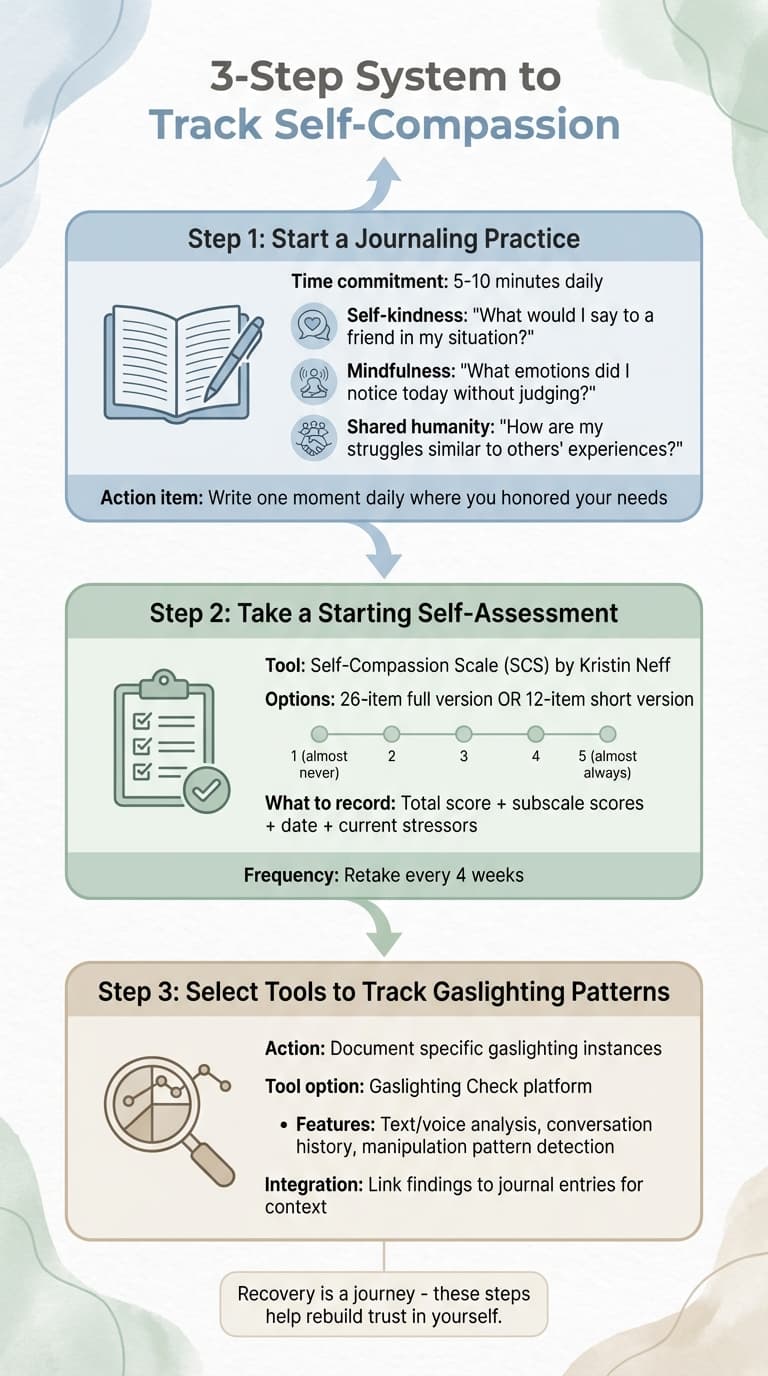
Set up a straightforward system to notice patterns in your experiences and respond to yourself with kindness.
Step 1: Start a Journaling Practice
Journaling helps you reflect on your inner world, which is especially valuable if manipulation has shaken your sense of self-trust. Spending just 5–10 minutes a day gives you a safe space to process your emotions, challenge self-blame, and build self-awareness.
Use prompts that encourage self-kindness, mindfulness, and a sense of shared humanity. For example:
- Self-kindness: "If a close friend faced what I did today, what would I say to them?"
- Mindfulness: "What emotions did I notice today without judging myself?"
- Shared humanity: "How are my struggles similar to what others experience after manipulation?"
Additionally, jot down one moment each day where you honored your own needs - like saying no when pressured - to remind yourself that your feelings and boundaries matter. Whether you prefer a notebook or a notes app on your phone, the key is to make journaling a consistent habit.
Once you’ve built this routine, you can take the next step: assessing your starting point.
Step 2: Take a Starting Self-Assessment
After establishing your journaling habit, measure your self-compassion with a structured tool like the Self-Compassion Scale (SCS). Created by Kristin Neff, this scale is widely used to evaluate self-compassion. The full version includes 26 items rated from 1 ("almost never") to 5 ("almost always"), covering areas like self-kindness, self-judgment, mindfulness, isolation, and over-identification. If you prefer something quicker, there’s also a 12-item version.
When completing the assessment, focus on how you tend to respond during difficult times. Record your total score, any subscale scores, and the date (e.g., 03/01/2026). It’s also helpful to note any current stressors - such as ongoing contact with an abuser, legal issues, or co-parenting challenges - to provide context for your results.
Many survivors of gaslighting find that their scores reflect lower self-kindness or higher self-judgment, which makes sense given the impact of repeated invalidation. Remember, these scores highlight how manipulation has influenced you - they’re not a reflection of your worth. Over time, tracking your scores can reveal patterns, like a high isolation score signaling the need to remind yourself that others share similar struggles. Plan to retake the SCS every four weeks to monitor progress and trends, rather than reacting to daily changes.
With your baseline in place, you can begin tracking specific gaslighting interactions.
Step 3: Select Tools to Track Gaslighting Patterns
To deepen your understanding, document specific instances of gaslighting alongside your journaling and self-assessment. Linking your emotional responses to particular patterns of manipulation can provide valuable context. Tracking these moments - like noting dates, times, and settings of invalidating interactions - can help explain why some days feel tougher and highlight moments when you showed self-compassion despite the challenges.
One helpful tool for this is Gaslighting Check, a platform designed to analyze text and voice conversations for manipulation tactics. It offers features like real-time audio recording, text analysis, and conversation history tracking for $9.99/month. The service prioritizes privacy with encrypted data and automatic deletion policies, ensuring your information stays secure.
Use Gaslighting Check to analyze conversations and generate detailed reports. Then, incorporate insights from these reports into your journal. This process can validate that your emotional responses are natural reactions to manipulative behavior, helping you build understanding and resilience over time.
Measuring Self-Compassion Over Time
Keeping track of your self-compassion regularly can help you spot patterns, recognize progress, and fine-tune your approach. Combining daily reflections, weekly ratings, and conversation analysis offers a well-rounded way to monitor your journey.
Daily Journaling for Self-Compassion
Start with a daily journal to track how you treat yourself. Write 1–3 sentences each day about moments of doubt or conflict. Include a "What I said to myself" section, where you note both critical and supportive thoughts. For instance, if a coworker questions your memory and laughs it off, you might write: "My inner critic said: 'You're so sensitive; you always get things wrong.'"
Follow this with a "Compassionate response" section, where you reframe one negative thought with a kinder perspective. Using the same example: "It's normal to feel hurt when dismissed. My memory has been reliable many times before." To wrap up, assign yourself a self-compassion rating from 0–10, where 0 reflects being extremely harsh and 10 reflects consistent kindness. This number helps track your weekly progress.
At the end of the week, calculate your average score and review where you showed self-respect versus where old, harmful beliefs crept in. Choose one small, actionable self-compassion habit to focus on for the next week. These daily reflections, when paired with a weekly review, can reveal longer-term trends in how you treat yourself.
Weekly Scoring with the Self-Compassion Scale

Use the Self-Compassion Scale (SCS) weekly or biweekly at the same time each week. Record your total and subscale scores, paying attention to changes in areas like self-kindness versus self-judgment, isolation versus shared humanity, and over-identification versus mindfulness.
Keep these scores organized in a notebook or spreadsheet. Look for patterns over 4–6 weeks instead of reacting to individual results. Life events - such as stressful moments, contact with an abuser, or anniversaries - can temporarily lower your scores without negating your progress. Even a small increase of 2–5 points over a month signals gradual improvement.
If your isolation scores remain high and your journal includes phrases like "No one would believe me", consider reading survivor stories or repeating affirmations like "Others have experienced gaslighting; my feelings are valid." For over-identification, where emotional overwhelm is a theme, try grounding exercises like three minutes of mindful breathing before journaling.
Pair these subjective scores with insights from your Gaslighting Check reports for a fuller picture of your progress.
Using Gaslighting Check Reports for Analysis

The Gaslighting Check platform provides detailed, AI-powered reports that identify subtle manipulation tactics, such as emotional invalidation, reality distortion, and blame shifting. These reports can validate your feelings and reinforce your self-compassion. Each report also includes actionable recommendations to help you understand what occurred.
Use the Conversation History feature to track analyzed interactions over time. Record the dates of high-manipulation conversations and compare them to dips in your self-compassion ratings or SCS subscale scores. For instance, you may notice that self-judgment spikes after certain interactions or that isolation scores rise when specific manipulation tactics are present. Recognizing these patterns can help you understand that harsh self-talk isn't a personal flaw - it's a natural reaction to being manipulated.
"Identifying gaslighting patterns is crucial for recovery. When you can recognize manipulation tactics in real-time, you regain your power and can begin to trust your own experiences again." - Stephanie A. Sarkis, Ph.D., leading expert on gaslighting and psychological manipulation [1][2]
Incorporate insights from these reports into your journal. If a report confirms manipulation, write a compassionate statement to validate your feelings: "The analysis confirmed what I sensed - this was manipulation, not my imagination. My confusion is understandable." Over time, this objective evidence can help rebuild trust in your own perceptions, which is a cornerstone of self-compassion.
Detect Manipulation in Conversations
Use AI-powered tools to analyze text and audio for gaslighting and manipulation patterns. Gain clarity, actionable insights, and support to navigate challenging relationships.
Start Analyzing NowReviewing and Charting Your Progress
Creating Progress Charts
Tracking your self-compassion progress visually can make a big difference. Try plotting your daily or weekly self-compassion scores on a simple line graph. You can use tools like Google Sheets or even go old-school with graph paper. For instance, imagine a three-month trend: Month 1 shows an average Self-Compassion Scale (SCS) score of 2.2 out of 5 (indicating frequent self-blame). By Month 2, after starting daily journaling, the score rises to 2.8. By Month 3, with consistent boundary-setting, it climbs to 3.6. Even a 0.6-point increase is worth celebrating - it’s progress.
To make your chart more insightful, add color codes: green for scores 7 or higher, yellow for 4–6, and red for 0–3. This makes it easier to spot patterns at a glance. For example, clusters of red days could signal a tough period. Cross-checking these with your journal or Gaslighting Check reports can help you identify triggers. You might also benefit from creating a monthly summary table. Include your average self-compassion score, the number of days you journaled, and any major stressors or events where manipulation was detected. These visuals don’t just track your progress - they provide clarity and direction for your recovery.
Monthly Review and Goal Setting
Once you’ve charted your progress, set aside 15–30 minutes each month to review your data and adjust your goals. Use this time to reflect on moments of self-kindness and identify recurring challenges. Seeing the bigger picture can help you avoid unnecessary self-blame, especially when natural reactions to manipulation come into play.
From these trends, set one or two specific, manageable goals for the next month. Let the data guide you, but don’t aim for perfection - small, achievable steps are key. Research shows that even modest improvements in self-compassion can significantly reduce anxiety and depression over time. When writing your goals, adopt a kind and supportive tone, as if offering advice to a close friend. This approach keeps the focus on growth rather than criticism.
Common Mistakes to Avoid When Tracking Self-Compassion
Inconsistent Tracking Habits
Only journaling when you're feeling good or skipping entries during tough weeks can leave gaps in your understanding of your emotions. Gaslighting can already make you question your own reality, and inconsistent tracking makes it harder to notice patterns in your self-talk or emotional responses. Even during stressful times, a brief check-in - like jotting down a sentence or two - can make a big difference. The key is to maintain some level of consistency, even if it’s just once or twice a week.
To help with this, create a simple routine. For example, spend five minutes journaling before bed or pair it with an activity you already do, like sipping your evening tea. If you’re feeling overwhelmed, don’t worry about details. Instead, focus on how you’re feeling in the moment or the tone of your self-talk. On especially hard days, even writing something as short as "Today was tough, but I tried my best" can be enough to keep the habit going.
By addressing these habits, you'll be better prepared to understand how outside influences might be affecting your progress.
Ignoring Context from Gaslighting Patterns
Your self-compassion scores don’t tell the whole story on their own. A sudden drop might feel like a personal failure, but it could actually be tied to external events, like contact with a gaslighter or a manipulative interaction. These emotional shifts often reflect natural reactions to invalidation rather than flaws in your character.
Using tools like Gaslighting Check can help put things into perspective. These tools analyze conversations for manipulation tactics and provide detailed reports, giving you a clearer picture of what’s happening. Experts stress that recognizing these patterns is a crucial step in recovery - it helps you reclaim trust in your own experiences.
If you notice a dip in your scores during a time when Gaslighting Check flags an instance of manipulation, try reframing it. Instead of seeing the drop as a failure, view it as a normal response to external stress. This shift in perspective can help you move forward with greater self-compassion.
Expecting Perfect Progress
Gaslighting often sets up unrealistic expectations, making you feel like anything less than perfection is failure. This mindset can turn normal ups and downs into "proof" that you aren’t doing enough, reinforcing shame and self-doubt. Recovery, however, is rarely a straight path. Plateaus and setbacks are natural and don’t diminish your worth or effort.
Instead of criticizing yourself for low scores, approach them with curiosity. Ask, "What might this be telling me?" Remind yourself that dips in self-compassion, especially after triggering events, are temporary and understandable. Shift your focus to process-oriented goals, like journaling a few times a week, rather than fixating on achieving a specific score. After recording a low score, consider adding a kind note to yourself, like "This is part of the journey, and I’m still making progress."
Conclusion
Rebuilding self-compassion after experiencing gaslighting is a journey that requires both patience and persistence. Healing doesn’t happen overnight - it unfolds as you take the time to reflect and slowly rebuild trust in your own perceptions.
The strategies shared in this guide - like daily journaling, weekly self-assessments, and tools such as Gaslighting Check - are designed to help you recognize patterns, validate your feelings, and gently challenge self-blame. By tracking your progress, you create a record of your growth and begin to reclaim your inner voice. Trauma-informed therapists often highlight the importance of self-compassion, emotional validation, and creating a sense of safety in the healing process.
You may notice progress in small but meaningful ways: catching self-critical thoughts more quickly, trusting your experiences instead of doubting them, or taking steps to care for yourself more regularly. Even when feelings of hurt or anxiety persist, these subtle shifts signal that your self-compassion is strengthening. It’s important to remember that setbacks and moments of stagnation are a natural part of recovery - they don’t erase the progress you’ve made. Every small victory builds the foundation for continued healing.
If you find yourself missing a day of tracking or facing an emotional setback, try to extend the same compassion to yourself that you’re working hard to develop. Reflect on what might have made tracking difficult - whether it was stress, a triggering event, or concerns about safety - and take one small step to begin again. Each time you journal, check in with your emotions, or review a Gaslighting Check report, you’re reclaiming your sense of self, reinforcing your resilience, and moving forward on your healing journey.
FAQs
How can I start journaling to build self-compassion after gaslighting?
Carve out a dedicated time each day to sit down and write about your thoughts and feelings. Treat this as a moment of self-care, approaching your reflections with kindness and patience. If you're not sure where to start, try using simple prompts like:
- "Today, I treated myself with kindness by..."
- "One thing I value about myself is..."
Let your words flow freely without self-criticism. The goal isn’t perfection - it’s about giving yourself space to process and grow. Over time, sticking to this habit can deepen your self-awareness and nurture a sense of compassion toward yourself.
What can I do if I notice a sudden drop in my self-compassion progress?
If you notice a sudden dip in your self-compassion, pause and think about any recent experiences or interactions that could have influenced your emotions. Treat yourself with care and focus on small, comforting actions like journaling, practicing mindfulness, or doing activities that bring you joy.
You might also find it helpful to use resources or tools that can uncover patterns of manipulation or emotional triggers affecting your peace of mind. And if things feel too heavy to handle alone, consider reaching out to a trusted friend, family member, or a mental health professional for support and a fresh perspective.
How can Gaslighting Check help me identify and track manipulation patterns?
Gaslighting Check is a tool aimed at helping you identify and understand manipulation tactics in conversations. It works by analyzing interactions to uncover subtle patterns of emotional manipulation, offering clear insights into recurring behaviors.
With features like real-time audio and text analysis, detailed reports, and conversation history tracking, it provides concrete evidence and practical insights. This can make recognizing gaslighting patterns easier and support your journey toward recovery.