
Improving AI for Diverse Mental Health Needs
Artificial intelligence (AI) is transforming mental health care by making it more accessible and personalized. But there’s a big problem: most AI systems are trained on data from Western, predominantly White populations. This lack of diversity creates biases, making these tools less effective for people from other backgrounds.
Key points from the article:
- Bias in AI training data: AI models often fail to understand non-Western expressions of distress or behaviors, leading to misdiagnoses or ineffective treatments.
- Underrepresented groups: Women, racial minorities, older adults, and LGBTQ+ communities are often overlooked in AI datasets, creating noticeable performance gaps.
- Ethical risks: Biased AI systems can harm marginalized groups, reinforce stereotypes, and erode trust due to privacy and fairness concerns and unregulated tools.
- Solutions: Building diverse datasets, supporting multiple languages, and regularly testing for bias can improve AI tools. Collaborating with communities and ensuring ethical practices are critical steps.
Example of progress: Tools like “Gaslighting Check” use AI to detect manipulation through text and voice analysis, offer privacy-focused features, and provide affordable pricing plans to reach more users.
To make AI work for everyone, it’s crucial to address biases, involve diverse populations, and prioritize fairness in mental health care.
How algorithmic bias created a mental health crisis
Detect Manipulation in Conversations
Use AI-powered tools to analyze text and audio for gaslighting and manipulation patterns. Gain clarity, actionable insights, and support to navigate challenging relationships.
Start Analyzing NowProblems with Current AI Mental Health Tools
::: @figure
Bias in AI Training Data
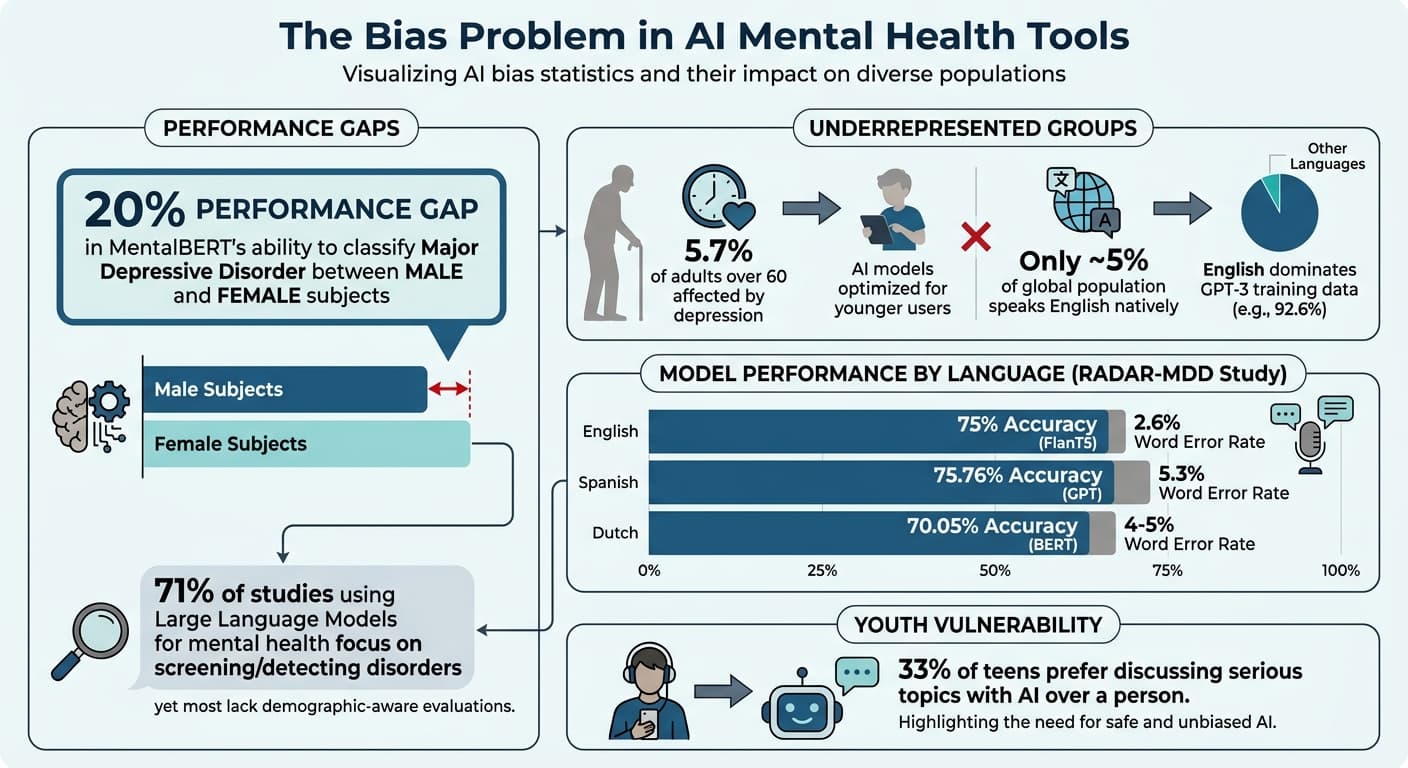
AI mental health tools often reflect the biases present in their training data, which is heavily influenced by Western populations. For example, platforms like Reddit - dominated by younger, male users - shape these models' understanding, leaving them ill-equipped to address the needs of other demographic groups. This bias leads to significant issues, such as a 20% performance gap in MentalBERT's ability to classify Major Depressive Disorder between male and female subjects [5]. Additionally, these models struggle to interpret culturally nuanced expressions that vary across communities.
Missing Data from Marginalized Groups
A major challenge lies in the lack of representation from marginalized groups in training datasets. Women, racial minorities, and individuals with public insurance are often underrepresented, leading to noticeable performance gaps [4]. Historical healthcare data, frequently used to train these algorithms, tends to carry forward systemic inequities. For instance, algorithms that use past healthcare costs as a measure of "need" often undervalue Black patients, as systemic barriers have historically resulted in lower healthcare expenditures for these groups [4].
"AI models frequently rely on datasets that fail to reflect the diversity of global patient populations... which can potentially exacerbate inequalities in care delivery for marginalized communities." – BMC Medical Informatics and Decision Making [4]
Another overlooked group is older adults. Despite depression affecting 5.7% of adults over 60, many AI models are optimized for younger users due to their reliance on social media data [5]. Similarly, LGBTQ+ communities face significant representation gaps, leaving their unique experiences underaddressed in mental health AI datasets [4]. These omissions not only reduce the overall accuracy of these tools but also limit their ability to identify culturally specific manipulation tactics.
Missing Culturally Specific Gaslighting Patterns
To provide effective mental health support, AI tools must account for culturally specific behaviors and expressions. However, models trained predominantly on Western data often fail to detect gaslighting patterns shaped by unique cultural or religious contexts [3]. Language variability plays a key role here - while AI might recognize manipulation in standardized language, it often overlooks the same tactics when expressed through culturally nuanced phrases.
"If these biases are not addressed, LLMs may misinterpret symptom-related cues across different populations... a model might fail to detect expressions of distress in non-standard dialects or misclassify culturally specific emotional language." – Scientific Reports [5]
A striking statistic highlights the gap: 71% of studies using Large Language Models for mental health focus on screening or detecting disorders, yet most do not incorporate demographic-aware evaluations [5]. Without meaningful input from diverse communities during development, these tools risk missing the broader social and structural factors that influence how manipulation or distress manifests in different cultural settings [1].
Ethical and Practical Risks of Current AI Systems
AI systems in mental health come with challenges that extend beyond technical limitations, touching on ethical and practical concerns that can have far-reaching consequences.
Depending Too Much on Biased Algorithms
When AI systems are built on biased data, the results can be harmful, especially in healthcare. A January 2026 study published in the Journal of Health Equity by researchers from George Mason University revealed a troubling issue with "race-blind" AI models used to treat Major Depressive Disorder. Led by AI expert Farrokh Alemi and health informatics researcher Vladimir Cardenas, the study showed that these models often recommended antidepressants that were less effective for African American patients compared to race-specific models. This research was supported by the Artificial Intelligence/Machine Learning Consortium to Advance Health Equity and Researcher Diversity and partially funded by the Patient-Centered Outcomes Research Institute (PCORI) [2].
"If AI systems are not trained on correct information, including patient demographic information, such as race, it will give incorrect or inaccurate information, which can result in people ending up with less effective medications." – Farrokh Alemi, George Mason University [2]
These biases don't just lead to isolated errors - they create feedback loops. Misdiagnoses and ineffective treatments get reinforced over time, embedding inequities even deeper into healthcare systems. Furthermore, technical flaws in tools like voice and face recognition have been shown to disproportionately affect users from diverse racial and gender backgrounds, further compounding the issue [1]. These systemic problems raise broader questions about privacy, trust, and the overall quality of care.
Privacy Concerns and Loss of Trust
A significant number of AI-powered mental health apps operate without proper clinical validation or safeguards [7]. This is why it is essential to use vetted tools for detecting gaslighting and other forms of manipulation. This lack of oversight puts users, particularly vulnerable populations, at risk. Young people are especially exposed to these unregulated tools.
"Commercial apps powered by LLMs are accessible to youth with minimal oversight, allowing potentially harmful interactions to occur without informed consent or clinician supervision." – Francis C. Ohu, Darrell Norman Burrell, and Laura A. Jones [7]
The perceived anonymity of AI systems often encourages users to share deeply personal information, which can then be exploited [7]. For example, a qualitative study of 18 low-income, first-generation community college students of color revealed that trust and cultural alignment are crucial factors in engaging with AI chatbots [6]. When users don't feel their cultural experiences are understood or represented, they disengage, reducing the effectiveness of these tools. This erosion of trust can lead to significant harm, especially for those already in vulnerable situations.
How AI Can Harm Vulnerable People
AI systems that lack cultural sensitivity and awareness can unintentionally harm individuals struggling with mental health challenges. These tools often miss subtle, culturally specific distress signals, which can lead to inadequate or even harmful responses [7].
"Adolescents, who are developmentally susceptible to therapeutic deception and emotionally driven over-disclosure, are particularly endangered by AI systems that simulate empathy without relational attunement or accountability." – Francis C. Ohu, Darrell Norman Burrell, and Laura A. Jones [7]
The problem lies in the illusion of understanding. Users may believe an AI system can empathize with them or keep their secrets in the same way a human therapist would. However, these systems lack accountability and can inadvertently spread misinformation or reinforce stereotypes [1]. Without addressing these flaws, AI tools risk causing more harm than good, particularly for individuals from non-Western cultures or marginalized communities who may already face barriers to effective care.
How to Build AI That Works for Different Cultures
To address the biases and risks previously discussed, AI must be designed with a foundation that includes diverse cultural perspectives. This effort goes beyond technical solutions - it requires meaningful collaboration with the communities these tools aim to serve.
Building Diverse Datasets
Creating fair AI starts with inclusive data that reflects a wide range of voices. While English dominates online content and GPT-3's training data, it’s worth noting that only about 5% of the global population speaks English natively [8]. To collect data effectively, partnerships with cultural custodians and patient advisory boards are crucial. This approach ensures data is ethically sourced and culturally relevant [8][1].
One example of this is the RADAR-MDD study, conducted in London, Amsterdam, and Barcelona. Researchers worked alongside a patient advisory board to develop protocols that balanced language and demographic representation. The study collected speech data in English, Spanish, and Dutch, achieving word error rates of roughly 2.6% for English, 5.3% for Spanish, and 4–5% for Dutch [5].
Beyond language, demographic balance - especially across age and gender - is vital to avoid performance gaps. For instance, the RADAR-MDD study revealed that age-balanced datasets improved model performance, with FlanT5 achieving 75% accuracy in English. However, balancing both age and gender introduced complexities, altering decision boundaries and highlighting the challenges of intersecting identities [5]. Techniques like down-sampling or the Synthetic Minority Over-sampling Technique (SMOTE) can help ensure fair representation across groups before training begins [1][5].
For communities lacking a written language system, collecting speech data and supporting local orthographies ensures broader inclusion [8]. Additionally, data sovereignty is critical - Indigenous and non-Western communities must have control over their data to prevent exploitation [8].
This diverse data collection forms the backbone for creating multilingual and culturally sensitive AI models.
AI Models That Support Multiple Languages and Cultures
Language is deeply tied to culture. Anthropologist Edward T. Hall famously said, "Communication is culture and culture is communication" [8]. In March 2025, researchers incorporated cultural frameworks, such as Africa's Ubuntu philosophy, to fine-tune AI models for non-Western contexts. This approach addressed the limitations of Western-centric models in areas like mental health [9].
"Africa's growing mental health crisis underscores a significant lack of accessible and culturally relevant mental health services... highlighting the need for innovative approaches." – Springer Nature [9]
Multilingual AI models require tailored fine-tuning for each language, as their performance often declines outside of English. In the RADAR-MDD study, the top-performing models varied by language: FlanT5 reached 75% accuracy for English, GPT achieved 75.76% for Spanish, and BERT scored 70.05% for Dutch [5]. These models must also account for factors like age, gender, and socioeconomic status, given that depression prevalence varies across demographics [5].
Culturally adapted models require ongoing bias monitoring, which leads us to the next critical step.
Regular Testing and Updates for Bias
Creating equitable AI isn’t a one-and-done process - it requires constant oversight and refinement. The BRIDGE (Dynamic Generative Equity) model provides a framework for integrating bias detection with regular community feedback [1].
"This model integrates fair-aware machine learning with co-creation techniques, combining quantitative methodologies to detect bias in AI algorithms with qualitative input from community collaborators to ensure cultural relevance." – Nature Reviews Psychology [1]
Bias testing should include identifying subtle triggers that humans might miss, such as names or dialects (e.g., African American Vernacular English), which could lead to unintended discrimination [10]. Regular audits focusing on age and gender are also essential since these factors frequently influence performance disparities in mental health applications [5].
How Gaslighting Check Supports Diverse Mental Health Needs

Gaslighting Check takes a practical approach to addressing mental health challenges, focusing on manipulation detection, privacy, and affordability. By building on earlier strategies, this tool is designed to be accessible across various cultural contexts, breaking down barriers that often limit diverse populations from seeking mental health support.
Text and Voice Analysis for Detecting Manipulation
Using AI, Gaslighting Check identifies gaslighting tactics - like denial, contradiction, and reality distortion - through both text and voice analysis. Its voice analysis feature goes a step further by detecting subtle vocal cues, making it adaptable to a variety of cultural nuances. This layered detection system is supported by a strong commitment to privacy.
Privacy-First Design
Handling sensitive mental health data requires trust, and Gaslighting Check prioritizes user privacy through end-to-end encryption and automatic data deletion. These measures create a safe space for individuals, particularly those who might not have access to reliable support systems.
Pricing Plans for Different Needs
To make its tools accessible, Gaslighting Check offers a range of pricing options. Financial accessibility is essential, especially for those who rely on AI wellness apps when traditional care is unavailable or unaffordable [11]. The tool’s tiered pricing structure ensures that financial constraints don’t prevent users from accessing its features.
| Plan Name | Price | Features | Limitations/Restrictions |
|---|---|---|---|
| Free Plan | $0 | Text analysis, limited insights | No voice analysis, no history tracking |
| Premium Plan | $9.99/month | Text and voice analysis, detailed reports, conversation history tracking | None |
| Enterprise Plan | Custom Pricing | All premium features, additional customization options | None |
The Free Plan ensures everyone can access basic text analysis, regardless of their financial situation. For those seeking more in-depth support, the Premium Plan offers full functionality at $9.99/month - an affordable alternative compared to traditional therapy. This model is particularly relevant, as 33% of teens have expressed a preference for discussing serious topics with an AI companion over a person [11]. By catering to a wide range of financial and personal needs, Gaslighting Check plays a key role in making mental health support more accessible to younger and diverse populations.
Conclusion: Building AI That Works for Everyone
When it comes to mental health AI, equity must be a core priority from the very beginning. Research shows that biases in AI systems can deepen healthcare disparities, especially for marginalized groups [1]. With so much on the line, these issues simply can't be overlooked.
The solution lies in combining data-driven accuracy with human understanding. While fair-aware machine learning can help identify algorithmic bias, it must be paired with insights from diverse communities to recognize patterns that raw data might miss [1]. This blend of technical rigor and lived experience is key to addressing bias effectively. Together, these approaches pave the way for real-world solutions.
Take Gaslighting Check, for example. This tool embodies these principles by offering text and voice analysis, prioritizing user privacy, and providing a $0 entry plan to eliminate barriers for underserved populations. For those seeking more features, the Premium Plan at $9.99/month delivers comprehensive tools to detect manipulation, ensuring accessibility for those who need it most.
To truly advance mental health AI, continuous feedback loops are critical. Systems must evolve based on how they're used in everyday life [1]. Regular audits and ongoing input from the community aren't just helpful - they're essential for ensuring mental health support reaches everyone fairly and effectively.
FAQs
How can I tell if a mental health AI is biased for my culture?
To evaluate cultural bias in a mental health AI, start by examining its training data and design principles. Bias often creeps in when datasets fail to include a wide range of populations, which can result in inaccurate or less effective outcomes for underrepresented groups.
It's important to look for transparency in how the AI was developed. This could include details about bias assessments, as well as whether the datasets used were diverse enough to reflect various cultural backgrounds. Additionally, models designed with cultural awareness in mind and informed by feedback from a broad spectrum of users can play a big role in spotting and minimizing biases.
What data should mental health AI include to be fair?
To make mental health AI tools more inclusive, it's crucial to use datasets that represent a wide range of populations. This means including people from various racial, ethnic, and socioeconomic backgrounds. These tools should also consider factors like language, religion, and social determinants of health. By addressing cultural beliefs, social stigmas, and traditional practices, mental health AI can offer more personalized and meaningful support, especially for communities that have historically been underserved.
How can I protect my privacy when using AI for mental health?
To protect your privacy, opt for AI tools that prioritize features like encryption, automatic data deletion, and restricted access to stored information. Technologies like federated learning and differential privacy can further minimize risks, such as data breaches. It's also crucial to carefully review the platform's data handling policies to ensure your personal information stays safe while you access mental health support.