
Study: Impact of Cultural Competency on Trust
Trust is essential in diverse settings, but building it requires understanding how interactions across backgrounds shape perceptions. Research shows that people are more likely to generalize negative experiences with individuals from different racial or ethnic groups, which can harm future relationships. For example, in a study of 1,255 White U.S. adults, negative first interactions with Latino partners led to participants choosing Latino partners only 36.1% of the time, compared to 46.6% after positive experiences. This highlights the importance of awareness and effective communication in fostering trust.
Key insights include:
- Cultural awareness and self-reflection are critical for reducing misunderstandings and building connections.
- Online trust-building depends on interpreting nonverbal cues, like smiles, which vary by cultural norms.
- Face-to-face strategies, such as using bilingual workers and prioritizing transparency, help strengthen relationships.
- Cultural humility complements competency by encouraging ongoing self-awareness and respect for individual experiences.
Practical steps include participating in training programs, leveraging tools like Gaslighting Check for communication improvement, and working with cultural brokers to mediate cross-group interactions. By combining these approaches, individuals and organizations can create environments where trust thrives.
Building Trust Through Cultural Competence in Healthcare
Detect Manipulation in Conversations
Use AI-powered tools to analyze text and audio for gaslighting and manipulation patterns. Gain clarity, actionable insights, and support to navigate challenging relationships.
Start Analyzing NowMain Findings: The Link Between Cultural Competency and Trust
::: @figure
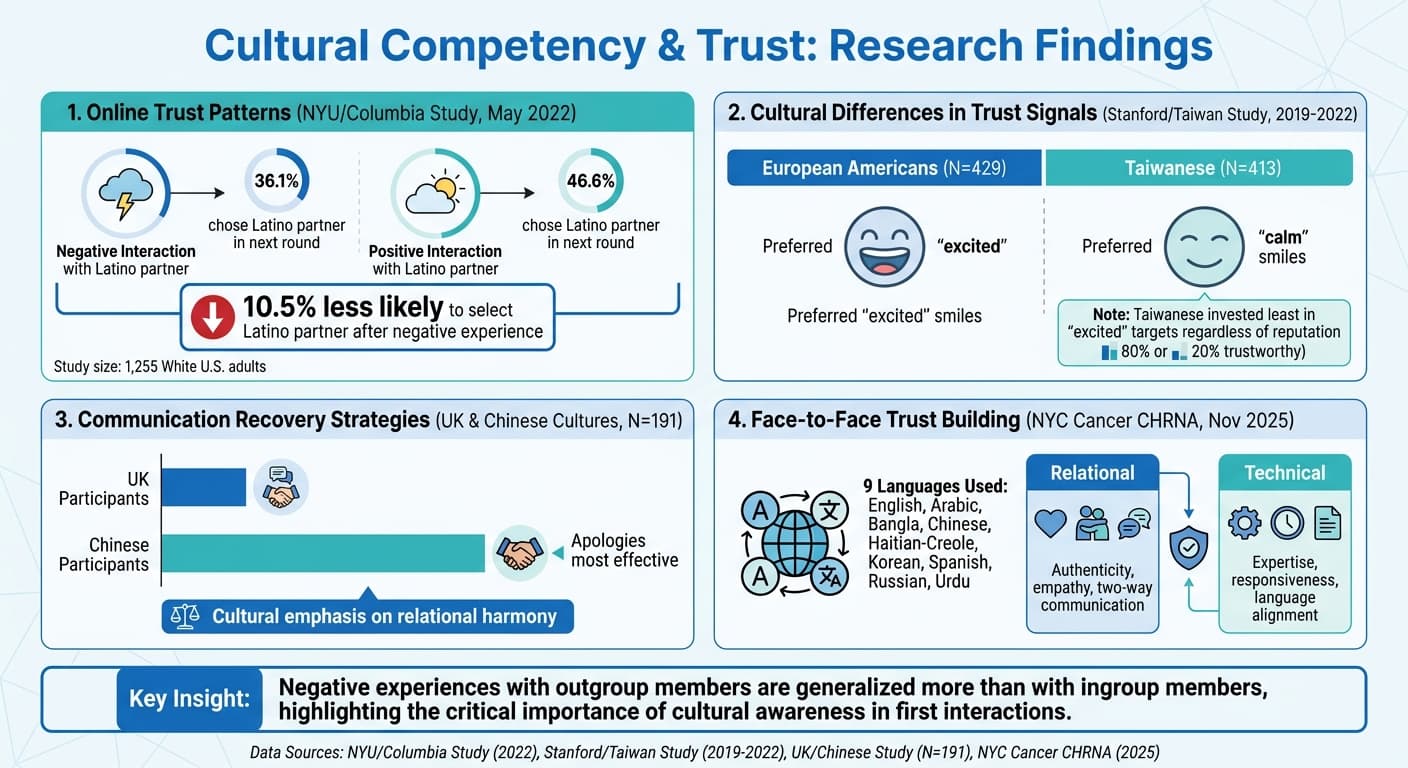
Recent studies highlight a strong connection between cultural awareness and the ability to build trust. Patterns in both digital and in-person interactions show that trust depends on a mix of practical skills and cultural understanding. In some cases, this includes using emotional manipulation detection tools to identify and mitigate deceptive behaviors in digital communication.
Results in Online Communities
Building trust across cultures in digital spaces comes with unique challenges. A study conducted in May 2022 by researchers from NYU and Columbia University explored this through trust games involving 1,255 White U.S. adults on Amazon Mechanical Turk. Participants interacted with programmed bots, and the findings were striking: when paired with an untrustworthy Latino partner in the first round, participants were 10.5% less likely to select a Latino partner in subsequent rounds. This revealed a tendency among majority group members to generalize negative experiences with outgroup members more than with their own group [3].
Cultural values also influence how trust signals are interpreted online. Between 2019 and 2022, researchers from Stanford University and National Taiwan University conducted four studies with 429 European Americans and 413 Taiwanese participants in single-shot Trust Games. The results showed that Americans were more likely to trust individuals displaying "excited" smiles, while Taiwanese participants preferred "calm" smiles. Interestingly, Taiwanese participants invested the least in "excited" targets, regardless of whether their reputation was deemed 80% or 20% trustworthy. Julie Y. A. Cachia, a lead author from Stanford University, explained:
"When targets' reputations were ambiguous... European American and Taiwanese participants invested more in targets whose smiles matched their culture's ideal affect" [5].
Errors in communication can damage trust, but culturally sensitive recovery strategies can repair it. A study involving 191 participants found that brief online interactions with judgment errors lowered perceived rapport across UK and Chinese cultures. However, apologies were particularly effective for restoring trust with Chinese participants, reflecting a cultural emphasis on maintaining relational harmony. As Lorraine Hope, a Professor at the University of Portsmouth, noted:
"Apology emerged as the most effective recovery strategy, especially among Chinese participants, perhaps reflecting cultural preferences for relational harmony" [6].
These findings in digital spaces echo the challenges of face-to-face interactions, where cultural and linguistic alignment plays an equally critical role.
Building Trust in Face-to-Face Settings
In-person interactions also highlight the importance of culturally informed strategies. For example, in November 2025, the NYU Grossman School of Medicine launched the Cancer Community Health Resources and Needs Assessment (Cancer CHRNA) across New York City. The initiative, led by A. Rakhra and SC Kwon, relied on bicultural and bilingual Community Health Workers (CHWs) who conducted assessments in nine languages, including English, Arabic, Bangla, Chinese, Haitian-Creole, Korean, Spanish, Russian, and Urdu. Rakhra emphasized:
"Culturally and linguistically concordant CHWs, working in partnership with trusted CBOs, were central to fostering trust across the relational and technical strategies of trust building and facilitating broad community participation" [7].
Face-to-face trust-building involves two key approaches: relational strategies (such as authenticity, empathy, and two-way communication) and technical strategies (like expertise, responsiveness, and language alignment). Research on multicultural project teams found that frequent interaction and transparency were more impactful for trust-building than general emotional intelligence. Wenyuan Yu from the National University of Ireland explained:
"Interaction and transparency significantly and positively influence trust in intercultural communication; empathy marginally and positively influences trust" [8].
Cultural Competency vs. Cultural Humility
Research highlights that cultural awareness is key to building trust, but there's an ongoing discussion about whether cultural competency or humility should take precedence. The truth is, both are essential. Cultural competency equips you with the skills and knowledge to engage across diverse backgrounds, while cultural humility fosters the mindset and self-awareness needed to acknowledge personal biases and power dynamics. As community leader Ella Greene-Moton aptly put it:
"Cultural humility/cultural competence is not an either/or but rather a both/and" [12].
Cultural Competency: Knowledge and Skills in Action
Cultural competency focuses on acquiring the tools and understanding necessary for effective interactions across cultures. The National Association of Social Workers (NASW) defines it as:
"social workers' ability to identify their own affiliations to culture and recognize and respect differing traditions of culture in others" [11].
This can include practical measures like offering language services or tailoring your approach based on someone’s cultural background. For instance, the University of Michigan, Flint, pioneered a course in 2002 titled "Cultural Competence to Eliminate Health Disparities", which now trains around 200 students annually [12].
However, relying solely on competency has its limits. It can unintentionally lead to a mindset where one assumes they fully understand another's culture, risking stereotyping. This framework might inadvertently treat individuals as representatives of a group rather than acknowledging their unique experiences. To counter this, cultural humility plays a vital role by encouraging continuous self-reflection and adaptability.
Cultural Humility: A Commitment to Self-Awareness
Unlike competency, cultural humility is about an ongoing process of self-examination and openness. The Centers for Disease Control and Prevention (CDC) describes it as centering on:
"self-awareness, openness, and learning from each unique individual" [10].
Instead of assuming the role of an authority on someone else’s culture, cultural humility acknowledges that individuals are the true experts on their own lives. Katherine Yeager and Susan Bauer-Wu explain it as:
"a process of self-reflection and discovery in order to build honest and trustworthy relationships" [9].
This approach requires regular reflection on personal privilege and unconscious biases [13]. Cultural competence itself is not static; it evolves over time [10]. Clinical psychologist Shamaila Khan, PhD, underscores the importance of blending both frameworks:
"Utilizing one of these frameworks without the other misses the mark, and effective interventions would uphold both" [13].
How to Apply Cultural Competency
Applying cultural competency means taking specific steps to build trust and understanding in diverse communities. Whether you're a healthcare provider, manager, or team member, these methods can make a real difference.
Training Programs and Workshops
Training is a key way to develop cultural competency skills. For instance, the HHS Think Cultural Health program offers a free e-learning series called Improving Cultural Competency for Behavioral Health Professionals. This program covers topics like self-awareness and culturally appropriate interventions. Participants can earn 4 to 5.5 continuing education credits for roles such as counselors, nurses, psychologists, and social workers - provided they achieve a minimum post-test score of 80% [14].
For more focused needs, workshops like Building Trust with Indigenous Patients explore the impact of historical trauma, such as forced sterilizations and systemic neglect, on trust in institutions. This free, one-hour clinical training uses trauma-informed communication strategies to emphasize transparency and relationship-building [1]. As the program highlights:
"Cultural and linguistic competency is recognized as an important strategy for improving the quality of care provided to clients" [14].
Digital tools can also enhance training by offering real-time analysis and feedback.
Using Tools like Gaslighting Check

Digital platforms can help identify communication challenges caused by cultural differences or power imbalances. For example, Gaslighting Check uses sentiment analysis to track emotional manipulation, offering actionable insights to improve trust-building behaviors [15]. The tool provides detailed communication reports, promoting self-reflection and cultural humility. This contributes to creating a psychologically safe environment where individuals feel comfortable addressing trust concerns [2].
The platform's Premium Plan ($9.99/month) includes features like conversation history tracking, which helps users spot recurring patterns that might hinder trust. By combining digital insights with interpersonal communication, you can strengthen relationships and build trust more effectively.
Working with Cultural Brokers and Specialists
Cultural brokers serve as mediators between formal systems - like healthcare or business - and community values. Cindy Brach, a Senior Healthcare Researcher at the Agency for Healthcare Research and Quality, describes their role:
"A cultural broker is someone who understands two different cultures and mediates in cross‑cultural interactions to help both parties understand each other" [2].
These brokers are often trusted and respected members of their communities, making them invaluable in fostering understanding.
In March 2013, the Agency for Healthcare Research and Quality launched the Re‑Engineered Discharge (RED) Toolkit, which recommends hiring bilingual and bicultural discharge educators. These educators provide culturally tailored instructions, which research shows can significantly reduce hospital readmissions and emergency department visits after discharge [2]. Similarly, the AHRQ TeamSTEPPS Limited English Proficiency module trains clinical staff and interpreters to collaborate effectively, assigning interpreters specific roles to enhance patient safety and psychological security.
To maximize the impact of cultural brokers, integrate them into your core teams rather than treating them as occasional resources. Hiring bilingual and bicultural staff for frontline roles and including diverse members on advisory councils ensures they are part of your organization’s decision-making processes [2].
Conclusion: Main Points on Cultural Competency and Trust
The Importance of Empathy and Awareness
Trust plays a pivotal role in strengthening relationships across all sectors. As researchers Jeanne M. Brett and Tyree Mitchell put it:
"Trust is the social glue that holds business relationships together" [16].
Without trust, collaboration suffers as people focus more on self-preservation than on working together. Here’s where cultural competency steps in - it offers a framework to overcome barriers like language differences and stereotypes, which often hinder trust-building [4].
It’s also crucial to recognize that levels of trust vary across cultures. What might appear as resistance or doubt could simply reflect cultural norms rather than personal opposition [15]. Research shows that individual interactions significantly influence trust patterns, underscoring the need to be aware of personal biases and avoid generalizing from a single encounter. These moments can either strengthen or weaken trust across cultural divides [3].
With this understanding in mind, here are practical steps individuals and organizations can take to foster trust.
Action Steps for Individuals and Organizations
Empathy and awareness must translate into actionable strategies. Start by implementing focused intercultural training aimed at addressing language barriers and dismantling stereotypes - these are among the most common obstacles to trust [4]. When assessing trust or engagement in diverse teams, use tools that are culturally adaptable and focus on specific behaviors rather than abstract ideas. As Purdue Business researchers highlight:
"Psychometric rigor is not an academic technicality. It is a strategic business asset" [15].
For example, instead of broadly asking if someone "trusts" their supervisor, ask about concrete actions, such as whether the supervisor follows through on commitments or communicates openly. Avoid negatively framed survey questions, as cultural perceptions can differ widely [15]. Tools like Gaslighting Check can also help by analyzing communication patterns and offering insights to encourage self-reflection and cultural humility.
It’s equally important to address the issue of tokenism, where the actions of minority members are unfairly seen as representing their entire group [3]. Organizations can combat this by building individual connections, diversifying advisory boards, and including cultural brokers as integral team members [2]. These steps not only support trust but also create a more inclusive and collaborative environment.
FAQs
Why do negative cross-cultural first impressions stick more?
Negative first impressions in cross-cultural settings tend to linger because they’re often rooted in stereotypes - preconceived notions that are tough to shake. These snap judgments can shape future interactions, reinforcing the initial negative perception and making it challenging to move past in diverse cultural environments.
How can teams rebuild trust after a cultural misunderstanding online?
Teams can work on rebuilding trust by openly admitting mistakes with sincerity and taking full responsibility for their actions. It's also essential to acknowledge and validate the feelings of those impacted. To improve communication, take the time to understand different cultural backgrounds, show genuine empathy, and adjust your communication approach to suit diverse needs. Additionally, offering clear, honest explanations and committing to meaningful change can help promote better understanding and sensitivity. Over time, these efforts can help restore respect and rebuild trust.
What’s the difference between cultural competency and cultural humility?
Cultural competency is about gaining the knowledge and skills needed to understand, communicate, and work effectively with people from different cultural backgrounds. It often involves learning specific details about various cultures to bridge gaps and foster understanding.
Cultural humility, however, takes a slightly different approach. It focuses on ongoing self-reflection and recognizing that no one can fully master every aspect of another culture. Instead, it encourages an open mindset, a willingness to learn from others, and an acknowledgment of personal limitations. While competency might imply reaching a certain level of expertise, humility emphasizes lifelong learning and genuine respect for diversity.