How Selective Omission Fuels Gaslighting

How Selective Omission Fuels Gaslighting
Gaslighting manipulates your perception of reality, often through selective omission - intentionally leaving out critical details to mislead without outright lying. This tactic is subtle, making it difficult to detect and confront. Here’s what you need to know:
- What It Is: Selective omission involves withholding key facts or stripping context, leaving you doubting your memory or judgment.
- Why It’s Hard to Spot: The manipulator avoids lying, creating plausible deniability. They may claim they "forgot" or "didn’t think it mattered."
- Where It Happens: Common in relationships, families, workplaces, and institutions, often used to control narratives or undermine trust.
- Impact on Victims: Leads to self-doubt, reliance on the manipulator, and distorted reality over time.
How to Respond:
- Keep detailed records of conversations to document interactions.
- Ask direct, specific questions to clarify omissions.
- Set boundaries and disengage from circular arguments.
- Use tools like Gaslighting Check to analyze patterns of manipulation.
Recognizing selective omission is the first step to regaining confidence in your perceptions and protecting yourself from this form of psychological manipulation.
How Selective Omission Works in Gaslighting
Common Manipulation Tactics That Use Omission
Selective omission involves subtle tactics that distort reality without outright lies.
One of the most common methods is lying by omission, where key facts are withheld to craft a misleading narrative. This allows manipulators to maintain an appearance of honesty while distorting the truth [4]. Another tactic, paltering, involves using truthful statements to nudge someone toward false conclusions. Together, these strategies create a warped version of reality while preserving the gaslighter's plausible deniability [4].
When confronted, gaslighters often deflect by denying the omission and shifting attention to the victim's response, labeling it as an overreaction [2]. Another form of omission, isolation, removes outside influences, leaving victims dependent on the gaslighter's version of events [2].
"They live in an alternate reality. And they want you to live there with them." - Selah, Domestic Violence Survivor [2]
These covert manipulation tactics are alarmingly versatile and show up in various settings.
Settings Where Selective Omission Happens
Selective omission is common in personal relationships, families, workplaces, and even larger institutions [2].
In romantic relationships, a partner might omit critical details - like meeting with an ex or hiding financial troubles - technically avoiding lies but creating a distorted reality [4]. Within families, particularly those with narcissistic dynamics, omission can become a collective behavior. Family members may silently ignore mistreatment to maintain a facade of harmony [1].
Workplaces are another breeding ground for this behavior. For example, a manager or coworker might leave out positive details about your contributions when speaking to others, subtly damaging your reputation. Researchers call this credibility slashing, a quiet yet effective way to undermine someone [2].
"Gaslighting feeds off social vulnerabilities and stereotypes. It entrenches existing power imbalances while fostering new ones." - Paige L. Sweet, Sociologist [2]
How Selective Omission Affects Victims
The harm caused by selective omission builds over time, often going unnoticed until the damage is deeply ingrained.
One of the first effects is a loss of self-trust. Without access to the full picture, victims start doubting their own perceptions and interpretations. This can escalate into what researchers term testimonial injustice, where individuals no longer trust themselves as credible witnesses to their own experiences [2]. A 2016 study in the Journal of Personality and Social Psychology revealed that many people see omission as less unethical than outright lying, which only adds to the confusion [4].
As the gaslighter controls the flow of information, victims may come to rely on them for their sense of reality. This imbalance of power makes it increasingly difficult to challenge or break free from the situation [2][4].
"Without all of the information relevant to a situation, a person can't create a full and accurate picture of reality. They may think things are fine when they aren't... This can be similar to gaslighting because you're making someone question their own sense of reality." - BetterUp [5]
Recognizing these patterns is a critical step toward identifying and addressing gaslighting.
Detect Manipulation in Conversations
Use AI-powered tools to analyze text and audio for gaslighting and manipulation patterns. Gain clarity, actionable insights, and support to navigate challenging relationships.
Start Analyzing NowHow to Recognize Selective Omission in Conversations
Warning Signs in Conversation
Selective omission often hides in plain sight, making conversations feel unsettling without offering clear proof of manipulation. One of the most telling signs is when someone gives vague or evasive answers - replies that seem to address your question but sidestep offering a direct response.
Be on the lookout for strategic shifting: when someone confidently makes a claim but changes their stance when challenged, all while never acknowledging the inconsistency [7]. Another clue is the use of anti-performatives - phrases like "I don’t mean to undermine you, but..." followed by exactly that. These statements create a facade of fairness while doing the opposite [7].
Gaslighters often use face-threatening acts disguised as concern, such as saying, "I’m worried the stress is affecting your memory" or "I think you’re not tracking things clearly." These statements aren’t genuine concern; they’re subtle ways of questioning your credibility [7]. As one expert explains:
"The manipulation works because it looks like communication while actually being reality warfare." - The Strategic Linguist [7]
These tactics can show up in both spoken and written exchanges, making it important to stay alert across all forms of communication.
Language Cues in Text and Voice Communication
Certain language patterns are common in gaslighting. Watch for absolute generalizations like "You always do this" or "You never listen." These phrases shift the focus from specific details to attacking your character, conveniently avoiding accountability for their own actions [8].
Another common tactic involves minimization markers, such as "You’re making too big a deal" or "It was just a joke" [9]. These phrases don’t just dismiss your emotions; they erase the context that justifies your reaction. In text conversations, inconsistencies can be particularly revealing. If someone’s account of an event changes between messages without explanation, those shifting details often point to where the omission lies.
"Gaslighting is almost always a pattern of behavior, and that's how we begin to spot it." - The Performance Scientist [8]
Tracking these patterns over time can help you identify manipulation more clearly using tools for detecting gaslighting.
Why Tracking Patterns Over Time Matters
A single vague or dismissive comment might seem insignificant. That’s what makes gaslighting through omission so effective - no single instance feels like enough evidence. The key is observing and documenting patterns over time.
Gaslighting isn’t a one-time event; it’s a process [2]. Keeping a written record of conversations - noting what was said, what was avoided, and how you felt afterward - can provide clarity. Dr. Robin Stern, a psychoanalyst, offers this advice:
"Write down, 'I said, he said, I said, he said' to the best of your ability and see - in black and white - how your gaslighter distorts what has happened or pivots away from it." [6]
Also, pay attention to selective responsiveness: does the person consistently ignore messages that ask for accountability but respond quickly when the topic suits them? Documenting these behaviors over weeks or months creates a clearer picture that’s harder to dismiss than any isolated exchange [1]. Your own emotional and physical reactions are equally important. If you consistently leave interactions feeling confused, unseen, or like something crucial is missing, that’s worth noting - even if you can’t yet put your finger on why [1].
Am I Being Gaslit? 10 Signs You Shouldn’t Ignore
How to Respond to Selective Omission
::: @figure
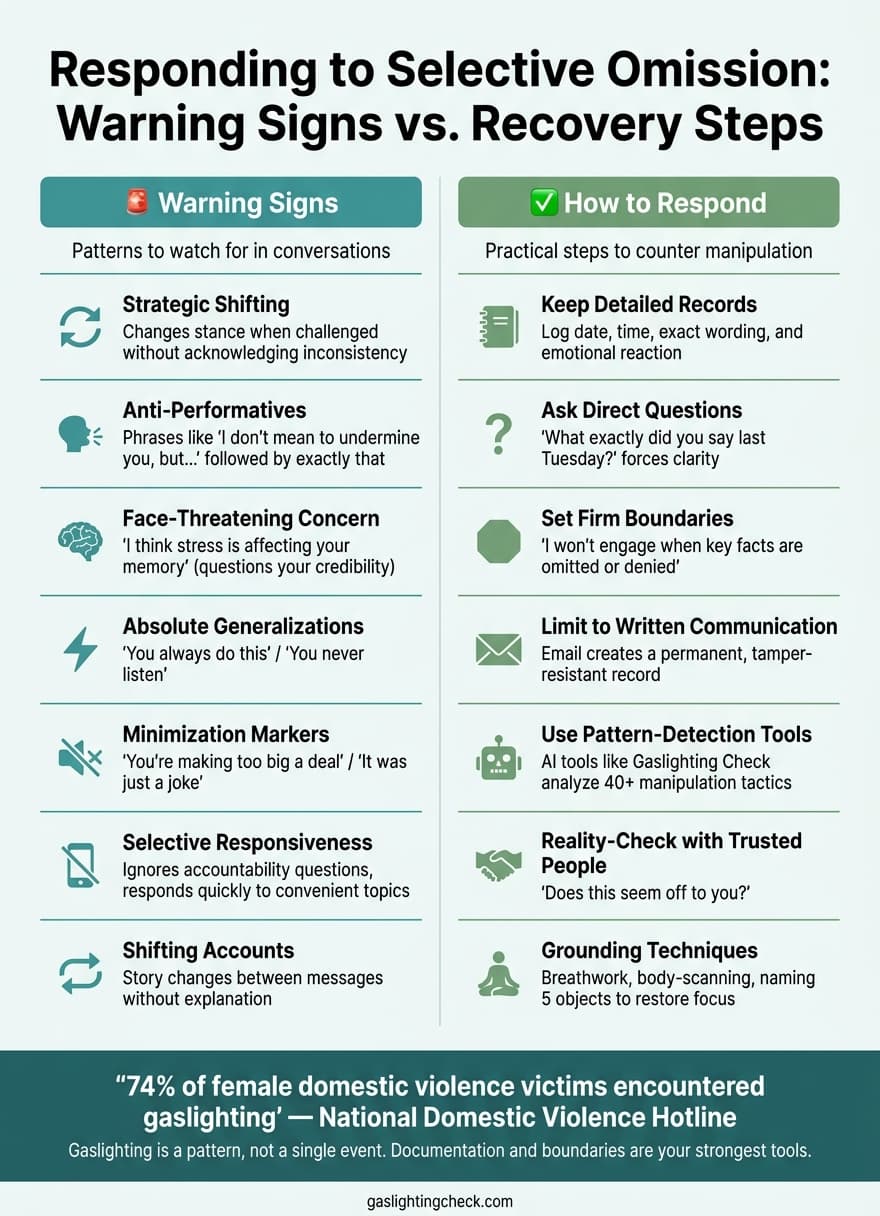
Once you've identified patterns of gaslighting, knowing how to respond is key. The goal is to address the manipulation without getting stuck in endless debates. This involves combining personal strategies with tools that can help counter selective omission.
Grounding Yourself With Objective Records
One of the best ways to counter selective omission is by keeping a detailed written record. Use a journal to log the date, time, exact wording, and your emotional reaction to interactions. Stick to the facts and avoid interpreting motives. Dr. Robin Stern, Co-founder of the Yale Center for Emotional Intelligence, emphasizes the importance of this approach:
"Sorting out the truth from the distortion can be a helpful step in turning off the gas. Pay close attention to what your gaslighter says and how the conversation flows." [6]
Write your version of events before reading or hearing theirs, and use timestamps as solid proof. When dealing with digital conversations, save entire threads instead of isolated screenshots. This allows you to see how manipulation plays out over multiple exchanges rather than focusing on a single instance [12].
Armed with thorough documentation, you'll find it easier to set boundaries and maintain clarity in your interactions.
Setting Boundaries and Asking Direct Questions
If the conversation becomes evasive, ask specific and direct questions like, "What exactly did you say last Tuesday?" This approach forces clarity, making selective omission harder to maintain.
Short, assertive responses can also help you stand firm without escalating the situation. Examples include: "I remember it differently, and I trust my memory", or "I'm not going to keep debating what happened." These statements acknowledge the manipulation without inviting further argument.
Dr. Ramani Durvasula, Clinical Psychologist, highlights the power of silence in manipulation:
"The cruelest lies are often told in silence. A narcissist doesn't need to speak falsehoods to make you question your reality - they can accomplish this simply by refusing to acknowledge your truth." [1]
If the pattern persists, clearly state that you won't engage in conversations where key facts are omitted or denied. In situations where complete avoidance isn't possible, such as gaslighting at work or within family dynamics, limit communication to written formats like email. This creates a permanent record and reduces opportunities for selective omission.
With accurate records and clear boundaries, you can also explore objective tools to analyze manipulative patterns.
Using AI Tools Like Gaslighting Check

Selective omission is tricky to spot because no single message may seem blatantly wrong - the manipulation unfolds over time. This is where an AI tool like Gaslighting Check can be incredibly useful.
Gaslighting Check reviews text and voice conversations for over 40 manipulation tactics, including omission, blame-shifting, and DARVO (Deny, Attack, Reverse Victim and Offender) [12]. Instead of relying solely on how the conversation feels, the tool identifies patterns like responsibility deflection, perception questioning, and concern redirection. For example, documenting 15 instances of memory denial over three months provides concrete evidence that therapists or legal professionals can act on [12].
The platform ensures privacy with end-to-end encryption and automatic data deletion, so you can analyze sensitive conversations securely. A free plan offers basic text analysis, while the Premium plan ($9.99/month) includes voice analysis, detailed reports, and conversation history tracking - features that help you build a timeline of repeated behaviors.
Rebuilding Your Sense of Reality After Gaslighting
Once you've taken steps to counter manipulation through documentation and setting boundaries, the next challenge is regaining confidence in your own perceptions. Gaslighting often works by distorting reality through selective omission rather than outright lies, leaving you questioning what’s real. Reclaiming your sense of reality is a gradual process, but it’s essential for healing and recovery.
Learning to Trust Your Own Perception Again
The first step in rebuilding trust in yourself is to acknowledge what happened. Recognize the manipulation for what it was - a deliberate tactic designed to distort your reality. This isn’t about being "too sensitive" or at fault in any way [10][13]. As Shahida Arabi explains:
"Gaslighting provides malignant narcissists with a portal to erase the reality of their victims without a trace. It is a method that enables them to commit covert psychological murder with clean hands." [14]
Trust your instincts. That feeling of confusion? It’s often a red flag for manipulation [10][14]. Two simple practices can help you regain clarity. First, conduct regular "reality checks" by asking someone you trust, "Does this seem off to you?" This can help you recalibrate your understanding of normalcy after prolonged distortion. Second, if you feel overwhelmed, try grounding techniques like body-scanning or slow breathing exercises. Even something as simple as naming five objects in the room can help lower stress and restore focus [3][11].
As you rebuild this trust in your perceptions, start focusing on small, daily decisions to reinforce your independence.
Building Skills to Protect Yourself Long-Term
Taking practical steps each day can gradually strengthen your autonomy. Start by making small, independent choices - decide what to eat, what to watch, or which route to take without seeking validation from others. These seemingly minor actions can help rebuild the self-trust that gaslighting often undermines [11]. Another helpful tool is keeping a "reality journal." Write down what you observe, feel, and experience each day. This practice reinforces the habit of trusting your own reality [11].
Also, learn when to walk away from circular arguments. When conversations start to go in circles, disengaging can be one of the most protective choices you make. As Dr. Chivonna Childs from the Cleveland Clinic wisely puts it:
"A fire cannot burn if there's no fuel. They can't fight if there's no one to fight with." [3]
Choosing not to engage in endless debates about your reality isn’t about giving up; it’s about conserving your mental energy.
| Recovery Step | Practical Application | Goal |
|---|---|---|
| Reality Testing | Ask trusted people, "Does this sound off?" | Counter memory distortion |
| Grounding | Use breathwork, body-scanning, or name objects | Reconnect with physical intuition |
| Self-Validation | Make small, independent decisions | Rebuild self-trust and autonomy |
| Professional Support | Explore therapies like EMDR or EFT | Process long-term trauma |
For deeper emotional healing, therapies like EMDR (Eye Movement Desensitization and Reprocessing) or EFT (Emotionally Focused Therapy) can be valuable tools for addressing lingering trauma.
Conclusion: Recognizing and Responding to Selective Omission
Selective omission is a subtle yet powerful tactic that manipulates by leaving no visible trace. As Dr. Shannon Thomas explains:
"Silence creates plausible deniability. Unlike verbal abuse which might be witnessed or recorded, silence leaves no evidence." [1]
Understanding that deliberate silence and withholding information are forms of manipulation - not personal shortcomings - can help you regain clarity. A survey by the National Domestic Violence Hotline revealed that 74% of female domestic violence victims encountered gaslighting [15].
Keeping detailed documentation can serve as a safeguard when your reality is questioned. Tools like Gaslighting Check analyze text and voice communications to detect emotional manipulation, including patterns of omission.
Recognizing these behaviors is just the beginning. The journey forward involves reclaiming your sense of self. Gradually rebuild trust in your own perceptions, seek support from reliable sources, and establish firm boundaries. Since isolation often enables gaslighting, focus on nurturing meaningful connections, keeping thorough records, and trusting your instincts to break free from its grip.
FAQs
How is selective omission different from forgetting?
Selective omission is a deliberate act - it’s about intentionally leaving out or hiding information to shape or distort reality. On the other hand, forgetting happens unintentionally, simply due to a lapse in memory, with no aim to mislead. The distinction lies in the purposeful intent behind selective omission compared to the accidental nature of forgetting.
What are quick signs I’m being gaslit by omission?
Gaslighting by omission can be subtle, but there are telltale signs to watch for. You might find yourself feeling confused or second-guessing your own perceptions. Emotional changes like heightened anxiety or creeping self-doubt may also emerge. Another red flag is when others dismiss or flat-out deny your experiences or feelings. These behaviors can chip away at your confidence and make you question your sense of reality.
How can I document omissions without escalating conflict?
To handle omissions effectively, maintain clear and objective documentation. This can include written notes or, when suitable, recordings. Stick to factual details, avoiding any accusatory language that might heighten tension. Tools like conversation logs can be helpful, but always ensure you respect privacy and adhere to legal guidelines. By keeping a calm, non-confrontational tone and focusing on observable facts, you can address omissions confidently while minimizing unnecessary conflict.