How Mindfulness Rewires the Brain After Abuse

How Mindfulness Rewires the Brain After Abuse
Mindfulness can help recover from emotional abuse and repair the brain, which often causes structural and functional changes in key areas like the hippocampus, amygdala, and prefrontal cortex. These changes can lead to memory issues, emotional dysregulation, and constant hypervigilance. Gaslighting intensifies these effects by disrupting memory and self-perception through stress hormones like cortisol.
Research shows that mindfulness can reverse some of these changes by increasing hippocampal volume, reducing amygdala reactivity, and strengthening the prefrontal cortex. Techniques like mindfulness-based stress reduction (MBSR), sensory grounding, and mindful movement can help survivors regain emotional balance and clarity. Tools like Gaslighting Check provide external validation, complementing mindfulness practices to rebuild trust in one’s perception and reality.
Heal Narcissistic Abuse Through Mindfulness/An Exploration of Human Consciousness/Lisa A. Romano
Detect Manipulation in Conversations
Use AI-powered tools to analyze text and audio for gaslighting and manipulation patterns. Gain clarity, actionable insights, and support to navigate challenging relationships.
Start Analyzing NowHow Emotional Abuse and Gaslighting Change the Brain
Emotional abuse doesn’t just leave emotional scars - it physically alters the brain. Understanding these changes can help explain the symptoms survivors often face. Let’s break down how specific brain regions are affected and what that means for those who’ve endured this kind of trauma.
Brain Changes Caused by Abuse
Three key brain regions take the brunt of emotional abuse: the amygdala, the hippocampus, and the prefrontal cortex. Each one reacts differently to prolonged stress and trauma.
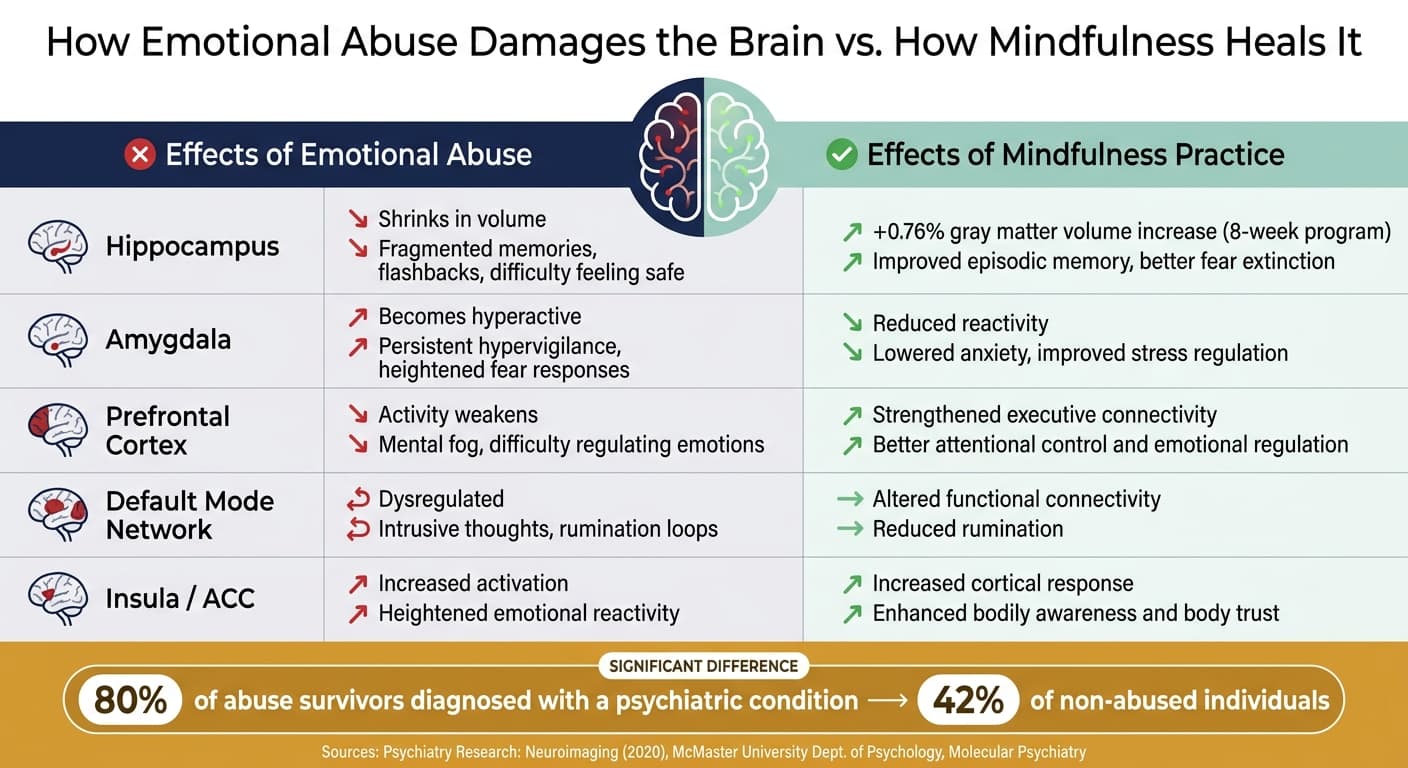
| Brain Region | Effect of Abuse | What Survivors Experience |
|---|---|---|
| Amygdala | Becomes hyperactive | Persistent hypervigilance; heightened fear |
| Hippocampus | Shrinks; function impairs | Fragmented memories; flashbacks; struggle to feel safe |
| Prefrontal Cortex | Activity weakens | Mental fog; difficulty regulating emotions |
| ACC / Insula | Increased activation | Heightened emotional reactivity |
Timing matters, too. Studies show that abuse before age 13 primarily disrupts non-conscious processing, increasing hippocampal activation and affecting automatic threat responses. For abuse during adolescence (ages 13–18), the amygdala becomes more reactive, impacting conscious emotional processing.
"Individuals exposed to abuse before age 13 showed heightened hippocampal activation during non-conscious negative emotion processing compared to non-abused individuals." - Molecular Psychiatry [2]
This means early abuse leaves deep, subconscious imprints, as children lack the tools to fully process their experiences [2].
How These Changes Affect Survivors
These brain changes aren’t just theoretical - they show up in survivors' daily lives. A hyperactive amygdala, combined with a weakened prefrontal cortex, creates a cycle of constant vigilance and emotional dysregulation. Survivors often feel stuck in a loop of fear, unable to relax or manage their emotions effectively [1].
The numbers back this up. In a study of 635 individuals, 80% of abuse survivors were diagnosed with a psychiatric condition, compared to 42% of non-abused participants. Survivors also scored significantly higher on measures of depression (+8.76 points), anxiety (+5.37 points), and stress (+7.43 points) on the DASS scale [2].
Memory issues are another common struggle. Damage to the hippocampus leads to fragmented, intrusive memories that are hard to organize or place in context. This is one reason gaslighting is so harmful - it preys on a brain already struggling to create a clear timeline of events. Elevated cortisol levels further disrupt serotonin and dopamine, making it even harder to feel calm, motivated, or connected to others [1].
"The result is a brain stuck in a loop of fear and hypervigilance, unable to relax or fully process traumatic memories." - ScienceNewsToday [1]
These biological changes aren’t permanent, though. With the right interventions, such as mindfulness practices, survivors can start to restore balance and heal.
What Research Says About Mindfulness and Brain Rewiring
::: @figure
Emerging research highlights that mindfulness doesn't just metaphorically heal the brain - it physically repairs neural structures, reversing the hidden effects of gaslighting and other forms of abuse. This is particularly relevant for individuals dealing with the effects of abuse, as mindfulness has been shown to impact brain tissue and neural connections in measurable ways.
Brain Changes Linked to Mindfulness Practice
A pilot study published in May 2020 in Psychiatry Research: Neuroimaging explored how mindfulness could affect the brain. Conducted by researchers at Massachusetts General Hospital and McLean Hospital, including Diane Joss, PhD, and Sara W. Lazar, PhD, the study followed 43 young adults with a history of childhood maltreatment. After participating in an eight-week mindfulness program, the mindfulness group experienced a 0.76% increase in gray matter volume in the right hippocampus. Meanwhile, the control group - who did not practice mindfulness - showed a 0.78% decrease in hippocampal volume during the same period [3].
"This study suggests mindfulness training has similarly beneficial effects on the hippocampus that are accompanied by clinical improvement." - Massachusetts General Hospital, Psychiatry Advances [3]
This finding is particularly important because the hippocampus plays a critical role in memory, learning, and stress regulation.
Mindfulness also influences other key brain circuits. Research from McMaster University's Department of Psychology has shown that mindfulness-based interventions enhance neuroplasticity across several brain networks, including the Default Mode Network, the Salience Network, and the Central Executive Network [4]. The table below outlines how mindfulness impacts specific brain regions and their functions:
| Brain Region/Network | Effect of Mindfulness | Functional Outcome |
|---|---|---|
| Hippocampus | Increased gray matter volume | Improved episodic memory; better fear extinction [3][4] |
| Amygdala | Reduced reactivity | Lowered anxiety; improved stress regulation [3][4] |
| Prefrontal Cortex | Strengthened executive connectivity | Better attentional control and emotional regulation [4] |
| Default Mode Network | Altered functional connectivity | Reduced rumination [4] |
| Insula | Increased cortical response | Enhanced bodily awareness and "body trusting" [4] |
These changes demonstrate how mindfulness can repair areas of the brain often affected by trauma, offering a pathway to recovery.
Mindfulness Outcomes for Abuse Survivors
The structural brain changes linked to mindfulness also lead to real-world benefits for survivors of abuse. For example, the Massachusetts General Hospital study found that increases in hippocampal volume directly correlated with reductions in depression and stress, as measured by the Perceived Stress Scale and the Beck Depression Inventory [3]. This means that the physical changes in the brain were tied to noticeable improvements in mental health.
Mindfulness also helps survivors transition from reactive to intentional behavior. By fostering non-reactivity to internal experiences, individuals can learn to observe difficult emotions without being overwhelmed. This process aids fear extinction and gradually shifts the brain from automatic reactions to more thoughtful responses [3][5]. This mental shift is a critical component of learning how to respond to gaslighting effectively. These outcomes show how mindfulness can empower survivors to regain control over their emotional and mental well-being.
Mindfulness Practices That Support Trauma Recovery
Understanding how mindfulness reshapes the brain is just the beginning. Various mindfulness techniques have been shown to offer both clinical and everyday benefits for trauma recovery. These practices, whether part of structured programs or simple daily routines, encourage neuroplasticity and help counteract trauma-related changes in the brain.
Structured Mindfulness Programs
One of the most studied approaches is Mindfulness-Based Stress Reduction (MBSR). However, for survivors of trauma, especially abuse, tailoring these programs to their needs is crucial.
A study published in March 2016 examined a Trauma-Informed MBSR (TI-MBSR) program with 45 women who had survived interpersonal violence. Led by Amber Kelly of Quinnipiac University and Eric L. Garland of the University of Utah, the 8-week program demonstrated significant reductions in PTSD and depressive symptoms compared to a control group. The more the participants practiced weekly, the greater their symptom relief [6].
"TI-MBSR appears to be a promising and feasible phase I intervention for female survivors of interpersonal trauma." - Amber Kelly, Quinnipiac University [6]
Another clinical trial, conducted between October 2020 and June 2022 at two state-funded residential treatment centers in Southern California, involved 156 women with PTSD. This modified MBSR program featured 90-minute sessions with meditations limited to 20 minutes - designed to avoid overwhelming participants. Results at the 6-month follow-up showed significant reductions in anxiety (contrast = −3.74) and depression (contrast = −5.65) [7]. Shorter, more frequent sessions proved more effective for trauma survivors than longer, intensive practices.
While structured programs provide a solid foundation, incorporating mindfulness into daily life can also play a key role in healing.
Simple Daily Practices
Daily mindfulness habits offer a practical and accessible way to support trauma recovery. Trauma-informed psychotherapist Alison James suggests a technique called mindful action, which involves bringing non-judgmental awareness to everyday activities like cooking, eating, or washing dishes [9]. This approach can be especially helpful for those who find traditional seated meditation unsettling.
"Mindful action is paying non-judgmental attention to the present moment as it unfolds. It's an attitude and quality of presence that can be brought to any ordinary activity." - Alison James, Trauma-Informed Psychotherapist [9]
Here are a few daily practices that address different aspects of trauma recovery:
- Sensory grounding: When feeling overwhelmed, focusing on the five senses - like the smell of a room, the texture of an object, or background sounds - can help anchor attention in the present moment.
- Mindful movement: Activities like walking or gentle Hatha Yoga help regulate the nervous system without requiring stillness. For those with high physiological arousal, movement-based practices may feel more approachable than breath-focused meditation [7].
- Pleasant/Unpleasant Event Calendar: This simple log, often used in structured MBSR programs, helps survivors track emotional patterns over time. It’s particularly useful for individuals whose perception of reality has been distorted by experiences like gaslighting [7].
These small, consistent practices work alongside structured programs to recalibrate the brain and stabilize emotional responses. By observing and trusting their own perceptions, survivors can gradually rebuild a sense of safety and self-awareness. This process is essential when learning how to deal with gaslighting and reclaiming your autonomy.
How Technology and Mindfulness Work Together for Recovery
Daily mindfulness can help rebuild a sense of internal awareness, but for survivors of gaslighting, trusting this process can be a challenge. That’s where external tools come in - they can provide the support needed to bridge the gap.
Gaslighting Check: A Data-Driven Support Tool

One of the most unsettling effects of gaslighting is what researchers call epistemic incompetence - the feeling that you can’t trust your own understanding of reality. As Willis Klein, a PhD candidate at McGill University, explains, this isn’t accidental:
"This is repeated over and over, until the target has really integrated the idea that they don't actually have a good grasp on reality." - Willis Klein, PhD candidate, McGill University [10]
Klein highlights how gaslighting exploits the brain’s Prediction Error Minimization process, gradually undermining trust in one’s own perceptions [10].
Gaslighting Check was created to tackle this issue head-on. Using real-time emotional manipulation detection, the tool identifies patterns of manipulation in conversations, giving users clear, actionable evidence when they begin to doubt their perceptions. It also provides detailed reports and tracks conversation histories, helping to confirm recurring patterns over time.
"In our model there's not necessarily anything specific about the target of gaslighting that makes them particularly vulnerable to it. In essence, it could happen to anyone, so long as they're trusting the wrong person." - Willis Klein, PhD candidate, McGill University [10]
This type of objective insight can be a game-changer, helping survivors begin to rebuild trust in their own reality. From there, mindfulness can take over to refine internal responses and rebuild cognitive clarity.
How Mindfulness Builds Cognitive Clarity
While AI tools like Gaslighting Check provide external validation, mindfulness helps survivors process these insights in a calm and constructive way. External tools may confirm manipulation, but mindfulness ensures survivors can face these truths without falling into self-blame. As Emily Nauman, a research assistant at the Greater Good Science Center, explains:
"This non-judgmental, non-reactive approach can help people identify thoughts and emotions with more clarity and objectivity, rather than automatically suppressing or becoming caught up in them." - Emily Nauman, GGSC research assistant [8]
For example, even when a tool flags a manipulative pattern in a conversation, survivors might still feel fear or self-doubt. Mindfulness techniques - like focusing on the breath or doing a body scan - can help calm the body’s threat response, allowing the prefrontal cortex to engage and process the situation effectively [11].
Conclusion: Using Mindfulness to Heal After Abuse
Emotional abuse and gaslighting can lead to noticeable changes in the brain, but thanks to neuroplasticity - the brain's ability to rewire itself in response to positive experiences - recovery is entirely possible.
Practicing mindfulness regularly helps strengthen the prefrontal cortex, reduce cortisol levels, and increase serotonin and GABA. These changes shift the nervous system from a heightened state of survival to a calmer, more balanced state. As Andrea Calderone from the Department of Clinical and Experimental Medicine explains:
"The non-judgmental awareness of internal experiences brings about a balanced state of mind and, thus, better mental health." [12]
This internal reset lays the groundwork for survivors to also benefit from external validation and support.
For those recovering from gaslighting, healing often involves both internal and external efforts. Mindfulness helps rebuild self-trust and emotional regulation internally, while tools like Gaslighting Check provide external support. By analyzing conversations, such tools offer survivors clear, data-based insights to validate their experiences, cutting through the doubt and confusion that gaslighting creates.
Together, mindfulness and external resources like Gaslighting Check help restore cognitive clarity and rebuild confidence in one's perceptions.
FAQs
How long does it take mindfulness to change the brain after abuse?
Mindfulness practice can start to show healing effects in as little as six weeks. Research indicates that during this period, the brain may undergo noticeable changes, like an increase in hippocampal volume. The key to unlocking these benefits lies in maintaining a consistent practice, which also supports lasting healing over time.
What mindfulness practice is safest if meditation triggers me?
If meditation feels overwhelming, consider mindfulness practices that center on external anchors instead. Activities like mindful movement - such as yoga or stretching - or grounding exercises can provide a gentler approach. Steer clear of techniques like body scans or breath-focused meditation, as these might lead to discomfort for some individuals.
How can I use Gaslighting Check with mindfulness to rebuild self-trust?
You can pair Gaslighting Check with mindfulness practices to begin rebuilding self-trust. By analyzing conversations and identifying gaslighting tactics, you gain clarity on manipulation patterns. From there, mindfulness techniques - like grounding exercises or meditation - can help soothe your nervous system and ease feelings of hypervigilance.
This method allows you to validate your emotions, sharpen your awareness of manipulation, and slowly regain confidence in your own perceptions. Adding self-compassion and prioritizing rest can further nurture emotional recovery and strengthen resilience.