Historical Context vs. Real-Time Analysis in Detection

Historical Context vs. Real-Time Analysis in Detection
Gaslighting and emotional manipulation can have long-lasting effects, but AI tools are stepping up to help identify these harmful behaviors. By analyzing communication, two methods are proving useful: Historical Context Modeling and Real-Time Analysis.
- Historical Context Modeling looks at long-term patterns in communication to identify recurring manipulation tactics, like repeated denial or emotional invalidation. It’s ideal for building detailed documentation over time.
- Real-Time Analysis focuses on immediate feedback, flagging manipulative language or tone during live interactions. It helps users recognize and address harmful dynamics as they happen.
Both methods have strengths and limitations. Historical modeling excels at spotting trends over time but requires large amounts of data and delayed insights. Real-time analysis works instantly but may miss broader patterns or context.
The best approach combines both methods. Tools like Gaslighting Check use this hybrid strategy, offering immediate alerts while tracking long-term trends. This empowers users to recognize manipulation, set boundaries, and make informed decisions - all while prioritizing privacy.
Key Takeaways:
- Historical Context Modeling: Tracks long-term manipulation patterns for validation and documentation.
- Real-Time Analysis: Provides instant feedback for immediate action in live situations.
- Hybrid Approach: Combines both for a balanced and effective detection system.
Gaslighting Check and similar platforms aim to reduce the time people spend in manipulative relationships by offering objective insights and tools to regain control.
1. Historical Context Modeling
Unlike real-time methods, historical context modeling focuses on tracking how manipulation evolves over extended periods.
Time Horizon
This approach examines communication over weeks, months, or even years, diving into past interactions to uncover recurring tactics and long-term patterns of manipulation. Instead of zeroing in on immediate conversations, it reviews stored messages, emails, and recorded calls to understand how manipulation tactics might have developed or intensified over time. This retrospective view creates a strong basis for identifying manipulation trends with precision.
Detection Capabilities
The real power of historical analysis lies in its ability to recognize patterns. Take, for example, a seemingly innocent comment like, "You're being too sensitive." On its own, it might not raise alarms. But when this phrase pops up repeatedly over six months, it paints a picture of systematic emotional invalidation. By comparing conversations across a timeline, this method differentiates isolated disagreements from ongoing, calculated manipulation. Tools like Gaslighting Check leverage this approach to create detailed reports that highlight cumulative trends, such as escalating instances of minimization or reality distortion. These reports provide users with concrete, objective evidence of manipulation patterns - a critical tool for validation. Of course, safeguarding this data is just as important as detecting these patterns.
Data and Privacy
Historical context modeling depends on stored transcripts, recordings, and metadata that are protected with strong encryption. Unlike real-time monitoring, which continuously tracks live conversations, this method processes batches of data that users have already collected and explicitly consented to share. This approach reduces the strain on live resources while requiring secure storage systems to handle large datasets that can accumulate over time. Platforms like Gaslighting Check put users in control, letting them decide how long their data is stored.
Use Cases
This method shines in areas like therapy, counseling, and legal documentation, where long-term communication trends help validate and document manipulation tactics. It’s especially valuable for individuals who sense something is wrong but struggle to articulate exactly what. Detailed reports generated from historical analysis can be shared with therapists, HR departments, or legal teams, providing a solid foundation for evidence-based discussions. Whether it’s workplace dynamics stretching over years, family relationships rooted in longstanding patterns, or romantic partnerships with gradually intensifying toxic behaviors, this approach offers clear documentation that empowers informed decisions.
2. Real-Time Analysis
Real-time analysis focuses on processing conversations as they happen - whether it’s a phone call, a text exchange, or an in-person discussion. The goal? To identify and flag manipulative behavior within seconds, giving you the chance to recognize and address it immediately.
Time Horizon
These systems work fast, analyzing live audio, voice calls, text messages, or chat streams within seconds. This speed is crucial because it allows you to gain awareness during the interaction, not after. For example, if someone says, "You're being too sensitive" or "That never happened", a real-time tool can alert you right then, helping you spot the tactic before it takes hold. In everyday communication - whether through SMS, WhatsApp, FaceTime, Zoom, or workplace chats - a response time of just 5–10 seconds can make all the difference. This immediacy supports quick boundary-setting and enables automated detection of verbal and tonal cues as they emerge.
Detection Capabilities
Real-time systems are designed to spot manipulation as it unfolds. They flag gaslighting patterns like repeated denials ("I never said that"), contradictions, or phrases meant to make you doubt your memory. They also pick up on coercive control through statements like "If you loved me, you’d..." or subtle threats and monitoring language. Guilt-tripping and shaming often appear in comments that twist healthy boundaries into selfishness, such as, "You only think about yourself."
When it comes to voice conversations, these tools analyze sudden changes in loudness, harsh tones, or faster speech, especially when paired with negative or aggressive words. Technically, this involves real-time language analysis for text, which evaluates intent, toxicity, and manipulation message by message, and streaming speech analysis for voice, which tracks vocal tone and provides live transcription. Tools like Gaslighting Check apply these methods to both text and audio, flagging manipulation as it happens and logging key moments for later review. This is particularly useful for building a broader understanding of patterns while still offering immediate insight.
However, there’s a trade-off: limited context. Real-time systems only analyze the current or recent exchanges, which means they might miss bigger patterns, like a months-long cycle of manipulation. A single harsh comment could be flagged as manipulative, even if it’s just a one-time conflict. Similarly, without deeper context, sarcasm, inside jokes, or neurodivergent communication styles might be misinterpreted, while subtle but systematic undermining might go unnoticed. Issues like background noise, overlapping speech, or poor connections can also reduce transcription accuracy, which affects detection.
Data and Privacy
Real-time detection tools analyze text (messages, emails, chat logs), audio (raw recordings or voice characteristics combined with speech-to-text), and metadata (timestamps, session details, and sometimes device identifiers). To align with U.S. privacy expectations, these systems often run on-device, ensuring that raw audio stays on your phone. Any data sent to servers is encrypted both in transit and at rest, and data minimization principles are applied - only necessary information (like short-term transcripts or extracted features) is stored, avoiding full raw audio or personal identifiers. Tools like Gaslighting Check also prioritize encrypted storage and automatic deletion of sensitive data, which is particularly important for users in abusive situations. This approach balances real-time functionality with privacy protection.
Note: Always be mindful of U.S. consent laws when recording conversations.
Use Cases
Real-time detection tools are particularly helpful in live interactions, offering immediate insights to help you pause, reset, or seek support. Here are some examples:
- Live calls and video conferences: On-screen alerts or post-call summaries can highlight gaslighting, blame-shifting, or intimidation, allowing you to challenge harmful narratives in the moment.
- Text and chat interactions: Real-time flags for manipulative statements give you time to pause and reconsider how to respond.
- High-stakes meetings: Whether it’s a performance review, negotiation, mediation, or custody exchange, consistent monitoring can help you maintain boundaries and take breaks when escalation is detected.
- Therapeutic or coaching sessions: Tools like Gaslighting Check can provide near-real-time summaries for counselors or coaches, helping clients quickly identify patterns and develop safety strategies.
The common thread across all these scenarios? These tools interrupt harmful dynamics as they happen, empowering users to take action in the moment rather than only reflecting on it afterward.
Detect Manipulation in Conversations
Use AI-powered tools to analyze text and audio for gaslighting and manipulation patterns. Gain clarity, actionable insights, and support to navigate challenging relationships.
Start Analyzing NowStrengths and Weaknesses
::: @figure
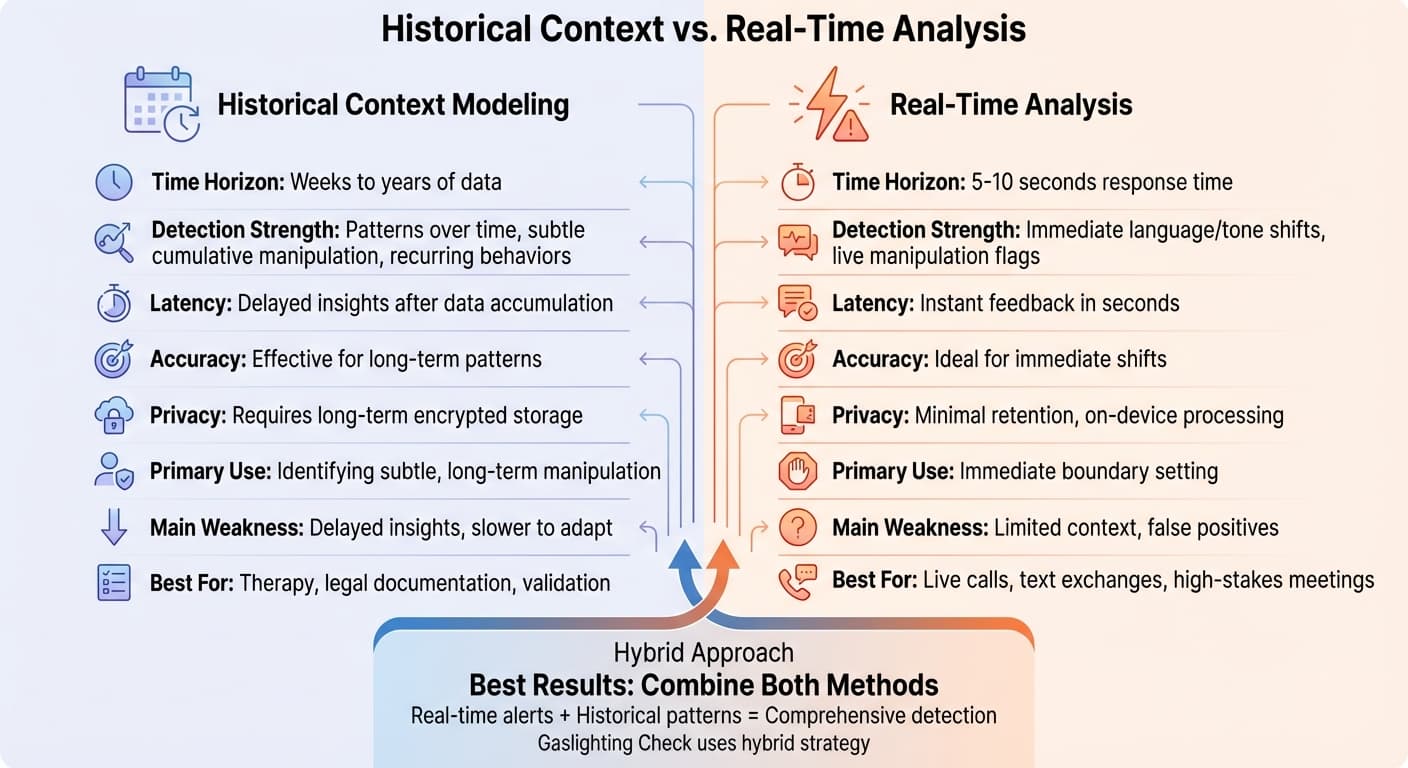
Both approaches bring distinct benefits and challenges. Knowing where each method excels - and where it struggles - can help you decide which tool fits your needs best.
Historical Context Modeling is particularly strong at recognizing patterns over time. It can identify recurring behaviors, such as repeated denial of past statements, cycles of love-bombing followed by devaluation, or gradual isolation that unfolds over weeks or months. This long-term view makes it effective at spotting subtle, cumulative manipulation that might seem insignificant in isolated instances but becomes clear when viewed as part of a larger pattern. However, this approach requires a lot of data to be effective, meaning insights often come too late - after potential harm has already occurred. It also demands extensive data storage, like full chat logs, call transcripts, and metadata, which can increase storage costs and raise privacy concerns, especially if you're uneasy about long-term data retention. Additionally, historical models can struggle to adapt quickly to new or sudden behavioral changes, leaving gaps in detection.
Real-Time Analysis, on the other hand, provides instant feedback, flagging manipulative language or tone within seconds. This immediacy is crucial for situational safety, allowing you to set boundaries during live interactions. However, because it focuses on a shorter time frame, it can lack the broader context needed to differentiate between isolated incidents and true manipulation. This can lead to false positives, such as flagging a single harsh comment during a normal argument. Gradual patterns, like slow isolation, are often missed. Real-time systems also require low-latency processing and a stable connection, making them more resource-intensive.
| Aspect | Historical Context Modeling | Real-Time Analysis |
|---|---|---|
| Latency | Insights emerge after data is accumulated | Provides feedback in seconds |
| Detection Accuracy | Effective for long-term patterns | Ideal for immediate language and tone shifts |
| Privacy Concerns | Requires long-term data storage with encryption | Minimal data retention, often processed on-device |
| Primary Use Case | Identifying subtle, long-term manipulation | Immediate boundary setting in live situations |
| Main Weakness | Delayed insights; slower to adapt to new tactics | Limited context; higher risk of false positives |
By comparing these methods, it’s clear that blending the two can create a more balanced and effective detection system. A hybrid approach, like Gaslighting Check, combines real-time alerts with historical data. This ensures warnings are triggered only when behavior deviates significantly from established patterns. Such a system offers immediate support during live interactions while also providing the long-term clarity needed for recovery, therapy, or legal documentation. Importantly, it can do so while safeguarding privacy through encrypted storage and automatic data deletion.
"When you can recognize manipulation tactics in real-time, you regain your power and can begin to trust your own experiences again." - Stephanie A. Sarkis, Ph.D., Author of "Healing from Toxic Relationships" [1]
Conclusion
Historical context modeling and real-time analysis each bring unique strengths to the table when it comes to identifying manipulation. Historical modeling shines in uncovering long-term trends, such as repeated cycles of blame-shifting or fluctuating narratives of flattery and criticism. On the other hand, real-time analysis acts as a radar for spotting manipulative language or sudden tone changes as they happen, offering immediate insights when conversations take an unexpected turn.
Neither method works perfectly on its own. Real-time analysis can sometimes magnify isolated incidents without the larger historical perspective, while historical modeling might miss urgent red flags that require quick action.
This is where platforms like Gaslighting Check demonstrate the power of a hybrid approach. By combining real-time features - like audio recording, voice and text analysis - with tools for tracking and analyzing conversation history, it offers a comprehensive solution. Live inputs are analyzed on the spot, while encrypted histories allow for pattern recognition over time. Importantly, user privacy is prioritized with encrypted storage and automatic deletion policies.
The most effective strategy blends both methods. Historical context helps map out broader patterns in relationships, while real-time analysis provides immediate support during tense or manipulative interactions. Together, these tools help create a fuller picture, empowering users to recognize manipulation more effectively.
That said, these tools are meant to assist - not replace - your judgment. Your personal experiences and instincts remain essential. Tools like these are designed to complement your boundaries and, when necessary, professional guidance.
FAQs
How does using both historical context and real-time analysis improve the detection of emotional manipulation?
Combining historical context with real-time analysis offers a well-rounded perspective on emotional manipulation. Historical context sheds light on recurring patterns and strategies that have been used over time, while real-time analysis focuses on identifying immediate behaviors and subtle cues as they unfold.
By integrating these methods, it's easier to spot manipulation early and evaluate it more precisely, ensuring that even the most subtle or prolonged tactics are recognized.
How does Gaslighting Check protect my privacy when detecting emotional manipulation?
Gaslighting Check puts user privacy front and center. Your data is safeguarded with end-to-end encryption, ensuring it's secure both while being transmitted and when stored. After the analysis is done, your data is automatically erased - unless you decide to save it.
The platform guarantees that your information stays private and is never shared with third parties. This secure and confidential approach creates a safe space for users to detect and address emotional manipulation without worry.
How does real-time analysis help detect emotional manipulation?
Real-time analysis offers a dynamic way to spot emotional manipulation as it happens. By examining patterns, tone, and emotional signals during conversations, it delivers instant feedback, helping people identify subtle tactics like gaslighting before they escalate.
This real-time awareness empowers individuals to respond effectively in the moment, building stronger self-awareness and emotional strength during difficult interactions.