Gaslighting Recovery in Multicultural Relationships

Gaslighting Recovery in Multicultural Relationships
Gaslighting is a form of emotional abuse where someone manipulates you into doubting your own reality. In multicultural relationships, this can become even more damaging when it targets cultural identity, traditions, or language. This behavior, often dismissed as misunderstandings, can lead to confusion, anxiety, and isolation. Here's what you need to know:
- What gaslighting looks like: Denying reality, trivializing emotions, or shifting blame. In these relationships, it may involve dismissing customs, labeling traditions as "weird", or exploiting stereotypes.
- The effects of gaslighting: Victims may feel disconnected from their identity, face physical symptoms like insomnia or fatigue, and struggle with self-doubt.
- Steps to recover: Reconnect with your identity, seek culturally informed therapy, and set clear boundaries and respond effectively. Tools like Gaslighting Check can help track patterns of manipulation and provide clarity.
Gaslighting is harmful, but recognizing the signs and taking action can help you regain confidence and protect your well-being.
Recognizing Gaslighting in Multicultural Relationships
Common Signs of Gaslighting Across Cultures
Gaslighting often follows familiar patterns, such as denying reality (“I never said that”), trivializing emotions (“You’re too sensitive” or “dramatic”), shifting blame, or stonewalling. In multicultural relationships, these tactics can take a more targeted form, directly attacking cultural identity. For instance, traditions like lighting candles for ancestors might be dismissed as “weird” or “irrational” [2]. Similarly, cultural practices like calling parents daily or supporting extended family could be unfairly labeled as “unhealthy” or “less evolved” behaviors [2].
The stress caused by gaslighting isn’t just emotional - it can manifest physically. Chronic exposure may lead to headaches, insomnia, fatigue, or even a weakened immune system [6]. If you find yourself feeling confused, attacked, or as if you’re “losing your mind” during disagreements, it’s often a sign that the conversation has shifted from a healthy exchange to a power struggle [1].
On top of these general tactics, manipulators may also exploit harmful cultural stereotypes to discredit and invalidate their partner’s experiences.
How Cultural Stereotypes Are Used in Gaslighting
In multicultural relationships, cultural stereotypes can become tools for manipulation. These stereotypes aren’t just used to dismiss feelings - they’re often weaponized to undermine someone’s entire identity. A manipulative partner might suggest you’re “academically inferior” or “untrustworthy” based on your background [3][4]. Gender and racial stereotypes are also common tools: women might be labeled “hysterical” or “irrational,” while anger from a person of color can be dismissed as a personal flaw rather than a justified response to injustice [7][5][8].
Robin Stern, Ph.D., highlights the mindset behind such behavior:
“The gaslighter may genuinely believe that they are saving you from yourself but they are driven by their own needs to seem like a strong, powerful person - they must prove they are right, and you must agree” [1].
When you call out bias, the gaslighter might escalate the situation by labeling you as “aggressive” or “too sensitive,” shifting the blame for the conflict onto you [3]. Research supports the damaging effects of these tactics: a 2020 study of 3,320 Black Americans found that experiencing racial microaggressions - subtle forms of gaslighting - was linked to lower happiness and reduced job satisfaction [9].
These dynamics can become even more complicated when language and communication barriers come into play.
Language and Communication Differences
Language barriers add another layer of complexity to gaslighting. Victims may find themselves simplifying or “shrinking” their stories, leaving out the cultural or spiritual nuances that make their experiences meaningful, just to make them easier for their partner to understand [2]. This oversimplification can make it easier for the partner to dismiss the story as irrelevant or unimportant.
Manipulators may also use language differences as a way to avoid accountability, claiming that you “misunderstood” or are “putting words in their mouth” [4]. These tactics can leave you questioning your own perceptions and experiences.
It’s important not to dilute your cultural identity to fit into someone else’s narrative. Take time to reflect on your identity without editing out the parts that matter to you [2]. If language barriers make it hard to articulate what’s happening, pay attention to feelings of confusion or anxiety - they’re often red flags [2][9]. Keeping a written record of incidents can also help you stay grounded, especially when a partner tries to claim you “misremembered” or “misunderstood” [9]. Assertive statements and clear documentation can be powerful tools for reclaiming your reality.
Detect Manipulation in Conversations
Use AI-powered tools to analyze text and audio for gaslighting and manipulation patterns. Gain clarity, actionable insights, and support to navigate challenging relationships.
Start Analyzing NowA Roadmap to Healing from Gaslighting and Trusting Yourself Again
Steps to Recover from Gaslighting in Multicultural Relationships
::: @figure
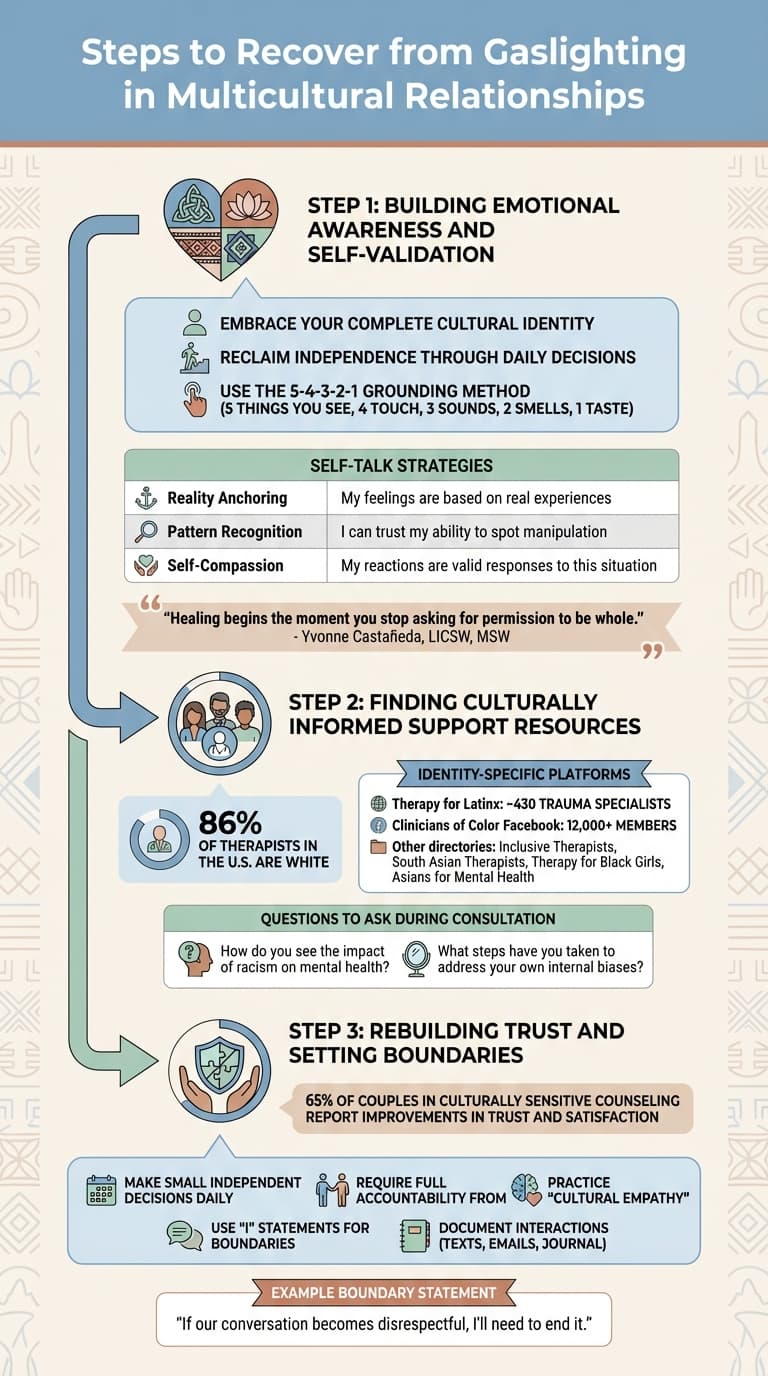
Building Emotional Awareness and Self-Validation
Recovering from gaslighting begins with learning to trust your own perceptions again. It's common to feel uncertain about your emotions or memories after experiencing manipulation. A crucial first step is embracing your complete cultural identity. Pay attention to moments when you downplay your background or omit important cultural details that are meaningful to you.
Yvonne Castañeda, LICSW, MSW at Boston College School of Social Work, puts it beautifully:
"Healing begins the moment you stop asking for permission to be whole. It begins when you remember that your story doesn't need to be simplified to be sacred." [2]
Take time to honor the cultural values and traditions that resonate with you. Reclaim your independence through small daily decisions - like choosing what to eat or how to spend your free time. When anxiety creeps in, try the 5-4-3-2-1 grounding method: identify five things you can see, four things you can touch, three sounds, two smells, and one taste. This technique can help anchor you in the present.
Here’s a quick look at how self-talk can help rebuild confidence:
| Self-Talk Strategy | Goal | Example Phrase |
|---|---|---|
| Reality Anchoring | Focus on facts | "My feelings are based on real experiences." |
| Pattern Recognition | Spot concerning behavior | "I can trust my ability to spot manipulation." |
| Self-Compassion | Build resilience | "My reactions are valid responses to this situation." |
Once you’ve reconnected with yourself, the next step is finding support that respects and understands your cultural background.
Finding Culturally Informed Support Resources
The right therapist can make all the difference, especially one who understands how culture influences your experiences. However, in the United States, about 86% of therapists are white [12], which highlights the importance of seeking culturally informed care.
Instead of relying on general search engines, explore identity-specific platforms. For example:
- Therapy for Latinx: Nearly 430 trauma specialists across the U.S. [12]
- Clinicians of Color Facebook group: Over 12,000 members [11]
- Other directories: Inclusive Therapists, South Asian Therapists, Therapy for Black Girls, and Asians for Mental Health [10][12]
Dr. Jenny Wang, a clinical psychologist, points out:
"If you are a person of color and your therapist does not understand or acknowledge the impact of racism on your mental health, this may become a barrier in their work with you." [10]
During a consultation (typically under 20 minutes), ask direct questions like:
- "How do you see the impact of racism on mental health?"
- "What steps have you taken to address your own internal biases?" [10][12]
A culturally competent therapist should make you feel comfortable discussing your identity without resorting to stereotypes. They should also be open to exploring how your cultural background intersects with the effects of gaslighting. While shared heritage isn’t necessary, the therapist’s ability to build trust and respect your experiences is crucial [13]. Don’t forget to confirm their licensing status through your state’s behavioral health board [10]. Many therapists also accept insurance or provide superbills for partial reimbursement if they’re out-of-network [10].
Rebuilding Trust and Setting Boundaries
Once you’ve reclaimed your identity and found culturally informed support, the next challenge is rebuilding trust - starting with yourself. Gaslighting often disrupts your sense of direction, so begin by making small independent decisions. Whether it’s choosing your outfit, deciding when to exercise, or calling a friend, these choices help rebuild confidence in your judgment.
If you’re staying in the relationship, accountability is non-negotiable. The person who gaslighted you must take full responsibility without excuses. Research shows that 65% of couples who engage in culturally sensitive counseling report improvements in trust and satisfaction [14], but only when both partners are committed to change.
In multicultural relationships, trust-building may require "cultural empathy." This means respecting your partner’s traditions without dismissing them as outdated or irrelevant. For instance, you might say, "I’ve been reflecting on what parts of my heritage I want to preserve. You don’t have to fully understand, but I need you to respect how important this is to me."
Setting boundaries is another key part of recovery. Use "I" statements to clearly express your needs, such as:
- "I feel overwhelmed when you call during work hours."
- "If our conversation becomes disrespectful, I’ll need to end it."
Documenting interactions - through texts, emails, or even journaling - can also help you stay grounded when self-doubt arises. This practice creates a record to counter any attempts to distort reality. Additionally, individual therapy can help both partners address personal trauma or triggers that may add to the challenges of gaslighting.
With these steps in place, you’ll be better equipped to recognize manipulation and protect your emotional well-being moving forward.
How Gaslighting Check Can Support Your Recovery

Recovering from manipulation in multicultural relationships requires self-awareness and effective tools. Gaslighting Check offers real-time analysis and documentation to help you tell the difference between genuine cultural misunderstandings and intentional manipulation. It complements earlier recovery steps by providing objective insights.
Using Real-Time Analysis to Detect Manipulation
In multicultural relationships, it’s easy to second-guess yourself. Is your partner unfamiliar with your traditions, or are they using cultural differences to manipulate you? Gaslighting Check helps by offering real-time audio recording and text analysis, identifying tactics like blame-shifting, deflection, and DARVO (Deny, Attack, and Reverse Victim and Offender).
The platform also analyzes text from emails or messages, giving you an objective perspective to differentiate facts from manipulation. It highlights tactics like "countering", where someone questions your memory of events, making you doubt yourself.
Tracking isolated incidents is helpful, but spotting long-term patterns is even more critical for understanding manipulation.
Understanding Patterns Through Detailed Reports
While single incidents may seem insignificant, patterns often tell a deeper story. Gaslighting Check’s detailed reports focus on recurring themes and behavioral shifts over time. This is especially useful in multicultural contexts, where manipulation might be disguised as cultural differences. Research even links gaslighting to emotional abuse (r = 0.49) and reduced mental well-being (r = -0.15) [15], emphasizing the importance of recognizing these patterns.
The platform’s conversation history tracking, available with the Premium Plan for $9.99/month, helps you identify triggers behind manipulative cycles. Common topics like family roles, money, religious practices, or cultural traditions often come up - what some experts call the "Gaslight Tango." By documenting exact phrases, dates, and contexts, you can uncover whether certain behaviors intensify as you assert boundaries or grow more confident.
These reports are also incredibly useful in therapy. Culturally aware therapists often prefer reviewing concrete examples rather than relying on memory alone, especially since gaslighting can make you doubt your own recollections. With Gaslighting Check, you can export secure, timestamped PDFs that provide clarity and counter the confusion gaslighting creates.
Privacy and Data Security Features
While detailed reports help you recognize patterns, keeping your information private is equally important. Gaslighting Check uses end-to-end encryption to ensure your data stays secure. Automatic data deletion policies further reduce the risk of unauthorized access.
This focus on privacy is especially important in multicultural relationships, where factors like family expectations, immigration concerns, or the stigma around mental health can complicate recovery. With control over your data and secure documentation, you can focus on healing, knowing your personal information is safe.
Conclusion: Moving Forward with Awareness and Action
Recognizing the behavior is the first step to breaking the cycle of self-blame. Identifying patterns like "cultural gaslighting" - when your traditions, faith, or family ties are dismissed - can help shift the focus away from self-doubt [2][17]. Trauma-informed therapist Amelia Kelley, Ph.D., emphasizes:
"The most effective way to stop gaslighting is with a clear and decisive response to it." [16]
Reconnecting with your heritage and values can serve as a powerful source of strength. When navigating these conversations, consider saying something like:
"I've been thinking about where I come from... it's okay if you don't fully get it, but I need you to respect that it matters to me." [2]
Your story is valid, just as it is.
Self-awareness plays a key role in identifying triggers - whether they stem from family expectations, finances, or traditions - that perpetuate harmful cycles [1]. Studies indicate that survivors often attempt to leave an abusive relationship 5 to 10 times before successfully breaking free [18]. Keeping a record of your experiences can help ground you in your reality. Tools like Gaslighting Check provide support through real-time analysis, detailed reports, and secure tracking, all protected by end-to-end encryption. The Premium Plan, priced at $9.99/month, offers these features to aid your recovery. As Yvonne Castañeda, LICSW, MSW, wisely says:
"Healing begins the moment you stop asking for permission to be whole." [2]
FAQs
How can I tell cultural confusion from cultural gaslighting?
Cultural confusion often arises from unintentional misunderstandings or differences in norms, beliefs, or communication styles. There’s no harmful intent - just a gap in understanding. Cultural gaslighting, on the other hand, is deliberate. It involves someone actively dismissing or invalidating your cultural experiences to make you question your reality.
To tell the difference, consider this: Is the person simply misunderstanding, or are they consistently denying or twisting your perspective, even after you’ve explained it? Recognizing this distinction is key to safeguarding your emotional well-being and addressing the situation appropriately.
What should I do if my partner blames 'miscommunication' or language barriers?
When your partner attributes issues to "miscommunication" or language barriers, it’s worth reflecting on whether this might be downplaying your emotions. These explanations, while sometimes valid, can occasionally sideline your feelings and impact your emotional health. It's essential to speak up assertively, share how this behavior affects you, and stress the importance of mutual respect in your relationship.
If your concerns continue to be brushed aside, consider reaching out to a therapist who specializes in multicultural relationships. Additionally, resources like Gaslighting Check can provide helpful insights to recognize patterns of emotional manipulation, ensuring clarity and emotional safety.
When is it time to leave instead of trying to rebuild trust?
It’s time to step away when a relationship stops being healthy - particularly if manipulation is present, emotional pain persists, or your gut tells you the situation isn’t safe. Learning to trust yourself and putting your well-being first is key. Pay attention if attempts to rebuild trust aren’t mutual or if staying continues to hurt you.