
Top 5 Gaslighting Patterns in Relationships
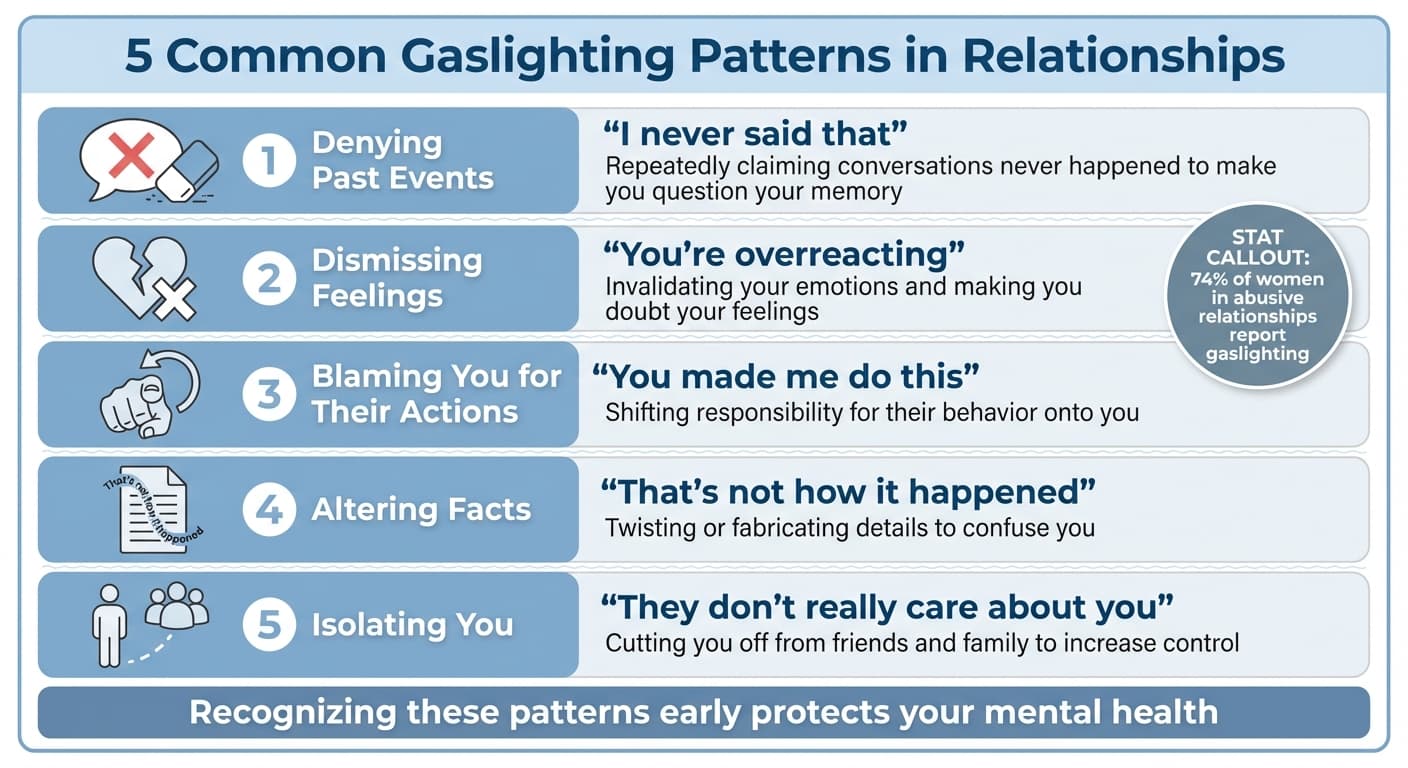
Gaslighting is a manipulative behavior that distorts your sense of reality, often leaving you doubting your experiences and emotions. This article identifies five common gaslighting tactics in relationships, helping you spot and address them:
- Denying Past Events: Repeatedly claiming conversations or agreements never happened to make you question your memory.
- Dismissing Feelings: Invalidating your emotions with phrases like "You're overreacting" or "You're too sensitive."
- Blaming You for Their Actions: Shifting responsibility for their behavior onto you, such as saying, "You made me do this."
- Altering Facts: Twisting or fabricating details to confuse you and make you doubt your reality.
- Isolating You: Cutting you off from friends and family to increase dependence and control.
If these behaviors feel familiar, keep records of interactions, talk to trusted people, and set boundaries. Tools like Gaslighting Check can also help identify these patterns by analyzing conversations and providing objective insights, starting at $9.99/month.
Recognizing gaslighting early is critical to protecting your mental health and reclaiming trust in your own experiences.
::: @figure
Gaslighting in an Intimate Relationship (examples) and How to Address It
1. Denying Past Events and Conversations
This behavior shows up when a partner outright denies that certain conversations or events ever happened. Common phrases include, "I never said that", "You're making that up", or "That never happened." For example, let’s say you remind your partner that they agreed to attend a family dinner. They might respond with, "I never agreed to that; you always remember things wrong", even though you’re confident the discussion took place.
The key difference between normal forgetfulness and gaslighting lies in the pattern and tone. Forgetting something occasionally is human and often comes with accountability, like saying, "I’m so sorry, I forgot - let’s fix this." Gaslighting, on the other hand, involves repeated, defensive denials that leave you questioning your own memory. If you often leave conversations feeling confused, doubting yourself, or apologizing for things you didn’t do, it’s a warning sign. This tactic sets the groundwork for deeper control and manipulation.
Over time, this repeated denial can chip away at your confidence in your own memory and judgment. It can make you second-guess yourself to the point where you start relying on your partner’s version of events instead of your own.
To protect yourself, consider practical steps to confirm your recollections. Keep a journal with dates and details of conversations, save texts and emails, and talk to trusted friends, family, or a therapist for perspective. Having these records can reinforce your confidence and help counteract manipulative behavior.
Often, early warning signs of this gaslighting tactic are easy to dismiss. A partner might occasionally say things like, "You’re remembering that wrong", or "I never said that", during moments that feel important to you. If these instances are brushed off as "not a big deal" and you find yourself apologizing repeatedly for what you thought was a misunderstanding, it could be an early indicator of a pattern of denial-based gaslighting.
2. Dismissing Your Feelings and Emotions
Have you ever voiced your hurt, frustration, or concerns in a relationship, only to be met with responses like, "You're being too sensitive" or "You're overreacting"? These phrases are classic examples of emotional dismissal - a tactic that makes you question the validity of your own feelings, leaving you doubting whether your emotions are justified.
In healthy disagreements, a partner might say something like, "I see it differently, but I understand why you're upset." This acknowledges your feelings while expressing a different perspective. Emotional dismissal, on the other hand, goes beyond a simple difference of opinion. It invalidates your emotions entirely, framing them as irrational or exaggerated. Common phrases include, "That's not a big deal, you're too dramatic", "You're imagining things again", or even, "No one else would put up with you." These dismissive comments often pave the way for deeper manipulation.
Here’s a relatable example: Imagine you're upset because your partner has canceled plans for the third time this month. When you express your frustration, they respond with, "You're overreacting - it's just work, you're too sensitive." Instead of addressing your concern, they deflect and make it about your supposed flaws. This tactic shifts the focus away from their behavior, making you doubt your own feelings. Research reveals that 74% of women in abusive adult relationships report experiencing gaslighting [2].
Over time, this kind of behavior chips away at your self-confidence. You might begin to second-guess your emotions and stop voicing your hurt altogether, fearing labels like "dramatic" or "crazy." That’s often the gaslighter’s goal - to control the narrative, making themselves the sole authority on what’s "reasonable" while dismissing your emotions as invalid or misguided.
The difference between normal conflicts and gaslighting lies in the pattern and intent. Occasional misunderstandings happen in any relationship. But if you consistently hear phrases like "You're too sensitive" whenever you express your feelings or try to set boundaries, it’s a clear warning sign that something deeper is at play.
3. Blaming You for Their Actions
When your partner cheats, lies, or lashes out and then says things like "You made me do this" or "This is all your fault", you're seeing a classic gaslighting tactic called blame shifting. Instead of taking responsibility for their actions, they turn it around on you, making you feel at fault. Statements like "If you hadn't done X, I wouldn't have done Y" or "You're the reason I acted this way" are designed to keep you on the defensive, distracting from their behavior and focusing on what they claim are your flaws.
Blame shifting is a common way gaslighters avoid accountability while manipulating your perception of reality.
Here’s how it often unfolds: Imagine your partner lies about where they were last night. When you confront them, they retort with, "If you trusted me more, I wouldn’t have to lie." Suddenly, the issue isn’t their dishonesty - it’s your supposed lack of trust. Or picture a heated argument where they yell or throw something, only to later say, "You pushed me too far; you provoked me, so you deserved it." The blame lands squarely on you, diverting attention from their outburst.
Over time, this behavior chips away at your self-esteem and fills you with guilt. You might find yourself questioning every disagreement, wondering if you’re truly the one at fault. That’s exactly what the gaslighter wants: for you to believe you’re the root of every problem in the relationship. This deepens your emotional dependence on them and makes it harder to break free. Unlike healthy relationships, where both people take responsibility for their actions, gaslighting relies on denial and projection to avoid accountability.
If phrases like "You made me…" or "If you had just…" come up frequently, it’s likely part of a pattern, not just a one-off reaction. Keep in mind: their harmful actions are their responsibility, even if boundaries were set or mistakes were made. Writing down conversations can help you untangle the confusion and self-doubt that blame shifting creates. Talking with a trusted friend or therapist can also provide clarity. Spotting this behavior is key, as it lays the groundwork for the strategies covered in the next section.
Detect Manipulation in Conversations
Use AI-powered tools to analyze text and audio for gaslighting and manipulation patterns. Gain clarity, actionable insights, and support to navigate challenging relationships.
Start Analyzing Now4. Changing Facts and Lying About Details
After denying and dismissing your reality, some gaslighters take things a step further by deliberately altering facts. When your partner twists the truth or outright fabricates details, it can leave you feeling confused and questioning your own memory. This isn’t just about denying an event happened - it’s about creating a false version of events to make you doubt yourself. You might hear things like, "That’s not how it happened", or "I never said that, you must be mistaken" [1].
This tactic often shows up in everyday interactions. Imagine your partner says something hurtful during an argument, but later insists, "I never said that; you’re imagining things", even though you clearly recall the exchange. Or they might twist the situation by claiming, "You’re always bringing this up; I thought we resolved it", or pretending, "I don’t remember saying that; maybe it was someone else." These statements can make you second-guess your own recollection. This method of distorting reality works hand in hand with other gaslighting behaviors, like denying or dismissing your experiences, to tighten their control.
Over time, this constant rewriting of events can chip away at your self-confidence, leaving you riddled with doubt.
To protect yourself, consider documenting conversations as soon as they happen. Write down specific phrases, dates, and details so you have a clear record to rely on if your memories are later questioned [4].
5. Cutting You Off from Friends and Family
Isolation is one of the most damaging tactics in gaslighting. It often starts subtly, with comments like, "Your family doesn't really care about you, they're just using you", or "If you really cared about me, you wouldn't spend time with those friends." Over time, these remarks chip away at your trust in the people who could help you see the manipulation for what it is. [2][3]
This behavior can escalate. A gaslighter might invent stories about your family criticizing you or claim your closest friends are "toxic" or "bad influences" to discourage you from staying in touch. In some cases, they may even create drama during family gatherings to embarrass you or make you feel unwelcome, further isolating you and increasing your reliance on them. [2][3][5]
When you're cut off from outside perspectives, it becomes harder to trust your own judgment. Self-doubt grows, and the manipulation becomes even harder to spot. Be alert for signs like your partner monitoring your communications or making excuses like, "They're just jealous of us." If you find yourself withdrawing from loved ones, consider it a warning sign. [2][3][6]
Keeping a connection with trusted friends or family members can be a lifeline. Setting boundaries - such as saying, "I value my relationships outside of ours" - can help preserve your support system. Even if you feel isolated, reaching out to just one trusted person can help you regain clarity and challenge the manipulation. [2][4][5] Recognizing these tactics is the first step toward reclaiming your sense of reality and resisting further control.
How AI Tools Help Detect Gaslighting Patterns
Detecting gaslighting in the moment is tough - it often leaves you questioning your own perception of reality. That’s where AI-powered tools step in to provide an unbiased perspective. These tools rely on advanced natural language processing to analyze conversations, identifying manipulation tactics like denial, shifting blame, or minimizing emotions. These patterns, often hard to see when you're emotionally involved, become clearer with AI's objective insights. By offering evidence-based analysis, these tools complement your personal observations and help validate your experiences.
Take Gaslighting Check, for example. This tool examines both text and voice conversations, flagging common gaslighting phrases based on research. It generates detailed reports that document these instances, giving you a clearer picture of recurring behaviors. The voice analysis feature even detects inconsistencies in tone, which can signal deception. For someone who’s spent months - or even years - doubting their own reality, this kind of evidence can be a game-changer. It helps rebuild trust in your own experiences.
Another valuable feature is the platform's ability to record audio in real-time and track conversation history. This allows you to identify patterns over time. Imagine a situation where your partner denies making a hurtful comment. Instead of second-guessing yourself, the tool's analysis and recorded evidence can reveal a consistent pattern of denial. Plus, privacy is a top priority: all data is encrypted and automatically deleted, so you can document manipulation without compromising your safety. By turning subjective feelings into objective data, these tools empower you to see the bigger picture.
| Plan | Price | Key Features |
|---|---|---|
| Free | $0 | Basic text analysis and limited reporting |
| Premium | $9.99/month | Unlimited recording, voice analysis, detailed reports, conversation history tracking |
| Enterprise | Custom | Bulk analysis tools, API access, advanced support |
For just $9.99 a month, the Premium plan offers round-the-clock analysis and advanced features, making gaslighting detection more accessible. While it’s not a substitute for professional therapy or counseling, it provides much-needed clarity and evidence when you're trying to discern manipulation from ordinary relationship challenges.
Conclusion
Understanding the predictable patterns of gaslighting can significantly reduce their impact. The five tactics - denial, dismissal, blame shifting, fact altering, and isolation - are calculated methods of control that can leave individuals feeling anxious, depressed, and emotionally drained. This summary ties back to the detailed breakdown provided earlier.
Spotting these patterns early is key to safeguarding your mental well-being and fostering healthier relationships. When you recognize these behaviors in real-time, you can establish boundaries, seek clarity from trusted friends or a therapist, and evaluate whether a relationship supports or undermines you. It’s important to remember that manipulation is never the fault of the person being targeted - responsibility always lies with the individual engaging in abusive behavior. If you frequently feel confused, overly sensitive, or burdened with blame, these are warning signs of gaslighting, not evidence of personal shortcomings.
To protect yourself, keep a record of dismissive or manipulative interactions, share your concerns with someone you trust, and set firm boundaries. Technology can also play a role in identifying patterns of manipulation. For instance, tools like Gaslighting Check can analyze your conversations to detect gaslighting behaviors over time. For $9.99 per month, the Premium plan offers features like text and voice analysis, detailed reports, and conversation history tracking. Plus, it ensures your privacy with encrypted data and automatic deletion policies.
Rebuilding trust in your own perceptions after enduring gaslighting is possible. Recognizing these five tactics isn’t about labeling every disagreement as abuse - it’s about prioritizing your mental health, validating your emotions, and seeking relationships that value your reality. By understanding and documenting these behaviors, you take an important step toward reclaiming your sense of self. With the right support, clear boundaries, and useful tools, you can heal, regain confidence, and build safer, more meaningful connections.
FAQs
What are the signs that my partner might be gaslighting me?
Gaslighting is often marked by subtle, yet deeply harmful behaviors. Some common examples include invalidating your feelings, twisting your perception of events, placing blame on you, manipulating your recollection of past situations, or outright denying facts, even when there's clear evidence to the contrary.
If you start to notice these patterns, trust your gut. Consider exploring resources or tools that can help you pinpoint these manipulation tactics. Identifying these behaviors is a crucial step toward rebuilding trust in your own experiences and establishing firm, healthy boundaries.
How can I protect myself from gaslighting in a relationship?
To safeguard yourself against gaslighting, the first step is to identify familiar manipulation tactics and trust your gut if something doesn’t feel right. Establish firm boundaries and hold your ground, even when the other person questions or undermines them.
Keep a record of specific incidents, like conversations or actions, to help you stay anchored in the truth and spot recurring behaviors. Reach out to trusted friends, family members, or a professional who can offer an unbiased perspective. You’re not in this alone - leaning on others for support can be incredibly empowering.
How can AI tools like Gaslighting Check help detect gaslighting in relationships?
AI tools like Gaslighting Check are designed to spot signs of manipulation in conversations and audio. They analyze interactions for behaviors like emotional invalidation, distorting reality, or manipulating memories. These subtle patterns are often hard to catch in real-time, but the tool provides an objective lens to help you see them clearly.
By pinpointing red flags and offering detailed insights, Gaslighting Check gives users a deeper understanding of their interactions. It can help validate feelings and make it easier to identify and confront unhealthy dynamics.