
Gaslighting in Relationships: Why It Happens
Gaslighting is a form of manipulation where someone makes you question your reality, memory, or feelings. It often involves lying, blame-shifting, and dismissing emotions to gain control and avoid accountability. This behavior can leave you doubting yourself, feeling confused, and dependent on the manipulator’s version of events. Recognizing gaslighting is the first step to breaking free and rebuilding your confidence.
Key Points:
- What Drives Gaslighting: A need for control, fragile self-esteem, or learned behavior from childhood.
- Common Tactics: Withholding, countering, trivializing, denial, blame-shifting, and rewriting reality.
- Emotional Impact: Self-doubt, anxiety, confusion, and loss of confidence.
- How to Break Free: Document interactions, seek support, set boundaries, and trust your instincts.
Gaslighting thrives in power imbalances and often involves personality traits like narcissism or psychopathy. Tools like journaling or platforms like Gaslighting Check can help validate your experiences. If you're in immediate need, reach out to resources like the National Domestic Violence Hotline (1-800-799-7233). Trust yourself - awareness and support are key to regaining control.
Why Gaslighting Happens in Relationships
What Motivates Gaslighters
Gaslighting often stems from a need to dominate and protect one's ego. Abusers use it to deflect blame and avoid accountability, leaving their victims feeling confused and defensive. For those with fragile self-esteem, gaslighting becomes a shield to protect their self-image and avoid feelings of shame. Robin Stern, Ph.D., Co-founder of the Yale Center for Emotional Intelligence, explains:
"A gaslighter... needs to be right to preserve their own sense of self and to keep a sense of power in the world."
Some gaslighters may have picked up these manipulative behaviors during childhood, especially if they grew up in environments where such tactics were normalized. Others may turn to gaslighting out of fear - fear of confrontation, rejection, or even having their own flaws exposed—often blurring the line between gaslighting and healthy conflict. Alarmingly, research shows that 74% of female domestic violence victims have experienced gaslighting from a partner or ex-partner [5].
But personal motives aren't the only factor. Broader societal power imbalances also play a major role in enabling gaslighting.
Power Imbalances That Enable Gaslighting
While personal insecurities might drive gaslighting, unequal power dynamics create the perfect conditions for it to thrive. Harvard researcher Paige L. Sweet highlights this connection:
"Gaslighting could not exist without inequities in the distribution of social, political, and economic power." [5]
Abusers often exploit their control over material resources - like money or housing - to deepen a victim’s dependency. On top of that, they may isolate their victims, cutting them off from outside support or perspectives that could validate their experiences. This dynamic, sometimes called the "Gaslight Tango", involves a powerful partner who insists on being right and a less powerful one who seeks approval. External factors, such as limited access to childcare or fair wages, can further trap victims in this cycle.
Personality Traits of Gaslighters
Gaslighting behaviors are closely linked to what psychologists call the "Dark Tetrad" of personality traits: narcissism, Machiavellianism, psychopathy, and sadism. In a study involving 315 participants, these traits accounted for 61.2% of the variance in gaslighting acceptance [6].
Primary psychopathy - characterized by emotional detachment, lack of empathy, and callousness - is a strong indicator of gaslighting tendencies. Machiavellianism involves calculated manipulation for personal benefit, while sadism reflects a disturbing enjoyment of destabilizing others. Narcissists, whether grandiose or vulnerable, also rely on gaslighting. Grandiose narcissists use it to assert their superiority, while vulnerable narcissists employ it as a defense mechanism to protect their fragile self-esteem. Both types seek constant validation and control.
Interestingly, research suggests that men are generally more accepting of gaslighting tactics than women, a trend linked to higher levels of primary psychopathy [6]. This gender difference further underscores the complex interplay of personality, power, and societal norms in gaslighting dynamics.
Red Flags of Gaslighting in Relationships
Common Gaslighting Behaviors
Gaslighting often follows a recognizable set of tactics. One such behavior is withholding, where a partner refuses to engage, claiming they don’t understand or outright shutting down conversations with phrases like, “I don’t want to hear this again.” Another is countering, which involves challenging your recollection of events, insisting you’re wrong - even when you’re sure of what happened. If your partner dismisses your feelings as “too sensitive” or “dramatic,” they’re trivializing valid emotions, leaving you feeling unheard.
Gaslighters may also deny or forget important conversations, even when you have clear memories. Diverting is another common tactic - they deflect accountability by changing the subject or suggesting your thoughts are influenced by “crazy” outside sources, like friends or family. Then there’s blame-shifting, where they flip the script entirely, making you feel as though their harmful actions are somehow your fault.
Perhaps the most damaging behavior is rewriting reality. In this tactic, the gaslighter retells events with altered details that favor them, distorting your sense of truth. Jill Daino, LCSW-R, BC-TMH, a therapist at Talkspace, underscores the harm of these behaviors:
"Gaslighting takes many forms in a relationship and leads to self-doubt and confusion." [4]
These behaviors work together to create a deeply unsettling emotional environment.
How Gaslighting Affects Victims Emotionally
The emotional fallout from gaslighting can be overwhelming. Persistent invalidation and manipulation leave victims doubting their own memory, judgment, and perceptions. Many describe living with constant anxiety or a sense of dread around their partner. You might find yourself apologizing excessively, even when you’ve done nothing wrong.
Over time, gaslighting chips away at your sense of self. Confidence wanes, and you may feel emotionally hollow. Robin Stern, PhD, author of The Gaslight Effect, explains this devastating progression:
"Over time, you begin to believe that there is something wrong with you because one of the most important people in your life is telling you this." [5]
This emotional toll often leads to feelings of inadequacy, as though you can’t do anything right. For some, the stress manifests physically - with headaches, insomnia, and fatigue becoming regular companions [2]. Gaslighters often take it a step further by isolating their victims, claiming others see them as “unstable” or “crazy.” This isolation cuts off access to support systems that could validate your experiences, leaving you even more vulnerable.
What Is Gaslighting in Relationships (Gaslighting Examples)
How to Break Free from Gaslighting
::: @figure
How to Identify Gaslighting Patterns
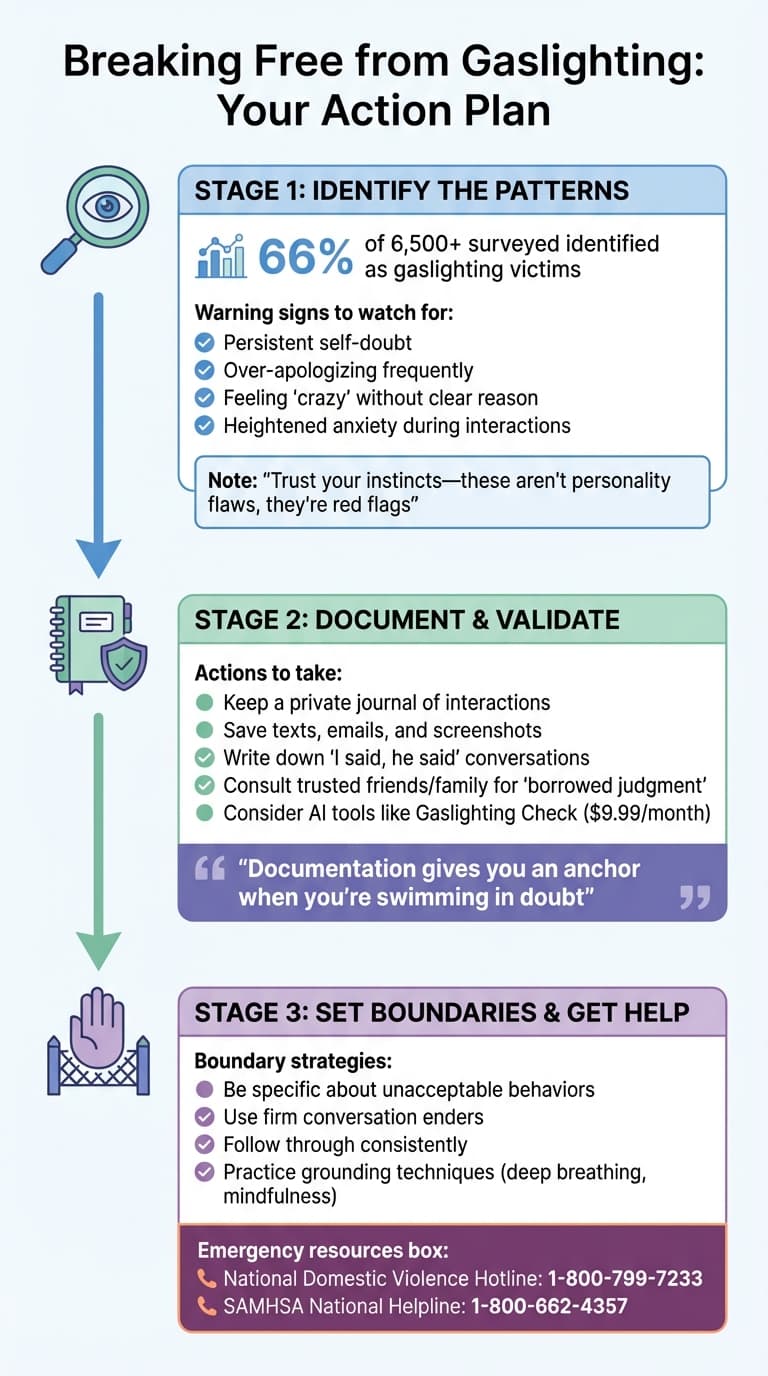
The first step to breaking free is recognizing the signs. Gaslighting isn't just a heated argument or a misunderstanding - it's a calculated effort to make you question your reality. In a survey of more than 6,500 people, 66% identified as victims of gaslighting, while 31% suspected they had been but didn’t realize it at the time [8]. This highlights how subtle and insidious gaslighting can be.
Watch for internal warning signs like persistent self-doubt, over-apologizing, or feeling "crazy" for no clear reason. These aren't flaws in your personality - they're red flags [8][10]. Gaslighting often unfolds in three stages: disbelief, defensiveness as you seek validation, and eventually depression, where you may accept the manipulator's version of events [10]. Trust your instincts - if you feel heightened anxiety during interactions, it’s a signal something is wrong [13][2]. Unlike normal disagreements that aim for mutual understanding, gaslighting is about control and erasing your perspective [2].
Once you identify these patterns, the next step is to seek support and validate your experiences.
Getting Help and Using Available Tools
You don’t have to navigate this alone. Start by documenting everything - keep a private journal, save texts, archive emails, and take screenshots. Robin Stern, PhD, Co-founder of the Yale Center for Emotional Intelligence, suggests a simple but effective method:
"Write down, 'I said, he said, I said, he said' to the best of your ability and see - in black and white - how your gaslighter distorts what has happened or pivots away from it." [3]
This documentation becomes a crucial reference point when your memory is challenged [1][12]. As the Calm Editorial Team explains:
"Documentation gives you an anchor, and on days when you're swimming in doubt, it can remind you that what occurred did actually happen." [12]
Seek "borrowed judgment" by consulting someone you trust - a friend, family member, or therapist who can help you see things clearly [11]. For a more objective approach, try tools like Gaslighting Check (https://gaslightingcheck.com). This platform uses AI to analyze text and voice interactions, providing detailed reports and actionable insights while keeping your data secure with end-to-end encryption. At $9.99/month for the premium plan, it’s an affordable option for those needing validation when self-doubt creeps in.
If you need immediate assistance, contact the National Domestic Violence Hotline at 1-800-799-7233 or the SAMHSA National Helpline at 1-800-662-4357. Both offer free, confidential support [8][9].
With clear documentation and external validation, you can begin to set boundaries to protect yourself.
Setting Boundaries to Protect Yourself
Boundaries are only effective if they’re enforced. Setting clear limits helps you reclaim your sense of self, which gaslighting seeks to undermine. Be specific about what behavior you won’t tolerate and what actions you’ll take if it continues. For example, you might say, "I can’t engage when you speak to me that way", or "If you keep calling me names, I’m leaving the room" [13]. The key is to follow through consistently.
Avoid getting trapped in circular arguments. You won’t win a debate with someone who distorts reality. Instead, use firm conversation enders like, "I’m clear on what happened; I’m not going to keep debating it" [11]. Chivonna Childs, PhD, a psychologist at Cleveland Clinic, advises:
"Naming unhealthy behaviors as they occur can stop them from progressing. It puts the other person on notice that you will no longer accept this type of treatment." [1]
To stay grounded during tense moments, practice techniques like deep breathing or mindfulness [8][4]. Remember, you don’t need the gaslighter to validate your experience. Healing starts with standing firmly in your truth, regardless of whether they agree [13][11].
Conclusion
Gaslighting is a calculated form of manipulation designed to make you question your sense of reality. Gaslighters often avoid accountability and seek control, whether their behavior stems from personality disorders, deep-seated insecurities, or patterns learned early in life [14] [15] [16] [17] [18]. Over time, this behavior chips away at your ability to trust yourself, creating a cycle that can damage your confidence and self-worth.
Pay attention to signs like distorted perceptions and dismissed emotions [16] [18] [19] [7]. If you frequently find yourself apologizing, doubting your memories, or overwhelmed by uncertainty, these could be strong indicators of manipulation [19] [7].
To regain control, start by documenting your experiences and validating your feelings. Reaching out to trusted friends or family members who can affirm your perspective is a crucial step. Additionally, working with a therapist who specializes in emotional abuse can guide you toward rebuilding your self-trust.
For a more objective approach, tools like Gaslighting Check (https://gaslightingcheck.com) provide AI-driven analysis of text and voice interactions, offering detailed reports. Their premium features start at $9.99/month and can help you identify manipulation patterns and take steps toward recovery.
Setting boundaries is essential, and if you're in immediate need of help, resources are available. Contact the National Domestic Violence Hotline at 1-800-799-7233 or the SAMHSA National Helpline at 1-800-662-4357 for support.
Trust what you feel and perceive - acknowledging the truth is the first step to taking back control of your life.
FAQs
How is gaslighting different from a normal argument?
Gaslighting stands apart from a typical argument because it’s rooted in deliberate emotional manipulation. The goal is to make someone question their own memories, perceptions, or even their sanity - often as a way to gain control or dominance in a relationship. On the other hand, a normal argument is simply a disagreement, without the calculated attempt to distort reality or erode the other person’s self-assurance.
Why do some people gaslight the person they love?
Gaslighting often occurs when someone wants to control, evade responsibility, or manipulate the dynamics of a relationship. This form of emotional abuse chips away at the partner’s ability to trust themselves, eroding their confidence and increasing their dependence on the gaslighter. While some gaslighters act out of personal insecurity, unresolved past issues, or behaviors they've picked up over time, others deliberately aim to maintain power by distorting their partner’s sense of reality.
What should I do if I think I’m being gaslit but I’m not sure?
If you think you might be experiencing gaslighting but feel uncertain, it’s important to start by recognizing the warning signs. These can include feeling confused, doubting your own memory, or questioning your perceptions of events. One helpful step is to document specific incidents. Writing things down can give you a clearer picture of what’s happening.
It’s also crucial to reach out for support. Talk to trusted friends, family members, or consider speaking with a mental health professional. They can help you better understand your situation and offer guidance to protect your emotional well-being. Taking these steps can help you regain clarity and feel more secure.