
Gaslighting Effects on Self-Perception: What to Know
Gaslighting is a form of psychological manipulation that makes you doubt your thoughts, memories, and reality. Over time, it erodes self-trust and confidence, leaving you reliant on the manipulator's version of events. This article explains how gaslighting distorts your self-perception, the tactics used, and ways to recover.
Key Takeaways:
- What is Gaslighting? A manipulative behavior designed to make you question your reality, often involving denial, blame-shifting, and trivializing your emotions.
- How It Affects You: Leads to self-doubt, memory issues, and emotional instability. Victims may feel "too sensitive" or "dramatic" when their emotions are dismissed.
- Common Tactics: Denying events ("That never happened"), isolating you from support, and undermining your credibility.
- Recovery Steps: Recognize the behavior, document interactions, set boundaries, and rebuild trust in your emotions and memory.
Gaslighting distorts your sense of self, but tools like journaling, therapy, and even apps like Gaslighting Check can help you regain clarity and confidence. Recovery takes time but begins with trusting your own perceptions.
How Gaslighting Destroys Intuition (And How to Get it Back)
Detect Manipulation in Conversations
Use AI-powered tools to analyze text and audio for gaslighting and manipulation patterns. Gain clarity, actionable insights, and support to navigate challenging relationships.
Start Analyzing NowHow Gaslighting Changes the Way You See Yourself
Gaslighting operates by repeatedly presenting false information, leading you to question your own memory, perception, and even sanity [4]. This manipulation creates what some psychologists call "reality violations" - moments when your clear memories conflict with the manipulator's version of events. Faced with this clash, your brain often defaults to self-doubt. It’s easier to believe you made an error than to accept that someone is outright lying to you [7].
"Gaslighting doesn't just manipulate victims, over time, it literally rewires their brains."
- Joni E. Johnston, Psy.D., Clinical/Forensic Psychologist [7]
This "rewiring" happens through a combination of psychological tactics. For instance, cognitive dissonance causes discomfort when your love for someone doesn’t align with their abusive behavior. To resolve this conflict, your brain may reject your own observations in favor of the abuser’s narrative [8]. Another tactic, intermittent reinforcement, alternates between cruelty and affection, creating an unpredictable dynamic that makes you cling to the moments of kindness [8]. Meanwhile, monopolization of perception forces you to focus solely on the abuser’s reality, shutting out alternative viewpoints [1]. These subtle shifts in thought patterns set the stage for more direct tactics that further destabilize your sense of self.
Manipulation Tactics and Their Mental Effects
Gaslighters use specific strategies to distort how you see yourself, eroding your self-trust over time. For instance, when someone repeatedly denies your experiences with phrases like "That never happened", you may begin doubting the vivid memories you once trusted [8]. Blame-shifting can lead you to internalize guilt, making you think, "I must be the problem" [8][1]. Similarly, dismissive comments like "You're too sensitive" can make you question your emotional responses [8]. Isolation from friends and family removes external validation - those critical "counternarratives" that help ground you in reality - leaving you entirely reliant on the abuser’s version of events [6]. Another tactic, credibility slashing, undermines your sense of reliability, making you feel that no one will believe your truth [6].
| Manipulation Tactic | Mental/Emotional Effect on Victim |
|---|---|
| Denial ("That never happened") | Doubting your memory and recollections [8] |
| Blame-shifting/Twisting | Internalizing guilt and believing "I am the problem" [8][1] |
| Trivializing ("You're too sensitive") | Discrediting your emotional responses [8] |
| Isolation from friends/family | Losing external validation and becoming dependent on the abuser [6] |
| Credibility Slashing | Feeling that no one will believe your truth [6] |
Gaslighting often unfolds in three stages: initial disbelief, where you question the manipulator’s actions; active defense, where you try to resist or push back; and resigned acceptance, where you begin to lose your sense of self entirely [5].
Mental and Emotional Signs of Gaslighting
Prolonged exposure to gaslighting can lead to noticeable mental and emotional changes. You might find yourself apologizing constantly, even when you’ve done nothing wrong [5]. There’s often a lingering sense that something feels off, even if you can’t pinpoint exactly what it is [5]. Decision-making may also become a struggle, as you lose confidence in choices that once felt natural. Over time, the stress can cause brain fog, impairing areas like the hippocampus and prefrontal cortex, which are critical for memory and decision-making [9]. At the same time, the brain regions responsible for assessing threats may become overactive yet unreliable, leaving you hypervigilant but unsure of your own instincts [7].
A study involving 122 interviews revealed that around 30% of participants identified their parents as their primary gaslighters, illustrating how these patterns can start early in life [6]. Recognizing these signs is an important first step in reclaiming your sense of self. You can also use tools for detecting gaslighting to gain objective clarity on your interactions.
Gaslighting vs. Healthy Self-Awareness
::: @figure
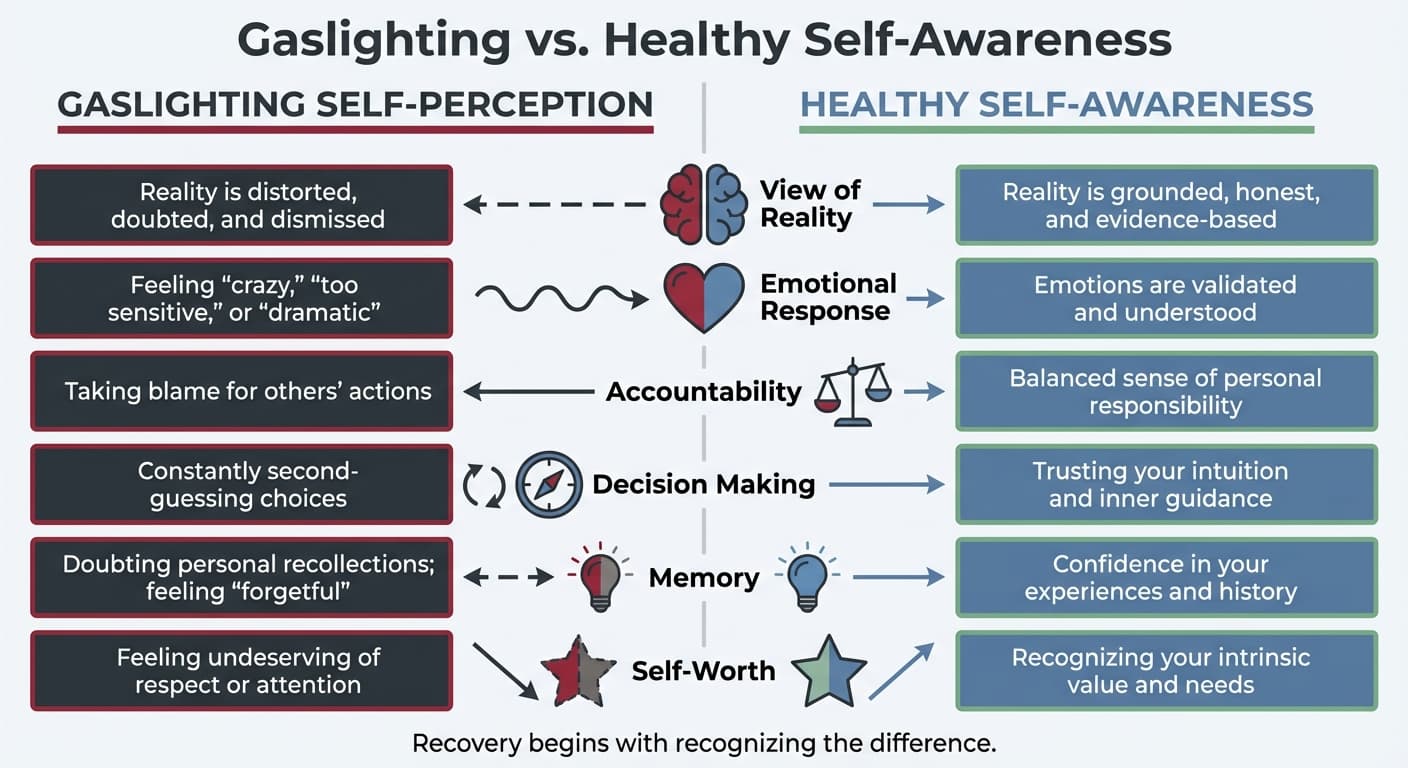
Understanding the tactics of gaslighting is only part of the equation. It’s equally important to recognize how its effects contrast with a healthy sense of self, which plays a key role in recovery. Gaslighting warps your reality, forcing you to question your own experiences and accept the abuser's narrative instead. On the other hand, healthy self-awareness keeps you anchored in reality, allowing you to trust your perceptions while respecting your emotions.
The emotional experiences of these two states couldn’t be more different. Under gaslighting, you might hear accusations like being "too sensitive" or "overreacting", which can push you toward self-doubt and invalidation. Healthy self-awareness, however, affirms that your emotions are valid and reflect the reality of your circumstances. It’s about treating your feelings as valuable insights into your experience.
"When you're constantly dismissing your own feelings or doubting your own perceptions, you're disconnecting from your own internal compass, and it's hard to know what you actually want, what you actually feel, and what you actually need."
- Lauren Auer, Therapist [3]
This distinction also impacts how responsibility is assigned. Gaslighting often traps you in a cycle of feeling accountable for the abuser's actions, a phenomenon sometimes referred to as "credibility slashing" [6]. You might think, "If only I hadn’t said that, they wouldn’t have reacted this way." Healthy self-awareness, however, separates fair accountability from misplaced blame, encouraging you to ask questions like, "What is my role here?" without shouldering responsibility for someone else's behavior.
Main Differences in How You View Yourself
The contrast between gaslighting and healthy self-awareness becomes even more apparent when looking at specific aspects of self-perception. Gaslighting can leave you second-guessing decisions that once felt clear, while healthy self-awareness fosters trust in your instincts. Similarly, gaslighting may erode your confidence in your memory, making you feel "forgetful", whereas self-awareness strengthens your belief in your personal history. The table below highlights these differences:
| Feature | Gaslighting Self-Perception | Healthy Self-Awareness |
|---|---|---|
| View of Reality | Reality is distorted, doubted, and dismissed | Reality is grounded, honest, and evidence-based |
| Emotional Response | Feeling "crazy", "too sensitive", or "dramatic" | Emotions are validated and understood |
| Accountability | Taking blame for others' actions | Balanced sense of personal responsibility |
| Decision Making | Constantly second-guessing choices | Trusting your intuition and inner guidance |
| Memory | Doubting personal recollections; feeling "forgetful" | Confidence in your experiences and history |
| Self-Worth | Feeling undeserving of respect or attention | Recognizing your intrinsic value and needs |
This breakdown highlights just how profoundly gaslighting can distort your self-perception, while healthy self-awareness helps you maintain trust in yourself and your experiences.
How to Rebuild Your Self-Perception After Gaslighting
Gaslighting can leave you doubting yourself, but recovery begins by reclaiming your story. One of the first steps is naming the behavior for what it is - gaslighting. Doing so shifts the focus away from self-blame and places accountability where it belongs: on the person manipulating you. Instead of internalizing thoughts like "Maybe I'm the problem", you start recognizing the abuser's role in distorting your reality.
A practical way to anchor your recovery is by keeping records. Document conversations, texts, and events to counter any denials and reinforce your confidence in your memory. When faced with manipulation, use grounding phrases like, "I trust my memory of what happened," or "I won't debate my experience." These statements help you stay rooted in your truth and resist being swayed by gaslighting attempts [11][12].
Setting boundaries is another key step. Limit contact or, if necessary, enforce the "No Contact Rule" to protect your emotional space and block attempts to manipulate you further. If contact is unavoidable, involve neutral third parties to act as witnesses, making it harder for the gaslighter to twist events. As Dr. Chivonna Childs, PhD, Psychologist, wisely puts it:
"A fire cannot burn if there's no fuel. They can't fight if there's no one to fight with" [2].
Identifying and Responding to Manipulation
Recognizing gaslighting tactics is essential for regaining clarity and confidence. Keep a record of conversations, often referred to as an "I said, they said" list. This can reveal patterns of manipulation, such as shifting the focus from your concerns to accusations of being "too sensitive" or "dramatic" [10]. These patterns, when documented, become harder to ignore.
Pay attention to debates that seem to go in circles. These arguments aren't about resolving issues - they're about control and wearing you down. Instead of engaging, try statements like, "I'm clear on what happened; this isn't a debate," or "This conversation isn't productive for me." The goal isn't to win an argument but to protect your emotional well-being and sense of reality [11][12].
For extra support, tools like Gaslighting Check can help you stay grounded.
Using Gaslighting Check for Detection and Support

Gaslighting Check is designed to provide clarity when you're doubting your own perception. It analyzes texts and voice recordings to identify manipulation tactics, such as denial, deflection, and blame-shifting, offering detailed reports that validate your experiences.
The tool also includes a real-time audio recording feature, creating an unbiased record of events to counter any claims of "that never happened." For $9.99/month, the Premium plan offers conversation history tracking, which helps you monitor recurring patterns of abuse over time. You can even export these analyses as PDF reports to share with therapists, making recovery work more targeted. With end-to-end encryption and automatic data deletion, your privacy remains protected.
| Feature | Benefit for Recovery |
|---|---|
| Text/Voice Analysis | Counters claims like "I never said that" with objective proof |
| Detailed Reports | Identifies manipulation tactics to help you understand patterns |
| Conversation Tracker | Tracks long-term cycles, including "hoovering" attempts |
| PDF Export | Enables evidence-based discussions with therapists or counselors |
| Community Access | Connects you with a supportive, moderated network of survivors |
While tools like this provide external support, rebuilding your inner world is just as important.
Developing Healthy Emotional Patterns
Reclaiming your sense of self involves rebuilding trust in your own emotions and experiences. Journaling can be a powerful tool for spotting patterns and validating your feelings. Pair this with a "psychological first-aid kit" - a list of activities that boost your mood and energy, like walking, painting, or practicing deep breathing. These can help you cope during challenging moments.
Reality checks are also helpful. Share specific interactions with trusted, neutral friends to confirm your perspective without relying on the gaslighter's version of events. If you feel triggered, try grounding exercises like the Five Senses Exercise: identify five things you see, four you can touch, three you can hear, two you can smell, and one you can taste. This simple technique can bring you back to the present moment.
Therapies like Cognitive Behavioral Therapy (CBT) can help challenge distorted beliefs, while Narrative Therapy allows you to separate your truth from the gaslighter's version of events. Reconnecting with hobbies or interests that were criticized or suppressed during the relationship is another step toward rediscovering who you are. This isn't selfish - it's necessary for healing.
Finally, shift your focus from proving you're "right" to prioritizing how you feel. If you sense you're being attacked or manipulated, disengage to protect your emotional safety. Your feelings are valid - they're not weaknesses but valuable insights. By practicing these steps, you can rebuild self-trust and reclaim the parts of yourself that gaslighting tried to erase. [10]
Long-Term Benefits of Detection Tools in Recovery
When it comes to recovery from gaslighting, prevention plays a crucial role in rebuilding self-trust. It’s not just about healing from past experiences - it’s also about safeguarding yourself against future manipulation. Tools like Gaslighting Check provide ongoing support by identifying patterns of manipulation before they escalate. While memory can falter, these tools offer an objective record of interactions, helping to counter self-doubt and strengthen your confidence over time.
One of the key advantages lies in recognizing long-term patterns. A single, confusing conversation might not raise alarms, but tracking interactions over weeks or months can reveal cycles of behavior that are easy to miss. Research highlights this challenge: 3 in 5 people fail to recognize gaslighting as it happens, and individuals often remain in manipulative relationships for over two years before seeking help [2]. By documenting interactions, these tools help bring clarity to situations that might otherwise remain murky.
Detection tools also act as a stabilizing force during moments of uncertainty. For instance, when someone claims, "That never happened", or accuses you of being "too sensitive", having a secure, time-stamped record can immediately challenge their narrative. This isn’t about proving someone wrong - it’s about staying grounded in reality when someone tries to distort it.
How Gaslighting Check Prevents Future Manipulation
Gaslighting Check goes beyond just documentation; it actively works to prevent future manipulation. Using AI-powered analysis, it examines both text and voice conversations to detect tactics like denial, deflection, projection, and blame-shifting. Its Natural Language Processing (NLP) flags invalidating phrases such as "You’re overreacting" or "I never said that", while voice analysis identifies stress markers, tone shifts, and subtle signs of condescension.
The platform’s conversation history tracking, available with the Premium plan for $9.99/month, provides a chronological log of interactions. This makes it easier to spot contradictions, like when someone insists they’ve "always supported you", despite clear records of criticism. The tool also assigns severity scores to manipulation tactics, helping you monitor whether the behavior is becoming more intense.
Privacy is a central feature. All data is encrypted end-to-end, and automatic deletion policies ensure that sensitive conversations aren’t stored indefinitely unless you choose to keep them. Additionally, you can export analyses as PDF reports to share with therapists, giving you actionable insights to make your recovery process more focused and effective.
Gaslighting Check Plans: Free, Premium, and Enterprise
Gaslighting Check offers three subscription options, tailored to different needs and levels of usage.
| Plan | Price | Key Features | Best For |
|---|---|---|---|
| Free Plan | $0 | Basic text analysis, limited insights, encrypted data storage | Ideal for occasional users or those beginning to explore manipulation detection |
| Premium Plan | $9.99/month | Full text/voice analysis, detailed reports, conversation history tracking, severity scores, personalized insights | Best for individuals in recovery or those monitoring long-term patterns |
| Enterprise Plan | Custom Pricing | All premium features plus tailored solutions, multi-user management, organizational tools | Designed for therapists, HR teams, and support organizations |
Every plan includes robust privacy protections, ensuring your data remains secure no matter which option you choose. Whether you’re just starting to identify manipulation or need comprehensive tools for long-term recovery, there’s a plan to support your journey toward self-trust and clarity.
Conclusion: Restoring Your Self-Trust and Mental Clarity
Understanding how gaslighting impacts your self-perception is a critical step in reclaiming your sense of reality. When you can identify the behavior - even if it's just in your own mind - you begin to break free from the confusion and start affirming your experiences again [11]. This shift allows you to move away from self-blame and focus on holding the manipulator accountable, which is key to rebuilding your confidence [1].
Recovery isn't about trying to win arguments or proving someone else wrong. It's about anchoring yourself in facts when self-doubt starts to creep in. Keeping track of interactions through journals, screenshots, or tools like Gaslighting Check provides an objective record you can rely on when someone attempts to distort the truth. As Dr. Chivonna Childs, a psychologist at Cleveland Clinic, puts it: "Calling out gaslighting behaviors helps set boundaries and change the power dynamic. It puts the other person on notice that you will no longer accept this type of treatment" [2].
Rebuilding self-trust also involves rejecting the manipulator's internalized criticism [3]. When thoughts like "Maybe I am too sensitive" or "I probably did overreact" come up, pause and ask yourself: Is this my thought, or is it theirs? Grounding phrases such as "I know what happened, and I trust my memory" can help you stay steady during moments of doubt [11].
This process takes time, but you don't have to go through it alone. Whether you turn to tools for identifying gaslighting, work with a therapist, or set clearer boundaries, each step strengthens your ability to trust yourself again. Your experiences are real, your feelings are valid, and you deserve relationships built on honesty - not manipulation.
The first step toward emotional well-being begins with one decision: to stop doubting yourself and start trusting your own perceptions. That choice is yours, and it holds more power than any gaslighter would want you to realize.
FAQs
How can I tell gaslighting from normal disagreements or miscommunication?
Gaslighting is a deliberate form of emotional manipulation. It often involves tactics like denying facts, invalidating your feelings, or making you doubt your perception of reality. Unlike typical disagreements that rely on mutual respect and open communication, gaslighting is rooted in a power imbalance, with the goal of controlling or dominating the other person. Common signs include brushing off your emotions, calling you overly sensitive, or constantly twisting the truth to erode your self-confidence.
Why do I doubt my memory so much after being gaslit?
Gaslighting is a manipulative tactic that twists your perception of reality. It works by planting seeds of doubt about your memories and thoughts, leaving you unsure of what’s true. This deliberate strategy chips away at your confidence and makes you second-guess your own mind.
What should I document (and how) to protect my reality?
To protect your sense of reality, make it a habit to document your experiences, thoughts, and emotions. Tools like journals or even recording conversations can be incredibly useful for creating accurate records. These records can serve as a powerful way to counteract gaslighting and bring clarity to your experiences. Aim to capture details as objectively and consistently as possible to ensure your evidence remains reliable.