
Gaslighting Check AI for Workplace Relationships
Gaslighting in the workplace can erode confidence and mental well-being. Gaslighting Check AI is a tool designed to help employees and HR teams identify subtle manipulation tactics like memory distortion, blame-shifting, and emotional invalidation. Using advanced technologies like natural language processing (NLP) and voice analysis, it analyzes communication patterns with an 84.6% accuracy rate. This AI-based platform provides real-time insights, annotated transcripts, and long-term pattern tracking, making it easier to document and address workplace gaslighting.
Key Features:
- Text and Voice Analysis: Detects manipulative language and tone.
- Real-Time Tools: Records conversations and flags issues instantly.
- Detailed Reports: Annotated transcripts highlight problematic statements.
- Privacy-Focused: End-to-end encryption and anonymized data.
- Pricing: Free basic plan, $9.99/month for premium features, and custom enterprise options.
While Gaslighting Check AI excels in speed and objectivity, it works best when combined with human oversight to account for nuances like sarcasm or cultural differences. Traditional HR methods still play a role, offering context-sensitive judgment but often lacking the precision and evidence AI tools provide.
Quick Comparison:
| Criteria | Gaslighting Check AI | HR Methods |
|---|---|---|
| Detection Speed | Real-time | Reactive (after incidents) |
| Objectivity | High (data-driven) | Subjective/emotional |
| Evidence | Timestamped reports | Verbal accounts |
| Pattern Tracking | Automated | Manual |
| Cost | $9.99/month (Premium) | Free |
Gaslighting Check AI is a practical solution for documenting manipulation, empowering employees and HR teams to address workplace toxicity with data-backed evidence.
::: @figure
1. Gaslighting Check AI

Detection Accuracy
Gaslighting Check AI boasts an impressive 84.6% accuracy in identifying deceptive behaviors by analyzing long-term patterns, as highlighted by studies from its developers[1]. The platform focuses on six key manipulation tactics: emotional manipulation, reality distortion, blame-shifting, memory manipulation, emotional invalidation, and truth denial. Unlike human observers, it excels at spotting recurring patterns of manipulation across multiple interactions.
Three core technologies power its detection capabilities. Natural Language Processing (NLP) scans text for dismissive phrases like "You're overreacting." Voice pattern analysis evaluates pitch, tone, and speech rate to identify condescending cues. Finally, long-term pattern recognition tracks how manipulation tactics evolve and escalate over time. Together, these technologies provide a highly detailed and consistent approach to identifying harmful behaviors at work.
Features and Capabilities
Gaslighting Check AI analyzes both text and voice, making it adept at catching subtle forms of manipulation. Real-time audio recording allows users to capture meetings instantly, while annotated reports generate detailed transcripts that highlight problematic statements. For example, the system flagged a manager's comment, "I think you're misremembering", as possible memory manipulation, and the phrase "if you had been clearer... we wouldn't be in this mess" as blame-shifting.
For Premium users, the platform offers a conversation history tracker to document trends over time - an invaluable tool for HR-related cases. In late 2025, the platform introduced an AI Coach feature, enabling users to review analysis results and receive tailored advice on managing toxic workplace interactions.
User Privacy and Security
Gaslighting Check AI prioritizes user privacy with robust security measures. End-to-end encryption protects data at every stage, while anonymization ensures that no conversation can be traced back to specific individuals. Additionally, an automatic data deletion feature removes information after analysis or a set period unless users opt to retain it. The platform's "Data Fortress" policy guarantees that user data is never sold or shared with third parties[2].
Research from Cornell University, cited by the developers, underscores the importance of AI in removing emotional bias from communication analysis[1]. This objectivity is crucial for employees seeking reliable validation before approaching HR or compiling evidence for formal complaints.
Cost and Accessibility
Gaslighting Check AI combines advanced detection tools with secure data handling at a price point designed to be widely accessible. The platform operates on a freemium model:
- Free Plan: Includes basic text analysis at no cost.
- Premium Plan: Priced at $9.99/month, unlocks voice analysis, conversation tracking, and other advanced features.
- Enterprise Plan: Offers custom pricing for larger organizations, with added benefits like integration options, advanced reporting, and administrative controls.
Its user-friendly design ensures that anyone can create detailed, data-backed records, turning workplace disputes into actionable evidence for HR teams.
Detect Manipulation in Conversations
Use AI-powered tools to analyze text and audio for gaslighting and manipulation patterns. Gain clarity, actionable insights, and support to navigate challenging relationships.
Start Analyzing Now2. General Workplace Manipulation Detection Methods
Detection Accuracy
Traditional approaches to spotting workplace manipulation often rely on manual processes like reviewing complaints, conducting interviews, and analyzing email threads. While these methods can uncover some issues, they lack the ability to operate in real-time and often miss subtle or gradual manipulation tactics.
AI-powered tools have stepped in to offer more systematic and precise methods. These tools typically use four key types of analysis: text analysis, which scans emails, chats, and other written communications for signs of manipulation like memory distortion or blame-shifting; voice analysis, which examines tone or pitch changes in meetings and calls that might indicate condescension; pattern recognition, which reviews conversation histories to detect escalation tactics; and sentiment analysis, which evaluates the emotional tone of communications. These advanced techniques address many of the challenges traditional methods face, offering more nuanced insights.
Features and Capabilities
Detection tools vary in scope, offering solutions for both individual and organizational needs. Some focus on analyzing specific conversations through text or audio, while others aggregate sentiment data across teams to detect larger trends. Many platforms also include workflows for managing flagged cases, making it easier to address issues systematically.
A significant advancement in these tools is the use of explainable AI, which allows users to see the specific data points that triggered manipulation alerts. Dr. Stephanie A. Sarkis, a psychologist and author, emphasizes the importance of recognizing these patterns:
"Identifying gaslighting patterns is crucial for recovery. When you can recognize manipulation tactics in real-time, you regain your power and can begin to trust your own experiences again." [1]
User Privacy and Security
While detection capabilities are critical, protecting user data is just as important. Most tools employ safeguards like encryption, anonymization, and automated data deletion to comply with regulations such as GDPR and CCPA. To ensure fairness and accuracy, organizations are encouraged to keep humans involved in the review process. AI-generated reports should be treated as supporting evidence, with trained HR professionals overseeing all flagged cases [1].
Cost and Accessibility
The cost of implementing these tools depends on the features and scale an organization requires. Basic text analysis is often available through freemium models, making it accessible to smaller teams. More advanced features, such as voice analysis or enterprise-level sentiment aggregation, are typically offered in professional subscriptions starting at around $9.99 per month. For large-scale solutions, custom pricing is common, especially for tools that integrate with platforms like Microsoft Teams or Gmail [1].
To make the most of these tools, organizations are advised to start with pilot programs. This allows them to test the functionality, gather employee feedback, and assess the tools' effectiveness before committing to a full rollout [1].
Advantages and Disadvantages
Gaslighting Check AI offers some solid benefits when it comes to identifying manipulation. Its standout feature is real-time detection, which uses natural language processing and voice analysis to evaluate tone, pitch, and stress levels - key indicators of hidden aggression or condescension. On top of that, it provides annotated transcripts that flag manipulative tactics like Memory Manipulation and Blame Shifting. These transcripts include precise, timestamped evidence, turning subtle conversational cues into actionable insights.
Another strength lies in its long-term pattern recognition. Unlike traditional methods, which might overlook gradual changes, this AI tool can identify manipulation that unfolds over weeks or months. Independent studies have shown that AI can reduce emotional bias, making it an especially useful tool for workplace environments where gaslighting often goes unnoticed. Plus, the freemium pricing model makes it accessible: basic text analysis is free, while premium features start at $9.99 per month.
That said, Gaslighting Check AI isn’t without its challenges. Natural language processing can struggle with sarcasm and non-native idioms, which might lead to false positives or missed manipulative behavior - especially in diverse workplaces. Voice analysis also relies on high-quality audio, so background noise or poor connections can limit its effectiveness. Another hurdle is that the system requires historical data to track escalation patterns, making it less effective for identifying manipulation in newly formed workplace relationships. For these reasons, the tool works best when paired with human judgment rather than being used as a standalone solution.
Traditional HR methods, on the other hand, have their own strengths. They’re free and allow for context-sensitive decision-making, but they often lack the objectivity and hard evidence that AI tools bring to the table. This can lead to serious concerns being reduced to "he-said/she-said" disputes, leaving victims without clear validation.
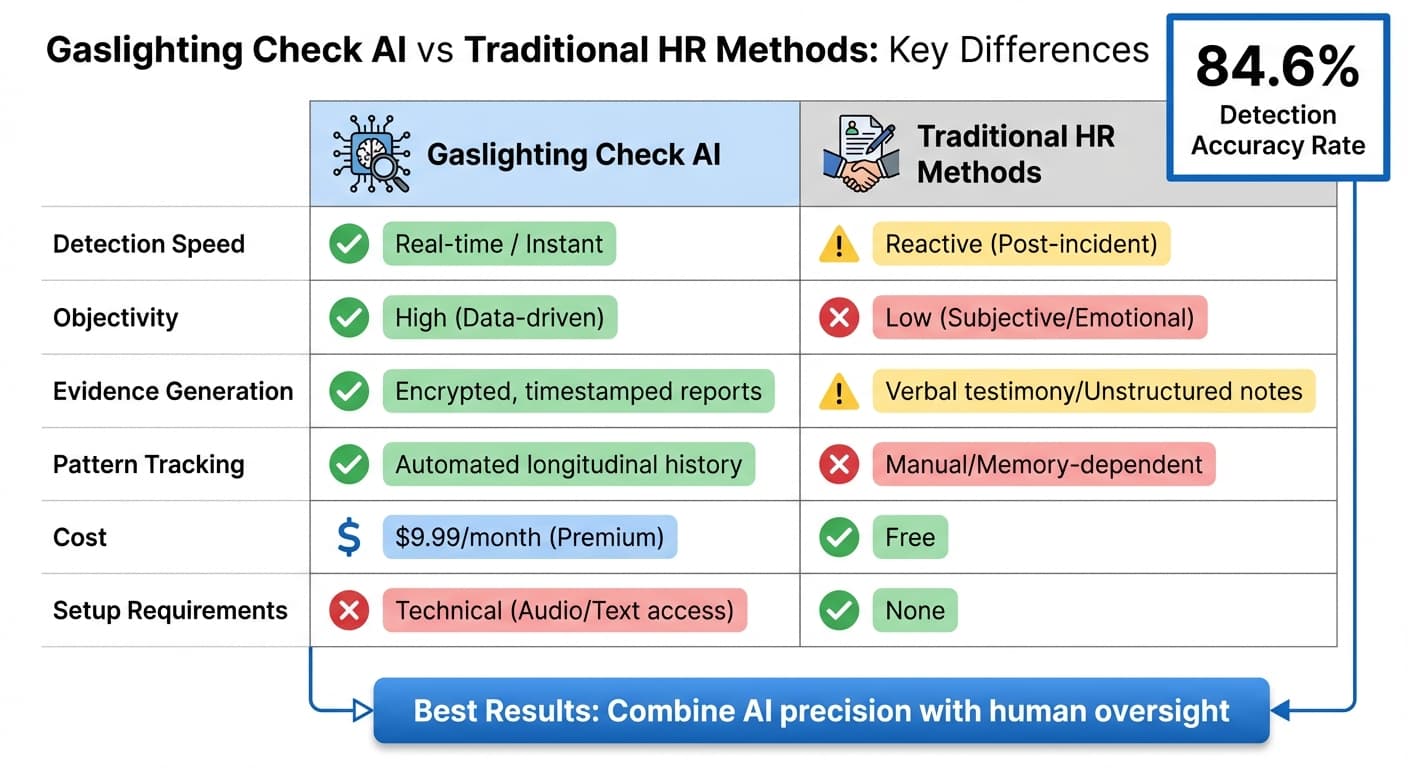
Here’s a quick comparison of Gaslighting Check AI and traditional HR methods:
| Criteria | Gaslighting Check AI | Traditional HR Methods |
|---|---|---|
| Detection Speed | Real-time / Instant | Reactive (Post-incident) |
| Objectivity | High (Data-driven) | Low (Subjective/Emotional) |
| Evidence Generation | Encrypted, timestamped reports | Verbal testimony/Unstructured notes |
| Pattern Tracking | Automated longitudinal history | Manual/Memory-dependent |
| Cost | $9.99/month (Premium) | Free |
| Setup Requirements | Technical (Audio/Text access) | None |
While Gaslighting Check AI brings precision and speed, traditional methods still provide a human touch. Together, they can complement each other for a more balanced approach to addressing workplace manipulation.
Conclusion
Gaslighting Check AI offers a powerful way to document and analyze manipulation patterns in real-time, giving users the proof they need to confront workplace gaslighting. Using advanced natural language processing and voice analysis, the platform identifies tactics like memory distortion and blame-shifting, creating timestamped records that can help ensure accountability and support managerial decisions.
For managers, the platform's privacy-conscious analysis can complement existing HR workflows. Meanwhile, employees can use it to document questionable interactions. While the tool provides valuable insights, it works most effectively when combined with personal judgment and individual record-keeping.
FAQs
How does Gaslighting Check AI protect my privacy and secure my data?
Gaslighting Check AI prioritizes your privacy by using end-to-end encryption for both text and audio data. This means your information is processed securely, either through encrypted channels or directly on your device.
For added security, all data is automatically erased after analysis unless you opt to save it. These steps are designed to keep your information private and secure while you use the platform.
What challenges does Gaslighting Check AI face in diverse workplace settings?
Gaslighting Check AI is a helpful tool for spotting manipulative behavior, but it does have its limitations - particularly in diverse workplace settings. For instance, the AI might have trouble analyzing short or vague messages, as these often lack the context needed to identify manipulation patterns. Another challenge lies in its training, which is primarily based on Western English. This means it could misread cultural expressions, regional slang, or communication styles, especially those commonly used by neurodivergent individuals, leading to potential inaccuracies.
Privacy and consent are critical issues to consider as well. While the platform incorporates encryption and automatic deletion to safeguard user data, sharing workplace conversations could still raise ethical or legal concerns. This tool should be viewed as a complementary resource rather than a standalone solution, with human judgment playing a key role in interpreting its results. To use the AI responsibly, organizations should implement clear policies on data handling and ensure consent is obtained from all parties involved.
How does Gaslighting Check AI support HR in addressing workplace manipulation?
Gaslighting Check AI supports HR teams by serving as an early-warning system to spot manipulation tactics such as blame-shifting, distorting reality, or denying the truth. Through natural language processing and sentiment analysis, it monitors emails, chats, and voice calls in real-time to flag problematic behaviors, allowing HR to address concerns before they grow into larger issues.
The platform generates objective, AI-driven reports that summarize the frequency, context, and severity of flagged behaviors. These reports help HR teams streamline investigations, reduce reliance on subjective narratives, and ensure decisions remain consistent. To protect employee privacy, the system uses encrypted data and enforces automatic deletion policies. For premium users, detailed conversation histories are available, making it easier to track patterns over time and uncover deeper, systemic problems.
By incorporating Gaslighting Check AI into their processes, HR teams can better allocate resources, concentrate on high-risk areas, and promote a workplace culture built on trust and accountability.