
Boundaries for Dealing with Gaslighters
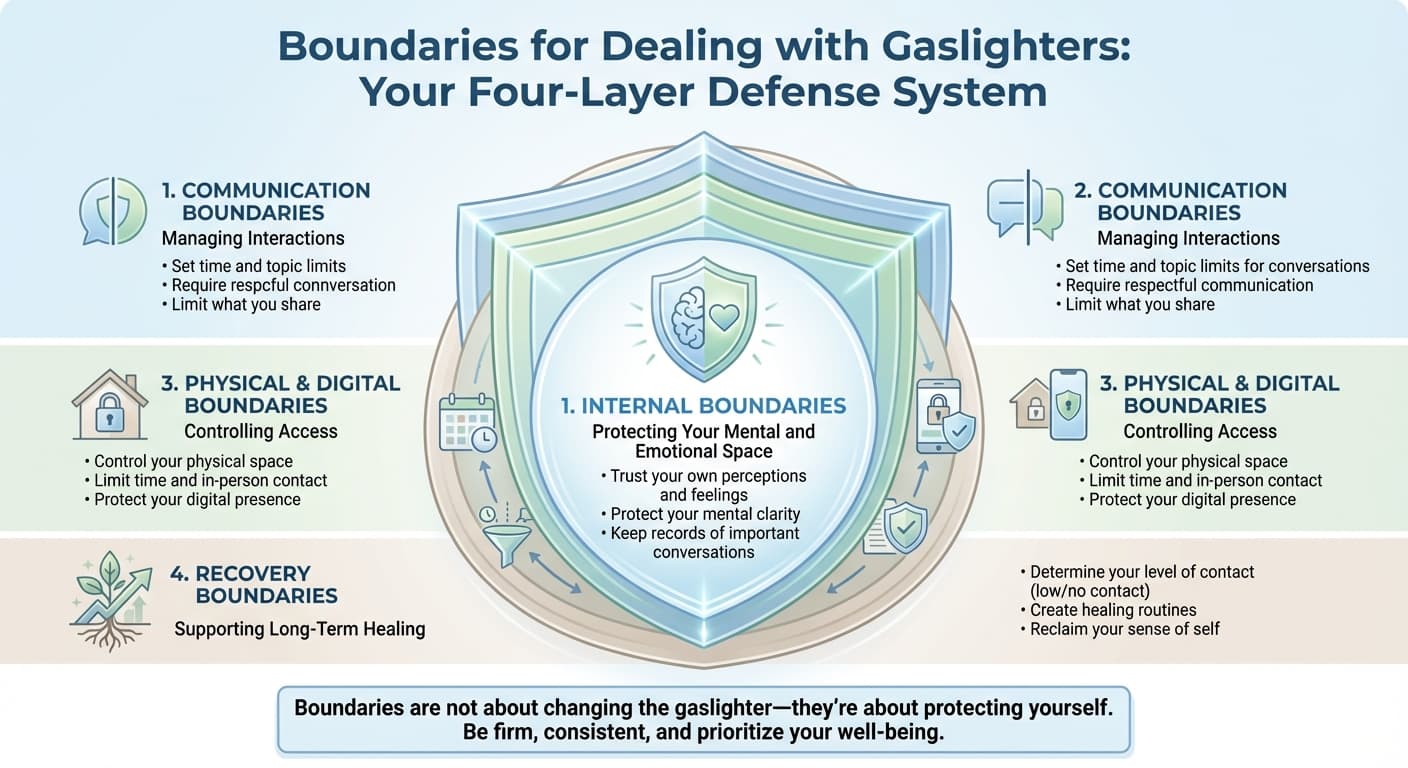
Gaslighting is a manipulation tactic that makes you doubt your memories, emotions, and reality. It often results in self-doubt, confusion, and emotional harm. If you’re dealing with a gaslighter, setting boundaries is your best defense. Here’s how boundaries can protect your mental and emotional health:
- Internal Boundaries: Trust your feelings, validate your experiences, and keep records of interactions to maintain mental clarity.
- Communication Boundaries: Limit discussions, enforce respectful communication, and avoid sharing personal details that can be used against you.
- Physical and Digital Boundaries: Control access to your space, reduce in-person interactions, and secure your online presence.
- Recovery Boundaries: Decide on contact levels (low or no contact), build healing routines, and reconnect with your sense of self.
Boundaries are not about changing the gaslighter but about protecting yourself. Be firm, consistent, and prioritize your well-being. Tools like journaling, therapy, and secure documentation can support your recovery journey.
::: @figure
Don't Fall for the Gaslighter Trap: Setting Boundaries for Self-Protection
Internal Boundaries: Protecting Your Mental and Emotional Space
Internal boundaries are the personal limits you set to safeguard your mental and emotional well-being. These boundaries help you decide what you will believe, accept, and engage with, regardless of someone else’s behavior. Unlike external boundaries, which manage others' actions, internal boundaries shield your inner world by separating your values, feelings, and perceptions from a gaslighter's distorted reality. For instance, if someone repeatedly says, "You're too sensitive" or "You're overreacting", an effective internal boundary might be reminding yourself, "My feelings matter, even if someone else disagrees." Below are some strategies to strengthen your internal boundaries.
Trust Your Own Perceptions and Feelings
Gaslighting often leaves you doubting your own experiences. Rebuilding trust in yourself starts with validating what you feel and observe. When something feels off, pause and affirm, "I felt uneasy when they raised their voice - that feeling is valid, even if they deny it."
Ground yourself by asking questions like, "What did I actually see, hear, and feel?" or "If I could replay this conversation, what would it show?" Another helpful check is to ask, "Would I treat a close friend’s experience the way I’m treating mine?" These steps shift your focus from arguing with the gaslighter to gathering internal evidence. Journaling daily about events, emotions, and physical sensations can also reinforce the reality of your experiences and help rebuild trust in your perspective.
Protect Your Mental Clarity
Gaslighters often use circular arguments that leave you feeling drained and confused. A practical way to handle this is to calmly say, "We remember this differently," and step away from the conversation. Remind yourself, "Their refusal to agree doesn’t change what I experienced." This mental separation helps you maintain clarity and avoid falling into their narrative.
It’s also helpful to recognize common gaslighting phrases so you can mentally flag them. When you hear statements like, "You’re imagining things," or "That never happened," remind yourself, "This is gaslighting, not a memory issue." For sensitive topics, consider shifting the conversation into writing - text or email slows the pace and creates a record you can review later. Keeping a written account of your experiences strengthens your confidence in your own reality.
Keep Records of Important Conversations
Documenting interactions can be a powerful tool. Gaslighters often say, "I never said that," or "You misunderstood," but keeping records provides concrete evidence of what actually happened. Maintain a private log - either a secure digital file or a notebook stored safely - where you note dates, times, what was said or done, and your emotional and physical reactions. Save screenshots of texts, emails, and direct messages to capture patterns of denial, blame-shifting, or vagueness.
If possible, record in-person conversations, but make sure to check local U.S. recording laws first. Some states require one-party consent, while others require all-party consent. Tools like Gaslighting Check (https://gaslightingcheck.com) can help by analyzing text and audio for manipulation patterns, offering summaries, and securely storing data with automatic deletion options. Mental health professionals emphasize that keeping records and setting boundaries are acts of self-protection, not signs of vindictiveness or instability. These steps help you reclaim your sense of reality and emotional security.
Communication Boundaries: Managing Interactions
Communication boundaries help you decide how, when, and what to discuss with a gaslighter. They protect your mental energy and ensure you maintain clarity. The point isn’t to convince the gaslighter or win an argument - it’s about preserving your emotional health while managing necessary interactions. These strategies help you stay grounded while navigating challenging conversations.
Set Time and Topic Limits for Conversations
Establishing time limits for discussions can help you maintain control. For instance, you could say, "I have 15 minutes to talk about this; after that, I’m stepping away." When the time is up, follow through - end the call, leave the room, or stop replying. It’s also better to avoid serious conversations when you’re exhausted. Instead, postpone them by saying, "Let’s revisit this tomorrow afternoon when I’m more focused."
Topic boundaries are just as important. Refuse to argue about your memory or emotions. If a gaslighter challenges your perspective, stick to brief, neutral responses like, "We remember that differently" or "That’s not how I experienced it." Don’t let the conversation spiral into rehashing resolved issues. If they persist, reiterate your boundary and disengage: "I’m not discussing this further."
Require Respectful Communication
Before engaging, define what respectful communication looks like for you. This could include rules like no yelling, no insults, no threats, and no dismissing your feelings. Make these expectations clear: "I won’t stay in a conversation where I’m insulted, shouted at, or told my feelings aren’t valid."
If disrespect happens, enforce immediate consequences. For example, say, "If you keep raising your voice, I’ll end this call," and then hang up if the behavior continues. Consistency is key - gaslighters often test boundaries, so your response needs to be firm every time. Use simple, direct language like, "This behavior makes me uncomfortable, and I won’t tolerate it" or "If the insults continue, I’m leaving." These statements set clear expectations without unnecessary explanations.
Limit What You Share
Just as internal boundaries protect your emotions, limiting what you share prevents external manipulation. By keeping personal details to yourself, you reduce the risk of having your words twisted or your vulnerabilities exploited. Stick to sharing only what’s necessary and factual. If someone pries, you can respond with, "I’m not comfortable discussing that with you."
For sensitive or contentious topics, consider shifting the conversation to written formats like texts or emails. Written communication provides a clear record and gives you time to compose thoughtful responses. It also helps expose contradictions and keeps discussions focused. Some tools even allow you to analyze conversations for patterns, helping you identify triggers or areas where you can refine your approach. By controlling what you share and how you communicate, you can make more informed decisions about what to reveal and what to withhold.
Detect Manipulation in Conversations
Use AI-powered tools to analyze text and audio for gaslighting and manipulation patterns. Gain clarity, actionable insights, and support to navigate challenging relationships.
Start Analyzing NowPhysical, Digital, and Access Boundaries
Managing interactions with a gaslighter goes beyond conversations - it’s about controlling where, when, and how they can reach you. Establishing boundaries for your physical environment, digital presence, and access to your time creates distance and a sense of safety. Gaslighting isn’t limited to words; it often involves persistent intrusions into your space, time, and attention. By taking control of your surroundings, you can limit their ability to disrupt your life.
Control Your Physical Space
Your surroundings should feel like a safe haven. If a gaslighter makes you feel trapped, confused, or uneasy during a conversation, trust your instincts and leave immediately - no explanation needed. Pay attention to physical cues like a racing heartbeat or mental fog, which may signal it’s time to walk away.
Prepare for situations that might escalate. Make sure you have access to clear exit routes and keep essentials like a charged phone and some cash within reach. If you share a living space or anticipate challenging interactions, identify safe rooms with accessible exits and have critical phone numbers (trusted friends, family, or emergency services like 911) readily available. For higher-risk situations, consider packing a "go bag" with essentials such as identification, medications, and a payment card, so you can leave quickly if needed. Set simple ground rules, such as only discussing serious matters in public or avoiding conversations in spaces where you feel unable to leave freely.
Limit Time and In-Person Contact
Reducing face-to-face interactions minimizes opportunities for real-time manipulation. Time-boxed meetings work well here - say something like, "I have 15 minutes to discuss the kids' schedule", and stick to it, especially if the conversation becomes repetitive or confusing. For sensitive topics, switch to email or text. This gives you time to think through your responses and creates a written record of the exchange.
Set boundaries for when and how you respond to messages to protect your emotional well-being. For example, avoid replying to texts late at night or give yourself several hours to respond to heated messages. When interactions are unavoidable, such as for co-parenting or work, keep them short and focused. Stick to essential, straightforward communication to reduce the chance of manipulation.
As you reduce physical interactions, securing your digital footprint becomes even more important.
Protect Your Digital Presence
Gaslighters can exploit digital platforms to intrude and manipulate, so securing your online presence is crucial. Start by updating all your accounts with strong, unique passwords and enabling two-factor authentication. Check which devices are logged into your accounts, sign out of unfamiliar sessions, and disable shared location features like "Find My."
Use features like mute, block, or restrict on your phone and social media platforms to stop or limit unwanted contact. Regularly review your privacy settings and consider removing mutual connections who might share information with the gaslighter.
Documenting key interactions can also help you preserve evidence. Tools like Gaslighting Check allow you to securely analyze and store conversation records with end-to-end encryption and anonymization. The platform doesn’t sell or share user data, and it offers options to export analysis results as PDF reports, which can be useful for sharing with a therapist or keeping for personal reference.
Recovery Boundaries: Supporting Long-Term Healing
Establishing recovery boundaries is essential for long-term healing. Recovering from gaslighting isn't a quick fix - it's an ongoing process of rebuilding trust in yourself, separating your identity from the gaslighter's narrative, and creating routines that prioritize your mental health. Research into psychological abuse highlights that gaslighting often leads to symptoms similar to PTSD, such as hypervigilance, intrusive thoughts, and emotional detachment, which underscores the importance of structured recovery strategies [3]. Recovery boundaries build on the internal and communication boundaries discussed earlier, providing a foundation for lasting well-being.
Determine Your Level of Contact
Managing future interactions is a key part of recovery. Deciding how much contact to maintain with a gaslighter depends on factors like safety, legal obligations, and emotional health. A no-contact approach - blocking calls, texts, and social media - is often the most effective way to create space for healing. Studies reveal it can take multiple attempts (often seven or more) to fully break abusive ties, so setbacks are common. Building a strong support system can help you stay on track [3].
If going no-contact isn't possible due to co-parenting, work, or family obligations, a low-contact approach might be necessary. This means keeping interactions brief and structured. Stick to email or text for logistical matters, use a neutral, business-like tone, and avoid emotional topics that could be turned against you. For example, in co-parenting situations, tools like parenting apps can help manage schedules while keeping communication focused on logistics, such as, "Pickup is at 3:00 p.m. on Friday." Prepare clear exit phrases, like "I'm not discussing this further" or "I'll respond when I’ve had time to think", and end conversations when they become circular or manipulative.
It's normal to feel guilt or second-guess your decisions - this is often a result of the gaslighter's manipulation, not a sign that your boundaries are wrong.
Create Healing Routines
Daily routines can help anchor your recovery by shifting focus away from the gaslighter and back to your well-being. Journaling or documenting incidents can help you process emotions and gain clarity [2].
Incorporate grounding exercises, paced breathing, or muscle relaxation techniques to calm your nervous system after triggering interactions. Regular physical activity and consistent sleep habits are also key to counteracting the effects of chronic stress caused by gaslighting.
Working with a trauma-informed therapist can be invaluable. In the U.S., therapy sessions typically cost between $100 and $250 per hour, with some therapists offering sliding-scale fees [3]. A therapist can help you challenge self-blame, rebuild trust in your perceptions, and process traumatic memories through methods like CBT, EMDR, or somatic therapies.
Digital tools like Gaslighting Check can also support your healing. This platform securely analyzes and stores conversation records using end-to-end encryption, ensuring your privacy. You can export analysis results as PDF reports to share with your therapist or use for personal reflection, helping you identify patterns without having to revisit painful interactions.
Set small, consistent self-care goals - like 10 minutes of journaling, a short walk, or an evening relaxation exercise - and treat them as non-negotiable appointments with yourself.
Reclaim Your Sense of Self
Gaslighting often erodes self-trust, leaving you doubting your memories and emotions [1]. Over time, many people internalize the gaslighter's negative views, seeing themselves as incompetent, selfish, or unstable. Rebuilding your sense of self involves actively separating your identity from these harmful narratives.
Start by identifying the beliefs you've adopted from the gaslighter - such as "I'm too sensitive" or "I can't do anything right" - and question the evidence for and against these statements. Replace these labels with affirmations that reflect your true values, like "I value empathy" or "I value honesty." Begin making decisions based on your principles, not fear.
Regularly remind yourself, "My feelings and memories are valid." Practice internal dialogues, such as thinking, "That’s not my experience", when reflecting on past interactions. Reconnect with activities you once enjoyed or try new ones to rediscover what brings you joy and meaning, independent of the gaslighter's influence. Reclaiming your sense of self means re-engaging with your values, interests, and supportive relationships, helping you rebuild a life that reflects who you truly are.
Conclusion: Using Boundaries to Protect Yourself
Boundaries are not just helpful - they’re essential when dealing with gaslighters. These limits act as your personal safeguard, protecting your emotional well-being and mental clarity. Unlike healthy relationships, where mutual respect and shared understanding prevail, gaslighting dynamics demand a proactive approach. Manipulation won’t stop with goodwill or reasoning, so setting firm boundaries becomes your way of safeguarding your reality.
Think of boundaries as layers of protection, each serving a unique purpose. Internal boundaries help you trust your perceptions and resist self-doubt. Communication boundaries dictate how and when you engage with the gaslighter. Physical and digital boundaries control access to your personal space and information. Lastly, recovery boundaries focus on long-term healing by guiding decisions about maintaining or cutting contact. Together, these layers create a comprehensive defense for your emotional space.
When you enforce these boundaries, expect pushback - it’s a common tactic of manipulators. They might deny your limits, use guilt to undermine your resolve, escalate emotions, or even involve others to challenge you. This doesn’t mean you’re failing. Stay firm by using calm, brief responses like, “I’m not available right now,” and end interactions promptly if needed. Tools such as Gaslighting Check can help you track patterns of manipulation, offering clarity and records you can revisit on your own or with a therapist.
If feelings of guilt, fear, or self-doubt creep in, remember these are common effects of gaslighting, not proof that your boundaries are wrong. Long-term manipulation can distort your sense of self, making you question your actions or feel overly responsible. When this happens, affirm truths like, “Protecting my mental health is necessary,” or “Their reaction reflects their need for control, not my worth.” Whether it’s limiting certain conversations or choosing low or no contact, maintaining distance is a valid and sometimes necessary boundary when repeated violations occur.
Revisiting these strategies reinforces their importance in both immediate protection and long-term recovery. Upholding boundaries reminds you that your feelings, reality, and safety are valid. Pair these limits with recovery practices such as therapy, support groups, grounding exercises, or activities that bring you joy and rebuild your sense of self. While setbacks may happen, every time you honor a boundary, you strengthen your self-trust and take another step toward reclaiming the life you deserve.
FAQs
What are some effective ways to set personal boundaries with gaslighters?
To establish personal boundaries with gaslighters, begin by recognizing the behaviors that feel manipulative or damaging. Take the time to clearly outline what actions you find unacceptable and what you’re willing to accept. When communicating these boundaries, be direct and assertive. The most important part? Stick to your limits consistently, especially when they’re tested.
Safeguard your emotional well-being by staying aware of manipulation tactics and giving yourself the space to process situations when necessary. Using tools to evaluate interactions and spot recurring patterns can offer valuable insights, helping you stay in control of your emotional health.
How can I effectively set boundaries when communicating with a gaslighter?
To establish boundaries with a gaslighter, aim for clear and concise communication. Stick to short, direct responses to minimize conflict and steer clear of emotional entanglement. If the discussion turns manipulative or feels overwhelming, step away or politely end the conversation. Your emotional well-being should come first - set the terms for when and how you engage to protect your mental space.
How do setting boundaries help with recovering from gaslighting?
Setting boundaries plays a crucial role in the recovery process after experiencing gaslighting. It gives you the power to reclaim your emotional space and protect your mental well-being. Boundaries act as a shield, helping you guard against further manipulation while creating a safe space to rebuild trust in yourself and your instincts.
When you establish clear limits on what behaviors are acceptable and what are not, you lessen the chances of being vulnerable to future gaslighting. More importantly, this act of self-assertion strengthens your sense of empowerment. Over time, it helps you restore your self-esteem and regain confidence in your perceptions and reality.