Best Practices for Gamified Abuse Education

Best Practices for Gamified Abuse Education
Gamified abuse education uses game design elements - like points, badges, and interactive challenges - to teach people how to identify and prevent abuse. It works by creating safe, low-pressure environments where learners can practice recognizing patterns like manipulation, gaslighting, or grooming. Studies show this approach increases engagement and improves understanding, especially for sensitive topics that are hard to address in traditional settings.
Here’s what makes gamified abuse education effective:
- Interactive Learning: Tools like SafeCare and gamified e-books allow users to experiment, learn from mistakes, and build real-world skills in a controlled space.
- Instant Feedback: Points, badges, and immediate responses help clarify actions and motivate learners.
- Progression and Levels: Structured paths guide learners from basic to advanced skills, ensuring steady improvement.
- Peer Support: Features like leaderboards encourage collaboration while minimizing pressure through thoughtful design.
- Ethical Design: Tailored content respects age, privacy, and cultural differences, ensuring inclusivity and safety.
- AI Integration: Tools like Gaslighting Check use AI to provide real-time feedback, analyze manipulation patterns across contexts, and enhance learning while protecting user privacy.
Gamified education isn’t just about making learning fun - it’s about building practical skills and lasting behavior changes. By combining engaging game mechanics with ethical design and facilitator support, these tools can make a real impact in abuse prevention.
Taboobreaker - Welcome to Love Land: A Gamified Learning World for Mental & Sexual Health
Core Components of Gamification for Abuse Education
::: @figure
Points and Rewards for Pattern Recognition
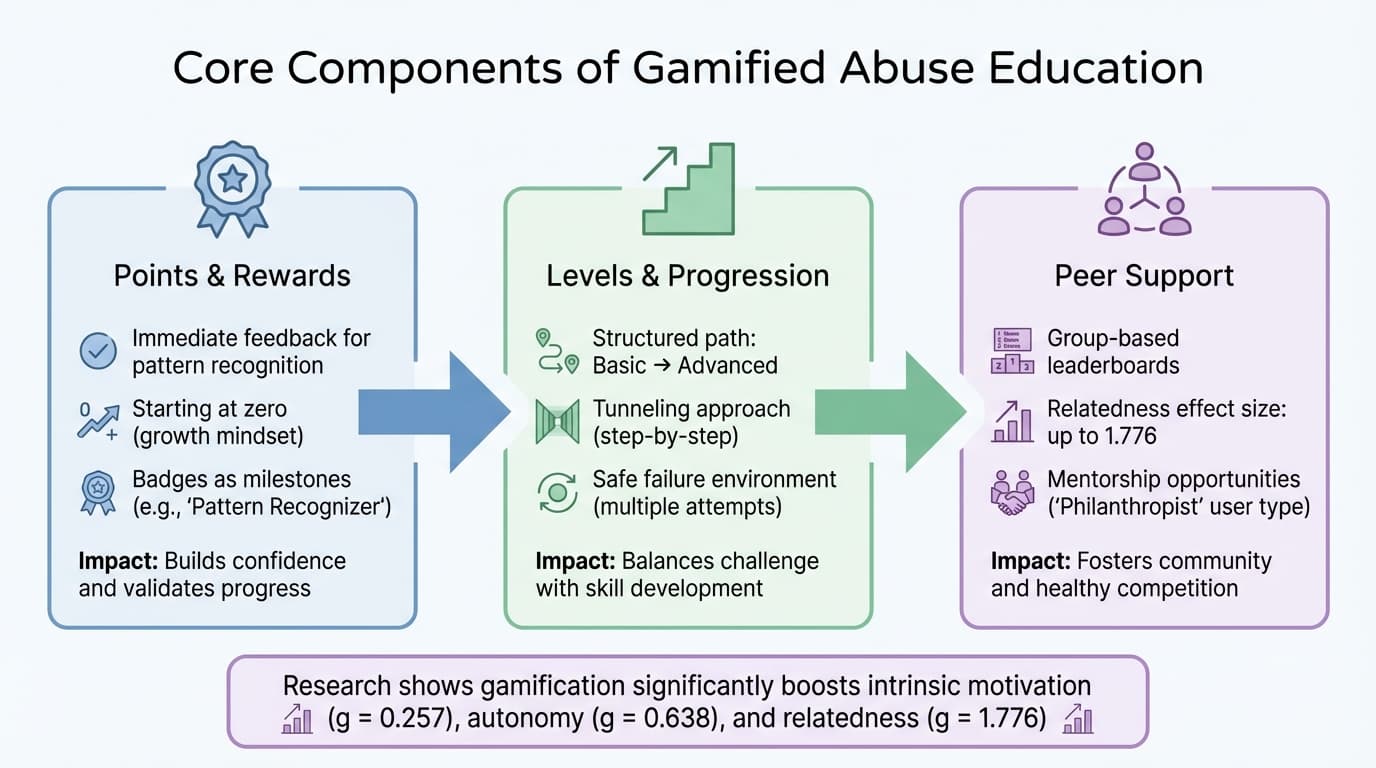
A point system offers immediate feedback when learners identify abusive behaviors. Starting at zero and adding points for correct answers emphasizes improvement and growth rather than penalizing mistakes. This approach encourages learners to focus on recognizing patterns like gaslighting or manipulation tactics, fostering a sense of progress and accomplishment [2].
"'Leveling up' indicates how their experience is increasing and how they are moving toward the end goal, rather than how they are not 'making the grade' and falling further down the scale." - UC Berkeley Teaching Guide [2]
Rewards such as badges and trophies act as milestones, celebrating achievements along the way. A review of behavior change games highlights that rewards, challenges, points, and feedback are key features for boosting engagement [3]. While these external motivators provide immediate satisfaction, they are most impactful when they also nurture a deeper interest in abuse prevention. For instance, earning a "Pattern Recognizer" badge can validate a learner’s progress and build confidence, encouraging them to continue practicing.
These rewards lay the groundwork for a structured and engaging learning journey.
Levels and Progression in Learning
Structured levels provide a clear path from basic understanding to advanced skill mastery. This method uses tunneling - a step-by-step approach that ensures learners grasp foundational concepts before tackling more complex scenarios [3]. For example, learners might start by identifying obvious red flags and gradually progress to recognizing subtler forms of manipulation. Maintaining the right balance between challenge and skill is key to keeping learners engaged. If tasks are too simple, they may lose interest; if too difficult, frustration can take over [3].
Incorporating safe failure - where learners can make multiple attempts in low-pressure settings - allows them to practice identifying abuse patterns without fear of harsh consequences [2]. This creates a supportive environment where mistakes are part of the learning process.
This progression naturally leads to opportunities for collaborative learning through peer interaction.
Peer Support Through Leaderboards
As learners advance individually, leaderboards can add a sense of community and healthy competition. By showcasing achievements relative to peers, leaderboards fulfill the need for competence and connection. Studies show gamification can significantly enhance feelings of relatedness among students (effect size up to 1.776) [5]. Group-based competition fosters a shared sense of purpose, which is especially valuable when addressing sensitive topics. However, poorly designed leaderboards can create discomfort for those ranked lower, potentially harming the learning environment [5].
To avoid this, focusing on "leveling up" and earning points rather than direct score comparisons can alleviate pressure. Anonymizing lower rankings ensures a more supportive atmosphere. Additionally, research indicates that many female learners resonate with the "Philanthropist" user type, driven by a desire to help others and share knowledge [6]. Features that allow experienced learners to mentor peers can tap into this altruistic motivation, strengthening the sense of community and mutual support.
Designing Tools for Sensitive Topics
Ethical Guidelines for Abuse Topics
When designing tools for sensitive subjects like abuse education, it's crucial to maintain transparency about the science and goals behind each feature. Clearly explain the reasoning and objectives to build trust. Tailor the design to fit different age groups and demographics. For instance, younger users might find leaderboards motivating, but older adults could feel discouraged by them. Collecting demographic information early on allows for customization that avoids harming users' self-esteem. Be cautious with features that may cross the line between engagement and manipulation, as these can lead to anxiety or lower self-worth. Gamification should empower users by aligning with their personal goals and offering clear opt-out options for features that might not suit everyone’s preferences [8].
Data privacy is another critical element. Use encrypted storage and establish clear, transparent policies to protect user information. This is especially important given the 30% rise in data breaches within educational settings over the past two years [7]. Strong privacy measures not only safeguard users but also encourage participation by addressing common concerns.
Finally, consider how cultural factors and accessibility can shape the tool’s effectiveness for diverse audiences.
Cultural Sensitivity and Accessibility
Collaborating with local stakeholders is key to creating abuse education tools that resonate with specific communities. A great example is the mobile game "HappyToto" in Tanzania, which was developed with input from local partners. By aligning with cultural norms, it has successfully encouraged discussions about prevention [10].
Respect for local customs is essential, especially when it comes to language and content. In some regions, explicit terms for body parts might be seen as offensive. Adjusting the terminology or integrating local religious teachings and gender roles can make the material more acceptable and relatable [10].
Accessibility plays a big role, too. A mobile-first design is particularly effective in areas with limited resources, as smartphones are widely used even in many developing regions. Adding multi-language support and breaking content into short, interactive modules can help learners stay engaged without feeling overwhelmed. Applying flow theory - balancing difficulty with the user’s skill level - ensures the experience remains both challenging and enjoyable [10][11][12].
Lastly, prioritize user safety. Include features like restricted interactions and real-time reporting to prevent misuse, ensuring the tool doesn’t become a platform for exploitation or grooming [4].
Implementation Strategies
Combining Gamification with Facilitator Support
Blended learning combines the interactive nature of gamified tools with the personalized guidance of live facilitators. This method allows learners to engage with dynamic content while receiving immediate support for complex emotional or behavioral challenges [15].
"Learning by doing when you're constructing, building your own knowledge is more powerful in many cases. It's not sugarcoating a broccoli." - Celia Hodent, Games UX Expert [16]
For example, a clinical pharmacist at VA Connecticut Healthcare System implemented a six-session gamified curriculum. This program used game formats and role-playing to teach both factual content and clinical skills. The results? A high effectiveness rating of 4.55 out of 5 and a practice change among 66% of the residents who participated [15].
To structure sessions effectively, consider adopting a "10-45-5" format: spend 10 minutes on introductions and instructions, 45 minutes on active gameplay, and 5 minutes on feedback and debriefing [15]. This approach keeps learners engaged while reducing cognitive load by focusing their attention on one task at a time [13]. Facilitators are essential in bridging the gap between the gamified experience and real-world application, ensuring that behavior changes persist even after the tools are no longer in use [16].
Facilitators should also prioritize psychological safety by establishing clear ground rules for participation [15]. In programs that allow content reporting, moderators must be trained to handle sensitive issues, such as identifying and addressing online child sexual exploitation and abuse [4].
This blend of gamification and facilitator support creates a strong foundation for incorporating interactive tools into broader educational strategies.
Adding Gamified Tools to Educational Programs
Once facilitator support is in place, integrating gamified tools into existing curricula can amplify abuse education efforts. Instead of creating standalone initiatives, embed these tools into programs where psychological safety and learning expectations are already established [15]. Tailor the game mechanics to the type of content being taught: for example, use knowledge-based games like Jeopardy-style quizzes for factual learning, and opt for scenario-based role-playing to develop skills and encourage behavioral shifts [15].
A great example of this is Omnicom Media Group's gamified diversity program, which engaged millennials through role-based challenges. These challenges rewarded inclusive behaviors, offering a safe space to explore unconscious bias without real-world repercussions [13].
Sony Music took a different route, adapting live workshops for geographically dispersed teams into a scalable gamified eLearning course. This transition not only improved knowledge retention but also saved the company $100,000 in costs [13].
For long-term impact, consider delivering gamified sessions over a year-long curriculum to reinforce sensitive topics and improve retention [15]. Use short-term, rotating leaderboards or allow learners to compete against their own previous scores. This approach keeps motivation high without the risk of alienating participants, which can happen with permanent, company-wide leaderboards [13][14]. Framing learning tasks as "missions" or "quests" can also transform passive learning into an engaging, problem-solving experience [14].
Detect Manipulation in Conversations
Use AI-powered tools to analyze text and audio for gaslighting and manipulation patterns. Gain clarity, actionable insights, and support to navigate challenging relationships.
Start Analyzing NowMeasuring and Improving Gamified Tools
Tracking Engagement and Learning Results
The MAKE Framework provides a structured way to measure four key areas: Motivation, Attitude, Knowledge, and Engagement [17]. This framework has been shown to be highly reliable, with scores ranging from 0.90 to 0.92. Here's how each element can be assessed:
- Motivation: Evaluate how well the tool captures attention, presents relatable content, builds confidence, and delivers satisfaction.
- Attitude: Distinguish between emotional reactions (how users feel) and cognitive perceptions (what users believe).
- Knowledge: Move beyond basic test scores to determine if learners grasp the importance of the material, find the delivery effective, and can apply concepts in practical scenarios.
- Engagement: Look at both emotional (fun, interest, excitement) and cognitive aspects (meaningful effort and deep thinking) of user involvement [17].
To refine these assessments, incorporate key performance indicators like completion rates, quiz attempts, and the accumulation of experience points [2]. For example, in 2024, Luis Fernando Pérez Armas from IÉSEG School of Management introduced "Pugcoins", a digital currency system aimed at improving sexual health literacy. Students earned tokens by participating in peer consulting and asking thoughtful questions, fostering collaboration and active learning [21].
Updating Design Based on Feedback
Once engagement levels are tracked, regular feedback is crucial for improving gamified tools. This can be gathered through static methods like surveys or dynamic metrics such as login frequency, time spent on tasks, and quiz attempts. Research shows that 56% of studies on tailored gamification emphasize the importance of "user modeling" to adapt tools effectively [18]. Real-time data can help adjust difficulty levels or provide hints when users face challenges [18].
Blending various user profiles, such as player types and motivation styles, can enhance learning outcomes more effectively than relying on a single profile. Regular updates are also essential to counteract the "novelty effect", where initial excitement wanes over time [19].
"The consultation of all relevant stakeholders (including but not limited to mental health researchers, technology users, clinicians, software developers, and, where involved, game and gamification designers) is crucial for the success of gamification for mental health and wellbeing." - Vanessa Wan Sze Cheng, The University of Sydney [19]
For sensitive topics like abuse, it’s vital to have experts review the game’s abstractions to ensure they don’t unintentionally convey harmful messages. Additionally, be vigilant for users who might "game the system" by rushing through modules just to earn points, which can lead to poor retention and missed learning opportunities. A practical solution is to implement daily point caps to encourage balanced and meaningful engagement [20].
Using AI Tools Like Gaslighting Check

Real-Time Emotional Analysis in Games
AI tools like Gaslighting Check are transforming gamified abuse education by offering real-time emotional analysis and enhanced security features. By integrating AI into these platforms, users benefit from immediate feedback and deeper insights into behavioral patterns.
These tools use natural language processing (NLP) to monitor text and voice interactions, identifying manipulation tactics such as guilt-tripping, FOMO (fear of missing out) strategies, and indirect control techniques. This creates a "safe failure" environment where users can practice recognizing and responding to manipulation without real-world consequences [2][9].
Gaslighting Check leverages this technology to analyze conversations across both text and voice channels. It generates detailed reports on manipulation tactics and provides actionable insights. A standout feature is its real-time audio recording capability, which captures interactions and highlights emotional manipulation patterns that users might overlook.
Additionally, computer vision technology can assess facial expressions and emotional states during sessions. This allows the tool to adapt content in real time, helping users identify manipulation across multiple communication methods. This layered approach enhances pattern recognition skills and provides a comprehensive understanding of how manipulation operates in various contexts [23].
Privacy and Security in Learning Tools
While swift detection of manipulation is vital, ensuring privacy and security is equally critical. AI tools must prioritize protective defaults, transparent data usage, and human oversight to build trust with users, particularly adolescents, who are more vulnerable when using educational AI tools [24].
Gaslighting Check addresses these concerns with features like end-to-end encryption and automatic data deletion. For users on its Premium Plan ($9.99/month), the tool securely tracks conversation history under strict user-controlled encryption policies. Automatic data deletion further ensures confidentiality, fostering honest engagement, especially among younger users [25][1].
"AI can either extend access and personalization in higher ed - or it can trap students in manipulative loops. Which path we take depends on the questions we're willing to ask now." – Claire Brady, EdD [22]
To prevent unhealthy dependencies and maintain real-world social boundaries, the tool sends regular reminders to users that they are interacting with AI. It also includes clear options to report concerns or disengage from the platform. For adolescent users, the tool enforces age-appropriate defaults and sets interaction limits at the most protective levels, ensuring a safe and supportive learning environment [24].
Conclusion and Key Takeaways
Summary of Best Practices
Gamified abuse education isn’t just about sprinkling in points, badges, or leaderboards - it’s about building on a solid foundation of quality education. As Dr. Michael Wu, Chief Scientist at Lithium Technologies, wisely notes:
"Gamification is the icing on the cake. If your cake is bad, the icing won't make it any better." [20]
To make these programs effective, there’s a delicate balance to strike between sensitivity and engagement, ensuring the serious nature of abuse topics is never diminished [16]. A key focus should be on fostering intrinsic motivation - helping learners feel autonomous, competent, and connected - rather than relying too much on external rewards like prizes or rankings [16]. Research backs this up: a meta-analysis involving 35 interventions and 2,500 participants revealed that gamification significantly boosts intrinsic motivation (Hedges' g = 0.257) while also improving autonomy (g = 0.638) and relatedness (g = 1.776) [5].
Collaboration is another critical piece of the puzzle. When designers work with subject matter experts, they can ensure the game mechanics reflect real-life abuse scenarios without unintentionally sending harmful messages [4] [19]. And let’s not forget the importance of safe failure environments - spaces where learners can practice identifying manipulation tactics without fear of real-world consequences [2]. By aligning game design with ethical considerations and cultural awareness, gamified education can lead to meaningful, lasting behavior changes.
When these practices come together, they lay the groundwork for using technology to expand and improve abuse prevention efforts.
Technology's Role in Abuse Prevention
Technology plays a transformative role in abuse prevention by creating safe, judgment-free spaces where people can explore sensitive topics [25]. Research shows that gamified approaches improve both knowledge and attitudes toward abuse prevention (P < 0.001), while AI tools like Gaslighting Check provide real-time feedback and prioritize user privacy [1]. These tools highlight how digital platforms can scale and adapt to reach high-risk groups more effectively.
Take Gaslighting Check as an example. By blending gamification principles with advanced AI capabilities like pattern recognition and encrypted data protection, it makes abuse education more interactive and actionable. This approach aligns with the concept of “safety by design,” where features like reporting tools and proactive abuse detection are built into the system from the start rather than added later [4]. These advancements demonstrate how technology can amplify the impact of gamified abuse education, making it more accessible and impactful for those who need it most.
FAQs
How does gamification enhance engagement in abuse education?
Gamification takes tough and sensitive topics, like abuse education, and turns them into interactive and engaging learning experiences. By weaving in features like points, progress bars, and story-driven scenarios, it keeps learners motivated and makes the material feel less intimidating. These tools offer immediate feedback, create a sense of accomplishment, and inspire active participation.
Studies show that learning through games boosts both the ability to retain knowledge and the confidence to apply it. For instance, scenario-based games let learners practice decision-making in a risk-free setting, helping them adopt protective behaviors and develop empathy. This method doesn’t just grab attention - it holds it, transforming complex subjects into practical and impactful lessons.
How does AI enhance gamified tools for abuse education?
AI is transforming gamified abuse education tools, making them more interactive and impactful. By analyzing user behavior and adjusting scenarios in real time, AI delivers personalized learning experiences. These tools can simulate manipulation tactics, such as gaslighting or emotional abuse, and immediately highlight red flags. This helps learners identify abusive patterns more effectively and equips them with the knowledge to respond.
AI also processes user inputs - like text or voice - to detect subtle signs of emotional manipulation. For example, tools like Gaslighting Check use advanced algorithms to flag these tactics, offering detailed reports and real-time alerts. When integrated into gamified modules, this technology enhances engagement and reinforces key learning objectives.
Moreover, AI contributes to the ethical and inclusive design of these tools by prioritizing transparency, privacy, and fairness. These features ensure that AI-driven abuse education remains both responsible and effective in fostering awareness and prevention.
How can gamified education be designed to be inclusive and culturally sensitive?
To design gamified education that is inclusive and mindful of cultural differences, it’s crucial to create content that mirrors the varied experiences and values of learners. For abuse-prevention training, this means weaving in scenarios that are relatable across different cultural settings - whether it’s addressing family roles, communication habits, or community expectations. Making the material feel relevant and respectful can significantly boost engagement and learning outcomes.
Some practical approaches include working closely with community stakeholders and subject-matter experts to ensure authenticity. Offering personalization options, like customizable avatars or storylines, can help learners see themselves in the material. Using inclusive language and visuals that reflect a range of identities is another way to make the experience more welcoming. Additionally, flexible features like adjustable difficulty levels or alternative formats, such as text-to-speech, can enhance accessibility for a broader audience.
For sensitive topics like gaslighting, tools like Gaslighting Check can elevate the learning experience by providing real-time feedback during simulated conversations. This allows learners to practice spotting manipulation tactics in scenarios tailored to their cultural context, all while maintaining privacy. Thoughtful design choices like these make gamified education not only effective but also accessible and relevant for everyone.