Top Tools for Detecting Hate Speech

Top Tools for Detecting Hate Speech
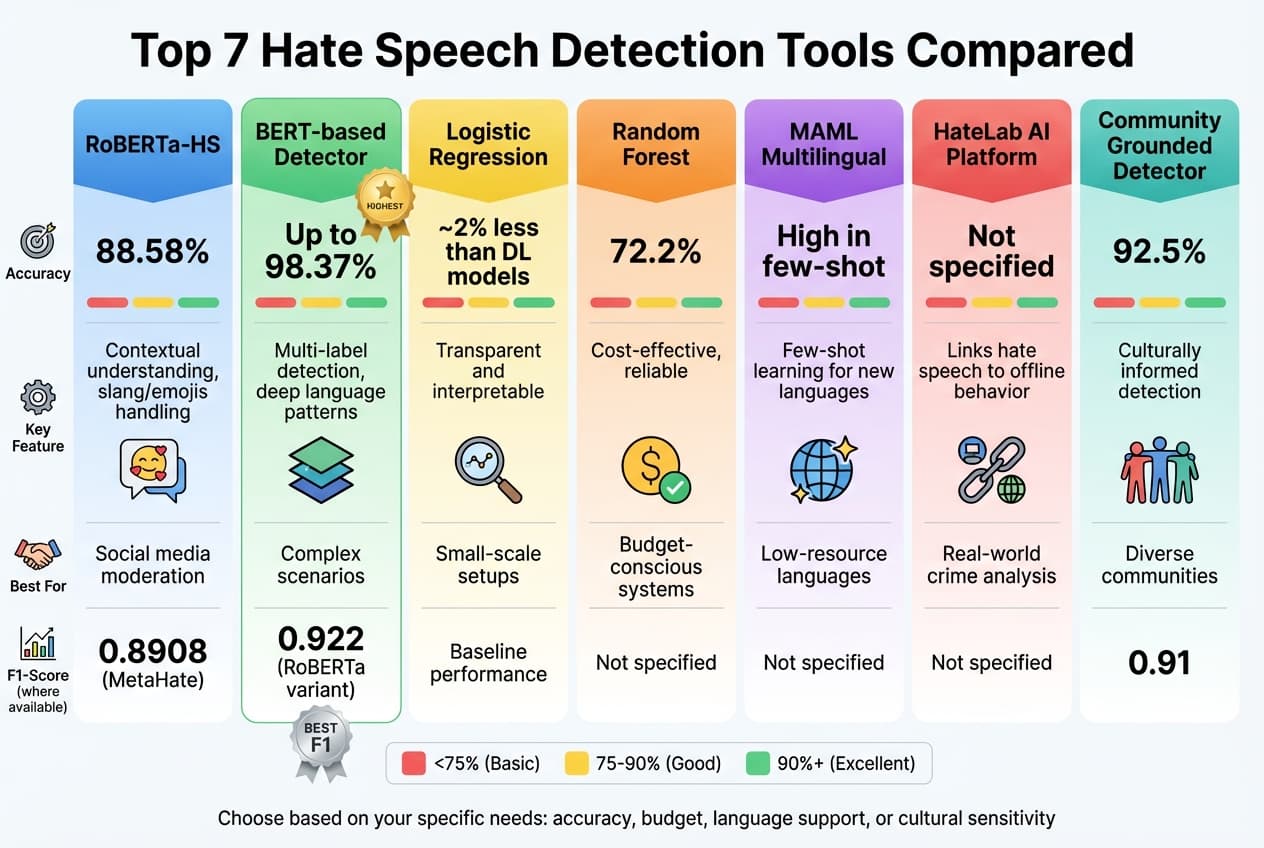
Hate speech detection is crucial for managing online platforms, where harmful content can spread quickly. Advanced AI tools now make it possible to identify and address emotional manipulation effectively. Here's a quick overview of the top tools discussed:
- RoBERTa-HS: A transformer-based model fine-tuned for hate speech, achieving 88.58% accuracy and excelling at understanding context, slang, and emojis. This level of detail is similar to how sentiment analysis tracks manipulation in digital text.
- BERT-based Detector: Known for its contextual understanding, it delivers high accuracy (up to 98.37%) and supports multi-label detection.
- Logistic Regression (LR): A simple, transparent model ideal for smaller-scale systems, offering steady performance.
- Random Forest (RF): An ensemble method that balances efficiency and reliability, suitable for cost-effective setups.
- MAML Multilingual Model: Adapts quickly to new languages with minimal training data, useful for underrepresented languages.
- HateLab AI Platform: Links online hate speech to offline trends, featuring tools for de-escalation and real-time monitoring.
- Community Grounded Detector: Focuses on local and linguistic nuances, with input from native speakers for better accuracy.
Each tool has strengths tailored to specific needs, from handling nuanced language to supporting multilingual detection or offering transparency. Below is a quick comparison of their features.
Quick Comparison
| Tool | Accuracy | Key Feature | Best For |
|---|---|---|---|
| RoBERTa-HS | 88.58% | Contextual understanding, slang/emojis handling | Social media moderation |
| BERT-based Detector | Up to 98.37% | Multi-label detection, deep language patterns | Complex scenarios |
| Logistic Regression | ~2% less than DL models | Transparent and interpretable | Small-scale setups |
| Random Forest | 72.2% | Cost-effective, reliable | Budget-conscious systems |
| MAML Multilingual | High in few-shot | Few-shot learning for new languages | Low-resource languages |
| HateLab AI Platform | Not specified | Links hate speech to offline behavior | Real-world crime analysis |
| Community Detector | 92.5% | Culturally informed detection | Diverse communities |
These tools empower organizations to tackle hate speech effectively, tailored to their specific operational needs.
::: @figure
Natural Language Processing for Hate Speech Detection
Detect Manipulation in Conversations
Use AI-powered tools to analyze text and audio for gaslighting and manipulation patterns. Gain clarity, actionable insights, and support to navigate challenging relationships.
Start Analyzing Now1. RoBERTa-HS

RoBERTa-HS stands out as a leading tool for detecting hate speech, thanks to its foundation on the RoBERTa architecture and its fine-tuning for this specific task. Using transformer-based technology, the model processes text in both directions, allowing it to grasp context, intent, and detect emotional manipulation effectively. As Ehxodus AI explains:
Detecting hate speech isn't just about flagging keywords. You need a system that understands context, recognizes intent, and adapts to evolving language.
RoBERTa employs dynamic masking, which helps it continually learn and adapt to language patterns. For hate speech detection, it is fine-tuned on labeled datasets using Byte-Pair Encoding (BPE). This approach enables the model to handle the nuances of online communication, including slang, emojis, typos, and abbreviations.
Accuracy
In July 2023, researchers Antypas and Camacho-Collados fine-tuned RoBERTa-base on a dataset of 83,230 tweets collected from 13 different platforms. Their work resulted in an impressive 88.58% accuracy on the MetaHate dataset [4].
F1-Score
RoBERTa-HS achieved strong results in F1-score metrics. Its average Macro-F1 score across 13 test sets was 69.7%. For specific categories, it scored 72.4% on racism, 70.4% on sexism, and 73.9% on disability-related hate speech. On the MetaHate dataset, the overall F1 score reached 0.8908 [3][4].
Dataset Used
The model is trained on large-scale datasets, including:
- MetaHate: 1,667,496 entries
- Kaggle's Hate Speech dataset: 24,783 tweets
- UC Berkeley's Measuring Hate Speech corpus: 50,000 annotations
These datasets pull data from platforms like Twitter, Facebook, and Reddit, ensuring the model encounters a wide variety of linguistic styles and contexts [1][2][4].
Key Strengths
RoBERTa-HS excels at handling the unpredictable nature of online language. It effectively processes slang, abbreviations, emojis, and creative misspellings. The model also incorporates explainability tools like SHAP and LIME, which help identify triggering words, offering more transparency and reducing its "black box" reputation. Additionally, variants like XLM-RoBERTa expand its functionality to detect hate speech in multiple languages, even in settings with limited resources [5].
These strengths make RoBERTa-HS a powerful benchmark for evaluating other tools in hate speech detection.
2. BERT-based Hate Speech Detector
BERT has proven to be highly effective in detecting hate speech, particularly in multi-label scenarios. Unlike older models like Recurrent Neural Networks (RNN) or Long Short-Term Memory (LSTM), BERT utilizes multiple transformer layers to grasp contextual subtleties. This enables it to identify nuanced hate speech and language manipulation, including negative stereotypes, metaphors, and irony [6][7].
Accuracy
Fine-tuned BERT models deliver impressive accuracy levels. For instance, the bert-base-uncased model achieved an accuracy of 98.14% in detecting hate and offensive speech. The larger roberta-large model performed slightly better, reaching 98.37% accuracy [12]. These results highlight BERT's ability to interpret complex language patterns that simpler, keyword-based systems often overlook.
F1-Score
BERT's performance is also evident in its F1-scores. In the OffensEval 2019 challenge, the best BERT model achieved an F1-score of 0.829, while RoBERTa pushed this to 0.922 by 2020, showcasing rapid advancements [9]. Multi-label BERT models are evaluated using metrics like Subset Accuracy, Hamming Loss, and F1-score, which are particularly useful for handling overlapping hate categories - such as content targeting both religion and gender [7].
Dataset Used
BERT-based hate speech detectors are trained on diverse datasets to ensure comprehensive coverage:
- RAL-E dataset: Built from Reddit comments from banned communities, this dataset was used to create HateBERT, a specialized version of BERT that outperforms general-purpose models [8].
- Measuring Hate Speech corpus: Contains nearly 50,000 annotations covering 10,000 unique comments from platforms like YouTube, Reddit, and Twitter [2].
- OffensEval datasets (2019 and 2020): These are widely recognized benchmarks, with all top 10 teams in 2020 using BERT-based architectures [9].
Key Strengths
BERT's ability to leverage transfer learning makes it highly effective, even with limited labeled data. By fine-tuning pre-trained models for specific tasks, BERT achieves high performance [11][13]. Additionally, Multilingual BERT (mBERT) supports 104 languages, enabling "zero-shot" applications - where a model trained in English can detect hate speech in less-resourced languages [13]. Specialized versions like HateBERT, retrained on abusive content, further enhance detection capabilities. As researchers Caselli, Basile, Mitrović, and Granitzer observed:
In all datasets, HateBERT outperforms the corresponding general BERT model.
Another advantage is BERT's ability to manage unbalanced datasets better than traditional machine learning models. It can also integrate bias mitigation mechanisms to reduce racial and dialectic biases, particularly those affecting African-American English [10][11]. With these advanced features, BERT has set a strong foundation for the ongoing development of hate speech detection tools. This progress mirrors advancements in real-time emotional manipulation detection, which also relies on transformer-based architectures to analyze conversational intent.
3. Logistic Regression (LR) Model
While modern neural networks often steal the spotlight, Logistic Regression (LR) holds its ground as a straightforward and transparent option. Unlike the more complex deep learning models, LR provides clear, interpretable results, which can be especially helpful for content moderators trying to understand why certain content is flagged. Even though deep learning methods might achieve slightly better accuracy (around 2% higher) [14], the clarity and simplicity of LR make it a practical choice.
Accuracy
Logistic Regression is often used as a baseline in hate speech detection tasks [15]. While advanced deep learning models typically edge out LR in performance by a small margin (approximately 2% higher accuracy) [14], LR still stands out as one of the strongest individual classifiers among traditional machine learning techniques [16]. This steady performance makes it a dependable option, especially for initial testing in hate speech detection systems.
Dataset Used
LR models are trained on widely recognized datasets, such as the Offensive Language Identification Dataset (OLID) and its derivatives, including AbuseEval [15]. With the growing demand for multilingual capabilities, LR is also being tested on datasets in various languages like Bengali, Arabic, and Chinese [15]. Additionally, datasets that differentiate between explicit and implicit abuse are used to evaluate how well LR can handle nuanced forms of hate speech.
Key Strengths
One of LR's standout features is its transparency. Its decision-making process is easy to interpret, which is crucial for justifying flagged content. Frameworks like Rasch measurement theory, which treat hate speech as a continuous scale, further enhance LR's interpretability. Moreover, LR can integrate "data perspectivism", allowing it to reflect the diverse viewpoints of annotators [2]. This adaptability makes it particularly useful for analyzing human-labeled data from different cultural backgrounds.
4. Random Forest (RF) Model
Random Forest uses an ensemble of decision trees to classify hate speech, offering a practical and cost-effective alternative to deep learning methods. This approach has shown to be especially useful for analyzing unstructured text from platforms like Twitter, Facebook, and MySpace [17]. While it may not receive the same level of attention as deep learning models, RF consistently delivers reliable results, making it a valuable tool for hate speech detection research.
Accuracy
In July 2019, researchers Kristiawan Nugroho and Edy Noersasongko evaluated Random Forest using a Twitter hate speech dataset. The model achieved an accuracy of 72.2% in detecting hate speech and offensive language [17]. This performance was better than AdaBoost, which reached 70.8%, and significantly outperformed basic Neural Network methods, which achieved only 59.6% accuracy [17].
Dataset Used
Random Forest has been tested on several benchmark datasets, including:
- OffensEval from SemEval 2019 and 2020, which focuses on identifying offensive language [5].
- The Bengali Hate Speech Dataset, containing 30,000 posts with 33% classified as abusive [15].
- The Measuring Hate Speech corpus, which includes nearly 50,000 annotations across 10,000 social media comments from platforms like YouTube, Reddit, and Twitter [2].
For larger-scale evaluations, datasets with up to 100,000 tweets, categorized into hate speech, offensive language, and neutral content, have also been used [15].
Key Strengths
Random Forest stands out for its lower computational requirements compared to Transformer models, making it a practical choice for organizations with limited resources [5]. This efficiency is particularly valuable when working with smaller, manually annotated datasets. Additionally, RF serves as a dependable baseline for comparing newer detection methods [5].
While Support Vector Machines and Logistic Regression sometimes achieve slightly higher accuracy within traditional machine learning approaches [5], Random Forest remains a strong option for analyzing offensive speech patterns on social media [17]. Its balance of efficiency and reliability ensures it remains a relevant benchmark alongside advanced models like RoBERTa-HS and BERT-based detectors.
5. MAML Multilingual Model
The MAML (Model-Agnostic Meta-Learning) Multilingual Model adopts a "learning to learn" approach for detecting hate speech. Instead of relying on massive datasets for every language, it capitalizes on high-resource languages and adapts with just a few examples. This makes it especially useful for languages lacking large labeled datasets [18].
Key Strengths
MAML shines in few-shot learning, enabling it to detect hate speech in new languages with minimal training data. Studies reveal that MAML and Proto-MAML outperform traditional transfer learning methods when applied to languages with limited resources. The model has been tested across eight languages: English, Norwegian, Arabic, Spanish, German, Italian, French, and Portuguese.
Its model-agnostic design means it can integrate with different architectures, such as BERT or Nor-BERT, offering flexibility for various use cases. This flexibility proves valuable in both zero-shot scenarios (where no data from the target language is available) and few-shot scenarios (with limited examples). For instance, Hashmi's implementation effectively handled binary hate speech detection in both English and Norwegian.
Dataset Used
MAML-based models use multilingual datasets to ensure cross-lingual performance. Common datasets include HateCheck, which spans 10 languages, and specialized datasets for African and Indian languages. The model has also been tested on low-resource datasets like Norwegian using Nor-BERT, where traditional methods often fall short [18].
6. HateLab AI Platform

The HateLab AI Platform, created by Cardiff University and commercialized by Nisien.ai, bridges the gap between online hate speech detection and real-world crime. By linking digital behavior to offline consequences, the platform helps identify patterns of hate crimes in specific geographic areas [19].
Dataset Used
HateLab leverages a vast dataset to refine its predictive capabilities. This includes 180 million location-tagged tweets combined with nearly 600,000 crime incidents recorded by the Metropolitan Police. Additionally, it incorporates data from the All Wales Hate Crime Project, the largest study of its kind in the UK. Together, these datasets demonstrate a clear connection between online hate speech and physical hate crimes [21,22].
Key Strengths
The platform's Hero system goes beyond basic keyword searches, using advanced learning to understand evolving language patterns, context, and intent, similar to how AI detects emotional manipulation in digital conversations. This enables it to detect coded abuse that might otherwise go unnoticed. As highlighted by a representative from the Welsh Government's Inclusion and Cohesion Team:
Social media users have become more savvy in the way they direct abuse, and often do not use openly hateful language, instead choosing to use more coded words… The search function on HateLab provides a way of homing in on these terms.
One of its standout features is the "resolve" capability, which employs generative AI to suggest de-escalation responses instead of outright censoring content. Testing indicates this approach can reduce negative interactions by up to 65% by promoting counter-narratives [19]. Professor Matt Williams, Director of HateLab, elaborates:
The best way to fight hate and authoritarianism is via debate, so it's essential to maintain free speech. Through interacting with individuals using the Hero platform, the resolve capability aims to persuade them to change hateful behavior.
The platform has proven its effectiveness in real-world scenarios. In 2022, telecommunications company EE collaborated with Nisien.ai during the Women's Euros and Men's World Cup to monitor and address misogynistic hate targeting players on social media. In 2024, HateLab supported online threat analysis for Eurovision contestants amidst heightened tensions due to the war in Gaza. Most recently, in 2025, the Football Association of Wales used the platform to safeguard players during the UEFA Women's Euro 2025 [19].
7. Community Grounded Detector
The Community Grounded Detector takes a unique approach by involving local communities and native speakers to define hate speech. This method helps the model understand culturally specific expressions and subtleties that English-focused tools often overlook [20]. By combining community-driven insights with advanced AI models, it becomes better equipped to identify hate speech in a way that respects cultural and linguistic diversity.
Dataset Used
The detector was trained and tested using a multilingual dataset covering 12 languages, including less commonly represented ones like Amharic, Swahili, Urdu, and Sindhi. This dataset was developed in collaboration with local communities to ensure the definitions of hate speech were both culturally and linguistically relevant [23, 24].
Accuracy
The model delivers an impressive accuracy rate of 92.5%, showcasing its effectiveness across a variety of languages and contexts [21].
F1-score
With an F1-score of 0.91, the detector demonstrates a strong balance between precision and recall, even when working with datasets that have uneven distributions [21].
Key Strengths
This detector uses a hybrid architecture that blends Convolutional Networks, Capsule Networks, and Gated Recurrent Units (GRUs). This combination allows it to identify intricate linguistic patterns effectively [23, 24]. Its lightweight design ensures it can be deployed at scale, while the community-centered approach helps detect implicit hate, such as coded language and cultural stereotypes, which traditional keyword-based systems often miss [20].
Comparison Table
Here's a concise breakdown of the top hate speech detection tools, their datasets, and standout features, based on insights from the Measuring Hate Speech project. These tools utilize specialized datasets and advanced techniques to tackle the complexities of hateful content.
| Tool | Primary Dataset | Main Strengths |
|---|---|---|
| RoBERTa-HS | Measuring Hate Speech Corpus (50,000 annotations across 10,000+ comments from YouTube, Reddit, Twitter) | Uses advanced transformer architecture with a continuous measurement scale (based on Rasch theory) to capture context-specific nuances. |
| BERT-based Hate Speech Detector | Measuring Hate Speech Corpus | Strong contextual understanding and sensitivity to demographic variations in annotations. |
| Community Grounded Detector | Multilingual dataset | Excels at detecting implicit hate and coded language through culturally informed, community-driven definitions. |
This comparison illustrates how each tool brings unique strengths to hate speech detection systems. For example, RoBERTa-HS and the BERT-based Hate Speech Detector leverage the Measuring Hate Speech Corpus to analyze hate speech and detect emotional shifts along a nuanced spectrum, moving beyond simple binary classifications. Their focus on context and demographic subtleties ensures more precise detection.
On the other hand, the Community Grounded Detector stands out for its multilingual capabilities and cultural adaptability. By incorporating input from native speakers, it uncovers implicit and coded hate speech that traditional keyword-based approaches often miss. This makes it an ideal choice for organizations working in diverse linguistic and cultural settings.
Conclusion
Selecting the best hate speech detection tool means matching its capabilities to your specific needs. Transformer-based models like RoBERTa-HS and BERT lead the pack with impressive accuracy rates of about 95% and 94%, respectively [22]. These models shine at interpreting complex linguistic patterns and subtle nuances, such as distinguishing manipulation from healthy conflict, that simpler approaches might miss.
For organizations handling multiple languages or code-mixed content, multilingual models are specifically designed to navigate diverse linguistic challenges [22]. On the other hand, traditional methods such as Logistic Regression and Random Forest, while less accurate, can still work well for smaller-scale scenarios [22].
Accuracy isn’t the only factor to consider - performance and speed are equally critical. Advanced AI platforms now deliver ultra-low latency of around 190 ms for real-time processing, which is essential for live moderation systems [23]. As BetaKit aptly puts it:
Latency may be invisible to users, but it will define who wins in AI
The urgency for robust solutions is evident. Online racial hate speech spiked by 250% after events like George Floyd’s death, highlighting the pressing need for dependable detection systems [22]. The tools discussed here are designed to meet these challenges head-on, equipping organizations with the resources to build effective and responsive hate speech detection systems.
FAQs
How do I choose the right hate speech detection tool for my platform?
To pick the best hate speech detection tool, prioritize accuracy, real-time capabilities, privacy safeguards, and integration ease. Accurate detection is key for dependable results, while real-time analysis ensures swift moderation. Opt for tools that emphasize privacy with features like encryption and robust data security. Also, make sure the tool seamlessly integrates with your platform and can keep up with changes in language and slang to stay effective over time.
How do these models handle coded language, sarcasm, and emojis?
Hate speech detection models use advanced methods, including deep learning, to analyze more than just straightforward text. These models dive into coded language, sarcasm, and even emojis, uncovering meanings hidden beneath the surface. By assessing contextual clues and emotional patterns, they can pick up on subtleties that go beyond literal interpretations.
Some tools incorporate sentiment and emotion analysis to identify manipulative or harmful tactics, while emojis are evaluated based on their emotional undertones. However, sarcasm and coded language continue to be tricky areas for these models. Researchers are constantly working to refine these systems, aiming to improve their ability to handle such complexities.
What’s the best approach for detecting hate speech in low-resource languages?
Detecting hate speech in languages with fewer resources poses unique challenges, mainly due to the scarcity of datasets and linguistic tools. Tackling this requires a combination of strategies: developing datasets that reflect the cultural nuances of the language, leveraging transfer learning to adapt models trained on well-resourced languages, and employing multilingual NLP techniques. These approaches become even more effective when paired with culturally informed testing, especially for languages that involve code-switching or have distinct linguistic characteristics.