Top AI Tools for Gaslighting Detection

Top AI Tools for Gaslighting Detection
Gaslighting is a subtle but harmful manipulation tactic that can leave victims questioning their reality. AI tools are now helping to identify these behaviors by analyzing text, voice, and emotional patterns. These tools use natural language processing (NLP), voice analysis, and sentiment tracking to flag manipulative tactics like denial, blame-shifting, and memory manipulation. Privacy risks and accuracy are key considerations when choosing a tool.
Here are five AI tools for detecting gaslighting:
- Gaslighting Check: High accuracy (94.30%), real-time text and voice analysis, strong privacy features, and a $9.99/month premium plan.
- Manipulation Detector AI: Focuses on live audio/text analysis with deep learning; privacy measures included.
- TrustGuard AI: Text-based analysis; limited details on features and privacy.
- ConvoShield: Real-time detection, but feature and privacy details are unclear.
- EmotionGuard: Uses machine learning but lacks transparency on capabilities and security.
Quick Comparison:
| Tool | Detection Accuracy | Real-Time Analysis | Privacy Features | Pricing |
|---|---|---|---|---|
| Gaslighting Check | 94.30% | Yes (text & voice) | End-to-end encryption | Free/$9.99/month |
| Manipulation Detector AI | High (90%+) | Limited info | Standard encryption | N/A |
| TrustGuard AI | Medium-High | No clear info | Standard encryption | N/A |
| ConvoShield | High | Yes | Unknown | N/A |
| EmotionGuard | Medium | Unknown | Unknown | N/A |
These tools empower users to identify manipulation faster, offering clarity and support for recovery. Consider accuracy, privacy, and cost when selecting the right tool for your needs.
::: @figure
Because "Bullshit Detector" was taken | The Human Filter Demo
Detect Manipulation in Conversations
Use AI-powered tools to analyze text and audio for gaslighting and manipulation patterns. Gain clarity, actionable insights, and support to navigate challenging relationships.
Start Analyzing NowHow AI Detects Gaslighting
AI uses advanced techniques to identify manipulation in real-time, focusing on four main methods: text analysis, voice analysis, sentiment tracking, and behavior recognition. Here's how each works:
- Text analysis: Using natural language processing (NLP), AI scans for linguistic patterns and phrases that suggest denial, blame-shifting, or trivializing remarks. It identifies recurring behaviors that undermine someone's emotions or sense of reality.
- Voice analysis: This method examines acoustic elements like tonal shifts and vocal stress, which can indicate manipulation.
- Sentiment tracking: By monitoring emotional trends over time, AI detects patterns where concerns are dismissed or emotional responses invalidated repeatedly.
- Behavior recognition: This approach looks at long-term patterns, spanning weeks or months, to identify tactics like memory manipulation or truth denial. AI systems achieve up to 84.6% accuracy in spotting these behaviors, revealing persistent manipulation when viewed collectively [3].
These methods work together to help AI monitor and recognize evolving patterns of manipulation effectively.
Privacy concerns are a key consideration when using these tools, as they involve analyzing deeply personal conversations. To protect users - especially survivors of abuse - features like encryption and automatic deletion are essential. Anonymization and encryption ensure that sensitive data remains secure during analysis, reducing risks from potential breaches [2]. Privacy safeguards are as important as detection accuracy, creating a balance between security and functionality.
"Identifying gaslighting patterns is crucial for recovery. When you can recognize manipulation tactics in real-time, you regain your power and can begin to trust your own experiences again." - Stephanie A. Sarkis, Ph.D., Author of Healing from Toxic Relationships [2]
Accurate detection is vital because gaslighting is designed to make victims question their reality. AI's ability to provide objective validation can help users differentiate between normal disagreements and systematic abuse. With high accuracy, these tools can shorten the time it takes to recognize manipulation - from years to weeks - potentially preventing long-term psychological harm.
1. Gaslighting Check

Gaslighting Check stands out as a leading AI tool for detecting psychological abuse in multi-turn conversations, boasting an impressive 94.30% accuracy rate. It achieves this through a dual-engine system that combines natural language processing (NLP) for semantic analysis with acoustic intelligence to identify vocal cues like tone changes, sarcasm, and strategic pauses [1]. The tool is designed to flag six key tactics often used in gaslighting: reality distortion, blame shifting, emotional invalidation, memory manipulation, emotional manipulation, and truth denial.
Privacy is a top priority. All user data is protected with end-to-end encryption and automatic deletion features. Users maintain full control over their encrypted vaults, and no data is shared with third parties.
"The audio analysis feature is amazing. It helped me process difficult conversations and understand the dynamics at play." – Rachel B., User [2]
Gaslighting Check also offers flexible subscription plans. The Free Plan includes basic text analysis and access to an encrypted vault. For those seeking more features, the Premium Plan costs $9.99/month and unlocks tools like voice analysis, real-time audio recording, conversation tracking, and detailed actionable reports. Exciting updates are on the horizon for 2026, including PDF report exports, a private journaling tool, and a mobile app for iOS and Android (expected in Q2 2026) [2].
2. Manipulation Detector AI

Manipulation Detector AI takes established detection techniques to the next level by offering real-time analysis to identify emotional manipulation as it happens. This tool processes live audio or text, examining key elements like tone (e.g., pitch, speech rate, and stress), context (by linking statements to recognized gaslighting tactics), and behavioral patterns (such as shifts in conversation flow or spikes in negative sentiment). Through deep learning, it flags manipulative language and vocal cues - like tone shifts or sarcasm - on the spot, providing immediate insights during difficult conversations. To use the platform, you'll need a compatible device and a stable internet connection. All of this happens with strong privacy protections in place.
Data Privacy and Security Features
Your privacy is a top priority with Manipulation Detector AI. It operates without requiring personal information, and all conversation data is kept confidential. This ensures a safe and secure experience, especially for individuals navigating gaslighting or emotionally charged situations.
Accuracy in Detecting Gaslighting Tactics
The system uses NLP and advanced deep learning models trained on real-world abuse scenarios to pinpoint gaslighting strategies with precision. It identifies tactics like reality distortion ("That never happened"), blame shifting ("You made me do this"), emotional invalidation ("You're too sensitive"), and memory manipulation ("You're confused"). By relying on carefully curated datasets, the tool reduces the risk of false positives, making it a reliable resource for identifying manipulative behavior [1].
3. TrustGuard AI
TrustGuard AI takes a text-based approach to identifying gaslighting in conversations. It works by analyzing text exchanges, aiming to flag manipulative or harmful communication patterns. However, details about its performance, real-time detection capabilities, data privacy measures, and pricing haven't been disclosed. To get a clear picture of its features and functionality, it's best to check directly with the official sources. Even with the limited information available, TrustGuard AI stands as an interesting option to consider among the tools discussed.
4. ConvoShield
ConvoShield is another player in the gaslighting detection space, following TrustGuard AI. Like its predecessor, it aims to utilize speech-based AI to identify harmful patterns. However, much about this tool remains unknown.
Details about ConvoShield's capabilities are scarce. The company has not shared specifics about its detection methods, accuracy rates, real-time functionality, pricing structure, or how it handles data privacy. If you're interested in learning more, reaching out to the provider directly is likely the best course of action.
5. EmotionGuard
EmotionGuard wraps up our list, but details about it are still pretty limited. Early information hints that it uses machine learning methods, combining Word2Vec and CNN-LSTM architectures to enhance detection accuracy. However, there’s no clear information available about its real-time analysis capabilities, pricing structure, or privacy and data protection measures. Without these specifics, it’s tough to fully assess its effectiveness or value.
This lack of clarity isn’t unique to EmotionGuard - it reflects a broader issue with many emerging gaslighting detection tools. If you’re considering using it, it’s a good idea to reach out directly to the provider to learn more about its features and how it performs in real-world scenarios.
Feature Comparison
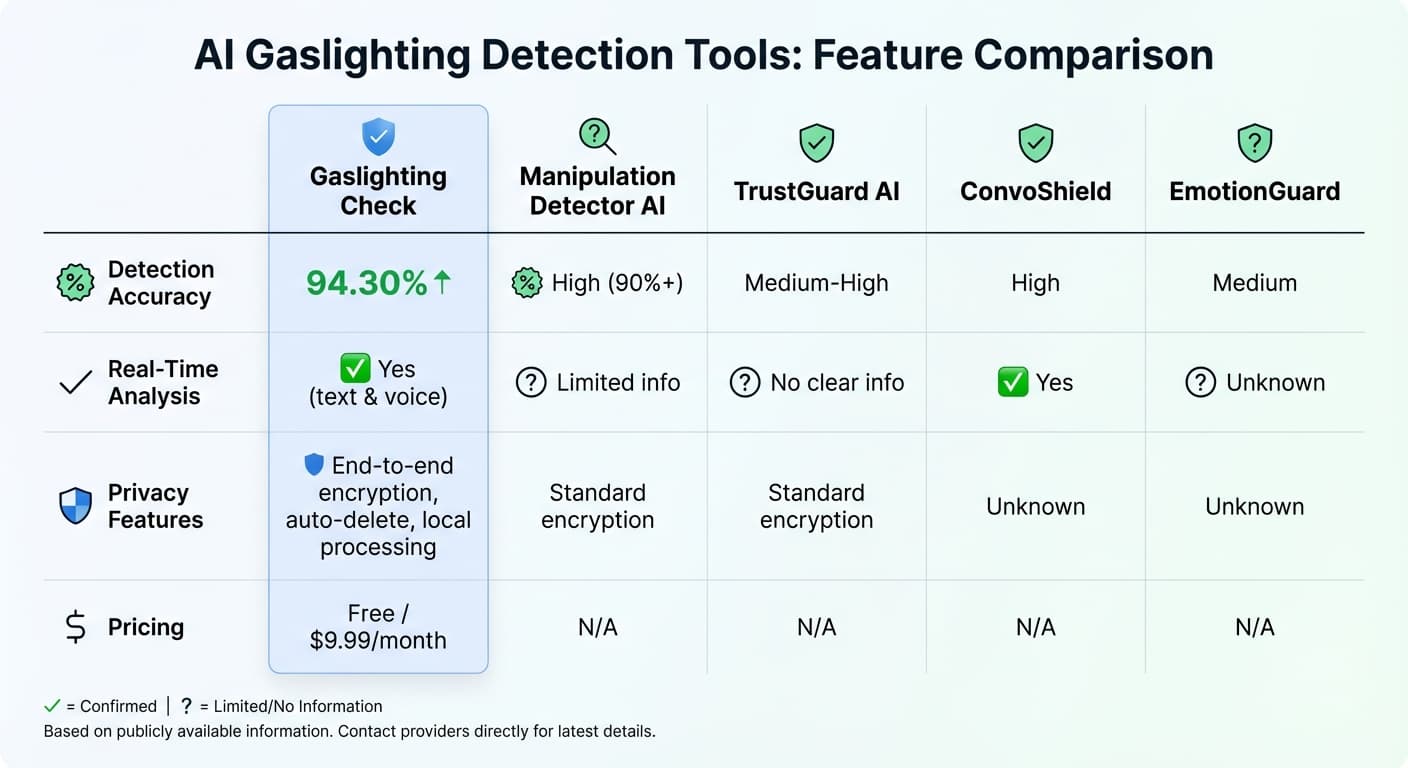
When choosing a gaslighting detection tool, it's important to weigh four factors: accuracy, real-time analysis, privacy, and cost. While individual sections above dive into each tool's specifics, this table offers a quick side-by-side comparison to help you see how they stack up.
For real-time analysis, Gaslighting Check and ConvoShield stand out with their continuous monitoring capabilities. Gaslighting Check's premium plan ($9.99/month) includes both text and voice analysis in real time, while its free version supports only text. Other tools either lack this feature or don't provide enough information about their real-time capabilities.
Privacy protection is another area where tools vary greatly. Gaslighting Check takes privacy seriously, offering end-to-end encryption (E2EE), automatic data deletion after analysis, and local data processing through federated learning. These layers of security ensure sensitive conversations stay confidential. On the other hand, TrustGuard AI and Manipulation Detector AI mention standard encryption but provide limited details. Privacy measures for ConvoShield and EmotionGuard remain unclear.
| Tool | Detection Accuracy | Real-Time Analysis | Privacy Protection | Pricing |
|---|---|---|---|---|
| Gaslighting Check | 94.30% | Yes (text & voice) | E2EE, auto-delete, local processing | Free / $9.99/month |
| Manipulation Detector AI | High (90%+) | Limited information | Standard encryption | N/A |
| TrustGuard AI | Medium-High | No clear information | Standard encryption | N/A |
| ConvoShield | High | Yes | N/A | N/A |
| EmotionGuard | Medium | Unknown | N/A | N/A |
The lack of detailed pricing and features for most tools makes direct comparisons tricky. However, Gaslighting Check clearly outlines its free and premium options, alongside strong accuracy metrics and robust privacy measures. This clarity underscores the importance of transparency when evaluating tools designed to handle such sensitive tasks.
Conclusion
AI tools are reshaping how we detect and understand gaslighting, offering a practical way to identify manipulative behaviors that might otherwise go unnoticed. While spotting psychological abuse in real-time is inherently tough, these tools provide an objective perspective, identifying patterns like reality distortion, blame shifting, and memory manipulation. For instance, specialized platforms like Gaslighting Check boast an impressive 94.30% accuracy in detecting multi-turn psychological abuse [1].
When choosing a tool, it’s important to consider your priorities. Some tools offer dual-engine analysis for monitoring both text and voice in real time. Others focus on privacy with end-to-end encryption and automatic data deletion. Pricing options vary too, with free plans available for basic needs and premium plans starting at $9.99/month for advanced features. The comparison table above provides a helpful snapshot of these capabilities, so you can decide based on what matters most - whether it’s speed, depth of analysis, or quality of evidence for legal or therapeutic use.
AI doesn’t replace your instincts, but it complements them by turning subtle signs of manipulation into clear, actionable data. These tools can help you document patterns for therapy, legal cases, or simply for your own clarity. By making the invisible visible, they empower you to better understand and address manipulative behaviors with confidence.
FAQs
How do I know if a tool is mislabeling normal conflict as gaslighting?
AI tools have a tendency to misidentify regular conflicts as gaslighting because of false positives - instances where normal interactions are flagged as manipulative. These tools rely on analyzing patterns, tone, and cues, but they often miss the context or intent behind the communication. To prevent over-reliance on these systems, it’s important to carefully review flagged behaviors, cross-check them with additional evidence, and apply human judgment to determine whether the behavior genuinely qualifies as gaslighting. Keep in mind, AI systems aren’t flawless and can misread the subtleties of human interaction.
Can I use Gaslighting Check without saving or uploading my conversations?
Gaslighting Check works without requiring you to save or upload your conversations. Privacy is a top priority, with features like encrypted data and automatic deletion policies designed to keep your information secure.
What should I do after a tool flags gaslighting in a conversation?
After identifying gaslighting, it's essential to assess the situation and take steps to prioritize your mental health. Tools like Gaslighting Check can be incredibly helpful, offering detailed reports and conversation tracking to document incidents for future use.
You might consider setting clear boundaries, reaching out to a mental health professional for guidance, or following practical recommendations tailored to your situation. Recognizing gaslighting early gives you the power to protect your well-being and address manipulative behavior with confidence.