AI Tools for Recognizing Verbal Manipulation

AI Tools for Recognizing Verbal Manipulation
Verbal manipulation, like gaslighting or blame-shifting, can deeply harm relationships by distorting reality and undermining trust. With the rise of digital communication, detecting these tactics has become more complex. AI tools, such as Gaslighting Check, use text and voice analysis to identify manipulative language patterns in real-time. These systems analyze language patterns, vocal cues, and recurring behaviors to help users recognize and address manipulation.
Key Features of Gaslighting Check:
- Text Analysis: Flags manipulative phrases like "You're too sensitive."
- Voice Analysis: Detects tone, pitch, and stress for deeper insights.
- Pattern Tracking: Monitors long-term behaviors for recurring tactics.
- Privacy: Offers end-to-end encryption and automatic data deletion.
- Pricing:
- Free Plan: Basic text analysis.
- Premium Plan ($9.99/month): Adds voice analysis and detailed reports.
- Enterprise Plan: Custom solutions for organizations.
AI tools like this empower individuals to better understand and confront manipulation, offering clarity and support in challenging interactions.
The Power–and Limits of–AI in Detecting Lies | Xunyu Chen | TEDxYouth@RVA

Detect Manipulation in Conversations
Use AI-powered tools to analyze text and audio for gaslighting and manipulation patterns. Gain clarity, actionable insights, and support to navigate challenging relationships.
Start Analyzing NowGaslighting Check: Features and Pricing

::: @figure
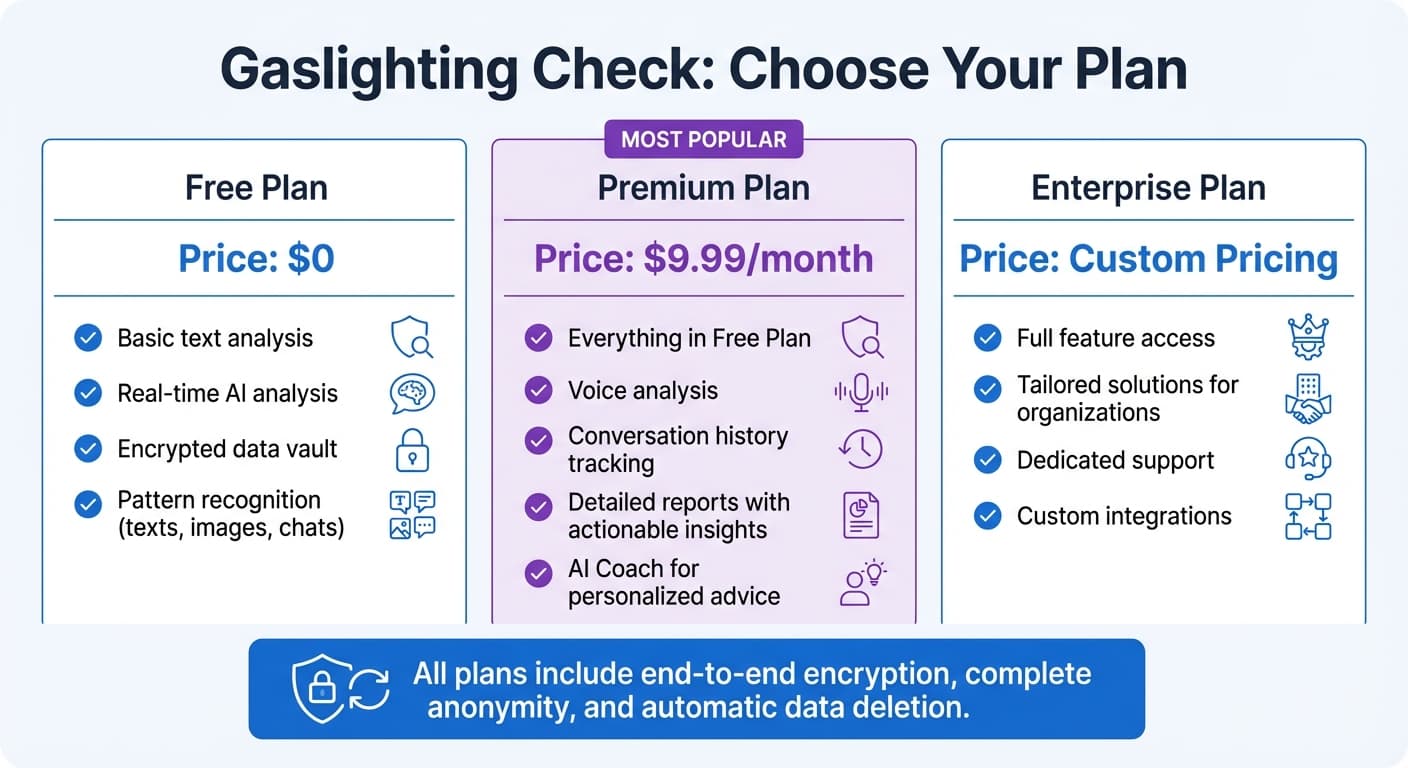
Gaslighting Check offers advanced AI tools designed to help users identify and counter verbal manipulation. This SaaS platform goes beyond basic detection methods by combining text and voice analysis to deliver deeper insights in real time. With a freemium model, it ensures accessibility for anyone, whether they're just starting to recognize emotional abuse or are on the path to recovery. Here's a closer look at its key features, privacy measures, and pricing.
Main Features
Gaslighting Check provides real-time audio recording, enabling users to capture and analyze live conversations instantly. The platform uses a multimodal analysis approach - merging NLP for text-based detection of manipulation tactics like reality distortion, blame-shifting, and invalidation, with deep learning to assess vocal cues such as pitch, tone, and speed. This combination helps uncover subtle manipulation methods that might be missed if only text were analyzed, like vocal stress or tonal shifts indicating emotional pressure.
For Premium users, the platform delivers detailed reports that highlight specific manipulative moments and suggest actionable steps. It also offers conversation history tracking, which helps users monitor recurring patterns of manipulation over time. The AI Coach feature adds another layer of support by providing personalized advice based on the analysis, helping users set boundaries and regain control in challenging interactions. All these features are backed by a strong focus on data security.
Privacy and Security
Gaslighting Check prioritizes user privacy with end-to-end encryption, ensuring that no third party can access transmitted or stored data. The platform also guarantees complete anonymity, making it impossible to trace information back to an individual. To further protect users, it includes automatic deletion settings that erase data after processing, minimizing long-term privacy risks.
Pricing Options
Gaslighting Check offers three pricing tiers - Free, Premium, and Enterprise - allowing users to choose a plan that fits their needs.
- The Free Plan ($0) includes basic text analysis, real-time AI capabilities, an encrypted data vault, and pattern recognition across texts, images, and chats.
- The Premium Plan ($9.99/month) builds on the Free Plan by adding features like voice analysis, conversation tracking, and detailed reports.
- The Enterprise Plan (custom pricing) is designed for organizations, offering full access to all features, tailored solutions, and dedicated support.
Stephanie A. Sarkis, Ph.D., author of Healing from Toxic Relationships, emphasizes the importance of tools like this:
"Identifying gaslighting patterns is crucial for recovery. When you can recognize manipulation tactics in real-time, you regain your power and can begin to trust your own experiences again." [3]
| Plan | Price | Key Features |
|---|---|---|
| Free Plan | $0 | Basic text analysis, real-time AI analysis, encrypted vault, pattern recognition in texts/images/chats |
| Premium Plan | $9.99/month | Everything in Free, plus voice analysis, conversation history tracking, and detailed reports |
| Enterprise Plan | Custom | Full feature access, tailored solutions for organizations, and dedicated support |
AI Technologies for Detecting Manipulation
Detecting manipulation with AI involves three main technologies: natural language processing (NLP), voice analysis, and pattern recognition. These tools work together to analyze not just the content of communication but also how it’s expressed, uncovering manipulation tactics that might otherwise slip by unnoticed. For example, a model developed at Edge Hill University demonstrated impressive results, achieving 88% accuracy in identifying abusive messages using historical data on domestic abuse [1].
However, implicit manipulation remains challenging for AI to detect. Experts like Soroush Vosoughi highlight that large language models (LLMs) such as GPT-4 often lack the nuanced social intelligence required to pick up on subtle cues. They may confuse general toxicity with targeted manipulation. Testing on the MentalManip dataset - a collection of 4,000 dialogues filtered for 175 manipulative phrases - has revealed that even advanced models struggle with subtler tactics like sarcasm or passive-aggressive remarks [2]. Below, we’ll explore how each technology contributes to detecting manipulation.
Text Analysis
AI breaks down written communication to uncover manipulation through language patterns, word choices, and sentence structures. NLP algorithms are particularly skilled at identifying common gaslighting phrases, such as:
- Reality distortion: "That never happened."
- Blame-shifting: "You made me do this."
- Invalidation: "You're too sensitive."
These tools can also flag emotionally charged questions or statements designed to confuse or control, such as sarcastic comments like "Great job" delivered after a failure [2]. Despite these advances, implicit manipulation can still be misinterpreted by LLMs. To improve accuracy, fine-tuning with specialized datasets remains crucial.
Voice Analysis
Voice analysis focuses on vocal cues that text alone can’t capture - like tone, pitch, speaking speed, pauses, and vocal stress. These elements often reveal emotional pressure or deception that contradicts spoken words. For instance, when someone says "I'm fine" but their tone and hesitation suggest otherwise, AI can pick up on the inconsistency as a potential sign of manipulation. Combining voice and text analysis creates a more comprehensive detection system, capturing subtle cues such as tonal shifts or vocal stress that might otherwise be missed.
Pattern Recognition
Beyond analyzing individual interactions, AI uses pattern recognition to identify systematic manipulation across conversations. By monitoring recurring behaviors, it builds on text and voice insights to detect manipulative cycles. For example, it can spot patterns like "love bombing" (excessive affection) followed by criticism or emotional withdrawal. Advanced algorithms use T-pattern analysis to identify behavioral sequences that indicate manipulative intent.
| Pattern Type | AI Detection Focus | Common Indicators |
|---|---|---|
| Emotional Manipulation | Shifts in emotional pressure | Guilt-tripping, excessive flattery, love bombing |
| Reality Distortion | Inconsistent narratives | Contradictory statements, "That never happened" |
| Memory Manipulation | Altering recollections | "You're remembering it wrong", "You're confused" |
| Blame Shifting | Responsibility deflection | Redirecting blame to the victim, false equivalencies |
This temporal analysis allows AI to reveal patterns often overlooked in isolated interactions, exposing the systematic nature of manipulation over time. By combining these insights, AI offers a powerful tool for identifying manipulation in both subtle and overt forms.
How Gaslighting Check Identifies Manipulation Tactics
Gaslighting Check uses a mix of how AI detects emotional manipulation through text analysis, voice recognition, and pattern tracking to uncover manipulation tactics in conversations. It pinpoints specific strategies designed to distort perceptions, shift blame, or provoke emotional reactions. The platform then compiles detailed reports showing when and how these tactics occur, helping users understand manipulation as it unfolds and evolves.
Let’s break down how the tool handles emotionally charged questions, manipulative phrases, and recurring behaviors.
Emotionally Loaded Questions
Gaslighting Check’s text analysis zeroes in on questions crafted to elicit guilt or defensiveness rather than genuine responses. These questions often include accusations, false premises, or emotional coercion. For example, questions like, "Why do you always make everything about yourself?" or "Don’t you care about my feelings at all?" are designed to corner you emotionally, not to foster open dialogue.
The platform’s NLP algorithms analyze word choices, sentence structure, and emotional tone to flag these tactics. By identifying these patterns, Gaslighting Check helps users see when questions are being weaponized instead of used for meaningful communication.
Gaslighting Phrases
The tool also identifies specific phrases often tied to manipulation. It can distinguish between misunderstandings and deliberate attempts to manipulate. For instance, phrases like "You made me do this" shift blame, while statements like "You’re too sensitive" invalidate the listener’s feelings.
When these phrases appear repeatedly or in tandem with other manipulative tactics, the system highlights them in its reports. This makes subtle manipulation tactics more recognizable and easier to address.
Recurring Manipulation Behaviors
Gaslighting Check goes beyond individual phrases or questions by tracking long-term patterns in conversations. Through its Premium Plan ($9.99/month), the platform monitors systematic behaviors over time. It establishes a baseline for normal communication and flags deviations, such as increased controlling language or isolation tactics.
Using T-pattern analysis, the system tracks the frequency and timing of manipulation tactics. It even measures speaking time ratios to identify "steamrolling" behaviors, where one person dominates conversations through constant interruptions. Premium users can access the "Pattern Analysis" section of their reports to view visual trends, showing how manipulation tactics may escalate over weeks or months. This feature helps uncover patterns that might otherwise go unnoticed in day-to-day interactions.
Using Gaslighting Check in Daily Life
Incorporating Gaslighting Check into your daily routine is straightforward. The platform operates discreetly, analyzing conversations in real-time and compiling a record of interactions over time. Whether you're dealing with a challenging relationship, reflecting on past experiences, or simply aiming to better understand communication dynamics, this tool adjusts to your needs without requiring technical know-how or lifestyle changes.
Setup and Basic Use
Getting started is simple. Download the app, grant microphone permissions, and you're ready to begin. Before a phone call or face-to-face conversation, tap the record button to capture audio. The system automatically flags unusual tone shifts or prolonged pauses that may indicate manipulation. If recording audio isn’t your preference, you can copy and paste text from messages or emails into the platform for analysis.
The app provides instant alerts during recordings if it detects potential red flags. Once the conversation ends, a detailed analysis is completed within minutes. For Free Plan users, text analysis identifies basic manipulation tactics. Premium Plan subscribers ($9.99/month) gain access to advanced voice analysis, which evaluates pitch changes and speech rate to distinguish between genuine emotional stress and intentional coercion. Recorded conversations are then compiled into easy-to-review reports.
Reading Reports
The platform's reports break down manipulative behaviors with clarity. Specific moments in the conversation are flagged, complete with scores indicating the severity of the manipulation. Sections marked for emotionally charged questions or gaslighting phrases are highlighted, making it easier to pinpoint triggers. For Premium users, voice analysis adds depth by including visual graphs that track pitch shifts and pauses, uncovering subtle emotional manipulation beyond the words themselves.
By combining text and voice data, you get a fuller understanding of what occurred. For example, a phrase like "I never said that" might appear harmless in writing, but voice analysis could reveal a sarcastic or dismissive tone that confirms manipulative intent. Rather than focusing on isolated incidents, the tool encourages users to identify recurring patterns, which are far more telling of consistent behavior.
Conversation History Tracking
Gaslighting Check also allows you to track conversation history, offering a broader view of long-term patterns. Premium users can revisit past recordings and reports to identify recurring manipulative tactics that might not be obvious in day-to-day interactions. The history feature even lets you set alerts for specific phrases, like "You're too sensitive" or "You're overreacting", so you can monitor their frequency over time.
For those seeking deeper understanding or validation, conversation logs can be exported for personal reflection or therapy discussions. Looking back on these records can help you recognize patterns and reinforce boundaries. Emily R., a user who relied on the tool while recovering from a manipulative relationship, shared:
"This tool helped me recognize patterns I couldn't see before. It validated my experiences and gave me the confidence to set boundaries."[3]
All conversation logs are stored securely and automatically deleted in accordance with the app's privacy policies.
Conclusion
Verbal manipulation thrives on silence and confusion. With 3 in 5 people experiencing gaslighting without realizing it at the time, and victims enduring an average of over two years in manipulative relationships before seeking help [3], the importance of accessible tools for identifying gaslighting is undeniable.
Gaslighting Check stands out by offering a blend of privacy, simplicity, and affordability. Features like end-to-end encryption and automatic data deletion ensure that your most personal conversations stay confidential, fostering honest self-reflection without the fear of exposure. This commitment to privacy aligns with broader efforts in AI to prioritize user security and trust.
What makes Gaslighting Check truly practical is how seamlessly it fits into everyday life. You don’t need technical know-how - the app does the heavy lifting. It flags emotionally charged questions, manipulative phrases, and subtle tone changes, helping users uncover hidden patterns of manipulation in ordinary conversations. With clear and actionable insights, it equips users to recognize and address manipulation head-on.
Identifying manipulation is the first step toward reclaiming control. For those questioning their experiences in relationships, gaslighting at work, or even within families, tools like this provide validation and clarity. While they’re not a substitute for professional help, they serve as a critical starting point - documenting interactions and shedding light on subtle behaviors that might otherwise go unnoticed.
Breaking free from manipulation starts with awareness. Gaslighting Check makes that awareness accessible, secure, and easy to use - helping you trust your instincts and take charge when it matters most.
FAQs
How accurate is AI at spotting subtle gaslighting?
AI has shown the ability to detect subtle indicators of gaslighting with an impressive accuracy rate of 94–95%. It does this by analyzing patterns in text and voice. However, its understanding isn't flawless - context, tone, and nuances tied to specific situations or backgrounds can still pose challenges, potentially impacting its accuracy in some cases.
Can Gaslighting Check mislabel normal conflict as manipulation?
Gaslighting Check might sometimes mistake ordinary disagreements for manipulation. This can happen because it struggles to pick up on subtle context, tone, or specific social dynamics. While the tool aims to spot emotional manipulation, its findings should be viewed as one piece of the puzzle, not as absolute proof.
Is it safe and legal to record conversations with the app?
Recording conversations with the app prioritizes your safety and privacy. It employs end-to-end encryption, ensures automatic data deletion, and processes data locally on your device. These features work together to keep your information secure and private at all times.