
AI Coaching for Healthy Communication
AI coaching tools are transforming how we improve communication skills. They provide instant feedback on tone, emotional shifts, and clarity, helping users tackle challenges like misunderstandings, conflict, and manipulation. Tools like BetterUp and Gaslighting Check offer practical solutions for both personal and professional interactions. Key benefits include:
- Real-time feedback: Instant suggestions on tone and clarity during conversations.
- Simulations: Practice challenging scenarios with AI personas.
- Gaslighting detection: Tools like Gaslighting Check analyze text and voice for manipulation patterns.
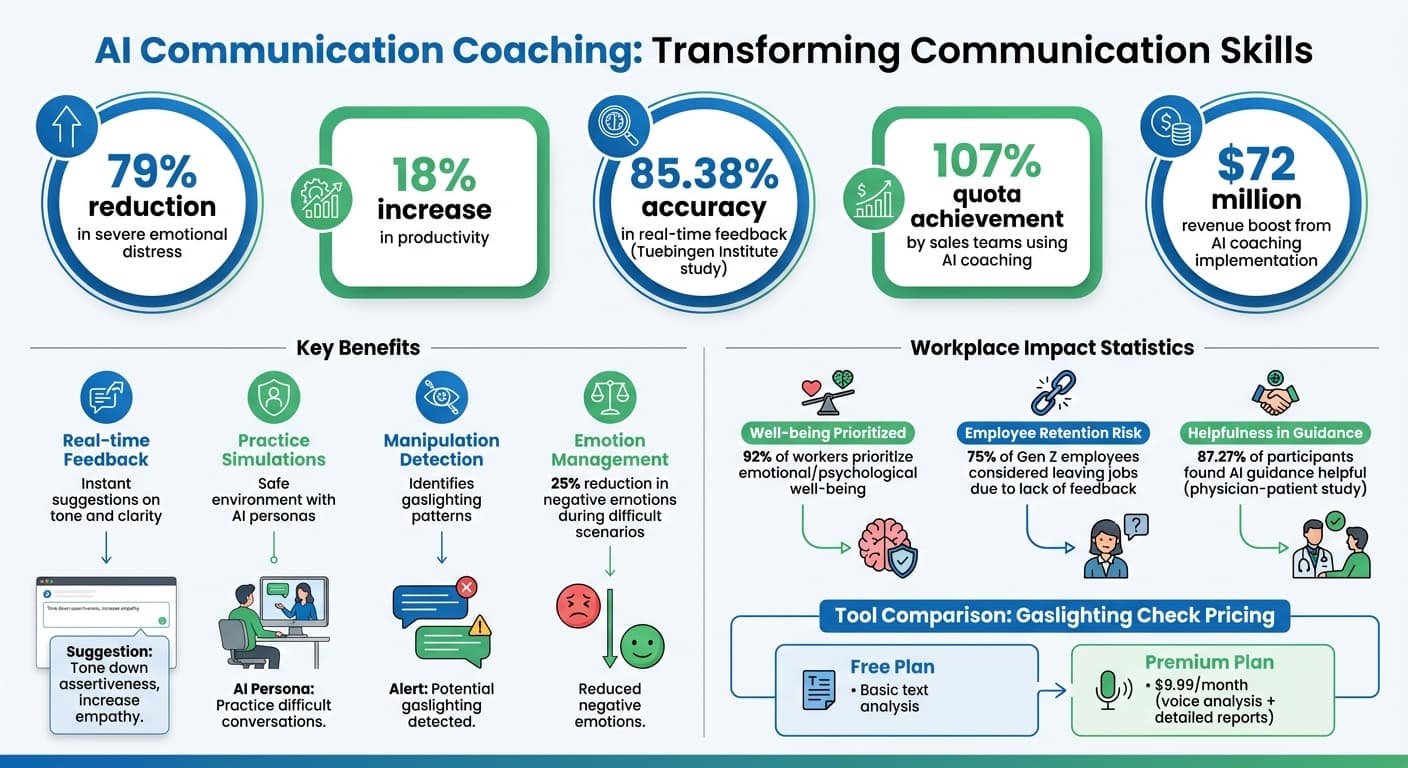
Studies show AI-assisted communication tools boost productivity by 18% and reduce emotional distress by 79%. These tools empower users to handle conversations with confidence, improving relationships at work and home.
::: @figure
Gemini 2.0 AI Helps You MASTER Difficult Conversations in Minutes
Common Communication Problems
Communication often stumbles in predictable ways. When crucial details are left out, misunderstandings are almost inevitable. For instance, telling someone to "handle this project" without specifying the deadline, budget, or priorities leaves too much room for misinterpretation. Vague expressions like "you should know what I mean" only add to the confusion [5].
In digital conversations, the absence of social cues - like facial expressions, tone of voice, and body language - makes it harder to interpret the intent behind messages. A neutral statement might come across as cold or even hostile, leading to unnecessary conflict. Without these cues, it’s easy for simple comments to spark tension [5]. These challenges exist in both online and in-person interactions, though they manifest differently.
Fear can also silence open communication. Today, 92% of workers rank emotional and psychological well-being as a priority when choosing an employer. Yet, many hesitate to speak up, worried they might appear incompetent or stir conflict. This silence can lead to what researchers call "innovation silos", where teams operate under false assumptions, wasting time and resources or missing deadlines [6][7].
How Gaslighting and Manipulation Affect People
Gaslighting stands out as a particularly damaging communication issue, distorting reality and causing people to doubt their own memories and perceptions. A manipulator might dismiss concerns with phrases like "that never happened" or "you're too sensitive", eroding the victim’s confidence in their own judgment over time [4].
Some common tactics include intermittent reinforcement - alternating between affection and neglect unpredictably - and token gestures, like small apologies or gifts, that fail to address the underlying issues. Manipulators may also engage in "victim playing", positioning themselves as the wronged party to deflect accountability.
Clinical psychologist Carla Marie Manly, Ph.D., explains:
Manipulation is the act of purposefully exerting psychological control over an individual for personal gain [3].
Victims often describe their experience as "walking on eggshells", censoring themselves to avoid triggering anger or displeasure. Psychologist Annia Raja, Ph.D., highlights this dynamic:
If you're afraid of setting off your partner's anger or displeasure, and you're constantly monitoring yourself around them, you may be dealing with a manipulative partner [3].
Manipulators often isolate their targets, cutting them off from friends, family, or colleagues who could provide an objective perspective. In workplaces, withholding key information can foster dependency and feelings of helplessness, further undermining self-trust [4][3].
What Stops People from Communicating Well
Even without overt manipulation, everyday communication challenges can disrupt clarity. Misreading intentions is a frequent issue - a curt "OK" in response to a detailed proposal, for example, can leave the sender questioning whether their effort was appreciated or dismissed.
Emotional reactions often derail conversations. Feeling criticized can make someone defensive or cause them to shut down entirely. Researchers have noted that these varied emotional responses - sometimes referred to as "cognitive asymmetries" - stem from how individuals process the same information differently [5].
Setting boundaries becomes especially difficult in environments lacking psychological safety. Nearly 75% of Generation Z employees have considered leaving their jobs due to a lack of personalized guidance and real-time feedback [7]. In such situations, fear of judgment or retaliation can lead to disengagement, where individuals are physically present but mentally checked out.
Ambiguity in communication further complicates matters. When someone’s tone doesn’t match their words, it can create doubt about their intentions or competence. Research shows that these mixed signals erode trust, prompting teams to second-guess decisions and potentially derailing projects [5]. These challenges underscore the growing demand for AI-driven coaching tools to address communication gaps effectively.
AI Solutions for Better Communication
AI-powered tools are changing the way we communicate by analyzing conversations in real time. These tools can flag issues like unclear messaging, emotional missteps, or an inappropriate tone, prompting immediate adjustments. They achieve this by evaluating verbal and nonverbal cues using established psychological methods. For example, if someone uses vague language or fails to express empathy, the AI highlights it instantly. In February 2025, the Tuebingen Institute for Medical Education tested this approach in 56 physician–patient conversations. The AI provided live feedback on techniques such as "Radical Genuineness" and "Cheerleading", with an impressive 85.38% accuracy. Among the participants, 87.27% found the guidance helpful for improving their communication skills [8]. These tools not only help users make on-the-spot improvements but also foster long-term healthy communication habits.
Practice Through Simulated Conversations
AI tools also offer a safe space to rehearse challenging conversations through realistic simulations. These environments let users practice with various personas, like a frustrated coworker, a sensitive patient, or a skeptical customer, who respond naturally to tone and word choice. The AI adapts its reactions in real time, providing a dynamic and lifelike experience.
In 2024, researchers introduced IMBUE, an interactive training system based on the DEAR MAN framework from Dialectical Behavior Therapy (DBT). In a trial involving 86 participants, those who practiced with IMBUE received just-in-time feedback and showed measurable improvements in communication skills and confidence compared to those who practiced without AI assistance. Additionally, the system reduced participants' negative emotions by up to 25% during difficult scenarios [9][10].
Another standout feature is the ability to instantly retry conversations with AI-generated suggestions. Inna Wanyin Lin, lead author of the IMBUE study, explained:
IMBUE is the first to focus on communication skills and emotion management simultaneously, incorporate experts' domain knowledge in providing feedback, and be grounded in psychology theory [9].
While simulations are excellent for building a strong foundation, real-time tone analysis takes live interactions to the next level.
Instant Feedback on Tone and Emotion
AI's ability to analyze tone and emotion in real time is revolutionizing communication training. This technology is particularly effective when comparing AI vs. human emotional tone analysis for identifying subtle manipulation. These tools monitor speech patterns, word choice, and emotional cues during conversations and offer immediate suggestions when something goes off course. In November 2025, Pearson introduced Communication Coach in collaboration with Microsoft. Integrated into popular workplace tools, this feature provides instant tips on tone, clarity, and professionalism during meetings and discussions [11].
This "in-the-moment" guidance ensures that feedback is timely and relevant, unlike traditional training sessions that may occur weeks after the actual challenge. Vishaal Gupta, President of Enterprise Learning Solutions at Pearson, emphasized:
By integrating helpful hints, nudges, and tips into trusted products that millions of people use every day, we can dramatically scale our ability to help people progress and succeed [11].
These tools don’t just teach communication principles - they reinforce them. For instance, Pure Storage’s sales teams using AI coaching exceeded their quotas by 107%, resulting in a $72 million boost in revenue [12]. This real-time feedback strengthens communication skills and supports long-term success, aligning perfectly with the broader goal of consistent, effective communication.
Detect Manipulation in Conversations
Use AI-powered tools to analyze text and audio for gaslighting and manipulation patterns. Gain clarity, actionable insights, and support to navigate challenging relationships.
Start Analyzing NowGaslighting Check: An AI Tool for Detecting Manipulation

Gaslighting Check is an AI-driven platform designed to address a pressing issue: emotional manipulation. While many AI coaching tools focus on refining general communication skills, Gaslighting Check hones in on identifying manipulative behavior in conversations. It uses advanced AI to analyze both text and voice cues, helping users spot gaslighting tactics that often go unnoticed. By exposing these covert strategies, the tool promotes more honest and respectful communication.
What Gaslighting Check Offers
Gaslighting Check combines real-time audio recording with a dual-layer analysis system to uncover manipulation. Here's how it works:
- The text analysis feature scans conversations for subtle signs of manipulation, like denial, contradiction, or invalidation.
- The voice analysis picks up on emotional cues in tone, detecting signs like defensiveness, insincerity, or tension that may indicate manipulative intent.
The platform generates clear, actionable reports that highlight manipulation tactics and emotional trends. Users can review their conversation history over time to spot recurring patterns. To ensure privacy, all data is secured with end-to-end encryption and automatically deleted according to strict policies.
Gaslighting Check is available in two plans:
- Free Plan: Includes basic text analysis.
- Premium Plan: For $9.99/month, users gain access to voice analysis, detailed reports, and conversation history tracking.
These features integrate effortlessly with other AI coaching tools, creating a comprehensive solution for improving communication.
| Feature | Function |
|---|---|
| Text Analysis | Identifies manipulative language patterns |
| Voice Analysis | Detects emotional cues in tone |
| Detailed Reports | Summarizes tactics and trends |
| Conversation History | Tracks recurring patterns over time |
| Encrypted Storage | Keeps all data secure |
How Gaslighting Check Helps Users
Gaslighting Check does more than just identify manipulation - it gives users the tools to reclaim control over their interactions. By providing clear evidence of manipulation, the platform helps users recognize and address unhealthy communication dynamics.
For instance, in June 2025, Lisa T., a mentee, used the tool to spot manipulation in her interactions and establish digital boundaries. Similarly, James H., an employee, relied on the Premium features to document and protect his workplace communications after enduring four years of persistent gaslighting. These real-world examples highlight how Gaslighting Check can empower individuals to take meaningful steps toward healthier communication.
Conclusion
Advancing our earlier discussion on common communication challenges and AI-powered solutions, it's clear that modern tools are transforming how we approach healthy communication in profound ways.
Effective communication isn't just about getting your message across; it also involves recognizing and addressing manipulation quickly. AI tools now provide a judgment-free environment to practice these skills, offering immediate feedback on tone and emotion. This helps identify harmful patterns that might otherwise slip by unnoticed until they cause significant issues.
One standout tool, Gaslighting Check, takes this a step further. By analyzing both text and voice patterns, it detects manipulation with precision. Starting at $0 for basic text features and $9.99/month for full access, the platform provides tangible evidence when something feels off in your interactions. It’s like having a vigilant assistant available 24/7 - something human coaches simply can't match.
A study from September 2025 reported a 79% decrease in severe emotional distress and an 18% increase in productivity among users of AI coaching tools. This aligns with BetterUp's Moritz Sudhof’s observation that technology’s ability to interpret language is unlocking more personalized and effective solutions [2][1].
By managing the heavy lifting of data analysis, AI allows you to focus on what truly matters: fostering genuine relationships built on respect and honesty. With consistent practice using AI feedback, you can approach real-life conversations with greater confidence and clarity.
Incorporating tools like Gaslighting Check into your daily life can help protect your emotional well-being while encouraging healthier, more authentic interactions.
FAQs
How does Gaslighting Check use AI to identify manipulation in conversations?
Gaslighting Check uses AI to help uncover emotional manipulation by studying communication patterns, language, and tone. It works with tools like real-time audio recording, text analysis, and voice analysis to pinpoint subtle manipulation tactics, such as shifts in tone, inconsistent language, or dismissive behavior.
The platform goes a step further by offering detailed reports and conversation histories. These insights allow users to better understand the dynamics of their interactions over time, equipping them to identify and tackle manipulation more confidently. This ultimately encourages healthier and more transparent communication.
How can AI tools improve communication in the workplace?
AI tools are transforming workplace communication by helping teams communicate more effectively, clearly, and thoughtfully. These tools assist leaders and employees in creating messages that are concise, respectful, and focused on solutions, which helps cut down on misunderstandings. Plus, they can offer real-time feedback and tailored coaching to help individuals sharpen their communication skills in practical, everyday situations.
On top of that, AI-driven platforms provide on-demand coaching and personalized feedback to enhance interpersonal skills, encourage teamwork, and handle conflicts more smoothly. By tackling common communication hurdles, these tools contribute to a more productive and cooperative work environment.
How can AI simulations help users prepare for difficult conversations?
AI simulations offer a practical way to help users prepare for difficult conversations. By simulating real-life interactions, these tools create a safe space where users can practice navigating tough scenarios without real-world consequences. They also provide instant feedback on things like communication style and emotional tone, allowing users to fine-tune their approach and build confidence.
Although AI can't fully capture the depth of human interactions, it serves as a helpful, low-risk method for practice. These simulations are particularly valuable for gearing up for high-pressure discussions, workplace negotiations, or emotionally sensitive conversations. They work well alongside traditional communication training, giving users an extra layer of preparation.