Submission in Trauma Bonds: What to Know

Submission in Trauma Bonds: What to Know
Trauma bonds trap individuals in abusive relationships through cycles of harm and brief kindness. This dynamic creates emotional dependency, reinforced by neurochemical responses like dopamine and oxytocin. Submission, often called the "fawn response", is a survival mechanism where victims comply with abusers to avoid further harm. Key signs include people-pleasing, ignoring personal needs, and constant hypervigilance to the abuser's mood. Over time, manipulation tactics like the cycle of gaslighting and isolation deepen control, eroding the victim’s sense of self.
Key Takeaways:
- What it is: Submission is a survival response in abusive relationships, not a conscious choice.
- Why it happens: Abusers use cycles of harm and kindness to create dependency.
- Signs to watch for: People-pleasing, neglecting personal needs, and constant monitoring of the abuser.
- Breaking free: Recognize the patterns, rebuild support networks, and document manipulation to regain autonomy.
Understanding these patterns is the first step toward breaking free from the cycle and reclaiming control over your life.
What is Submission in Trauma Bonds?
Definition and Main Characteristics
Submission in trauma bonds is a survival instinct that drives victims to comply with an abuser's demands to avoid further harm [3]. Often referred to as the "fawn response", this reaction kicks in automatically when escaping the situation feels impossible.
This behavior can lead to a complete loss of self, as the victim's own needs are overshadowed by the abuser's [8]. Unlike healthy forms of compliance, which are built on mutual respect, submission in this context stems from fear, terror, and unpredictability [9]. Victims often describe this experience as "walking on eggshells", constantly monitoring the abuser's moods —a process that can be clarified by using sentiment analysis for gaslighting detection— and suppressing their true feelings to prevent triggering an outburst [11].
"The fawn response is often referred to as people-pleasing. However, it's also a coping mechanism for survival."
– Verywell Mind [3]
The power imbalance in these relationships is stark. Abusers use tactics like intimidation, humiliation, and financial control to make victims feel dependent on their occasional moments of kindness [9]. This dynamic convinces victims that their survival depends on compliance, leading them to suppress their needs and even take responsibility for the abuser's harmful actions.
This behavior provides a framework for understanding how submission develops and takes hold in abusive relationships.
Why Submission Develops in Trauma Bonds
Submission in trauma bonds often deepens through a cycle of reinforcement. Abusers use intermittent reinforcement - alternating abusive behavior with moments of kindness - to create psychological and even biochemical dependency [10]. During these cycles, the brain releases dopamine, the neurotransmitter linked to pleasure and reward, which strengthens the bond [10].
Survivors frequently describe their abusers as being "perfect" or "wonderful" most of the time, with only occasional abusive episodes [2]. This pattern of brief affection keeps victims hooked, as they cling to the hope of returning to the relationship's earlier, more loving "honeymoon phase."
"Exploitive relationships create betrayal bonds. These occur when a victim bonds with someone who is destructive to him or her."
– Dr. Patrick Carnes, Author and Specialist in Addiction Therapy [10]
Cognitive dissonance also plays a major role. To cope with the pain of being hurt by someone they care about, victims often distort reality [9]. They rationalize the abuser's actions, downplay the violence, and focus on small gestures of kindness as proof that the abuser is fundamentally good. This mental shift makes it easier to stay in the relationship rather than face the difficult truth of its toxicity.
Detect Manipulation in Conversations
Use AI-powered tools to analyze text and audio for gaslighting and manipulation patterns. Gain clarity, actionable insights, and support to navigate challenging relationships.
Start Analyzing NowFawn Response: The Silent Struggle
Main Signs of Submission Behavior
The following behaviors highlight how submission tendencies often emerge in trauma bonds.
Constant Monitoring of the Abuser's Reactions
Victims caught in trauma bonds frequently live in a state of hypervigilance, closely observing the abuser's tone, mood, and body language. This constant monitoring is a survival mechanism, aimed at predicting and preventing potential outbursts. Over time, this behavior becomes second nature, suppressing the victim's own emotions and sense of self. Many begin to feel it's their duty to manage the abuser's stress, believing that picking up on subtle cues can help maintain peace. This hyper-awareness often evolves into actions designed purely to avoid conflict.
People-Pleasing and Conflict Avoidance
Here, the fawn response takes the form of excessive agreeableness and a reluctance to set boundaries. Victims may go out of their way to appease the abuser, agreeing to unreasonable requests or avoiding disagreements altogether. While these actions might provide short-term relief from tension, they come at the cost of the victim’s autonomy. Over time, some individuals may even adopt the abuser’s preferences and opinions, sacrificing their own identity for fleeting moments of calm.
Ignoring Personal Needs
In addition to these behaviors, victims often neglect their own needs to prioritize the abuser’s demands. They may downplay their feelings or avoid expressing them, fearing it will be seen as burdensome. This tendency is often reinforced by manipulative tactics from the abuser. These often include gaslighting and psychological manipulation to erode the victim's reality. The cycle of intermittent reinforcement - where occasional positive behavior from the abuser creates false hope - can lead to a dopamine-driven attachment. Victims may cling to the idea of returning to a honeymoon phase within the cycle of abuse, even at the expense of their own well-being. Interestingly, many survivors report that their abusers seemed "perfect" nearly 90% of the time, a perception that obscures the true extent of the abuse [6] [12]. This pattern deepens the victim’s dependency and fuels misplaced optimism for change.
How Submission Develops Over Time
::: @figure
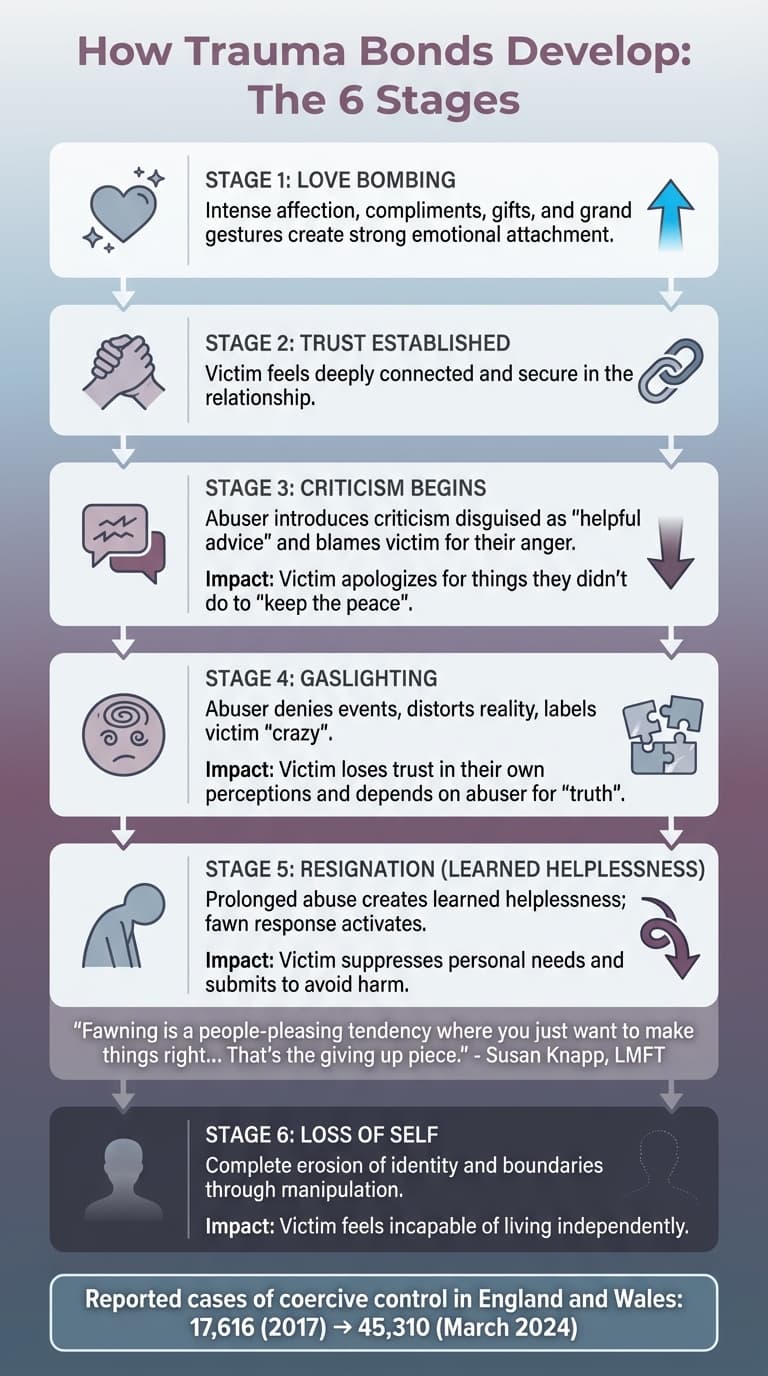
Submission in trauma bonds doesn’t happen all at once. Instead, it builds gradually, breaking down self-identity and increasing dependence on the abuser.
Love Bombing Followed by Criticism
Many abusive relationships start with a phase of intense affection, often called "love bombing." During this time, the abuser overwhelms the victim with compliments, gifts, and grand gestures to create a strong emotional attachment. But once trust and connection are established, the tone shifts. The abuser begins to sprinkle in criticisms, often disguised as "helpful advice." This sudden change can leave the victim feeling confused, even blaming themselves for the abuser's mood swings. The back-and-forth between affection and harshness creates a powerful emotional dependency.
This cycle of alternating kindness and criticism becomes the foundation for deeper control tactics.
Gaslighting and Control Tactics
As the relationship continues, gaslighting becomes a key method of control. The abuser twists events, denies past actions, or outright calls the victim "crazy." This manipulation undermines the victim's confidence in their own memory and judgment, forcing them to rely on the abuser’s version of reality. Sofia Wellness Clinic describes this dynamic:
"Gaslighting is a specific form of manipulation in which the abuser distorts the victim's perception of reality to make them doubt their own experiences, memories and sanity."
– Sofia Wellness Clinic
This constant distortion creates cognitive dissonance - leaving the victim feeling confused, conflicted, and more entrenched in the relationship.
| Stage of Trauma Bond | Role of Gaslighting/Manipulation | Impact on Submission |
|---|---|---|
| Stage 3: Criticism | Blaming the victim for the abuser's anger | Victim apologizes for things they didn’t do to "keep the peace" |
| Stage 4: Gaslighting | Denying events or labeling the victim "crazy" | Victim loses trust in their own perceptions and depends on the abuser for the "truth" |
| Stage 5: Resignation | Instilling learned helplessness | Victim suppresses personal needs and submits |
| Stage 6: Loss of Self | Complete erosion of identity and boundaries | Victim feels incapable of living independently |
Through these stages, the victim’s ability to trust themselves is systematically broken down, paving the way for learned helplessness.
Learned Helplessness and Stress-Driven Compliance
With manipulation and criticism taking their toll, prolonged abuse leads to learned helplessness. The constant stress leaves the victim feeling powerless, often triggering a "fawn" response - an instinct to people-please in order to avoid further harm. Licensed Marriage and Family Therapist Susan Knapp explains this response:
"Fawning is a people-pleasing tendency where you just want to make things right. So, you say, 'Oh, I'm sorry I said anything. I'll just do what you want.' That's the giving up piece."
– Susan Knapp, Licensed Marriage and Family Therapist
Over time, the victim may internalize the belief that asserting their own needs only invites more abuse. This mindset leaves them feeling incapable of making independent decisions, relying entirely on the abuser's guidance. The rising prevalence of coercive control underscores how common these dynamics are. This complexity often explains why victims stay in abusive relationships despite the harm. In England and Wales, reported cases of coercive or controlling behavior grew from 17,616 in 2017 to 45,310 by March 2024 [15]. These numbers reflect the widespread and damaging impact of such abusive patterns.
Submission During High-Stress Situations
As submission becomes more ingrained over time, stress amplifies these behaviors, making them even more extreme. In high-stress situations, this involuntary, biologically driven response strengthens the bond between victim and abuser.
Effects of Threats and Isolation
Abusers often isolate their victims, cutting them off from friends, family, and other external support systems. By doing so, they position themselves as the victim's sole source of validation, resources, and emotional connection. Without alternative support, victims become entirely dependent on the abuser for their sense of reality and survival [1][14].
This isolation sets off a damaging biological cycle. When humans feel threatened, they instinctively seek comfort from a caregiver. In cases of trauma bonding, the abuser becomes both the source of fear and the only available source of comfort. This forces victims into a paradox where they must seek safety from the very person causing their distress [6][10].
Dr. Eric Arzubi, MD, a psychiatrist at Frontier Psychiatry, sheds light on this dynamic:
"The intense feelings in a trauma bond originate from the body's survival instincts rather than from a true sense of safety and connection." [16]
Under constant threat, victims often develop hypervigilance, a state of being perpetually on edge - carefully monitoring the abuser's mood to avoid triggering conflict. This "walking on eggshells" behavior, coupled with isolation, leaves victims feeling trapped, with no choice but to comply with every demand [4][16]. The fawn response, a survival mechanism characterized by extreme people-pleasing, further reinforces this cycle [13][14]. Over time, the victim's isolation and dependence on the abuser deepen, perpetuating the survival-driven submission process.
This combination of isolation and sporadic affection creates a distorted sense of security, leading victims to develop misplaced loyalty toward their abuser.
Occasional Affection and False Loyalty
After periods of intense stress and abuse, abusers may occasionally show kindness - offering a small gift, an apology, or a brief moment of gentleness. These unpredictable acts of affection trigger what psychologists call intermittent reinforcement, the same psychological mechanism that makes gambling so addictive [4]. In such dire situations, victims cling to any sign of hope.
Dr. Carver, a psychologist who specializes in abuse dynamics, explains:
"In threatening and survival situations, we look for evidence of hope - a small sign that the situation may improve. When an abuser/controller shows the victim some small kindness... the victim interprets that small kindness as a positive trait of the captor." [10]
These fleeting moments of kindness activate a neurochemical reward system, reinforcing false loyalty. Victims often rationalize the abuse by blaming external factors - or even themselves - to reconcile the painful contradiction between love and harm. Utilizing AI self-help modules can assist in processing these complex emotions during recovery. This cycle keeps them emotionally tethered to their abuser, despite the ongoing harm.
Using Gaslighting Check to Identify Patterns

When you're caught in a cycle of submission, stress and isolation can cloud your ability to see things clearly. Gaslighting Check offers a structured way to examine your interactions and uncover the subtle signs of emotional manipulation and control. Here's how it works:
Tools for Spotting Manipulation
The platform uses real-time audio recording to capture not just words but also tone and context, helping highlight manipulative behavior. This is especially important because survivors often recall mostly positive interactions, making abusive moments harder to identify [2][17].
Through text and voice analyses, the app flags language that signals compliance - like frequent apologies, over-explaining, or disregarded boundaries. It also detects tone changes that suggest fear or withdrawal. These shifts often occur instinctively as you try to read the abuser's mood and adapt to avoid conflict. This aligns with the survival-driven response discussed earlier, where even subtle tone changes can reveal deeper patterns of submission.
The app also generates detailed reports, helping you track how behaviors evolve - from initial "love bombing" stages to criticism and gaslighting [1]. With this factual record, you can combat the denial of red flags and resist rationalizing the abuser's actions [5]. This is crucial for addressing cognitive dissonance, the internal struggle of reconciling the abusive reality with the affection shown during the "Romeo" phase of the relationship [18][19].
Privacy and Data Protection
Tracking these patterns requires a secure system to safeguard your information. Gaslighting Check uses encrypted data protocols to ensure that all recorded and analyzed data stays confidential. Additionally, its automatic deletion policies mean sensitive information isn’t stored permanently, reducing the risk of an abuser finding evidence of your documentation efforts.
This security-first approach acknowledges the dual need to protect users - not only from emotional harm but also from the potential dangers of being discovered while monitoring abusive behavior.
How to Break Free from Submission Patterns
Breaking free from submission patterns starts with recognizing the hold of a trauma bond. This process involves acknowledging the trauma response and taking deliberate steps toward independence. Research shows that, on average, it takes a survivor seven attempts to leave an abusive relationship permanently [7]. This underscores that recovery is a journey, not a one-time decision.
Recognizing Denial and Identifying Warning Signs
The first step is understanding that what feels like love may actually be a trauma response. Survivors often idealize their partners, seeing them as mostly "perfect", which can obscure the abusive behavior that happens in between [6]. Rachel, a Hotline Advocate at The National Domestic Violence Hotline, explains:
"The positive behaviors actually enable the abusive behaviors to continue and escalate, because they make it so hard to honor the impulse to leave when abuse occurs" [6].
Watch for signs like hypervigilance, secrecy, or a loss of personal boundaries - these may indicate you’re trapped in a cycle of abuse [7, 21, 38]. If you find yourself justifying harmful behavior by focusing on the "good moments", it might be another clue that you’re caught in a trauma bond.
Building a Support Network
Isolation often strengthens the grip of submission patterns, so rebuilding connections is key. Reach out to trusted friends or family members, especially those who’ve expressed concern about your relationship [10, 43]. For professional guidance, contact the National Domestic Violence Hotline at 800-799-7233 or text "LOVEIS" to 22522 for free, confidential support [2, 43]. Online therapy platforms like BetterHelp also provide assistance, starting at $65 per week [20].
Joining survivor-led groups, such as Codependents Anonymous, can offer valuable perspectives and shared experiences [10, 45]. You can also create a safety plan for domestic violence by setting up code words or regular check-ins with trusted contacts [7, 45]. If you suspect your abuser monitors your communications, consider using a different device or creating new social media accounts with anonymous usernames [5].
In addition to human support, practical tools can play a role in recovery.
Using Tools for Tracking and Recovery
Tracking abusive patterns can help reinforce your recovery efforts. Keeping a factual log of incidents allows you to counter manipulated memories and recognize recurring behaviors [7, 15]. Write down events without emotional language, focusing solely on the facts. Tools like Gaslighting Check can help by offering secure, detailed reports that reveal patterns over time. As Rachel from The National Domestic Violence Hotline advises:
"Not compromising truth for promise means refusing to fantasize about how a partner might change someday, and staying grounded in the evidence of the partner's behavior remaining the same" [6].
Gaslighting Check provides structured analysis and encrypted data storage, ensuring your documentation is safe. For $9.99/month, the Premium Plan includes features like conversation history tracking, helping you spot trends that might otherwise go unnoticed.
To rebuild self-esteem, challenge negative thoughts with affirmations like, "I am taking steps to empower my future." Be prepared for withdrawal symptoms, which can feel similar to cravings during drug addiction, including an intense longing for the abuser [42, 43]. A strong support network and tracking tools can help you stay focused and grounded through this difficult phase.
Conclusion
Submission within trauma bonds often stems from a survival instinct shaped by cycles of abuse and moments of fleeting kindness. Over time, these patterns can become so ingrained that abusive behavior feels normal, making it harder to recognize the need for change [4]. A crucial step toward breaking free is understanding that what feels like love might actually be a trauma response.
Recovery starts by acknowledging your current situation. Rachel from The National Domestic Violence Hotline highlights that overcoming abusive behaviors is usually a long-term journey, often taking decades. Survivors should not sacrifice their present well-being for uncertain promises of future change [6]. Keeping detailed logs can help you identify manipulation patterns clearly. With this kind of documentation, you’re better equipped to seek the support you need.
A strong support network is vital. Confide in trusted friends or family, or reach out to the National Domestic Violence Hotline at 800-799-7233 for confidential help. For additional tools, platforms like Gaslighting Check offer encrypted documentation and reports - including conversation tracking - for $9.99/month, helping you uncover and document recurring manipulation.
Once you have clear records and a reliable support system, focus on self-compassion and positive self-talk. Reclaiming your sense of autonomy requires consistent effort, but with the right tools and support, genuine healing is possible.
FAQs
How can I tell submission from healthy compromise?
Submission in trauma bonds often arises from a mix of emotional manipulation, fear, and dependency. This dynamic can make staying in the relationship feel like an obligation, even when it causes harm. Typically, these bonds are defined by repeated cycles of abuse, followed by brief moments of affection or apologies. This back-and-forth creates a confusing emotional rollercoaster.
On the other hand, healthy compromise thrives on mutual respect, honest communication, and a shared commitment to honoring boundaries. In such relationships, both partners feel safe, understood, and genuinely valued. Understanding these contrasts is crucial for spotting unhealthy patterns and fostering healthier connections.
Why do I feel attached even after repeated harm?
Feeling connected to someone despite repeated harm in a trauma bond often stems from cycles of abuse paired with unpredictable moments of kindness or relief. This pattern, known as intermittent reinforcement, creates a psychological dependency. The rare positive moments strengthen feelings of loyalty and affection, even in the face of ongoing harm. This attachment is deeply tied to survival instincts and emotional reliance, making it incredibly hard to break without understanding the dynamic and seeking support.
How can I document manipulation without risking my safety?
To handle documentation securely, rely on tools that offer encryption and timestamping to safeguard records. Capture exact statements, including tone and context, and retain entire message threads with timestamps intact. Be aware of local recording laws, as regulations differ from state to state. Store evidence in encrypted systems, and arrange records chronologically to identify patterns more easily. Above all, prioritize your safety and consider seeking guidance from a trusted therapist or support organization to create a documentation plan suited to your needs.