
20+ Resources for Trauma Survivors in BIPOC Communities
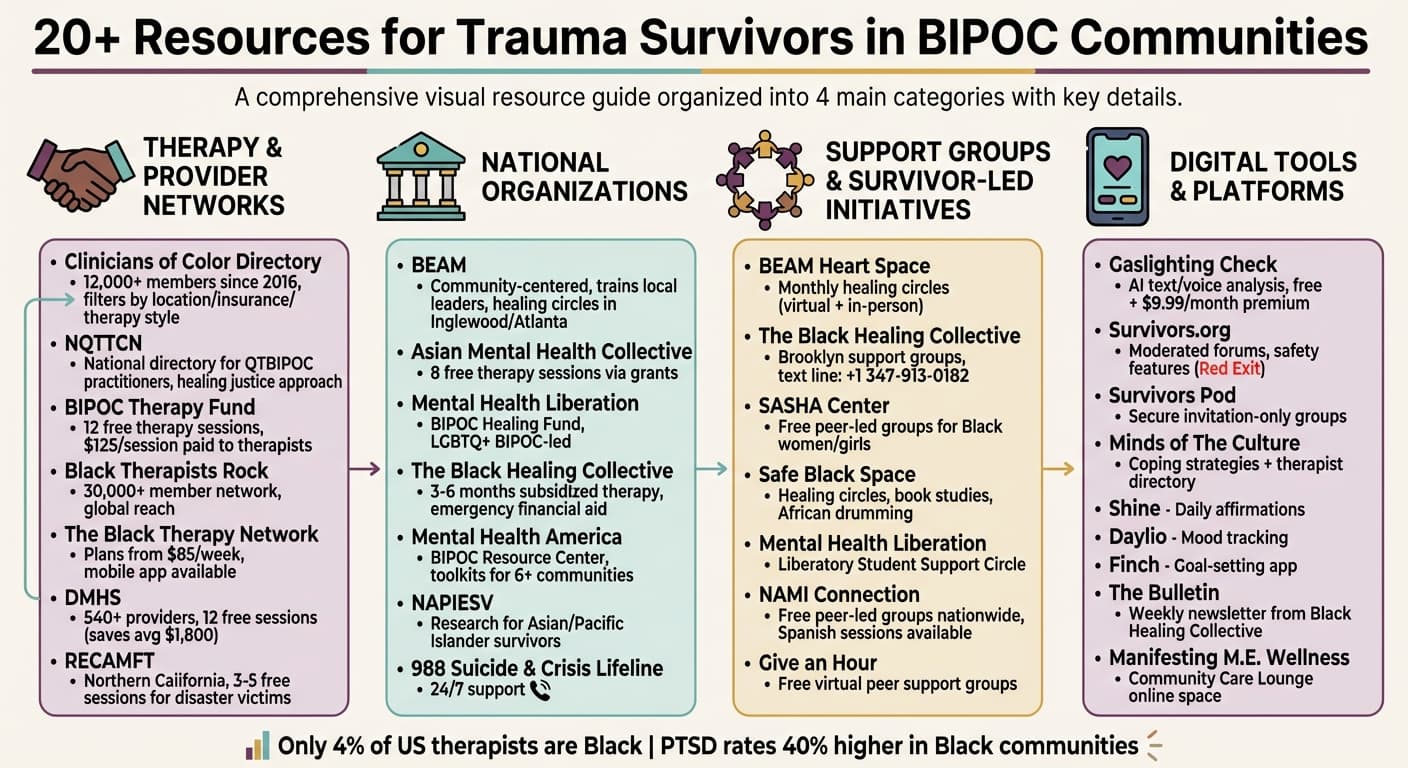
Trauma survivors in BIPOC communities often face unique challenges, including racial trauma, systemic barriers, and limited access to mental health care. This guide highlights over 20 resources designed to provide support through therapy networks, national organizations, survivor-led initiatives, and digital tools. Here's a quick overview:
- Therapy Networks: Directories like Clinicians of Color and NQTTCN connect individuals to therapists who understand their cultural backgrounds. Options include sliding-scale fees, free sessions, and "Get-Matched" programs for personalized care.
- National Organizations: Groups like BEAM and Mental Health America focus on systemic change while offering resources tailored to BIPOC needs, such as healing circles and therapy scholarships.
- Survivor-Led Initiatives: Programs like The Black Healing Collective and SASHA Center provide peer-led support, group therapy, and text-based communities.
- Digital Tools: Platforms like Gaslighting Check and Survivors.org offer AI-driven tools, forums, and self-care apps to support trauma recovery privately and flexibly.
These resources aim to address gaps in traditional mental health systems, offering tailored, accessible support for healing.
::: @figure
Cultural Betrayal Trauma in BIPOC Communities - Liberation Approaches to Healing
Therapy and Provider Networks
Working with a therapist who understands your cultural background can make a big difference in trauma recovery. Today, there are directories designed specifically to connect BIPOC individuals with therapists who bring that understanding to their practice.
The Clinicians of Color Directory is one such resource. Since its launch in 2016, it has grown to include over 12,000 members [5]. This platform helps users find therapists from diverse racial and ethnic backgrounds, offering various treatment approaches. You can filter your search by location, insurance type, and therapy style. Plus, it features educational resources, including content on intergenerational trauma, with updates as recent as March 2026 [5].
For individuals with overlapping marginalized identities, the National Queer and Trans Therapists of Color Network (NQTTCN) provides a national directory of QTBIPOC practitioners. Their mission is clear:
We are a growing base of health and healing practitioners and organizers working to transform mental health for QTBIPOC. Rooted in healing justice, we're challenging the harms of the medical industrial complex in order to build abolitionist ecosystems of care [4].
Regional directories are available as well. For instance, the RECAMFT BIPOC Therapist Directory serves Northern California. It includes filters for Medi-Cal and other insurance types and offers free sessions - ranging from 3 to 5 - for those impacted by local disasters like wildfires [6]. As always, it’s important to verify the credentials of any provider [6].
Financial accessibility is another critical focus. Resources like the BIPOC Therapy Fund aim to reduce cost barriers by offering 12 free therapy sessions per participant. Therapists are paid $125 per session directly through the fund [8]. Many directories also highlight options such as "Low Cost", "Sliding Scale", or "Non-Profit Services." Some even provide "Get-Matched" programs, where professionals manually pair individuals with therapists based on cultural alignment and financial needs [7].
These specialized networks play a key role in creating pathways to care while also connecting to larger national support systems.
National Organizations
Several national organizations are stepping up to tackle mental health challenges within BIPOC communities, combining individual healing with broader systemic change. These groups go beyond traditional therapy, weaving healing justice into their efforts. Let’s explore how they’re reshaping mental health support.
BEAM (Black Emotional and Mental Health Collective) takes a community-centered approach to mental health. This 501(c)(3) organization trains local leaders - like barbers and teachers - to recognize and respond to mental health crises in their neighborhoods. By using a "train the trainer" model, BEAM makes mental health resources more accessible and scalable. They also host events and offer grants to grassroots wellness initiatives, ensuring support reaches the community level.
For Asian communities, the Asian Mental Health Collective (AMHC) provides a directory of Asian therapists, helping individuals find care that aligns with their cultural and linguistic needs. They also fund therapy sessions, offering eight free sessions through grants available at various times throughout the year [13]. Similarly, Deconstructing The Mental Health System (DMHS), founded by Makinie Fortino in 2020, offers 12 free therapy sessions and maintains a directory of providers for People of the Global Majority (PoGM) and QTPoC individuals [11]. DMHS emphasizes their mission with this powerful statement:
Feeling whole is our birthright, and we are claiming it [11].
Grassroots organizations are also making an impact. Mental Health Liberation, a nonprofit led by LGBTQ+ BIPOC individuals, runs the BIPOC Healing Fund. This fund provides free, identity-affirming care, guided by their belief:
Marginalized communities deserve equitable access to culturally responsive, collective-trauma informed, identity-affirming mental health care [12].
For Black women and femmes, The Black Healing Collective offers a sanctuary of support. Through "The Well" program, they provide 3–6 months of subsidized therapy, alongside emergency financial aid and rent assistance [10].
National organizations like Mental Health America (MHA) complement these efforts with resources tailored to BIPOC communities. Their BIPOC Mental Health Resource Center addresses racial trauma, systemic racism, and workplace microaggressions and gaslighting. With toolkits designed for African, Arab, Asian/Pacific Islander, Indigenous American, Latine/Hispanic, and multiracial communities, they stress the importance of culturally sensitive care:
Culture, ethnicity, and race all play a large role in the way that each person experiences the world and in the types of mental health support they may need [1].
Support Groups and Survivor-Led Initiatives
Survivor-led initiatives are reshaping trauma support by focusing on collective healing rather than limiting it to individual therapy. Many of these initiatives adopt a Healing Justice framework, which emphasizes that recovery is both a personal and political journey. As The Black Healing Collective explains, "healing is never just personal - it is political. it is collective." [14] Below are some examples of how grassroots groups are turning this philosophy into action.
BEAM (Black Emotional and Mental Health Collective) has been growing its "Heart Space" healing circles, which are held monthly in Inglewood, Atlanta, and online. These circles include events like "Unmasked and Unapologetic" scheduled for April 8, 2026, and the Los Angeles-based "You Good?" check-in happening on March 29, 2026 [9].
For Black women and femmes, The Black Healing Collective recently began hosting in-person support groups in Brooklyn, starting in early 2026 after a successful fundraising campaign. They also provide a text-based community for peer support and resource sharing at +1 347-913-0182 [14].
SASHA Center (Sexual Assault Services for Holistic Awareness) offers free, peer-led educational support groups for Black women and girls who have experienced sexual assault. Their approach is guided by the "Black Women's Triangulation of Rape Model" [15].
Safe Black Space organizes community healing circles to help people of African ancestry process cultural and racial trauma. They also host online book study groups and African drumming circles. One participant, Deraan, shared that these healing circles offered much-needed relief, connection, and support [16].
For BIPOC students pursuing careers in mental health, Mental Health Liberation runs the "Liberatory Student Support Circle", which provides mentorship and peer support. They also offer a Healing Fund that covers free, identity-affirming therapy during specific seasonal cycles [12].
Online Tools and Self-Care Platforms
In addition to community-based support, digital platforms provide flexible and private options for trauma recovery. For example, BEAM (Black Emotional and Mental Health Collective) offers virtual healing circles and downloadable toolkits designed with healing justice principles in mind [9]. Similarly, Mental Health Liberation operates entirely online, featuring a Liberatory Student Support Circle for BIPOC students in mental health fields. They also manage the BIPOC Healing Fund, which provides free, culturally responsive therapy through seasonal applications [12].
For individuals dealing with emotional abuse, Gaslighting Check uses AI to analyze text and voice conversations to detect manipulation tactics. The platform offers a free text analysis plan, while its $9.99/month premium plan includes voice analysis, detailed reports, and conversation history tracking. Dr. Stephanie A. Sarkis, author of Healing from Toxic Relationships, explains:
Identifying gaslighting patterns is crucial for recovery. When you can recognize manipulation tactics in real-time, you regain your power and can begin to trust your own experiences again [18].
This is especially important considering that 74% of gaslighting victims experience long-term emotional trauma, and 3 in 5 people fail to recognize gaslighting as it occurs [18]. Tools like Gaslighting Check provide much-needed validation through objective analysis.
Survivors.org offers moderated, identity-based forums with safety features like a "Red Exit" button and browser history clearing instructions (Ctrl+Shift+Delete on Windows or Command+Shift+Delete on Mac) to protect users [2]. Additionally, Survivors Pod by Survivors Voices creates secure, invitation-only online groups where BIPOC survivors can share their experiences in a supportive environment [17].
Other digital tools cater to various aspects of mental health. Minds of The Culture provides coping strategies and a therapist directory tailored to individual needs, while Shine sends daily affirmations to encourage self-care [19]. Apps like Daylio (for mood tracking) and Finch (for goal-setting) help users manage their mental health on a daily basis. Even games like Stardew Valley and Animal Crossing create comforting virtual spaces that promote emotional regulation [3].
For those seeking creative outlets, platforms like Sketch.io support digital art creation, while Our Wave allows for anonymous storytelling. Pandora's Aquarium offers free message boards for peer support [3]. When choosing digital tools, prioritize platforms with end-to-end encryption and automatic data deletion to ensure your privacy remains protected [2][18].
1. Therapy and Provider Networks
Here’s a closer look at therapy and provider networks offering support tailored to the needs of BIPOC communities.
National Queer and Trans Therapists of Color Network (NQTTCN) connects QTBIPOC individuals with therapists who specialize in addressing the unique challenges tied to race, gender identity, and sexual orientation.
Black Therapists Rock (BTR) takes a global approach to addressing racial trauma, supported by a network of over 30,000 members. These resources help survivors rebuild self-trust after experiencing systemic or interpersonal harm. Their mission is to raise awareness about mental health in ways that resonate with diverse cultural experiences. It’s worth noting that only 4% of therapists in the U.S. are Black [21], while PTSD rates in the Black community are 40% higher than those in white and Hispanic populations [20].
Mental Health Liberation offers a BIPOC Healing Fund, which provides free mental health care that acknowledges identity and collective trauma. Since funding opportunities open seasonally, it’s a good idea to regularly check their website for updates.
The Black Therapy Network (BTN) focuses on the African American experience, offering therapy plans starting at $85 per week [21]. Their platform includes both a mobile app and a website, with a matching system that uses short assessments to pair clients with therapists who understand Black cultural experiences. As BTN puts it:
Therapy should feel like home [21].
Deconstructing The Mental Health System (DMHS), founded by Makinie Fortino, features a directory of over 540 providers for People of the Global Majority. Through their Free Therapy & Wellness Program, they offer 12 therapy sessions at no cost, saving clients an average of $1,800 compared to typical therapy rates, which range from $80 to over $200 per session [11].
2. National Organizations
National organizations provide vital support by addressing the systemic challenges and manipulative patterns faced by BIPOC trauma survivors.
BEAM (Black Emotional and Mental Health Collective) is a national nonprofit that uses a Healing Justice framework to promote mental health in Black communities. They focus on equipping community leaders - like barbers and teachers - with the tools to provide mental health support outside of traditional medical systems. BEAM also funds grassroots initiatives and organizes virtual healing circles [9]. As Joseph Beam said:
I dare myself to dream of us moving from survival to potential, from merely getting by to a positive getting over [9].
This approach to community-driven care serves as an inspiring model for other national programs.
The Black Healing Collective concentrates on supporting Black women and femmes, offering therapy scholarships and rent relief to alleviate the financial pressures that often worsen trauma. Their guiding principle is:
Healing is never just personal - it is political. It is collective [10].
For Asian and Pacific Islander communities, NAPIESV (National Alliance to End Sexual Violence for Asian and Pacific Islanders) conducts specialized research on the impact of sexual violence within these groups. This ensures advocacy efforts are tailored to their unique experiences [22].
Mental Health America (MHA) plays a key role in national advocacy, with initiatives like BIPOC Mental Health Month that highlight the intersection of race and mental health challenges [23].
Other resources add to the network of support. The 988 Suicide & Crisis Lifeline offers round-the-clock assistance from trained counselors, connecting trauma survivors to critical care nationwide by simply dialing 988.
Inclusive Therapists provides an online directory where users can filter therapists by race, ethnicity, language, and trauma expertise, making it easier to find professionals who understand diverse cultural backgrounds.
3. Support Groups and Survivor-Led Initiatives
Evaluating peer support for trauma recovery shows how these groups play a key role in bolstering collective healing within BIPOC communities. By building on existing therapy networks and broader national efforts, these survivor-led initiatives provide spaces for shared healing and empowerment. Here are some standout examples of these efforts in action:
BEAM Healing Circles organizes monthly gatherings in cities like Inglewood and Atlanta, as well as virtual sessions. One example is their session titled "Unmasked and Unapologetic", designed specifically for Black Autistic individuals, scheduled for April 8, 2026 [9].
The Black Healing Collective focuses its work on Black women and femmes. In late 2025, they introduced in-person support groups in Brooklyn and expanded their reach with new therapy scholarships [14]. They also operate a text-based peer support line, creating a space for venting, encouragement, and sharing resources. As they put it:
"Our programs meet Black women and femmes where they are - exhausted, healing, surviving, and still dreaming" [14].
Specialized services like the SASHA Center provide free, confidential peer-educational support groups tailored for Black women and girls who have experienced sexual assault. They use culturally relevant tools, such as the "Lived Experience Decision Tree" (LEDTree), to guide survivors through their healing process [15].
Mental Health Liberation offers the "Liberatory Student Support Circle", a program dedicated to mentoring and supporting BIPOC students pursuing careers in mental health and social work [12].
Digital platforms have also made peer support more accessible. NAMI Connection runs free, peer-led support groups across the country, including Spanish-language sessions known as "Los Grupos de Apoyo", available through local affiliates [25]. Similarly, Give an Hour provides free virtual peer support groups led by experienced survivors, ensuring a supportive and understanding environment [24].
These initiatives highlight the power of survivor-led approaches in fostering healing and connection. By addressing specific needs and offering culturally sensitive resources, they create spaces where individuals can feel seen, supported, and empowered.
4. Online Tools and Self-Care Platforms
Digital platforms are breaking down barriers like cost, transportation, and accessibility, offering tools like mobile apps and virtual healing spaces that prioritize collective care.
Take The Black Therapy Network, for instance. This platform has introduced a mobile app that connects users with Black therapists, allowing them to schedule virtual sessions and access mental health resources. Therapy plans start at $85 per week, addressing the long-standing underrepresentation of Black therapists in mental health care [27]. The app also provides a free self-care checklist, offering immediate mental health support.
Another example is BEAM's online resource library, which offers a searchable database filled with Healing Justice toolkits and educational materials. These resources aim to help Black communities create care systems outside of traditional clinical environments [9]. BEAM also hosts virtual healing circles, where participants gather monthly to learn healing strategies and engage in collective crisis support. These initiatives highlight the growing demand for accessible, culturally relevant care [14].
Similarly, The Bulletin, a digital newsletter from The Black Healing Collective, delivers weekly resources, community stories, and strategies for overcoming systemic challenges directly to its subscribers [14]. On another front, Manifesting M.E. Wellness runs the "Community Care Lounge", an exclusive online space where BIPOC individuals can find support and nourishment between formal healing sessions [26].
For survivors dealing with emotionally manipulative relationships, Gaslighting Check offers a unique solution. The platform uses text and voice analysis to detect manipulative tactics, providing detailed reports that validate survivors' experiences. This feature is especially helpful when systemic and interpersonal gaslighting overlap, giving survivors tangible evidence to back their feelings.
Together, these tools create a network of care that is accessible, culturally informed, and deeply supportive.
Conclusion
Healing from trauma is a deeply personal journey, often filled with ups and downs. As the Women's Resources Center at the University of Illinois explains:
Every path to recovery looks different and individuals may find certain resources better suited for their needs [3].
The resources highlighted here - from therapy networks and national organizations to support groups and digital tools - acknowledge the specific challenges faced by BIPOC survivors. These challenges often include cultural traumas and complex PTSD that traditional, mainstream approaches might not fully address.
Each of these tools offers a unique way to begin or continue healing. Some survivors might start with mood-tracking apps or anonymous storytelling platforms, while others may find comfort in trauma-informed yoga, culturally relevant literature, or talk therapy. Digital tools, like those designed to identify emotional manipulation patterns, add another layer of support. Artist Morgan Harper Nichols beautifully expresses this idea:
Art can become a space to reflect experiences, tell stories, share ideas, and create room to breathe [3].
Whether through clinical methods, creative outlets, or community-based efforts, every resource plays an important role in helping survivors move forward. Identity-specific forums and survivor-led initiatives provide a sense of connection, reducing feelings of isolation by bringing together people with shared experiences.
If you're a survivor or supporting someone who is, remember there’s no "right" way to begin. Choose what feels most comfortable - whether it's a digital safety plan, a culturally relevant book, or joining a virtual healing circle. Your healing journey is entirely your own, and these communities are here to walk alongside you every step of the way.
FAQs
How can I quickly find a culturally competent therapist?
Directories can be a helpful way to find professionals who understand and respect diverse experiences. Inclusive Therapists is one such directory, featuring verified mental health providers who specialize in working with BIPOC, LGBTQ+, and other marginalized communities. Their platform makes it easier to locate therapists experienced in supporting individuals from diverse backgrounds. Beyond connecting you with therapists, they also offer events, support groups, and resources designed to provide immediate help and guidance on care that respects cultural differences.
What free or low-cost therapy options are available for BIPOC survivors?
Free or low-cost therapy options for BIPOC survivors include several impactful programs:
- Mental Health Liberation: This program offers both mental health services and peer support, aiming to create a safe space for healing.
- Therapy Fund Foundation: Focused on breaking down barriers to Black healing, this organization helps make therapy more accessible.
- Deconstructing The Mental Health System (DMHS): Dedicated to BIPOC communities, DMHS provides therapy and wellness services tailored to their unique needs.
These initiatives are committed to ensuring mental health care is both accessible and inclusive for BIPOC individuals.
How can I protect my privacy when using online trauma support tools?
When engaging with online trauma support tools, it's crucial to take steps to safeguard your privacy. Here are some practical tips to help you stay secure:
- Stick to private or closed groups: These groups often have stricter safety measures in place, limiting who can view your interactions.
- Check confidentiality policies: Before sharing anything personal, make sure you understand how the platform handles your data.
- Be cautious about data sharing: Opt for platforms that prioritize encrypted communication and offer features like automatic data deletion.
- Use secure devices and networks: Avoid public Wi-Fi and ensure your device is protected to reduce the risk of unauthorized access.
- Share minimal personal information: Keep your details general and avoid oversharing in online spaces.
By following these steps, you can create a safer environment for yourself while seeking support online.