Psychological Impact of Gaslighting in Romance

Psychological Impact of Gaslighting in Romance
Gaslighting in romantic relationships is a form of emotional manipulation that makes you doubt your memories, perceptions, and even your sense of reality. This tactic can deeply harm mental health, leading to anxiety, depression, and a loss of self-identity. Here’s what you need to know:
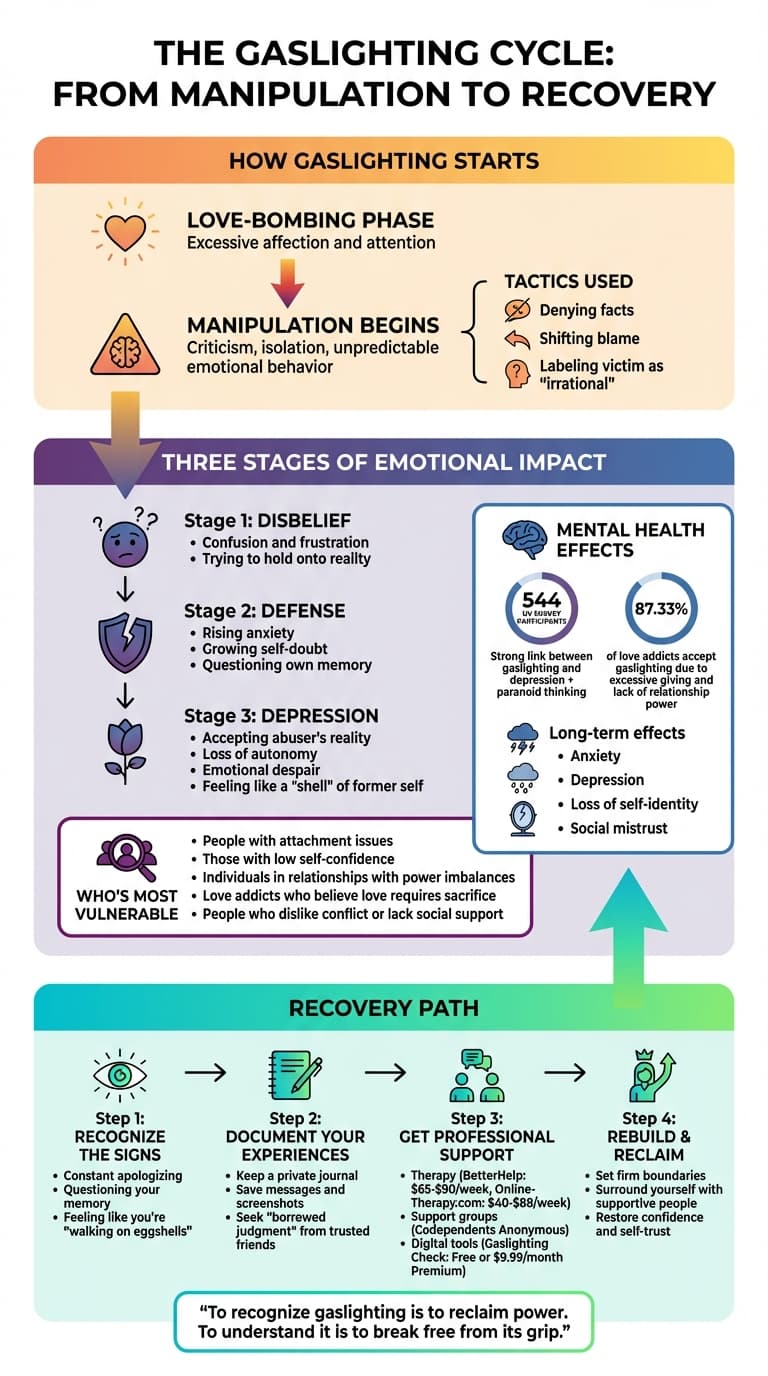
- What is Gaslighting? It’s a psychological tactic where someone denies facts, shifts blame, or labels you as irrational to control your perception of reality.
- How It Starts: Often begins with "love-bombing" (excessive affection) and progresses to criticism, isolation, and unpredictable emotional behavior.
- Mental Health Effects: Victims often experience confusion, low self-esteem, depression, and social mistrust. Long-term exposure can even alter brain function.
- Who’s at Risk? People with attachment issues, low self-confidence, or unequal power dynamics in relationships are more vulnerable.
- Recovery: Recognizing manipulation, seeking therapy, and building supportive networks are key steps to healing. Tools like journaling or apps can help validate your experiences.
Gaslighting thrives on control and emotional invalidation, leaving lasting scars. Recognizing its signs is the first step toward breaking free and reclaiming your sense of self.
::: @figure
Gaslighting in an Intimate Relationship (examples) and How to Address It
Detect Manipulation in Conversations
Use AI-powered tools to analyze text and audio for gaslighting and manipulation patterns. Gain clarity, actionable insights, and support to navigate challenging relationships.
Start Analyzing NowMental Health Effects of Gaslighting in Romantic Relationships
Gaslighting chips away at a person’s ability to trust their own memory and perception. Studies reveal that it fundamentally disrupts a survivor's confidence in their sense of reality, leaving them questioning their own sanity and recollection of events [1].
The impact is undeniable. A survey of 544 individuals in the United Kingdom found a strong connection between gaslighting and increased levels of depression and paranoid thinking [8]. Similarly, research involving participants from Israel and the United States showed that exposure to gaslighting was closely tied to poorer relationship satisfaction and higher rates of depression [6].
Loss of Self-Esteem and Identity
In romantic relationships, gaslighting systematically distorts a person’s sense of reality. Over time, repeated invalidation erodes self-identity, with many survivors describing themselves as a “shell” of who they once were [4]. One participant in Willis Klein’s University of Toronto study reflected on the experience:
“[I] barely felt like a person anymore. I suppose it did get worse, but when your perception of the truth gets warped, it’s hard to tell up from down.” [4]
This damage goes beyond low self-esteem - it’s a profound loss of self. Victims often feel disconnected from their true selves, unable to trust their instincts or judgment. This breakdown in self-trust leads to feelings of worthlessness, confusion, and emotional detachment [2], creating the foundation for even deeper psychological struggles.
Anxiety, Depression, and Emotional Distress
Victims of gaslighting often go through stages of escalating emotional turmoil [7]. It begins with disbelief, where confusion and frustration dominate as they try to hold onto their sense of reality. This transitions into a defensive phase, marked by rising anxiety and growing self-doubt. Eventually, many reach a depressive stage, where they start to accept the abuser’s manipulated version of reality, losing their autonomy and sinking into emotional despair.
One case study from North Sulawesi, Indonesia, highlights this progression. A 22-year-old student, referred to as “Esther,” endured a 13-month relationship where her partner used hunger strikes as a manipulation tactic - refusing to eat until she apologized for his mistakes. This left her overwhelmed with guilt, anxiety, and an inability to make decisions independently [7].
Adding to the distress is the unpredictable cycle of affection followed by rejection. Gaslighters often alternate between love-bombing and cold-shouldering, creating a chaotic emotional environment. This pattern heightens victims’ anxiety, increases their stress, and fosters a dependency on the abuser. Even basic decisions can feel paralyzing [5][6]. Over time, this emotional rollercoaster erodes trust and pushes victims toward isolation.
Mistrust and Social Isolation
Gaslighting doesn’t just harm the relationship with the abuser - it also leaves lasting scars on a victim’s ability to trust others. Survivors often carry long-term fears into future relationships, worrying that new partners might undermine their thoughts and feelings in the same way. As one participant in Klein’s study shared:
“It has affected every relationship I’ve had since. I’m still paranoid that people are trying to undermine me, that I can’t express my own feelings or opinions because someone will try to change them or take them away from me.” [4]
Abusers also actively isolate their victims, often by belittling their friends or using jealousy to force them to cancel plans [1][3]. Some even spread rumors, labeling the victim as “unstable” or “crazy,” which deepens the victim’s isolation and sense of entrapment [9]. Without access to outside perspectives or support, victims become entirely reliant on the abuser’s twisted version of reality, further intensifying their psychological vulnerability [1][3].
How Gaslighting Damages Mental Health
Gaslighting causes deep emotional pain while skewing how victims perceive their own thoughts and reality. This harm unfolds through two main avenues: emotional invalidation and the distortion of thinking patterns, both of which leave lasting scars.
Emotional Invalidation and Its Effects
Gaslighters undermine their victims' emotions by dismissing them as "crazy", "irrational", or "oversensitive" [1][3]. This constant trivialization makes victims feel like their concerns lack importance, often leading to intense self-doubt and confusion [10][11]. As psychologist Chivonna Childs, PhD, puts it:
"Gaslighting is a form of emotional manipulation to make you feel as if your feelings aren't valid, or that what you think is happening isn't really happening. Over time, you start to question your self-worth, self-esteem and mental capacity." [11]
The ultimate aim is to convince victims of their "epistemic incompetence" - the belief that they cannot trust their own knowledge or perceptions [1]. By repeatedly denying their memories and emotions, gaslighters erode the victim's self-trust, forcing them to depend entirely on the gaslighter's version of events as the only "truth" [10].
This emotional invalidation sets the stage for further cognitive manipulation, which is explored in the next section.
Distorted Thinking and Loss of Reality
Gaslighters use strategies that warp their victims' understanding of reality. Tactics like "countering" - questioning accurate memories - and "forgetting" - denying events ever happened - gradually dismantle the victim's trust in their own senses and judgments [10]. Over time, these methods lead to a complete disconnection from reality, often described as a "loss of grip" [1][3].
This isn't just psychological confusion; it can actually alter brain function. Psychologist Joni E. Johnston, Psy.D., explains how long-term exposure to gaslighting affects the brain:
"Gaslighting doesn't just manipulate victims, over time, it literally rewires their brains." [12]
Victims are frequently forced to choose between believing the gaslighter's lies or doubting their own sanity. To preserve a sense of safety, many repeatedly choose to question themselves, becoming "simultaneously hypervigilant and unable to trust their hypervigilance" [12].
The consequences are profound. Constant invalidation and distorted thinking erode the victim's sense of self, leaving them feeling like a hollow version of who they once were [1][4]. A study involving participants from Israel and the United States found that such experiences are closely linked to long-term issues like anxiety, depression, psychological trauma, and even paranoid thinking [10][8][6]. These cognitive shifts are at the root of the enduring mental health struggles faced by survivors, including the loss of identity and pervasive emotional distress.
Who Is Most Vulnerable to Gaslighting
Understanding who is most at risk of gaslighting sheds light on how certain traits and dynamics can make individuals more susceptible to this form of manipulation. Some personality tendencies and relationship imbalances significantly increase vulnerability.
Love Addiction and Excessive Attachment
People with a tendency toward love addiction often believe that love requires sacrifice, leading them to tolerate harmful behaviors to maintain a relationship. Researcher Yuxiao Wang from Guizhou Normal University explains:
"Love addicts... believe that love can only be obtained through giving, suffering, and sacrifice. This causes love addicts to rationalize their partner's misbehavior in the relationship as necessary to maintain the relationship." [13]
A 2025 study revealed that factors like excessive giving and a lack of relationship power accounted for 87.33% of the reasons love addicts accepted gaslighting.[13] These individuals often feel trapped by the perceived emotional or practical costs of leaving. Similarly, people who are highly sensitive to rejection or have people-pleasing tendencies may suppress their concerns or ignore warning signs to avoid conflict or abandonment.[13]
This combination of traits not only increases susceptibility to manipulation but also amplifies the emotional and psychological harm caused by gaslighting.
Power Imbalances in Relationships
Gaslighting often thrives in relationships where one partner holds significantly more power, creating a dynamic of dependency. Over time, victims may come to rely on the abuser not just for validation but even for their sense of reality. Psychologist Arash Emamzadeh notes:
"Gaslighting generates dependence power because the victim of gaslighting gradually depends more and more on the gaslighter - not just for approval... but to know what is real." [14]
When emotional, financial, or social power skews heavily in favor of one partner, the less powerful individual may struggle to challenge distorted narratives or assert their perspective. A study involving 298 college students found that gaslighting is particularly effective among those who dislike conflict, lack alternative relationship options, or have weak external social networks.[14][15] Additionally, gaslighters often isolate their victims from friends and family, cutting off sources of support and alternative viewpoints.[1] This isolation deepens dependency, giving the gaslighter even greater control and further destabilizing the victim’s sense of reality.
Recovery: Healing from Gaslighting
Recognizing the Signs of Gaslighting
Healing from gaslighting starts with identifying the manipulation patterns that distort your perception of reality. Abusers often rely on outright lies and denial, brushing off your concerns with phrases like, "That never happened" or "You're imagining things." They frequently shift blame, leaving you feeling like their actions are somehow your fault.
Internally, you may notice yourself questioning your memory and judgment. Signs like constant apologizing, feeling the need to tiptoe around someone, or experiencing a persistent sense of dread can point to the deep impact of gaslighting. Many survivors describe feeling like a shadow of their former selves. As Dr. Chivonna Childs from Cleveland Clinic points out, gaslighting invalidates your emotions and makes you doubt your lived experiences [11].
Recognizing these signs is a critical first step on the path to recovery and seeking the support you need.
Getting Support and Professional Help
Once you’ve identified the patterns of gaslighting, connecting with supportive people and seeking professional help becomes vital. Therapy can provide a much-needed reality check, helping you rebuild confidence and address the emotional wounds caused by manipulation. Trusted friends and family who affirm your experiences can also be a lifeline during this time.
Another helpful strategy is documenting your interactions. Keeping a private journal, saving messages, or taking screenshots can serve as a tangible reminder of what really happened, especially when self-doubt creeps in. This documentation not only reinforces your memory but can also be shared with a therapist or trusted confidant for added clarity. Some refer to this as seeking "borrowed judgment" - relying on someone else to help separate truth from distortion.
Support groups like Codependents Anonymous (CoDA) can also be invaluable, offering a sense of community and shared understanding. For professional help, online therapy platforms such as BetterHelp (about $65–$90 per week) or Online-Therapy.com (roughly $40–$88 per week) provide accessible options for guidance and healing.
How Gaslighting Check Can Help

In addition to therapy and support networks, modern tools like Gaslighting Check can help you regain your sense of reality. This tool uses AI technology to analyze text and voice interactions and even offers real-time audio recording to identify patterns of emotional manipulation. It’s designed to complement therapy by providing objective insights into your interactions.
Gaslighting Check offers two plans: a Free Plan with basic text analysis and a Premium Plan for $9.99/month, which includes detailed reports and logs to highlight subtle manipulation patterns. With features like end-to-end encryption and automatic data deletion, it ensures your privacy while helping you validate your experiences. Whether you’re just starting to question your reality or are actively working toward recovery, tools like this can be a steady resource on your journey to healing.
Conclusion: Recognizing Gaslighting and Moving Forward
Gaslighting is more than just a buzzword - it's a calculated form of emotional abuse that can deeply harm romantic relationships. It distorts your perception of reality, chips away at your confidence, and leaves lasting damage on your mental health. Research highlights how manipulation tactics like persistent lying, denying events, or dismissing you as "too sensitive" are all hallmarks of gaslighting. Recognizing these behaviors is the critical first step in reclaiming your sense of self. More and more people are now identifying these patterns, giving a name to what they’ve endured.
"To recognize gaslighting is to reclaim power. To understand it is to break free from its grip." - ScienceNewsToday [16]
If you've been affected by gaslighting, it's important to understand that your reactions - whether anxiety, depression, or a diminished sense of self - are not personal flaws but documented effects of this abuse. Acknowledging this can shift how you see the situation and empower you to take meaningful steps forward. These steps might include setting firm boundaries, seeking help from a therapist, or even leaving the relationship altogether.
Healing from gaslighting often requires rebuilding trust in yourself. Surrounding yourself with supportive people who validate your feelings is key. Writing down your experiences can help you see patterns more clearly, and professional support can guide your recovery. Tools like Gaslighting Check can also help by analyzing your conversations, identifying manipulation tactics, and offering detailed reports to keep self-doubt at bay. With this knowledge and the right resources, survivors can begin to restore their confidence and take back control of their lives.
FAQs
How is gaslighting different from normal conflict?
Gaslighting is distinct from regular conflict in both its purpose and effects. Regular conflicts usually arise from misunderstandings and can often be resolved through open communication. In contrast, gaslighting is a calculated form of manipulation aimed at making someone question their own reality. Unlike typical disagreements, it involves deliberate and repeated efforts to distort someone's perception, leading to confusion, self-doubt, and emotional distress. Its continuous and often subtle approach makes it particularly harmful and difficult to recognize.
Why do I doubt my memory after gaslighting?
Gaslighting works by making you doubt your own memory. The manipulator intentionally twists your reality, leaving you second-guessing your experiences and recollections. This deliberate tactic chips away at your self-trust, creating a fog of confusion. Over time, it becomes increasingly difficult to separate what’s real from what’s been distorted, which can severely undermine your confidence in your own perceptions.
When should I leave a gaslighting relationship?
If you're in a relationship where manipulation and emotional abuse are constant, or if you find yourself doubting your own perceptions, it may be time to leave. Gaslighting can deeply affect your mental health, and if attempts to resolve these issues don’t lead to change, prioritizing your well-being becomes essential. The first step in moving forward is recognizing these harmful patterns and choosing a path that leads to a healthier, more supportive environment.