
5 Language Patterns Gaslighters Use
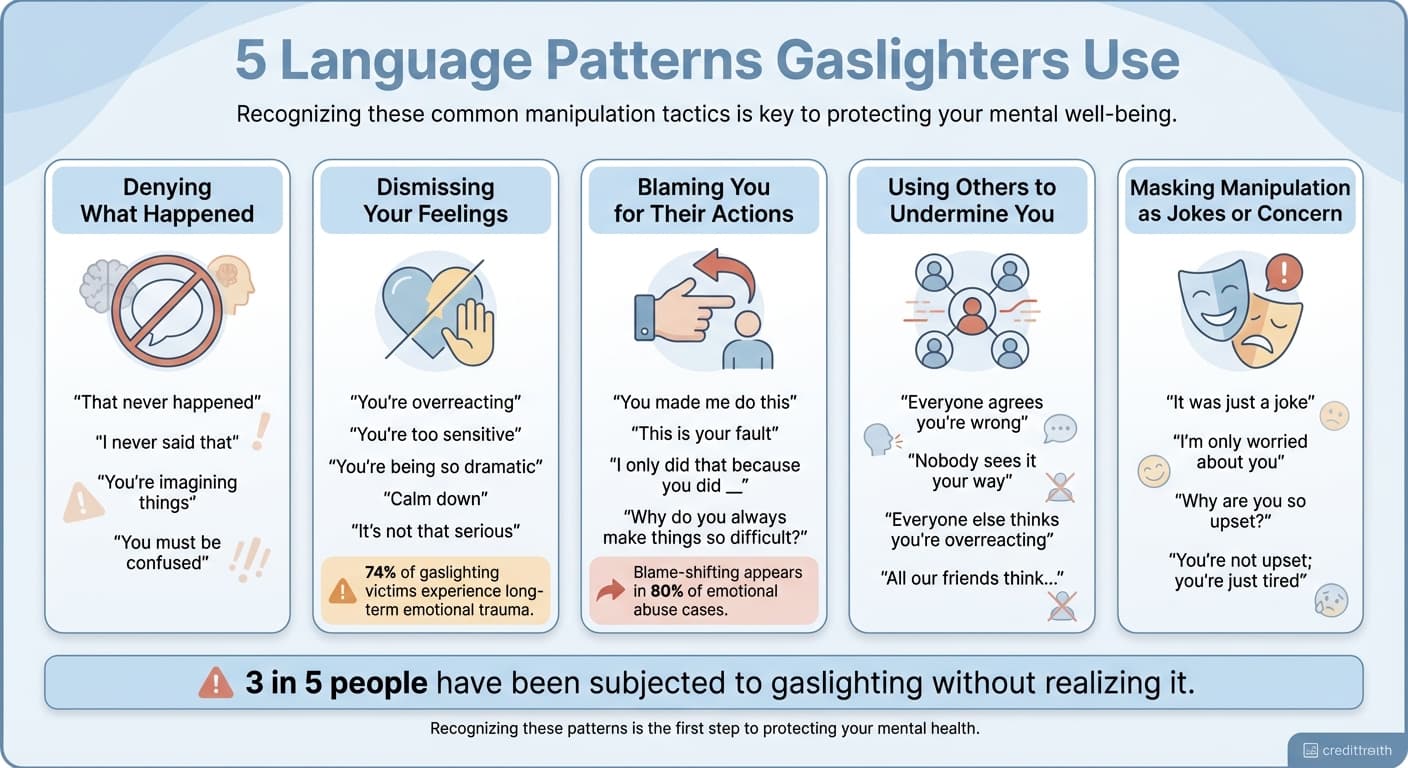
Gaslighting is a manipulative tactic aimed at making you doubt your reality. It often involves denial, blame-shifting, dismissing your emotions, or twisting narratives. Recognizing these patterns can help you identify manipulation and protect your mental health. Here are five common gaslighting language patterns:
- Denial and Changing the Story: "That never happened", or "You're imagining things."
- Dismissing Your Feelings: "You're overreacting", or "You're too sensitive."
- Blaming You for Their Actions: "You made me do this", or "This is your fault."
- Using Others to Undermine You: "Everyone agrees you're wrong", or "Nobody sees it your way."
- Masking Manipulation as Jokes or Concern: "It was just a joke", or "I'm only worried about you."
These tactics are designed to confuse and control you. Spotting them early is key to regaining confidence and setting boundaries. Tools like Gaslighting Check can help analyze conversations for manipulative patterns, providing clarity and support.
::: @figure
7 Gaslighting Phrases Manipulators Use to Control You - Day 3
1. Denying What Happened And Changing The Story
One of the most unsettling gaslighting tactics is outright denial of events you clearly remember. The gaslighter will confidently say things like, "That never happened", "I never said that", or "You're imagining things", leaving you questioning your own reality [2][5]. This isn't just about dismissing facts - it’s about reshaping them to fit the gaslighter's version of events. Unlike honest memory lapses or disagreements, where both sides aim to uncover the truth, gaslighters refuse to acknowledge your perspective or any evidence you present.
What makes this tactic even more harmful is their ability to rewrite the narrative to shield themselves. For instance, a manager or partner might make a promise or accusation, only to later deny ever saying it - even when confronted with clear proof [2].
These denials are often paired with blame-shifting. Phrases like "You're making that up", "You must be confused; I never did that", or "You're just trying to make me look bad" are common tools in their arsenal [2][4].
Over time, this behavior can erode your trust in your own memory. You might find yourself double-checking everything because your confidence has been shaken. Mental health experts warn that this gradual self-doubt can take a toll on your mental stability - exactly what the gaslighter intends [5].
The difference between gaslighting and genuine disagreements lies in the pattern and intent. Gaslighters consistently deny reality to maintain control, showing no interest in your point of view and insisting that you’re always in the wrong [2][5]. Recognizing this recurring behavior is essential to understanding - and countering - the manipulative nature of gaslighting.
2. Dismissing Your Feelings and Reactions
One of the most common gaslighting tactics involves dismissing your emotions and responses. Gaslighters often use phrases like "You're overreacting" or "You're too sensitive" to make you question your feelings. This tactic shifts the focus away from their behavior and places it squarely on your reaction, leaving you feeling confused and invalidated.
Comments such as "You're being so dramatic", "Calm down", or "It's not that serious" are designed to undermine your perspective. In professional settings, this can sound like, "You're too sensitive. If you want to work here, you need to toughen up", or, "Relax, this is just part of the job." These remarks serve a single purpose: to deflect responsibility and make you doubt your own experiences.
"Identifying gaslighting patterns is crucial for recovery. When you can recognize manipulation tactics in real-time, you regain your power and can begin to trust your own experiences again."
- Stephanie A. Sarkis, Ph.D., Expert on gaslighting and psychological manipulation, Author of Healing from Toxic Relationships [1]
The repeated dismissal of your emotions can erode your confidence, making you question your sanity and giving the manipulator even more control. Studies show that 74% of gaslighting victims experience long-term emotional trauma, and 3 in 5 people have been subjected to gaslighting without realizing it [1]. Recognizing these verbal patterns is an essential step toward reclaiming your sense of self.
If you encounter this kind of behavior, consider responding with, "My feelings are valid, and dismissing them doesn't change what I experienced." Tools like Gaslighting Check can help you identify dismissive phrases such as "You're overreacting" in your conversations. These tools analyze your interactions while ensuring your data remains private and secure. Spotting these patterns as they happen can help you safeguard your emotional health and regain control of your narrative.
3. Blaming You for Their Actions
Gaslighters have a knack for dodging responsibility. Instead of owning up to their behavior, they flip the script and pin the blame on you. This tactic not only deflects accountability but can leave you questioning whether you somehow caused the problem in the first place.
You might hear things like, "I only did that because you did __," or "You made me do this." In more personal contexts, such as romantic relationships, it could sound like, "This is your fault. Why do you always have to make things so difficult?" These phrases are designed to make you second-guess yourself and take on guilt that isn’t yours to bear.
Studies reveal that blame-shifting shows up in around 80% of emotional abuse cases, often paired with tactics like denial or outright dismissal [2][3]. Over time, this constant deflection can erode your confidence, leaving you with anxiety, self-doubt, and diminished self-esteem.
Healthy relationships thrive on mutual accountability, not one-sided blame games. If you find yourself facing this kind of manipulation, setting firm boundaries is key. You might respond with something like, "Your choices are your responsibility, not mine," or "I understand you're upset, but blaming me isn't fair." Another approach is to steer the conversation back to the issue at hand by saying, "Let's not bring up past issues to avoid addressing what's happening right now."
Tools like Gaslighting Check can help you identify blame-shifting patterns in your interactions. Recognizing these repeated accusations can give you the clarity to spot manipulation and protect your mental well-being over time.
Detect Manipulation in Conversations
Use AI-powered tools to analyze text and audio for gaslighting and manipulation patterns. Gain clarity, actionable insights, and support to navigate challenging relationships.
Start Analyzing Now4. Using Others To Question Your Credibility
Gaslighters have a knack for twisting social dynamics to make you doubt yourself. One of their go-to tactics? Using others - friends, family, or coworkers - to reinforce their distorted version of events. By claiming that "everyone" agrees with them, they aim to make you feel isolated and question your own judgment.
You might hear things like, "Everyone else thinks you're overreacting", or "Nobody sees it your way - you're the only one complaining." In romantic relationships, it might sound like, "All our friends think you're being paranoid about my loyalty", after the gaslighter has shared a skewed version of the story. In a workplace setting, a manager could say, "Your team believes you’re not keeping up with the workload; this is on you" [2][3]. The purpose? To strip you of credibility and establish their narrative as the only valid one.
This tactic relies on social proof to erode your confidence and make you second-guess your perceptions. Over time, it can lead to feelings of isolation and a persistent sense of self-doubt [2][3].
The good news is that these claims are often exaggerated - or outright fabricated. A strong response might be something like, "I don’t need others’ opinions to validate how I feel; this is between us", or "Even if others disagree, it doesn’t change what actually happened" [3]. You can also set boundaries by saying, "Let’s stick to the facts - bringing in unrelated opinions isn’t helpful."
If you notice this behavior becoming a pattern, consider using tools like Gaslighting Check to track phrases like "Everyone thinks…" that are designed to undermine your confidence. Recognizing these tactics is the first step toward reclaiming your sense of self.
5. Hiding Manipulation Behind Jokes Or Concern
Gaslighters often disguise harmful comments as humor or false concern, using phrases like, "It was just a joke", or "I'm just worried about you", to sidestep accountability and make you question your own reactions [2][6].
In personal relationships, this might look like a partner mocking your insecurities and brushing it off with, "Why are you so upset? It was just a joke." In the workplace, a colleague might frame critical or undermining feedback as concern, saying something like, "I was only thinking about the project" [2].
This kind of false concern can be just as damaging as outright insults. Statements like, "You're not upset; you're just tired and hungry", or "Are you okay? You seem really off today", invalidate your feelings and plant seeds of self-doubt [2][3]. Over time, these tactics chip away at your ability to trust your own emotions, making it harder to express yourself authentically. They also normalize abusive behavior, masking it as humor or concern [2][3][6].
True humor doesn’t exploit your vulnerabilities, and genuine concern acknowledges your feelings rather than dismissing them [2][6]. Manipulative jokes and fake concern, however, repeatedly target your insecurities, leaving you feeling undermined.
To counter this, set firm boundaries. You might say, "Calling it a joke doesn’t undo the hurt it caused - let’s talk about what was said", or "Your concern feels dismissive; let’s focus on the real issue" [3][6]. If you notice a pattern of these behaviors, tools like Gaslighting Check can help. This platform tracks key phrases while ensuring your data remains secure and encrypted, helping you identify when humor or concern is being used as a smokescreen for manipulation. Recognizing these patterns can also help you connect them to other gaslighting tactics, making it easier to spot manipulative behavior over time.
How To Spot Patterns Over Time
Gaslighting thrives on repetition. If you frequently hear phrases like "I never said that" or "You're overreacting", these aren't random comments - they're calculated attempts to make you question your reality. The trick is to focus on patterns over time rather than isolated incidents.
Start by documenting these interactions. Write down the date, time, details of the conversation, and how it made you feel. Use secure methods, such as a private journal or an encrypted note app, to keep your records safe. When you review your notes - whether weekly or monthly - look for inconsistencies. For example, did someone commit to helping on a specific day and later deny ever saying so? Also, take note of repeated dismissive or blaming statements.
Pay attention to your emotional state, too. Do you often feel confused, anxious, or full of self-doubt after certain interactions? Try rating your stress levels daily; over time, this can help you connect specific feelings to particular conversations or people. These observations can reveal whether manipulative behavior is a recurring issue.
You can also use tools like Gaslighting Check, which analyzes text messages and audio recordings for signs of denial, trivializing, or blame-shifting. It generates encrypted reports that can help you identify patterns of manipulation. By consistently tracking interactions, you empower yourself to recognize gaslighting tactics and take steps to safeguard your mental health.
"Identifying gaslighting patterns is crucial for recovery. When you can recognize manipulation tactics in real-time, you regain your power and can begin to trust your own experiences again."
- Stephanie A. Sarkis, Ph.D., Leading expert on gaslighting and psychological manipulation, Author of "Healing from Toxic Relationships"
Conclusion
When someone repeatedly denies events, dismisses your feelings, shifts blame onto you, involves others to undermine you, or masks hurtful comments as "jokes", these are calculated tactics designed to make you question your reality. Over time, these behaviors can chip away at your confidence, leaving you feeling disoriented, anxious, and increasingly reliant on the gaslighter's version of events. The key to breaking free begins with recognizing these manipulative patterns for what they are.
Studies show that prolonged exposure to gaslighting can lead to deep emotional harm, with effects that may linger for years [1]. Identifying these tactics early - and keeping a record of them - can make a huge difference. When you can pinpoint the behavior (such as labeling it "denial" or "blame-shifting"), you start to dismantle the gaslighter's narrative and regain trust in your own perceptions and emotions.
Once you spot these patterns, taking intentional steps can help rebuild your confidence and strengthen your boundaries. If you often encounter these phrases in your relationships, consider sharing documented conversations with a trusted friend or therapist to validate your experiences. Tools like Gaslighting Check can also analyze text messages or audio recordings, flagging manipulative tactics like denial and trivialization in detailed, secure reports. Seeing these patterns laid out objectively can empower you to set boundaries, seek professional help, or create a safety plan to protect your well-being.
Recognizing gaslighting isn't about being overly suspicious - it's about valuing your experiences and taking action to safeguard your mental health. Whether you document interactions in a journal, use analysis tools, or seek counseling, every step you take to expose manipulation is an act of self-care and a move toward healing.
FAQs
What are some effective ways to set boundaries with a gaslighter?
Dealing with a gaslighter requires setting boundaries that are clear, firm, and unwavering. Begin by calmly expressing your limits, using assertive and confident language to outline behaviors you won't accept. Keep the focus on your needs and avoid getting pulled into arguments or trying to justify your stance.
Equally important is following through with consequences when those boundaries are crossed. This reinforces that your limits are non-negotiable and that manipulation won't be tolerated. Protect your emotional health by leaning on trusted friends, family, or professionals for support when needed.
What are the long-term effects of experiencing gaslighting?
Gaslighting can deeply impact a person's mental and emotional health over time. Many who experience it struggle with emotional trauma, self-doubt, and a weakened ability to trust their own judgment. It often contributes to issues such as anxiety, depression, and ongoing feelings of confusion.
This manipulation can distort a person's sense of reality, making them second-guess their memories and perceptions. Without intervention, these effects can linger for years, emphasizing the need for support and tools to regain confidence and a clear sense of self.
How can I tell if someone’s concern is genuine or manipulative?
To tell the difference between genuine concern and manipulative behavior, focus on the way someone communicates with you. Genuine concern shows up through respectful listening, empathy, and acknowledgment of your feelings. It doesn’t dismiss or belittle your experiences.
Manipulative behavior, on the other hand, often includes tactics like invalidating your emotions, shifting blame, or twisting reality with phrases like, “You’re overreacting” or “That never happened.” If their words frequently leave you doubting yourself or feeling confused, it’s worth considering whether manipulation is at play. Trust your gut and stay alert to these patterns to safeguard your emotional health.