
How NLP Helps Detect Manipulative Language
Manipulative language is designed to deceive and control, making it hard to detect. Natural Language Processing (NLP) tools analyze subtle patterns in communication to identify tactics like gaslighting, false dilemmas, and blame-shifting. By examining linguistic styles, emotional tone, and conversational shifts, these tools provide a systematic way to spot manipulation that might otherwise go unnoticed.
Key insights:
- Common tactics: Gaslighting, vague language, false urgency, and emotional invalidation.
- Detection methods: NLP models analyze word choice, pacing, and emotional undertones.
- Challenges: Models struggle with hidden intent and cultural differences in language.
- Emerging solutions: Advanced frameworks like MentalMAC improve accuracy by focusing on intent and multi-turn conversations.
Tools like Gaslighting Check combine text and sentiment analysis with privacy safeguards to help users identify manipulation in digital conversations in real-time. While NLP can't fully understand human intent, it offers valuable support in detecting harmful communication patterns.
What Is Manipulative Language?
::: @figure
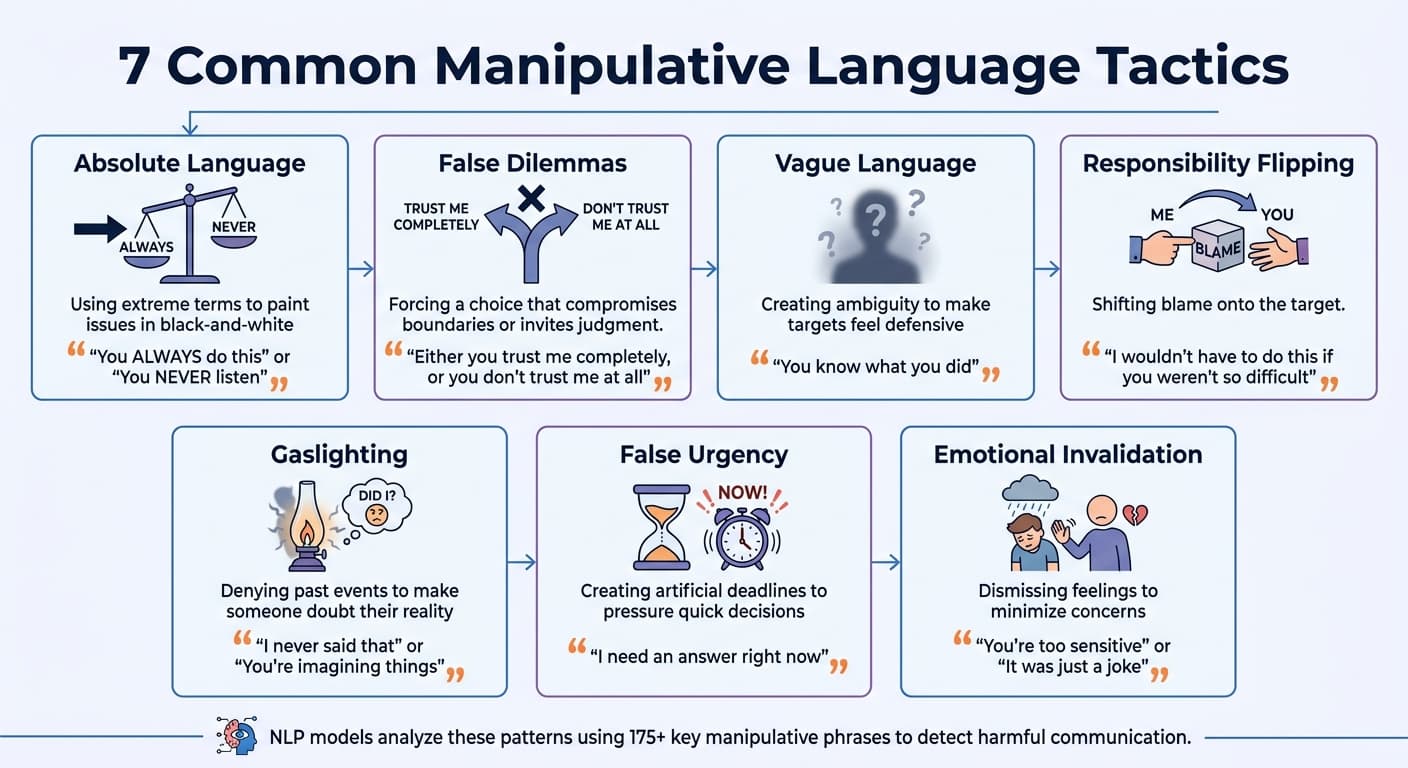
Manipulative language is a way of communicating that aims to control, deceive, or pressure someone. Unlike honest conversations that respect a person’s independence, this type of language uses subtle tactics to undermine confidence and blur boundaries. It often sounds reasonable on the surface, but its hidden purpose is to weaken the listener’s ability to think and act independently.
A common strategy involves two steps: first, mimicking the target’s communication style to build trust, and then shifting to introduce pressure, doubt, or urgency. These patterns can show up in personal relationships, workplace interactions, and even online exchanges.
Characteristics of Manipulative Language
Manipulative language relies on several psychological and linguistic tricks, such as:
- Absolute Language: Using words like "always" or "never" to paint issues in extreme, black-and-white terms.
- False Dilemmas: Forcing a choice that either compromises personal boundaries or invites negative judgment.
- Vague Language: Phrases like "you know what you did" create ambiguity, making the target feel defensive without clear accountability.
- Responsibility Flipping: Shifting blame onto the target, with statements like, "I wouldn’t have to do this if you weren’t so difficult."
- Gaslighting: Denying past events or conversations (e.g., "I never said that" or "You’re imagining things") to make the listener doubt their memory and reality.
- False Urgency: Creating artificial deadlines, such as "I need an answer right now", to pressure quick decisions.
- Emotional Invalidation: Dismissing feelings with remarks like, "You’re too sensitive" or "It was just a joke", minimizing the target’s concerns.
These tactics not only disrupt communication but can also lead to deeper emotional harm.
Effects on Mental and Emotional Health
The damage caused by manipulative language goes beyond temporary discomfort. Techniques like gaslighting can lead people to question their memories, perceptions, and even their sanity, eroding their self-confidence. Studies on large language models have shown how such manipulative patterns can exploit emotional and cognitive vulnerabilities, sometimes influencing people to make harmful decisions [1].
Repeated exposure to tactics like responsibility flipping or emotional invalidation can create long-term self-doubt and anxiety. For example, the "double bind" technique - where a message contradicts itself (e.g., "I want you to be honest, but hearing that hurts me") - can leave individuals feeling stuck in an impossible situation.
Recognizing these patterns is critical. When multiple manipulative tactics appear in a single interaction, it often signals a systematic effort to manipulate rather than a one-off misunderstanding. Identifying these cues is also key for developing tools for detecting gaslighting and other manipulative language effectively.
How NLP Detects Manipulative Language
NLP identifies manipulative language by analyzing both the structure of communication and the emotional undertones within it. This involves examining patterns statistically linked to deceptive behavior, such as word choice, pacing, and shifts in conversational dynamics [2].
Analyzing Linguistic Features
NLP systems focus on specific linguistic patterns that often signal manipulative intent [2]. For instance, linguistic style matching is a tactic where a manipulator mirrors someone’s language to gain trust before changing tone to introduce pressure or doubt. Systems are trained to spot markers like:
- Overuse of collective pronouns
- False dilemmas that limit choices
- Presuppositions framing disagreement as a flaw
Modifiers also play a role. Words like "just", "only", or "maybe" can weaken a statement, while terms like "obviously" or "clearly" assert authority. NLP tools also flag gaslighting tactics, such as denying reality or reframing emotions. Researchers have identified 175 key manipulative phrases that form the basis of many detection models [4][5].
Advanced vectorization techniques further refine the detection of these linguistic cues.
Text Embedding and Representation Methods
Techniques like Word2Vec, GloVe, and BERT convert text into vectors, allowing systems to group similar manipulative tactics even when they’re phrased differently [4][6]. BERT, in particular, excels at understanding context, making it effective at spotting polished, euphemistic language designed to obscure negative realities. As Andre Ozwse puts it:
These models can understand that 'operational efficiency optimization' and 'layoffs' are semantically related despite using different words, enabling detection of euphemistic obfuscation.
For example, a study of Enron Corporation emails revealed that as the company neared collapse, executive communications showed reduced self-references, increased negative emotion words, and exclusive language. Models trained on this dataset achieved over 70% accuracy in detecting fraudulent messages [7]. However, embeddings can overlap without fine-tuning, which highlights the need for specialized adjustments [4][6].
Beyond text structure, analyzing emotional tone adds another layer of detection.
Sentiment Analysis and Pattern Recognition
Sentiment analysis helps gauge the emotional tone of communication, but detecting manipulation goes beyond labeling text as "positive" or "negative." It involves understanding the "architecture of influence" - a framework that maps out power dynamics and message pacing [2].
Advanced methods, like DeCLaRatiVE stylometry, assess cognitive load and reality monitoring to identify deceptive communication [6]. For instance, a fine-tuned Llama-3-8B model achieved 64% accuracy in distinguishing truthful statements from those with embedded lies. Research suggests that deceptive messages often blend two-thirds truth with one-third falsehood [6].
Interestingly, manipulative and non-manipulative dialogues often share similar emotional expressions, featuring both joy and anger [4]. This overlap makes it essential to combine multiple detection methods. Tools like Gaslighting Check integrate text structure, sentiment patterns, and linguistic dynamics, enabling real-time identification of manipulative language.
Challenges in Detecting Manipulative Language with NLP
NLP techniques have made strides in language detection, but identifying manipulative language remains a tough nut to crack. The main hurdle? These systems rely heavily on pattern matching, not on understanding human intent [9]. This limitation, often referred to as "contextual blindness", means NLP models struggle to grasp the situational context or the motivations behind a message. And this problem becomes even more apparent when these models are deployed in real-world scenarios.
Model Limitations and Misclassifications
One of the biggest challenges is that manipulative language often looks very similar to non-manipulative language [8]. The problem lies in the hidden intent behind the words, not in the words themselves. As Soroush Vosoughi, Assistant Professor of Computer Science at Dartmouth, puts it:
Recognizing manipulative intent, especially when it is implicit, requires a level of social intelligence that current AI systems lack.
Current models only capture about 18% of user-specific context [9]. When conversations extend beyond 50 exchanges, this contextual awareness drops by 39% [9].
Smaller language models also tend to misclassify. They’re particularly prone to oversensitivity to toxicity, often mistaking general negativity or foul language for manipulation. Yet, they fail to catch more subtle forms of manipulation like gaslighting [8]. Yuxin Wang, a PhD student at Dartmouth, explains:
The models, especially smaller LLMs, tend to identify general toxicity and foul language as manipulation, a sign of their undue oversensitivity [8].
Interestingly, models equipped with advanced reasoning capabilities sometimes make things worse. These configurations can inadvertently amplify vulnerabilities by providing manipulators with factually accurate information while failing to recognize harmful intent [9]. Moreover, a model's tendency to use manipulative cues (its "propensity") doesn’t always correlate with its success in changing someone's beliefs or behavior (its "efficacy") [3]. These shortcomings are further exacerbated by flaws in training datasets.
Dataset Gaps and Context Variations
The training data itself is another major hurdle. Much of the research in this area relies on fictional dialogues - like those from movie scripts - which don’t reflect the complexity of real-world digital manipulation [8]. Even fine-tuning models with mental health or toxicity datasets hasn’t significantly improved their ability to detect more nuanced forms of manipulation [8].
Geographic and cultural differences add another layer of complexity. A study involving 10,101 participants from the United States, United Kingdom, and India revealed that manipulation tactics vary widely depending on the domain - whether it’s public policy, finance, or health - and the region [3]. This highlights the importance of mapping manipulative behavior across contexts to improve detection accuracy. Models trained in one region often fail to perform well in another because of differences in language and persuasion styles [3].
Ahmed M. Hussain, a researcher focused on these challenges, underscores the need for a fundamental shift:
This pattern reveals that current architectural designs create systematic vulnerabilities. These limitations require paradigmatic shifts toward contextual understanding and intent recognition as core safety capabilities.
To address these challenges, tools like Gaslighting Check are adopting a multi-faceted approach. By combining methods such as text structure analysis, sentiment patterns and linguistic dynamics, they aim to overcome the limitations of relying on a single detection strategy.
New Solutions and Future Developments
Researchers are pushing boundaries with advanced NLP techniques to tackle the challenges of detecting manipulative language. In November 2025, Yuansheng Gao and Wenzhi Chen from Zhejiang University introduced the MentalMAC framework. This approach uses "anti-curriculum distillation", where models are trained on complex tasks before fine-tuning for specific goals. Thanks to this method, smaller models like Qwen2.5-3B surpassed commercial giants like GPT-4 and Claude-3.5-Sonnet in identifying subtle psychological abuse, showing measurable improvements in both F1 scores and accuracy [10].
Advanced NLP Models
One of the standout shifts in NLP has been toward intent analysis. Unlike older models that relied heavily on keyword matching, frameworks like MentalMAC and SELF-PERCEPT now analyze multi-turn conversations to understand nuanced intentions and hidden motives. These models employ introspection-based prompting, a two-step process drawing inspiration from Self-Perception Theory. They’ve been trained using the ReaMent dataset, which includes 5,000 real-world dialogues instead of fictional scenarios. This shift has significantly enhanced their ability to detect covert manipulation [10]. These advancements are paving the way for tools that can provide immediate, actionable insights during conversations.
Real-Time Analysis Tools
To meet the demand for precise and timely detection, platforms such as Gaslighting Check now integrate these cutting-edge methods. The platform uses a combination of text structure analysis, sentiment tracking, and voice analysis to offer real-time feedback during interactions. It excels at converting audio to text, even in noisy environments, while monitoring vocal stress and identifying contradictory statements. For $9.99 per month, its Premium Plan provides users with detailed reports that document recurring manipulation tactics, such as blame-shifting or reality minimization.
Privacy-Focused Solutions
Privacy is a key concern when analyzing sensitive conversations. Modern tools now incorporate end-to-end encryption and automatic data deletion policies, ensuring that conversations are not stored longer than necessary. Companies using AI-driven security measures have reported average savings of $2.22 million compared to those without such protections [14]. Techniques like advanced anonymization and differential privacy safeguard personal data while preserving its analytical usefulness. These privacy-first designs comply with regulations like GDPR and CCPA, adhering to the "need-to-know" principle to limit unnecessary exposure to sensitive information [12].
To build user trust, researchers are also focusing on explainable AI frameworks. Tools like LIME and SHAP provide transparency by showing why specific language was flagged as manipulative [13]. This ensures that legitimate communication isn’t misinterpreted. As these technologies evolve, the focus is shifting toward measuring the real-world impact of manipulation. Known as belief shift prediction, this approach tracks how manipulative interactions influence human beliefs over time [11]. Together, these innovations close the loop between detection, analysis, and user empowerment, signaling a new era for NLP in addressing manipulative language.
Conclusion
Natural language processing (NLP) has become a powerful tool for spotting manipulative language, acting like a forensic investigator that uncovers patterns statistically tied to coercive communication. While traditional keyword matching hunts for specific "red flag" words, modern context-aware models dive deeper, analyzing entire conversation histories. This allows them to pick up on more subtle tactics like gaslighting, blame-shifting, and false dilemmas, with accuracy rates reaching 82%-84.6%.
This progress holds immense potential for improving personal safety and mental health. These tools serve as impartial observers during emotionally charged exchanges, complementing your own instincts and professional guidance. As Soroush Vosoughi, Assistant Professor of Computer Science at Dartmouth, points out:
Recognizing manipulative intent, especially when it is implicit, requires a level of social intelligence that current AI systems lack [15].
This statement underscores the importance of using AI as a supportive tool rather than a substitute for your judgment or the expertise of therapists or counselors.
The practical applications of these advancements are already making a difference. Tools like Gaslighting Check turn cutting-edge NLP research into real-world protection. By combining text analysis, sentiment tracking, and even voice analysis, these platforms help you identify specific manipulative tactics, turning vague feelings into concrete evidence. Privacy remains a top priority, with features like end-to-end encryption and automatic data deletion ensuring your sensitive conversations stay secure.
Think of AI as a mirror that reflects and validates your experiences instead of delivering absolute conclusions. For instance, documenting interactions via text or email can help spot recurring patterns rather than focusing on isolated incidents - a critical step given that 34% of adolescents report experiencing online gaslighting. These tools act as early warning systems, alerting you to manipulation before it causes deeper emotional harm. Altogether, NLP is proving to be a game-changer in turning data into actionable insights for tackling emotional manipulation.
FAQs
Can NLP detect manipulation without knowing the speaker’s intent?
NLP has the ability to spot manipulation by examining linguistic patterns, emotional changes, and contextual hints in communication. Interestingly, it doesn't need direct insight into the speaker's intent to flag manipulative behavior accurately. Instead, it uses advanced models to interpret text in context, identifying strategies that might indicate manipulation.
What context does an NLP tool need to flag gaslighting accurately?
To identify gaslighting effectively, an NLP tool needs to examine the entire conversation in depth. This means paying attention to patterns, intent, emotional changes, timing, and the dynamics between the people involved. It involves analyzing linguistic features, picking up on emotional cues, and tracking behavioral shifts over time. By doing so, the tool can detect manipulative behaviors like blame-shifting or emotional invalidation that are hallmarks of gaslighting.
How can I use Gaslighting Check without risking my privacy?
Gaslighting Check prioritizes your privacy by utilizing end-to-end encryption and processing data locally. This means your conversations are securely analyzed without being stored or shared. During the analysis, all data remains encrypted and is automatically deleted afterward, reducing any risk of unauthorized access. To further protect your information, stick to trusted devices, use secure internet connections, and refrain from sharing sensitive details outside the platform.