How AI Enhances De-escalation Frameworks

How AI Enhances De-escalation Frameworks
AI is transforming conflict management by improving detection, speed, and emotional analysis in de-escalation processes. While traditional methods rely on human judgment, AI tools like Gaslighting Check analyze conversations in real-time to identify emotional manipulation and escalation triggers. This approach has been shown to:
- Reduce conflict escalation by 43%.
- Detect anger with 89.3% accuracy and contempt with 82.1%.
- Lower employee turnover by 45% and boost productivity by 15%.
AI complements human skills by offering consistent monitoring, structured insights, and faster intervention. However, it lacks empathy and struggles with nuances like sarcasm or context. The best results come from combining AI's precision with the emotional understanding of human practitioners.
How to use Al to resolve human conflict | Jonmar | TEDxManhattanBeach

1. Human-Only De-escalation Frameworks
Before diving into how AI might enhance de-escalation strategies, it’s worth taking a closer look at the strengths and challenges of human-only approaches. For decades, these frameworks have been used to address tension in healthcare, crisis response, and workplace settings. Models like Safewards, Dix and Page, and Turnbull et al. equip professionals with tools centered on empathy, active listening, and ongoing risk assessment.[10] These methods rely on a practitioner’s ability to interpret nonverbal cues, understand context, and respond appropriately in real time. However, while effective in many cases, this human-only approach has limitations that AI technologies aim to address.
Escalation Detection Accuracy
Human practitioners often rely on nonverbal cues - like tone of voice or posture - and accusatory language patterns (e.g., phrases like “You always...” or “You never...”) to identify potential escalation.[5] The accuracy of this detection depends on several factors: the practitioner’s training, familiarity with the individuals involved, and their mental bandwidth in the moment.[6] Structured observation is a key focus in crisis negotiation programs because untrained individuals may overlook low-level agitation until it escalates into outright aggression.[6] Common errors include attribution bias (labeling someone as "difficult" instead of recognizing stress), cultural misinterpretations (mistaking directness for hostility), and stereotypes based on gender or race that can skew threat assessments.[5] Under pressure, practitioners often prioritize obvious behaviors, which means subtler signs - like withdrawal - can go unnoticed.[5][6]
Intervention Speed
Spotting early signs of escalation is one thing - acting quickly is another. In high-stakes situations, intervention speed depends on factors like situational awareness, clarity of roles, and training in specific response protocols.[6] For example, in healthcare or law enforcement settings, staff trained to engage verbally within 30 seconds of a raised voice generally respond faster and more effectively than those without such training.[6] However, in fast-paced U.S. environments, competing responsibilities, physical distance, and burnout can slow response times.[6] Additionally, concerns about being perceived as biased or uncertainty about legal and HR implications can cause hesitation, even when warning signs are clear.[5]
Emotional and Behavioral Insight
Many evidence-based frameworks emphasize the importance of understanding emotions and behavior. Techniques like emotion labeling, perspective-taking, and recognizing behavioral patterns help practitioners identify underlying feelings such as fear or shame.[6] Crisis negotiation models often train individuals to use reflective statements that validate emotions without approving harmful actions.[6] Similarly, restorative justice and mediation practices focus on addressing needs like safety, respect, and fairness, rather than merely reacting to surface-level behaviors. Recognizing patterns - such as withdrawal or passive resistance - can signal unmet needs and guide more effective interventions.[5] These methods rely heavily on ongoing self-reflection, supervision, and debriefing to deepen practitioners’ emotional awareness over time.[6]
Training and Skill Development
Traditional de-escalation training typically involves workshops and simulations. While these can be effective initially, infrequent practice and limited feedback often cause skills to fade over time.[5][6] Some sectors invest in scenario-based training that reinforces specific verbal techniques and nonverbal communication strategies, but many organizations lack systems to monitor whether these skills are consistently applied. Without structured reinforcement, even well-trained practitioners may struggle to maintain their proficiency.[5] For instance, a year-long implementation of the Safe Steps for De-escalation framework in three acute mental health units in New South Wales, Australia (2016–2017), combined a therapeutic four-step model with co-designed training and regular review meetings. The result? A noticeable reduction in restrictive practices, seclusion episodes, and the use of as-needed intramuscular psychotropic medications per 1,000 bed days compared to control units.[8]
2. AI-Supported De-escalation Frameworks (e.g., Gaslighting Check)

AI-supported frameworks bring a new layer of precision and speed to conflict resolution, addressing limitations of human-only interventions. By using tools like natural language processing (NLP), sentiment analysis, and voice analytics, these systems monitor conversations in real time, offering data-driven insights to prevent tensions from escalating. The aim isn’t to replace human judgment but to enhance it with constant monitoring and actionable guidance. Let’s explore how these systems excel in detection, speed, emotional analysis, and skill-building.
Escalation Detection Accuracy
AI systems excel at pinpointing emotional shifts that might signal conflict. For example, studies show that AI-assisted tools can reduce escalation by up to 37% compared to traditional methods [3]. Gaslighting Check zeroes in on manipulation tactics - like blame-shifting, distorting reality, or invalidating emotions - by analyzing both text and voice patterns. This continuous monitoring highlights subtle warning signs, such as changes in language or tone, that might otherwise go unnoticed.
Intervention Speed
Speed is crucial when it comes to de-escalating tense situations. AI tools can intervene much faster than human observers, cutting conflict escalation rates by 43% through real-time prompts and alerts [3]. Gaslighting Check processes audio and text inputs in seconds, flagging potential manipulation as it happens. This allows users to address issues immediately, well before they spiral out of control.
Emotional and Behavioral Insight
Through advanced sentiment and voice analysis, AI tools can measure emotional tones like anger, sadness, fear, and stress, providing structured insights into the emotional dynamics of a conversation. Gaslighting Check takes this further by identifying manipulation patterns and offering encrypted, detailed reports. Over time, these insights help users recognize subtle emotional abuse, empowering them to trust their instincts and establish stronger boundaries.
Training and Skill Development
Gaslighting Check isn’t just a monitoring tool - it’s also a teaching resource. By analyzing real conversations, it highlights manipulation techniques that might otherwise go unnoticed. Users gain access to detailed breakdowns of these tactics, helping them understand both the “what” and the “how” of manipulation. This continuous feedback supports personal growth, with studies linking such skill-building to outcomes like 45% lower employee turnover and a 15% boost in productivity [3][11].
Detect Manipulation in Conversations
Use AI-powered tools to analyze text and audio for gaslighting and manipulation patterns. Gain clarity, actionable insights, and support to navigate challenging relationships.
Start Analyzing NowStrengths and Weaknesses
::: @figure
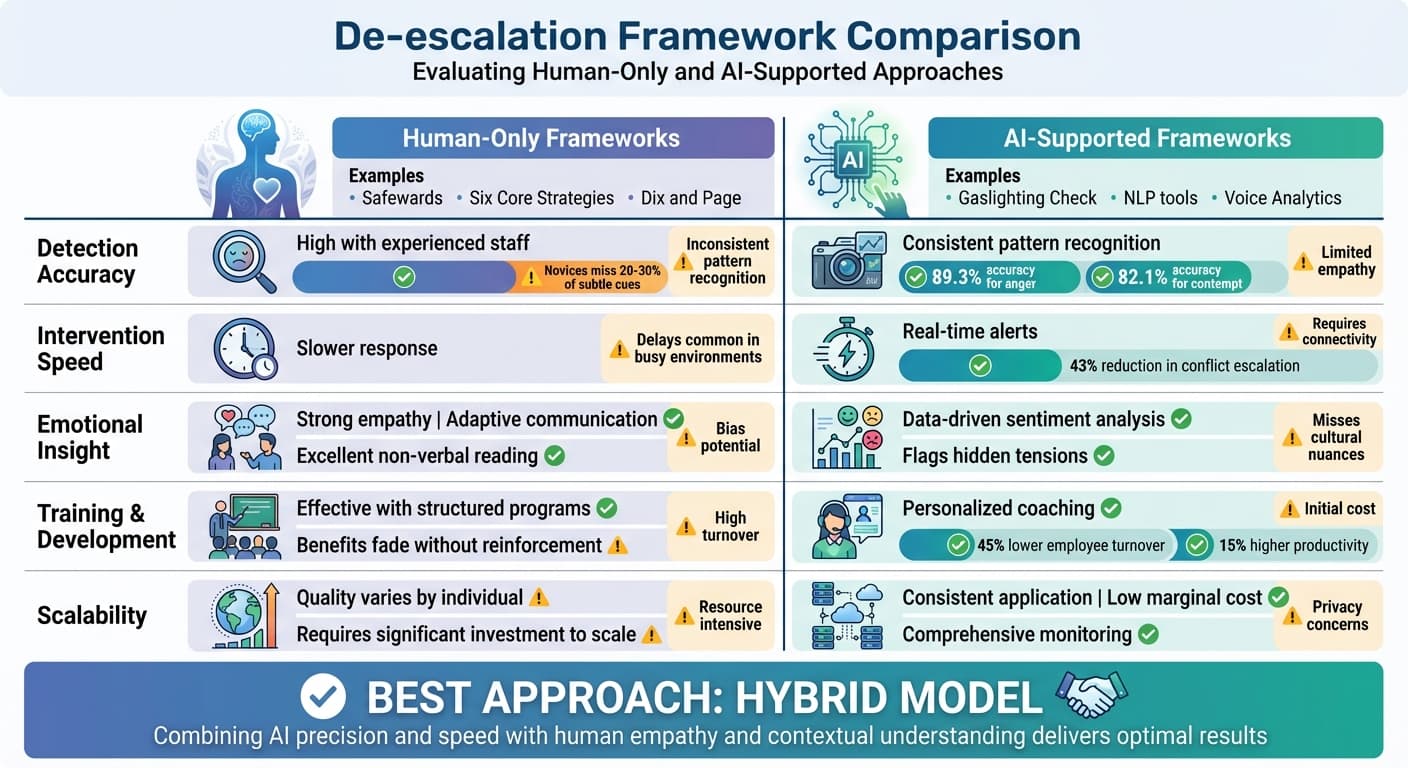
When it comes to conflict de-escalation, human-only frameworks and AI-supported frameworks each bring unique advantages and challenges. Knowing where each approach shines - and where it struggles - can help organizations make informed decisions about which tools to use in different scenarios. Let’s break down their strengths and limitations.
Human-only frameworks, like Safewards and Six Core Strategies, excel in providing empathy and understanding. Trained staff can interpret complex non-verbal cues, build trust over time, and adjust their communication styles to meet emotional needs [8][9][10]. However, these methods can be inconsistent. For instance, less experienced staff might miss 20–30% of subtle cues, and factors like fatigue, bias, or heavy workloads can slow response times [5]. Scaling these frameworks across large organizations is also resource-intensive, requiring significant investment in high-quality training [7][8][9].
On the other hand, AI-driven tools - such as Gaslighting Check - address some of the shortcomings of human-only methods. AI frameworks excel in consistent pattern recognition, providing real-time insights that can quickly flag potential manipulation. They also enhance training by offering objective feedback from real-world interactions. For example, companies using AI-driven coaching have reported a 45% drop in employee turnover and a 15% boost in productivity, along with a 43% reduction in conflict escalation compared to traditional methods [3][11].
That said, AI has its own set of limitations. While it’s great at analyzing patterns, it lacks genuine empathy and struggles with subtle cues like sarcasm, cultural nuances, or context-specific behaviors. Its effectiveness depends on the quality of the data it’s trained on, and without human oversight, it can misinterpret unusual situations [2][4][5]. Tools like Gaslighting Check are designed to complement - not replace - human judgment, providing data-driven insights to support faster, more informed decisions.
| Criterion | Human-Only Frameworks | AI-Supported Frameworks |
|---|---|---|
| Detection | High with experienced staff, though novices might miss 20–30% of subtle cues [5] | Consistent pattern recognition (e.g., 89.3% accuracy for anger, 82.1% for contempt); depends on data quality [2][3][5] |
| Speed | Slower due to workload and processing time; delays are common in busy environments [10] | Real-time alerts and prompts; cuts escalation by about 43% compared to traditional methods [3] |
| Emotional Insight | Strong empathy and adaptive communication; excels at reading non-verbal signals [8][9][10] | Data-driven sentiment analysis; flags hidden tensions but misses authentic empathy and cultural nuances [2][5] |
| Training | Effective with structured programs, though benefits fade without reinforcement [7][8][9] | Delivers personalized coaching via real interactions; linked to 45% lower turnover and 15% higher productivity [3][11] |
| Scalability | Quality varies across individuals and shifts; scaling requires significant investment [7][8][9] | Consistent application across locations at a low marginal cost; enables comprehensive monitoring [2][3] |
Ultimately, the best results often come from a hybrid approach - combining the precision and speed of AI with the empathy and contextual understanding of humans. This blend allows organizations to leverage the strengths of both systems while minimizing their weaknesses.
Conclusion
When comparing human-only frameworks with AI-supported systems, one thing becomes clear: AI doesn't replace human judgment in de-escalation - it complements and extends it. Human-led approaches like Safewards and Six Core Strategies excel in bringing empathy, ethical reasoning, and a deep understanding of conflict dynamics to the table. Meanwhile, research shows that AI-supported frameworks can deliver measurable benefits, such as reducing escalation rates by up to 43%, cutting turnover by 45%, and increasing productivity by 15% [3].
Take Gaslighting Check as an example of AI's potential. This platform analyzes text, voice, and real-time audio to detect emotional manipulation patterns that might otherwise go unnoticed - especially in moments of distress. With features like encrypted data storage, automatic deletion policies, and detailed reports, it gives users tools to set boundaries and make informed decisions with clarity and confidence.
That said, AI has its limitations. It can struggle with subtleties like sarcasm or cultural context, may reflect biases from its training data, and lacks the genuine empathy that humans bring. These challenges underscore the importance of maintaining strong oversight and safeguarding privacy.
Blending AI with established human strategies offers a balanced approach to conflict resolution. The speed and precision of AI, combined with human empathy and ethical decision-making, deliver the best outcomes. By focusing on low-risk applications and ensuring robust human oversight, this integration creates a framework where technology supports - not replaces - human expertise. As AI evolves with more advanced multimodal analysis and personalized coaching, the aim isn't to automate conflict resolution but to provide faster insights, better support, and greater confidence in navigating difficult situations.
"Identifying gaslighting patterns is crucial for recovery. When you can recognize manipulation tactics in real-time, you regain your power and can begin to trust your own experiences again." – Stephanie A. Sarkis, Ph.D., leading expert on gaslighting and psychological manipulation [1]
The future of de-escalation lies in thoughtful collaboration - where AI serves as a valuable ally, while evidence-based human skills, ethical frameworks, and professional judgment remain at the heart of resolving conflicts.
FAQs
How does AI identify emotional manipulation during conversations?
AI can spot emotional manipulation by examining conversations for tactics such as invalidation, blame shifting, distorting reality, and memory manipulation. It reviews both spoken and written communication, picking up on subtle strategies that might otherwise go unnoticed.
By offering clear and unbiased insights, AI enables users to identify manipulative behaviors as they happen. This awareness helps individuals respond with greater confidence and effectiveness in difficult interactions.
What challenges does AI face in understanding context and subtle nuances?
AI often has a hard time understanding context and picking up on subtle nuances like sarcasm, implied meanings, or delicate emotional signals. This can sometimes result in misunderstandings, especially in situations involving complex behaviors, such as gaslighting.
Although AI tools excel at identifying patterns and delivering insights, they can fall short when it comes to grasping the deeper, unspoken aspects of human interaction - areas that often demand emotional sensitivity and an understanding of cultural dynamics.
How do AI tools and human skills work together to improve de-escalation?
AI tools and human expertise work hand in hand to improve de-escalation strategies. AI has the ability to analyze conversations as they happen, identifying subtle emotional signals or manipulation tactics that might slip past human observation. These insights provide an objective layer of understanding that can be incredibly valuable.
At the same time, humans contribute empathy, contextual understanding, and the ability to connect on a personal level. These qualities are essential for responding in a way that feels genuine and builds trust during tense situations.
When you pair AI's analytical accuracy with human emotional insight, it leads to more thoughtful, compassionate, and effective interactions. This blend of technology and human touch creates opportunities for healthier communication and better conflict resolution.