
Gaslighting vs. Invalidation: How to Tell the Difference
When someone dismisses your feelings or makes you question your reality, it’s crucial to know if you’re experiencing gaslighting or emotional invalidation. Both behaviors can harm your mental well-being, but they have different intentions and effects:
- Gaslighting is a deliberate manipulation tactic. Its goal is to make you doubt your perception of reality, often for control or power.
- Emotional invalidation dismisses or downplays your feelings. It’s usually unintentional and stems from discomfort with emotions or misunderstanding.
Key Differences:
- Gaslighting: Repeated manipulation, targets your reality, often intentional.
- Invalidation: Dismissive comments, targets your emotions, often unintentional.
Understanding these differences helps you respond effectively, whether through setting boundaries, seeking support, or improving communication. Learning how to spot gaslighting and invalidation early can protect your emotional health.
Not All Invalidation is Gaslighting | What is Medical Gaslighting?
Detect Manipulation in Conversations
Use AI-powered tools to analyze text and audio for gaslighting and manipulation patterns. Gain clarity, actionable insights, and support to navigate challenging relationships.
Start Analyzing NowWhat Is Gaslighting?
Gaslighting is a calculated form of emotional abuse that makes you question your reality, memory, and even your sanity, giving the abuser control over you. Clinical psychologist Monica Vermani describes it as:
"Gaslighting is actually a highly calculating form of manipulation - which involves the destabilization - of one individual by another over a protracted period of time." [2]
The term comes from the 1938 play Gas Light and its 1944 film adaptation. In the story, a husband manipulates his wife into believing she's losing her mind so he can steal her family jewels. This perfectly illustrates gaslighting: it's not just lying - it's about breaking someone's trust in their own perception of reality.
What makes gaslighting stand out is its long-term nature. It's rarely a one-off incident. Instead, it unfolds over time - weeks, months, or even years - where the abuser repeatedly replaces your version of events with their own. Often, they exploit existing power dynamics, such as those tied to gender, race, or workplace hierarchies. The term became so relevant that Merriam-Webster named "gaslighting" its word of the year in 2022, following a 1,740% spike in searches [2]. Recognizing how it works is the first step to identifying its warning signs.
Common Signs of Gaslighting
Gaslighting tends to follow a pattern that escalates over time. One of the most common signs is when the abuser denies events, even when there's clear evidence, and insists you're misremembering. They might also accuse you of being "too sensitive", "paranoid", or "irrational."
Isolation is another major red flag. Abusers often work to cut you off from trusted friends and family who could validate your experiences. They may label you as "unstable" or "crazy" to discredit you further. As Dr. Chivonna Childs explains:
"It's like a magic trick: They make you look to the left so you don't see what's going on to the right." [1]
Gaslighters often use dismissive phrases like, "That never happened", "You're overreacting", "I was just joking", or "You're too sensitive." These remarks are carefully designed to make you doubt your judgment and memories. Over time, these tactics don't just distort your perception - they chip away at your emotional well-being.
How Gaslighting Affects People
The impact of gaslighting goes far beyond individual incidents. By undermining self-trust, it causes deep emotional harm. Victims often experience constant self-doubt, anxiety, and even depression. Everyday decisions become a struggle, and interactions leave them feeling confused and disoriented. Over time, this can lead to a significant loss of self-respect.
Sociologist Paige L. Sweet describes how gaslighting creates "testimonial injustice" [3]. This means the victim loses trust in their own perceptions and experiences. The effects often ripple beyond the abusive relationship, damaging the ability to trust others and recognize healthy dynamics. Without intervention, the mental and emotional scars can linger for years.
What Is Emotional Invalidation?
Emotional invalidation occurs when someone's thoughts, feelings, or behaviors are dismissed or deemed unimportant [4][5]. It’s different from gaslighting, which manipulates someone's sense of reality. Instead, emotional invalidation minimizes or ignores someone’s emotional experience. Jessica Tappana, LCSW, explains it this way:
"Invalidation happens when someone communicates - directly or indirectly - that your thoughts, feelings, or experiences are wrong, excessive, or don't make sense." [6]
Often, people who invalidate others don’t mean to cause harm. Their discomfort with strong emotions can lead them to unintentionally dismiss or downplay feelings. For example, they might offer unsolicited advice, attempt to "fix" the problem, or try to cheer you up with phrases like "Everything happens for a reason" [4][6]. While these responses may come from a caring place, they can still be deeply hurtful.
Invalidation isn’t always verbal. Actions like rolling your eyes, checking your phone while someone is speaking, or walking away during an important conversation also send a dismissive message [4][5]. Sharon Martin, LCSW, highlights a key point:
"Validation – saying that someone's feelings are acceptable or worthwhile – isn't the same as agreeing with their feelings. We can certainly feel differently, but make the effort to try to understand and empathize." [5]
Let’s explore how invalidation appears in everyday interactions.
What Emotional Invalidation Looks Like
Emotional invalidation often shows up in phrases that seem supportive at first but ultimately dismiss someone’s feelings. Unlike gaslighting, which distorts reality, invalidation broadly disregards your emotional experience. Common examples include:
- "You're overreacting."
- "It’s not a big deal."
- "You’re too sensitive."
- "Just let it go."
- "You shouldn’t feel that way." [4][5][6]
Other invalidating statements might be: "I know exactly how you feel", "You take everything so personally", "Stop making things up", or "It could be worse" [4][5][6]. While these comments might sound well-meaning, they shut down emotions rather than acknowledging them. The speaker may believe they’re being helpful, but the underlying message is clear: your feelings don’t matter.
This lack of empathy can leave lasting emotional wounds. Identifying these emotional manipulation patterns is the first step toward healing.
How Invalidation Affects People
When emotional invalidation happens repeatedly, it can make you feel invisible and unimportant. Over time, this can erode your self-confidence and lead to chronic self-doubt, making it hard to trust your own emotions or experiences [4]. Brittany Carrico, who writes about emotional health, explains:
"Emotional invalidation is the act of dismissing or rejecting someone's thoughts, feelings, or behaviors. It says to someone: 'Your feelings don't matter. Your feelings are wrong.'" [4]
The effects of invalidation can be severe. It’s linked to low self-esteem, anxiety, and depression [4][6]. In childhood, frequent invalidation can even contribute to the development of Borderline Personality Disorder (BPD) [4]. When someone dismisses your vulnerability, your nervous system may interpret it as "relational danger", leading you to suppress emotions, withdraw from others, or engage in people-pleasing behaviors [6].
Main Differences Between Gaslighting and Invalidation
::: @figure
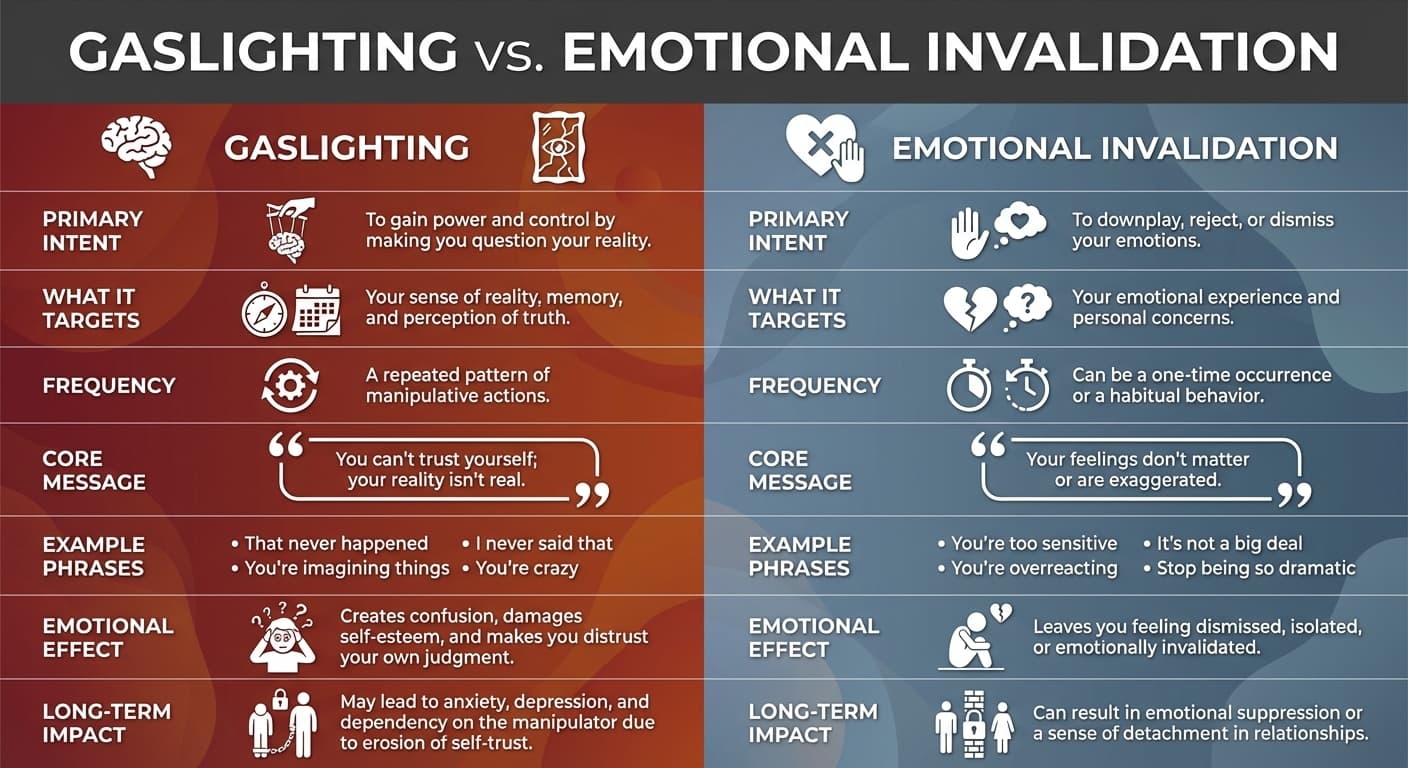
Gaslighting and emotional invalidation might both leave you feeling hurt or dismissed, but they stem from different intentions and have distinct effects. Recognizing these differences helps in addressing and responding to each behavior appropriately.
Intent Behind the Behavior
Gaslighting is about controlling your perception of reality. Whether intentional or not, it’s a behavior rooted in the need for power and control. Dr. Chivonna Childs, a psychologist at Cleveland Clinic, explains:
"Some people gaslight others just to inflict emotional pain or gain power and control over another person." [1]
In some cases, gaslighting can also act as a defense mechanism. When confronted, a gaslighter may shift blame onto you, making you feel responsible for their actions.
Emotional invalidation, however, is often unintentional. It typically arises from discomfort with emotions, a lack of understanding, or a defensive reaction. Rather than trying to manipulate your reality, the person may simply dismiss your feelings without realizing the impact.
The intentions behind these behaviors also influence how frequently they occur.
How Often It Happens
Gaslighting is a repeated pattern of manipulation. It involves ongoing cycles of lies, denials, and blame that gradually erode your trust in yourself.
Invalidation, by contrast, is more situational. It often happens as a one-time reaction during moments of stress or discomfort, without the systematic manipulation seen in gaslighting.
These differences in frequency also translate into distinct impacts on the person experiencing them.
Effects on the Person
Gaslighting can make you question everything you know. It chips away at your confidence in your memory, judgment, and even your sanity, leaving you doubting your own reality.
Emotional invalidation, while less extreme, can still hurt deeply. It leaves you feeling dismissed or unimportant, as though your emotions are excessive or unwarranted. While it doesn’t distort your sense of reality, it can harm your self-esteem and make you feel as though your feelings don’t matter.
Gaslighting vs. Invalidation: Side-by-Side Comparison
When trying to navigate a challenging relationship, understanding the difference between gaslighting and emotional invalidation is key. Here's a breakdown of how these two behaviors differ across several factors:
| Factor | Gaslighting | Emotional Invalidation |
|---|---|---|
| Primary Intent | To gain power and control by making you question your reality. | To downplay, reject, or dismiss your emotions. |
| What It Targets | Your sense of reality, memory, and perception of truth. | Your emotional experience and personal concerns. |
| Frequency | A repeated pattern of manipulative actions. | Can be a one-time occurrence or a habitual behavior. |
| Core Message | "You can't trust yourself; your reality isn't real." | "Your feelings don't matter or are exaggerated." |
| Example Phrases | "That never happened", "You're imagining things", "I never said that", "You're crazy." | "You're too sensitive", "You're overreacting", "It's not a big deal", "Stop being so dramatic." |
| Emotional Effect | Creates confusion, damages self-esteem, and makes you distrust your own judgment. | Leaves you feeling dismissed, isolated, or emotionally invalidated. |
| Long-term Impact | May lead to anxiety, depression, and a dependency on the manipulator due to the erosion of self-trust. | Can result in emotional suppression or a sense of detachment in relationships. |
This comparison highlights a key distinction: gaslighting manipulates your perception of reality, while invalidation minimizes or rejects your emotions. Both can be harmful, but understanding their unique effects is the first step toward addressing them. Next, we'll look at gaslighting in relationships examples and effects to further illustrate these behaviors in real-life situations.
Examples: Gaslighting vs. Invalidation in Action
Real-life examples can help illustrate the difference between gaslighting and invalidation.
Example 1: Denying a Conversation
Imagine discussing household responsibilities with your partner. Later, they say: "That conversation never happened. You're making things up - you're overinterpreting." This is gaslighting. The response undermines your memory and questions your credibility on purpose.
Now, compare it to this response: "I don't remember that conversation. You're overreacting - it wasn't that important anyway." This is emotional invalidation. They may genuinely not recall the conversation, but they dismiss the significance of your concerns and downplay your feelings.
The distinction lies in the intent. Gaslighting attacks your sense of reality, while invalidation diminishes the value of your emotional experience. Sociologist Paige L. Sweet describes gaslighting as:
"deny or occlude, then flip the script" [3]
In other words, the person not only denies the event but also shifts blame onto you for questioning it.
Now, let’s look at how responses differ when emotions are involved.
Example 2: Responding to Emotions
Picture a moment when you express feeling hurt. A gaslighting response might be: "You're crazy for thinking that. I never said anything hurtful - you're imagining things." This tactic is meant to make you doubt your perception of events.
On the other hand, an invalidating response could be: "You're exaggerating. It was just a joke - stop being so sensitive." Here, they acknowledge the event but trivialize your emotions. As one survivor of domestic violence, Selah, explains:
"They live in an alternate reality. And they want you to live there with them" [3]
While invalidation doesn’t try to alter your reality, it sends the message that your feelings about the situation don’t matter.
These examples show that gaslighting makes you question what’s real, while invalidation dismisses your emotions without altering your perceptions.
How to Recognize Gaslighting and Invalidation
Trust your instincts when identifying these behaviors - they often reveal themselves in subtle but consistent ways.
Warning Signs of Gaslighting
Gaslighting tends to emerge through patterns rather than isolated instances. Dr. Chivonna Childs, PhD, a psychologist, describes it well:
"It's like a magic trick: They make you look to the left so you don't see what's going on to the right." [1]
Common signs include repeated denial or distortion of facts, which can make you question your memory or perception. Withholding information is another tactic, as it stifles open communication and problem-solving. You might find yourself frequently second-guessing your judgment or feeling uneasy in interactions. Pay attention to moments when you feel more confused after a discussion - this could indicate manipulation. External labeling, where someone defines your thoughts or feelings for you, further undermines your trust in yourself [3].
Recognizing these behaviors equips you to take steps toward addressing them.
Warning Signs of Invalidation
Invalidation takes a different form. It often involves dismissive remarks that downplay your emotions, leaving you feeling unheard or insignificant. Unlike gaslighting, which manipulates your perception of reality over time, invalidation might happen in a single moment, disregarding your feelings while leaving the facts untouched.
Understanding these patterns is the first step toward responding to them effectively.
Using Gaslighting Check to Analyze Conversations

When you're unsure about a situation, objective tools can help. Gaslighting Check is a platform designed to analyze both text and voice conversations, making it easier to detect emotional manipulation. It creates detailed reports that highlight specific patterns in your interactions, so you're not relying solely on memory.
The platform's text and voice analysis features work together to uncover manipulative language and unsafe tones. For $9.99/month, the Premium Plan includes conversation history tracking, which is especially useful for spotting recurring behaviors [1][3]. Your data is securely encrypted and automatically deleted according to their privacy policies, ensuring confidentiality.
These tools provide a practical way to identify and address gaslighting and invalidation, helping you regain clarity and confidence in your interactions.
How to Handle Gaslighting and Invalidation
Protect your sense of reality and establish firm boundaries when faced with these behaviors.
Dealing with Gaslighting
Spotting gaslighting early is key. When it happens, rely on short, confident statements to affirm your reality: "I know what I experienced," "I remember it differently and trust my memory," or "This conversation isn’t productive, so I’m stepping away."
Avoid getting trapped in endless arguments. Dr. Chivonna Childs, a psychologist at Cleveland Clinic, offers this perspective:
"A fire cannot burn if there's no fuel. They can't fight if there's no one to fight with" [1].
Pay attention to actions rather than words. Gaslighters often use affectionate language or "love bombing" to distract you, but their behavior over time will reveal their true intentions.
Keep a record of interactions. Screenshots, recordings, or written notes can be helpful, especially if shared with someone you trust. Using tools for detecting gaslighting can help you analyze conversations for manipulative patterns.
Seek support from trusted friends, family, or a therapist. Gaslighting thrives on isolation, so staying connected to others weakens its grip. If you're in an abusive relationship, develop a safety plan. Include escape routes and resources like the National Domestic Violence Hotline at 1-800-799-7233 [1].
These techniques help ensure clarity and self-validation, which are critical when dealing with emotional invalidation.
Dealing with Invalidation
Handling invalidation also requires clear communication about your emotions.
Use "I" statements to express how you feel without casting blame. For example, instead of saying, "You always ignore me," try, "I feel dismissed when my concerns are labeled as overreacting." This shifts the focus to your experience and reduces defensiveness.
Address the behavior directly as it happens. Saying something like, "You’re minimizing my feelings," can steer the conversation toward a more respectful tone.
Set firm boundaries by stating what you need and what you won’t tolerate. For example: "I need my feelings to be acknowledged. If they aren’t, I’ll need to limit our interactions." After invalidating experiences, use grounding techniques or mindful breathing to regain calm and reconnect with yourself.
Conclusion
Understanding the distinction between gaslighting and invalidation can bring clarity to your relationships. Gaslighting is an intentional tactic aimed at making you doubt your perceptions and reality, while invalidation often dismisses your feelings, though it may not always be deliberate. Recognizing this difference is key to deciding whether better communication could improve a relationship or if ongoing harmful behavior signals the need to walk away.
Gaslighting, if ignored, can erode your ability to trust yourself and others, often leading to anxiety and depression [1]. Spotting these behaviors early is essential for stopping their impact and reclaiming your confidence. To counteract gaslighting, consider practical steps that help you stay grounded in reality.
Keep records of interactions - such as screenshots, recordings, or written notes - to separate facts from manipulation. Calling out the behavior when it happens can shift the power dynamic and assert that such actions are unacceptable. If the gaslighting continues despite your efforts, ending the relationship may be the healthiest option.
Additionally, professional support can play a critical role in rebuilding your self-esteem and setting healthy boundaries. A therapist can guide you through processing trauma and breaking free from cycles of manipulation. Tools like Gaslighting Check can also analyze conversations for manipulative patterns, offering objective insights.
If you are in an abusive situation, reach out to the National Domestic Violence Hotline at 1-800-799-7233 for confidential help. With the right support and resources, you can regain control of your reality and work toward healthier, more fulfilling relationships.
FAQs
Can invalidation turn into gaslighting over time?
Invalidation has the potential to evolve into gaslighting when it becomes manipulative, leading someone to doubt their own perceptions or sense of reality. This typically happens when invalidation is repeatedly used to erode trust in their emotions or personal experiences.
How can I tell if they’re lying or genuinely misremembering?
Lying is the act of deliberately sharing false information, whereas misremembering stems from an unintentional lapse in memory. Recognizing the difference often comes down to observing behaviors and emotional cues. Signs of lying might include contradictions in a story, evasive responses, or attempts to conceal facts. In contrast, misremembering is usually free of manipulation and carries less emotional intensity. Context matters too - misremembering often arises from genuine mistakes, not calculated deceit.
What should I document if I think I’m being gaslit?
If you think you're experiencing gaslighting, it's important to keep track of specific instances where manipulative behavior occurs. Write down details like what was said during the conversation, the date it happened, and how it made you feel or caused you to doubt your perspective. These records can help you spot recurring patterns and gain a clearer understanding of what's happening.