Gaslighting Signs and Boundary-Setting Tips

Gaslighting Signs and Boundary-Setting Tips
Gaslighting is a subtle yet harmful form of manipulation that can make you doubt your reality, memories, and feelings. Recognizing its signs - like denial, dismissing emotions, blame-shifting, and creating confusion - is the first step to protecting yourself. This article explains how to spot gaslighting tactics and offers practical boundary-setting strategies to maintain your emotional well-being.
Key Takeaways:
- Common Gaslighting Tactics: Denying events, trivializing feelings, shifting blame, and creating confusion.
- Boundary-Setting Tips: Keep records of conversations, use expert-backed "I" statements for clarity, and involve trusted third parties for support.
- Helpful Tools: Platforms like Gaslighting Check analyze interactions to identify manipulation patterns and provide clarity.
By understanding these behaviors and taking proactive steps, you can regain confidence in your perceptions and safeguard your mental health.
Podcast - Recognizing and Setting Boundaries with GaslIghting
Detect Manipulation in Conversations
Use AI-powered tools to analyze text and audio for gaslighting and manipulation patterns. Gain clarity, actionable insights, and support to navigate challenging relationships.
Start Analyzing NowCommon Signs of Gaslighting
::: @figure
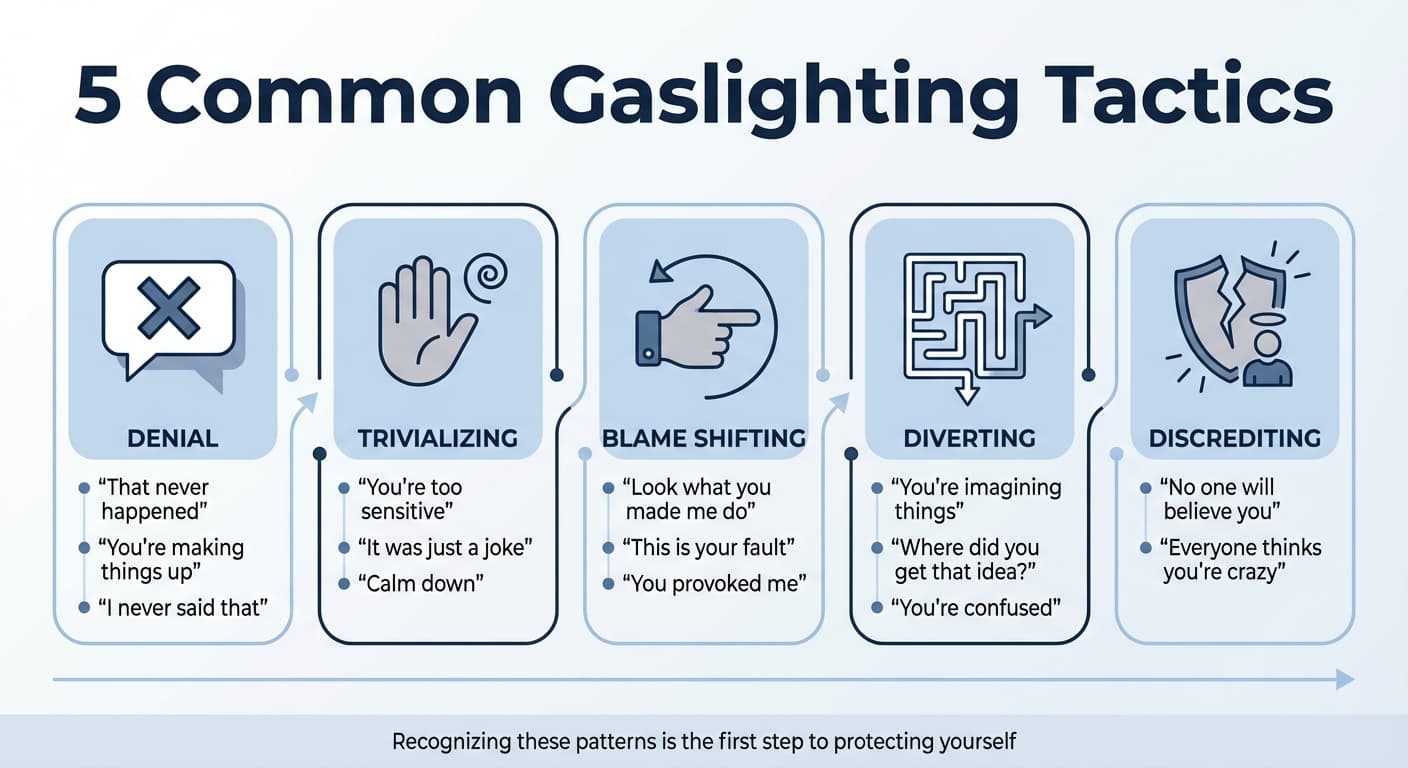
Gaslighting often starts subtly but intensifies over time, distorting your perception of reality and undermining your confidence [1]. These tactics appear in various relationships - romantic, family, workplace, or even medical - and are designed to manipulate and control.
Denying Things That Happened
Gaslighters frequently deny past events, using phrases like "I never said that", "That never happened", or "You're making things up" [1][6][7]. This tactic chips away at your memory and trust in your own experiences.
"A gaslighter - the more powerful person in a relationship - tries to convince you that you're misremembering, misunderstanding, or misinterpreting your own behavior or motivations." - Robin Stern, Ph.D. [9]
In today's digital world, this denial can include deleting messages, altering shared files, or blocking access to information to erase evidence. Even when confronted with proof, gaslighters often deflect by changing the topic or asking unrelated questions, leaving you doubting your memory and relying on their version of events [8].
Dismissing Your Feelings
When you voice valid concerns, a gaslighter may dismiss your emotions, labeling you as "too sensitive" or "overreacting" [1]. They might say things like "Calm down", "Why are you so sensitive?" or "It was just a joke" [1]. Over time, hearing these dismissive responses can erode your confidence in your feelings, making you question if the problem lies with you.
"Trivializing your emotions allows the person who is gaslighting you to gain power over you... When you deal with someone who never acknowledges your thoughts, feelings, or beliefs, you may begin to question them yourself." - Sherri Gordon, Certified Professional Life Coach [8]
This tactic also shifts attention away from their harmful behavior, leaving you doubting your emotional instincts.
Blaming You for Their Actions
Gaslighters avoid accountability by shifting blame onto you. They might say, "Look what you made me do", "It's all your fault", or "I wouldn't have messed up if you hadn't upset me" [1]. This approach allows them to maintain control while avoiding responsibility.
"A person who gaslights will shift blame to others in order to avoid responsibility." - Michelle C. Brooten-Brooks, LMFT [1]
For instance, if they yell at you, they might claim you provoked them by asking a simple question. If they break a promise, they’ll insist you didn’t remind them or accuse you of changing plans. This cycle leaves you apologizing and trying harder, while they continue to deflect blame.
Creating Confusion and Doubt
To destabilize your sense of reality, gaslighters use tactics like "blocking" or "diverting" [3][7]. They may pretend not to understand your point, steer conversations away from key issues, or challenge your sources of information.
"Gaslighters often lack self-awareness and fail to recognize their own manipulative behavior. They tend to blame others and avoid taking responsibility for their actions, making it nearly impossible for them to build constructive dialogue." - Boris Herzberg, Psychologist-Psychoanalyst [5]
Saying One Thing, Doing Another
Inconsistency between their words and actions is a hallmark of gaslighting [5][3]. They might promise to do something but fail to follow through, or verbally express support while actively undermining your efforts. For example, they could agree to attend an event with you but "forget" at the last minute, later claiming they never agreed or that you failed to confirm the details. These broken promises and shifting stories erode trust, leaving you more reliant on their narrative of events.
Together, these behaviors create a pattern designed to weaken your self-trust and independence.
| Gaslighting Tactic | Common Phrases Used |
|---|---|
| Denial | "That never happened", "You're making things up." |
| Trivializing | "You're too sensitive", "It was just a joke." |
| Blame Shifting | "Look what you made me do", "This is your fault." |
| Diverting | "You're imagining things", "Where did you get that idea?" |
| Discrediting | "No one will believe you", "Everyone thinks you're crazy." |
How to Set Boundaries
Dealing with gaslighting requires more than just recognizing the manipulation - it’s about taking back control and safeguarding your emotional well-being. Setting boundaries is a crucial step in this process. It begins with identifying manipulative behaviors and establishing clear, non-negotiable limits. Once you’ve pinpointed these boundaries, the next step is learning how to communicate and enforce them effectively.
Keep Records of Conversations
Keeping a record of interactions can help ground your understanding of events when someone attempts to distort your memory. Maintain a concise, timestamped account of key conversations, noting what was said, how it made you feel, and any inconsistencies you observe. This practice not only validates your experiences but also strengthens your ability to set and enforce boundaries.
"The documentation is not intended to change the gaslighter... instead, it is a way to connect with your sense of reality and to remind you of your own thoughts and feelings that are separate from the gaslighter." - Amelia Kelley, Ph.D., Trauma-informed therapist [10]
Tools like Gaslighting Check can simplify this process. Its features, such as real-time audio recording and text analysis, allow you to track interactions without the emotional strain of manual note-taking. While documenting is a helpful strategy, it’s essential to balance it with self-care to avoid overthinking or heightened anxiety [4].
State Your Limits Clearly
When setting boundaries, clarity is key. Use "I" statements to focus on specific behaviors and their impact on you, rather than making broad accusations. For example, instead of saying, "You never respect me", you could say, "When you interrupted me three times during dinner, I felt dismissed." This approach shifts the focus from blame to how the behavior affects you, making it harder for the gaslighter to deflect.
Boundaries should also include clear consequences. For instance, you might say, "If you dismiss my feelings again, I’ll leave the room." Avoid getting drawn into circular arguments about what "really happened." Neutral phrases like "We remember this differently" can help you end the conversation without escalating the conflict. Having prepared exit phrases can also help you remain calm and in control.
| Vague Statement | Specific Alternative |
|---|---|
| "You never respect me." | "When you interrupted me three times during dinner, I felt dismissed." |
| "You're so controlling." | "When you checked my phone without asking, I felt my privacy was violated." |
| "You always ignore my feelings." | "When I told you I was upset and you walked away, I felt abandoned." |
These specific alternatives make your boundaries clear and actionable, creating a foundation for accountability.
Get Outside Perspectives
Gaslighting thrives in isolation, so seeking input from others can be a powerful way to counteract its effects. Sharing your documented interactions with a trusted friend or family member can provide a more objective perspective. If possible, involve a third party during discussions with the gaslighter to help maintain accountability [4].
In addition to personal support, tools like Gaslighting Check can provide an unbiased analysis of your conversations, helping you identify patterns and affirm your reality. Whether through technology or trusted individuals, external perspectives can help you stay confident in your perception of events.
How Gaslighting Check Can Help

When gaslighting clouds your understanding of reality, trusting your own judgment can feel nearly impossible. That’s where Gaslighting Check steps in. This AI-powered platform analyzes your conversations to detect emotional manipulation tactics, serving as an impartial third party to uncover patterns you might miss.
The tool leverages T-pattern analysis to monitor behaviors across multiple interactions, identifying recurring tactics, their frequency, and how they escalate over time [11]. Since gaslighting is rarely a one-time event, this cumulative tracking is essential for recognizing how it undermines your confidence. By automating the documentation of these patterns, Gaslighting Check helps you regain a clearer perspective on your relationships.
Main Features
-
Real-time audio recording: Capture conversations as they happen, eliminating the need to rely solely on memory. The platform’s voice analysis evaluates tone, pitch, and speech patterns to detect manipulation beyond the words themselves. Its AI-powered system improves sentiment detection accuracy by up to 40% compared to older methods, offering insights you might otherwise overlook.
-
Text analysis: This feature digs into written exchanges - emails, texts, or chats - using advanced pattern recognition to expose manipulation tactics hidden in language. Each interaction generates a detailed report outlining the tactics used, their frequency, and severity. Premium users can access conversation history tracking, which shows how behaviors shift over time, making it easier to identify escalation.
Privacy is a priority. All features are protected by end-to-end encryption, and the platform enforces automatic deletion policies, ensuring your sensitive data doesn’t linger longer than necessary. This means you can focus on understanding your situation without worrying about compromising your privacy.
Pricing Options
| Plan | Price | Key Features |
|---|---|---|
| Free | $0 | Basic text analysis for identifying manipulation patterns |
| Premium | $9.99/month | Voice analysis, audio recording, history tracking, and detailed reports |
| Enterprise | Contact for Pricing | Custom solutions for organizations and professionals working with survivors |
The Free plan offers a simple way to test for manipulative patterns in your conversations. For $9.99 per month, the Premium plan unlocks advanced tools like voice analysis and historical tracking, giving you a deeper understanding of relationship dynamics. For therapists, counselors, or organizations, the Enterprise plan provides tailored solutions to support their work with survivors of gaslighting.
Conclusion: Taking Back Control
Recognizing gaslighting behaviors is the first step toward breaking free from its grip. By identifying tactics like denial, dismissal, and blame-shifting, you validate your own experiences and lay the groundwork for protecting your mental and emotional well-being.
Keep a record of dates, times, direct quotes, or screenshots to ground yourself in reality when manipulation clouds the truth. As psychologist Chivonna Childs, PhD, explains: "Calling out gaslighting behaviors helps set boundaries and change the power dynamic. It puts the other person on notice that you will no longer accept this type of treatment" [2]. This kind of factual evidence strengthens your ability to set and maintain firm boundaries.
Clear boundaries are key to regaining control over how you're treated. Use I-statements to make your limits unmistakable: "When you [behavior], I feel [emotion]. If this continues, I will [consequence]." If conversations start going in circles, phrases like "We remember this differently" can help you disengage, followed by physically stepping away from the situation.
When self-doubt creeps in, technology can offer additional support. Tools like Gaslighting Check provide AI-driven analysis and detailed reports that track manipulation patterns over time. This external validation can help you see things more clearly and make decisions about your relationships with confidence.
FAQs
How can I tell gaslighting from a normal disagreement?
A regular disagreement is simply a clash of opinions or viewpoints. Gaslighting, on the other hand, is a manipulative strategy designed to make you doubt your own reality or emotions. Unlike healthy conflict resolution, gaslighting is often used to control or destabilize someone. Common signs include repeatedly invalidating your feelings, distorting facts, or outright denying events you clearly remember happening.
What boundaries work when the person won’t admit anything?
Setting boundaries is an essential way to safeguard your emotional well-being, especially when someone refuses to acknowledge their behavior. Start by focusing on internal boundaries - trust your instincts and honor your emotions. Establish communication boundaries to manage discussions, ensuring they remain respectful and don't cross your limits.
You can also implement physical and digital boundaries to maintain control over your personal space and online presence. Stay firm and consistent in enforcing these limits, document any concerning incidents, and always put your safety first. Remember, boundaries are about protecting yourself, not about trying to change someone else's behavior.
Is it safe and legal to record conversations for documentation?
Recording conversations can be both safe and legal, but it largely depends on where you are and the situation. In the U.S., 38 states and Washington, D.C. follow one-party consent laws. This means only one person involved in the conversation needs to agree to the recording. However, 11 states, including California, require all-party consent, meaning everyone in the conversation must agree to being recorded.
To stay out of trouble, always check your state’s specific laws. Beyond legal considerations, it’s a good idea to secure consent whenever possible. Using privacy-focused tools can help ensure you protect your rights while respecting others' privacy and following the law.