Gaslighting in Families: 6 Real-Life Examples

Gaslighting in Families: 6 Real-Life Examples
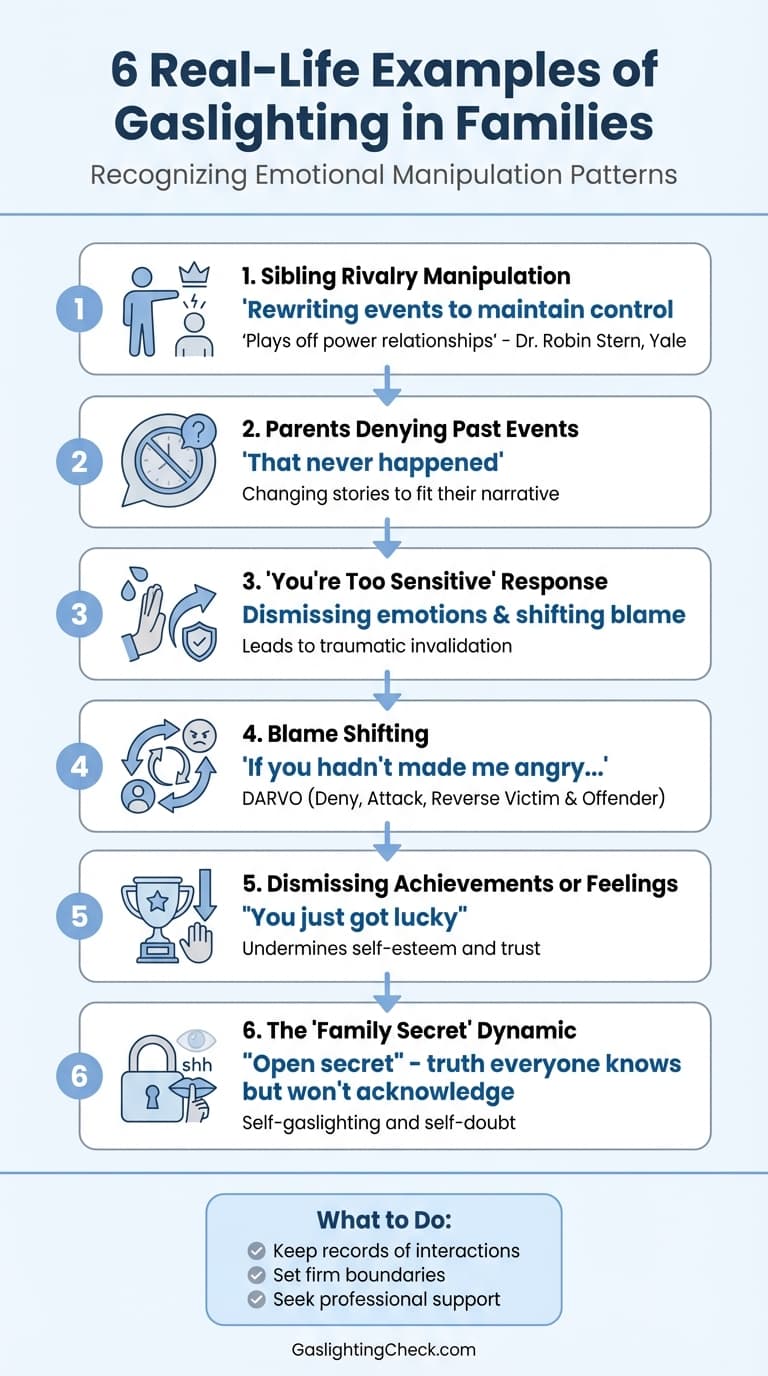
Gaslighting in families is a form of emotional manipulation where someone undermines your perception of reality. It often involves tactics like denying past events, dismissing feelings, or shifting blame. This behavior can deeply affect trust, self-esteem, and mental health. Here are six common examples:
- Sibling Rivalry Manipulation: Older siblings may rewrite events or undermine younger ones to maintain control.
- Parents Denying Past Events: Parents may alter memories to fit their narrative, causing children to doubt themselves.
- "You're Too Sensitive" Response: Dismissing emotions shifts blame onto the victim, invalidating their feelings.
- Blame Shifting: Manipulators avoid accountability by blaming others for their actions.
- Dismissing Achievements or Feelings: Downplaying successes or needs erodes confidence and trust.
- The 'Family Secret' Dynamic: Families may deny uncomfortable truths, silencing those who speak out.
To address gaslighting, keep records of interactions, set boundaries, and seek professional support. Tools like Gaslighting Check can help validate your experiences and protect your mental health. Recognizing these patterns is the first step toward healing and rebuilding trust.
::: @figure
7 Signs Your PARENTS Are GASLIGHTING You
1. Sibling Rivalry Manipulation
Sibling gaslighting thrives on power dynamics. For example, an older sibling might insist that their version of events is the only accurate one, leaving the younger sibling questioning their own memory. Even small twists - like tweaking details or outright denying past conversations - which is a common way to spot gaslighting in everyday conversations can chip away at someone’s self-confidence over time.
"Gaslighting plays off of power relationships, so in a family, it's likely to occur between a parent and child or between an older and younger sibling."
– Robin Stern, PhD, Co-founder and Associate Director of the Yale Center for Emotional Intelligence [2]
The methods may differ, but the aim is always control. A manipulative sibling might brand you as unstable or untrustworthy to make others doubt you. If confronted, they might pivot to criticizing your tone instead of addressing the issue. They could even downplay your successes - like a promotion, an award, or a major milestone - by attributing them to sheer luck, all to safeguard their ego.
In families with narcissistic dynamics, roles like the "Golden Child" and the "Scapegoat" often emerge. The "Golden Child" may align with a parent's manipulative narrative, while the "Scapegoat" is subjected to constant undermining, leaving them feeling isolated and unsure of their own reality.
Over time, this kind of manipulation - especially through conflicting messages, known as double-bind communication - can erode trust and make it harder to build healthy relationships as an adult. Up next, we'll delve into how parental gaslighting further distorts a person's sense of reality.
2. Parents Denying Past Events
When a parent says, "That never happened", it shifts reality. This behavior, often called narrative gaslighting, occurs when a parent deliberately alters a child’s memories to fit their own version of events. Instead of owning up to what actually happened, they might insist, "I never said that", or accuse the child of "imagining things." This kind of manipulation deeply impacts family relationships and emotional well-being.
"Narrative gaslighting [is when] a child might remember things a certain way and the parent changes the story and tries to convince the child it happened their way."
– Craig Malkin, PhD, Clinical Psychologist, Harvard Medical School [2]
This form of gaslighting, like others, chips away at trust - the cornerstone of any healthy relationship.
Consider this example: A father promises to buy his daughter a car if she earns her driver’s license. Once she passes, he denies ever making the promise, claiming he only said she could borrow his car and accusing her of "hearing what she wanted to hear" [7]. In another case, a son recalls seeing a bearded man in the house late one night. His mother dismisses it, insisting he was "dreaming" because he was "half-asleep", even though he remembers vivid details [7].
Over time, these denials have serious effects. Constantly having their reality questioned makes children doubt their own perceptions. To maintain their bond with the parent, they may unconsciously ignore the lies and develop emotional dependency [10][8].
"Gaslighting is a special form of lying that undermines the children's confidence in themselves while at the same time undermining trust and attachment to the parent."
– Daniel S. Lobel, Ph.D., Clinical Psychologist [10]
What can you do? Start by documenting conversations in a memory journal as soon as they happen. When a parent challenges your memory, use neutral responses like, "We remember this differently", or "I understand your perspective, but that’s not how I experienced it." Avoid engaging in circular arguments. Additionally, reaching out to trusted friends or siblings who were present during the events can provide much-needed validation and help you stay grounded in your reality.
3. The "You're Too Sensitive" Response
When someone says, "you're too sensitive", they're deflecting responsibility for their behavior onto your reaction. This is a classic gaslighting move often seen in family dynamics. Instead of recognizing that their words or actions caused hurt, they frame you as the issue. This tactic assumes there's some universal standard for what emotions are "acceptable", dismissing the fact that feelings are deeply personal and shaped by individual experiences.
This kind of manipulation doesn’t just dismiss your emotions - it shifts the responsibility entirely onto you.
"Telling other people they are overreacting when they're being victimized is the most common form of gaslighting that narcissistic abusers and their enablers engage in."
– Julie L. Hall, Author [12]
The damage goes far beyond the moment. Hearing this phrase repeatedly can lead to what experts call traumatic invalidation. Over time, you may start doubting your own perceptions and questioning whether your emotions are even legitimate [13]. This can chip away at your self-esteem and, in some cases, contribute to complex PTSD.
How can you respond? Try communicating effectively by using "I" statements to express how their words affect you, such as, "I feel unheard when my feelings are dismissed." Another option is to set a boundary by saying, "I'm not willing to continue this conversation if my feelings are going to be dismissed." You could also shift the focus back to them by asking, "What kind of reaction were you expecting?" or "Why do you think my response is the problem instead of the situation itself?" Most importantly, remind yourself that your feelings are valid [13]. Next, we’ll explore how blame shifting further complicates family gaslighting dynamics.
4. Shifting Blame Between Parents and Children
Blame-shifting is another way family dynamics can be distorted, often following the dismissal of emotions.
What is blame-shifting? It's when someone avoids responsibility by placing the fault entirely on you. In families, this might sound like a parent saying, "If you hadn’t made me angry, I wouldn’t have yelled", or a child insisting an accident was the parent's fault instead of owning up to their role. This tactic not only shifts accountability but also undermines your confidence in your own memory and judgment.
"If a parent repeatedly denies or disputes your experiences... or tries to relinquish responsibility for something he or she did by blaming you - those are all signs of gaslighting."
– Robin Stern, PhD, Co-founder of the Yale Center for Emotional Intelligence [2]
The effects can be long-lasting. Imagine a parent telling their child, "You're the reason I’m always stressed." Over time, the child might internalize this blame, apologizing for things they didn’t do and doubting their own perceptions. These patterns often carry over into adulthood, impacting self-esteem and relationships.
A real-life example highlights this behavior. In a 2022 domestic violence case in Arizona, Daniel Walker strangled his girlfriend, Tyesha Wayne, until she lost consciousness. He later told police he only used a "chokehold" to "calm her down" because she had "gone crazy." This is a textbook example of DARVO - Deny, Attack, and Reverse Victim and Offender - where the manipulator flips the narrative to avoid accountability. Shockingly, police initially believed Walker’s version and arrested Wayne instead [14].
How can you protect yourself from blame-shifting? Start by keeping an objective record of events. When confronted, respond with phrases like, "I remember it differently" or "That comment hurt me." If the other person refuses to take responsibility, you can say, "We’ll have to agree to disagree", and step away from the situation. Setting clear boundaries is key - try statements like, "I need you to speak to me respectfully."
For additional support, tools like Gaslighting Check (https://gaslightingcheck.com) can help you track and analyze conversations securely, making it easier to identify patterns of manipulation.
Next, we’ll look at other subtle ways gaslighting shows up in family relationships.
5. Dismissing a Child's Achievements or Feelings
Within families, dismissing a child's achievements or feelings is a subtle yet harmful form of gaslighting that can deeply affect a child's sense of self and their ability to trust others.
This behavior can show up in different ways. For instance, a parent might downplay a child's success with comments like, "You just got lucky", after a good grade. Emotional struggles might be brushed aside with phrases like, "Stop making a big deal out of nothing." Even basic physical needs can be invalidated with dismissals such as, "You're not hungry" or "You're not cold." These statements send a damaging message: that the child's experiences and perceptions aren't valid.
"This is often the most insidious form because it manipulates you to think that what you know about yourself is not true. It also undermines your self-esteem and trust in yourself."
– Craig Malkin, PhD, Clinical Psychologist and Lecturer at Harvard Medical School [2]
The impact of this dismissal can last a lifetime. Children subjected to this type of invalidation may internalize these messages, leading to what some call "self-gaslighting." As adults, they might constantly question their own feelings, instincts, or decisions, often feeling the need to justify or "prove" their emotions to themselves or others.
How can this cycle be broken? For parents, small changes in language can make a big difference. Instead of dismissing concerns, try saying, "I hear you" or "That sounds tough." For those dealing with dismissive family members, documenting interactions can help maintain clarity about your experiences. Setting neutral boundaries, like saying, "We need to agree to disagree", can also protect your sense of self without escalating tension.
This pattern of dismissal doesn't just harm individuals - it also disrupts family dynamics, laying the groundwork for other gaslighting behaviors, as we'll see in the next section.
6. The 'Family Secret' Dynamic
Some families operate under what trauma therapist Alice Zic describes as an "open secret" - a truth everyone knows but refuses to acknowledge. Outwardly, the family may seem loving and well-adjusted, but behind closed doors, a very different story unfolds [17]. When someone attempts to confront this hidden reality, they often face denial, deflection, or accusations that twist their perception of events. This tactic, like other forms of gaslighting, warps a person's sense of reality and discourages open expression.
These secrets can range from parental addiction and past abuse to financial struggles. For instance, a child who witnesses a parent's substance abuse might be dismissed as "paranoid" or "making things up" [1][2]. Similarly, survivors of childhood sexual abuse who speak out might be labeled "dramatic" to avoid uncomfortable conversations [8]. The person who dares to break the silence is frequently stigmatized as the "problem child" or accused of seeking attention [16][18].
"If you grew up in a family that made it a point to look loving, put together, impressionable in public but was very different in private, your family was operating under an 'open secret.'"
– Alice Zic, Trauma Therapist [17]
This enforced silence can lead to deep self-doubt. Children in such environments often wrestle with whether to trust their own perceptions, which can result in "self-gaslighting" - a pattern of questioning their own experiences [10][17]. This type of psychological abuse is considered one of the most harmful, as it’s linked to higher rates of depression, PTSD, and substance misuse in adulthood [9].
The internal conflict caused by these dynamics perpetuates the broader gaslighting patterns within the family, making it crucial to find ways to counteract them.
One way to start breaking free is to pay attention to your body’s signals. Physical reactions like chest tightness, shaking, or difficulty breathing can indicate that your reality is being distorted [15]. Keeping detailed records - such as text messages, emails, or dated notes - can also help you stay grounded in the facts of what actually happened [4]. When family members try to provoke conflict or deny the truth, consider using neutral responses like "That’s interesting" or "Let’s agree to disagree." These phrases can help you maintain your perspective without escalating tensions.
Documenting incidents as they occur and seeking professional support are also key steps. Tools like Gaslighting Check can analyze conversations and provide validation, helping you regain clarity and confidence in your experiences.
These examples show how deeply hidden truths can affect emotional well-being, highlighting the importance of identifying and addressing family gaslighting in all its forms.
How to Identify and Address Gaslighting in Families
Gaslighting in families can be subtle but deeply impactful. It often involves tactics designed to distort your sense of reality. Some common examples include denial ("That never happened"), dismissing emotions ("You're too sensitive"), shifting blame ("I wouldn't have to yell if you listened"), or rewriting past events ("I was joking, you always take things the wrong way"). These behaviors align with patterns observed in other family gaslighting scenarios.
"Gaslighting is a form of emotional manipulation to make you feel as if your feelings aren't valid, or that what you think is happening isn't really happening." – Dr. Chivonna Childs, Cleveland Clinic [6]
Within families, gaslighting often exploits power dynamics. Statements like "I am your parent, and I am telling you..." are used to enforce a single version of reality, dismissing any alternative perspectives.
Steps to Address Gaslighting
1. Keep Records of Interactions
Maintain a private journal where you document incidents, including dates, times, and key details of conversations. Save text messages or emails when possible. Having a clear record can help you identify patterns of manipulation and reaffirm your experiences.
2. Use "I" Statements
When addressing gaslighting behavior, focus on expressing your feelings without assigning blame. For instance, say, "I feel hurt when my memory is dismissed" or "I remember things differently." This approach can reduce defensiveness and keep the conversation constructive.
3. Set Firm Boundaries
Phrases like "We'll have to agree to disagree" or "I'm not ready to discuss this now" can help you disengage from unproductive arguments. Robin Stern, Ph.D., co-founder of the Yale Center for Emotional Intelligence, emphasizes the importance of stepping away from power struggles:
"As soon as you understand that it doesn't matter how right you are, the closer you will be to freedom." – Robin Stern, Ph.D., Yale Center for Emotional Intelligence [19]
If a conversation feels triggering, it’s okay to say, "I'd rather not have this conversation right now." Protecting your peace should take priority.
4. Prioritize Safety
If setting boundaries escalates to threats or physical danger, your safety comes first. Reach out to the National Domestic Violence Hotline at 1-800-799-7233 or confide in a trusted person who can help.
Tools and Professional Support
Gaslighting Check is a tool designed to analyze conversations for signs of emotional manipulation. Its free plan offers basic text analysis, while the premium plan ($9.99/month) adds voice analysis, detailed reports, and secure data tracking. Tools like this can help validate your experiences and rebuild confidence in your perceptions.
Additionally, seeking guidance from a therapist who specializes in family dynamics can provide personalized strategies to navigate and heal from gaslighting. Their expertise can be invaluable in helping you reclaim your emotional well-being.
Conclusion
The examples shared above highlight how gaslighting can deeply fracture trust within families. This behavior doesn’t just disrupt the family unit - it leaves lasting effects that can influence your ability to form close, healthy relationships later in life [5]. Whether it’s a sibling twisting the truth or a parent denying past events, these tactics warp reality and leave emotional scars.
Recognizing gaslighting is a crucial first step in reclaiming your sense of self [5][1]. Once you identify the behavior, you can begin to rebuild trust in your instincts and overcome chronic self-doubt [5][20]. By understanding that the confusion you feel is a result of manipulation - not a personal failing - you can start to reframe your experiences [3][11].
"Your feelings, experiences, and needs are real. They matter. And they are worth standing up for." – Jonice Webb, PhD, Licensed Psychologist [1]
Breaking free from this dynamic requires setting boundaries, keeping a record of interactions, and seeking professional guidance. These steps help protect your emotional health and rebuild your identity [3].
As Robin Stern, PhD, Co-founder of the Yale Center for Emotional Intelligence, wisely points out:
"Sometimes, being compassionate toward ourselves is the hardest task of all. But in my experience, that is often when change truly begins" [2].
You are worthy of relationships grounded in respect and honesty. Taking intentional steps toward healing paves the way for creating those connections.
FAQs
How can I tell gaslighting from a normal disagreement?
Gaslighting stands apart from a typical disagreement because of its intentional and persistent nature. In a disagreement, two people may have opposing views, but there’s mutual recognition of each other’s perspectives. Gaslighting, on the other hand, is a manipulative tactic designed to make you question your reality over time.
Some common signs of gaslighting include:
- Denying facts, even when they’re clear.
- Dismissing your emotions by labeling you as "too sensitive."
- Insisting that your memories are incorrect.
While disagreements are often temporary and balanced, gaslighting is a continuous pattern that thrives on a power imbalance.
What should I say when a family member denies what happened?
When a family member denies your version of events, it’s important to assert your experience calmly and without blame. For example, you could say, "It seems like we remember that differently. This is how I recall it." This kind of response interrupts any manipulative behavior, affirms your perspective, and steers clear of unnecessary conflict. In family dynamics, where gaslighting can feel especially damaging, maintaining a calm and clear approach not only safeguards your mental well-being but also strengthens your personal boundaries.
When is it time to get professional help or leave?
Deciding whether to seek professional help or distance yourself from a toxic family environment depends largely on how gaslighting impacts your mental health. If you're constantly second-guessing your memories or emotions due to manipulation - and this leads to anxiety, depression, or significant emotional strain - therapy can provide the support you need. On the other hand, if setting boundaries or addressing the behavior doesn’t bring change, or if your safety is compromised, stepping away might be essential for your well-being.