
How Gaslighters Use Emotionally Charged Language
Gaslighting is a manipulation tactic that makes you question your reality, often through emotionally charged language. Gaslighters use phrases like "You're too sensitive" or "That never happened" to invalidate your feelings, distort events, and shift blame. This creates confusion, erodes confidence, and fosters dependency on their version of reality. Recognizing these tactics is key to protecting yourself.
Key points:
- Gaslighting manipulates emotions to control and confuse.
- Common phrases target your feelings, memory, and mental stability.
- Tools like sentiment analysis can help identify manipulation.
- Assertive responses and documenting interactions safeguard your well-being.
Gaslighting Explained (Emotional Abuse / Manipulation)
Detect Manipulation in Conversations
Use AI-powered tools to analyze text and audio for gaslighting and manipulation patterns. Gain clarity, actionable insights, and support to navigate challenging relationships.
Start Analyzing NowCommon Emotionally Charged Phrases Gaslighters Use
::: @figure
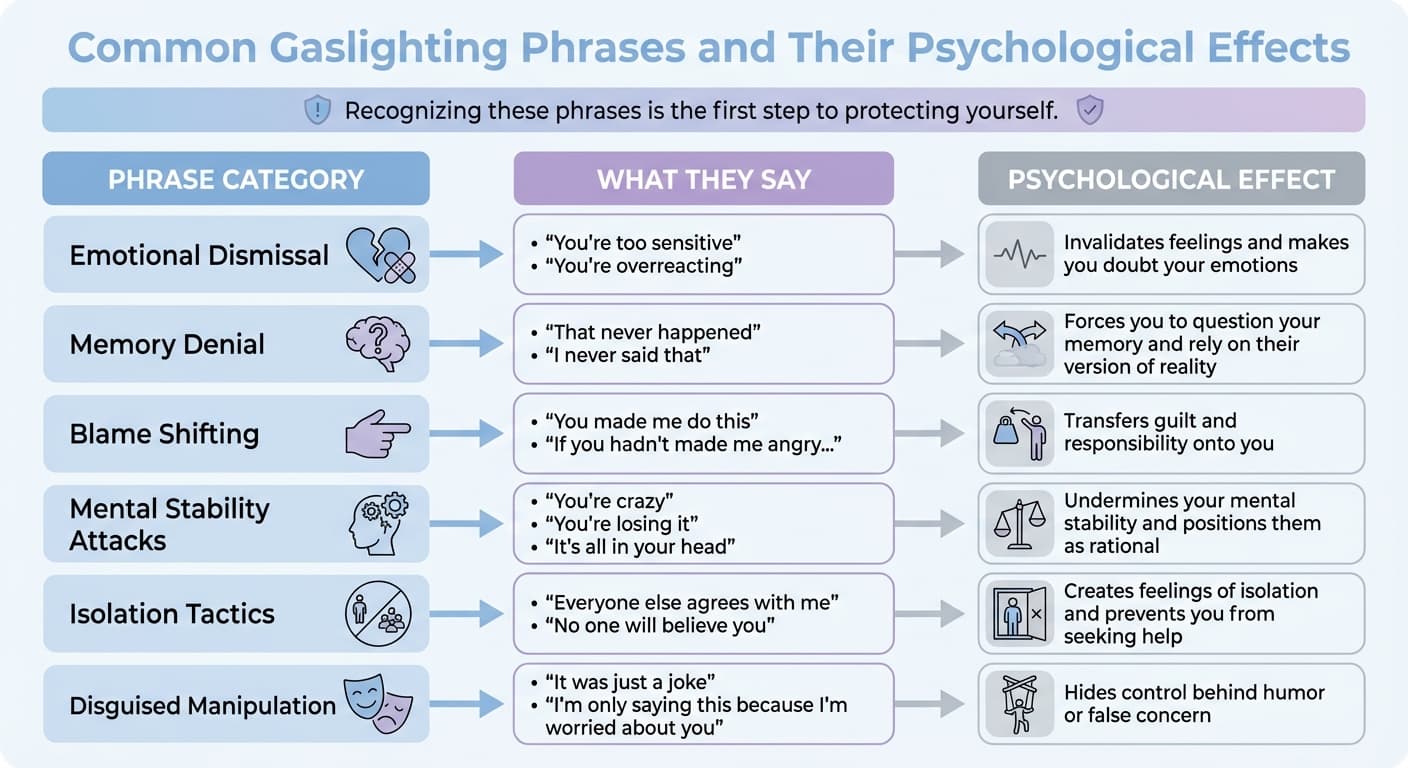
Gaslighters have a knack for using phrases that seem harmless on the surface but are designed to manipulate and confuse. These statements often provoke strong emotions while subtly shifting the blame onto you. Spotting these patterns is a crucial step in protecting yourself from their tactics.
Examples of Phrases and Their Effects
Let’s break down some common phrases gaslighters use and how they work to undermine you.
"You're too sensitive" or "You're overreacting" are classic ways to dismiss your feelings. Instead of addressing your concerns, the gaslighter invalidates them, making you doubt whether your emotions are justified. Over time, this can lead you to question the validity of your own reactions.
"That never happened" and "I never said that" target your memory directly. These phrases force you into a defensive position, scrambling to prove what you know is true. The gaslighter’s calm certainty can make you second-guess yourself, leaving you dependent on their version of reality.
"Gaslighting is one of the most destructive forms of emotional abuse that women can experience, causing them to distrust their own realities and perceptions and even believe they have a mental illness." - Amelia Kelley, Ph.D., Therapist and Author [1]
"You made me do this" and "If you hadn't made me angry..." shift blame onto you. These statements imply that their actions are your fault, piling guilt and shame on your shoulders while they dodge accountability.
Phrases like "You're crazy," "You're losing it," or "It's all in your head" directly attack your mental stability. By painting you as irrational or unstable, the gaslighter positions themselves as the voice of reason. If you react emotionally, they use it to further "prove" their point.
"It's trying to distract you or deflect guilt or accountability and responsibility. Sometimes, it's even harsher, like someone is trying to belittle you or damage or chip away at your self-esteem." - Danielle Hairston, M.D., Assistant Professor of Psychiatry [1]
"Everyone else agrees with me" and "No one will believe you" are tactics designed to isolate you. These phrases suggest that others are on their side, making you feel unsupported and hesitant to speak out. Even if these claims are entirely false, they can erode your confidence in seeking help.
Gaslighters often hide manipulation behind humor or concern. "It was just a joke, you can't take a joke" allows them to say hurtful things while blaming you for being upset. Similarly, "I'm only saying this because I'm worried about you" disguises control as care, making it harder for you to recognize their behavior as abusive. These tactics blur the lines between gaslighting and manipulation, leaving you even more confused.
How Gaslighters Weaponize Emotionally Charged Language
Gaslighters use emotionally charged language as a tool to manipulate and control, often invalidating your feelings or shifting their tone to keep you second-guessing yourself. By recognizing these tactics, you can better understand how they distort reality and maintain control.
Emotional Invalidation and Labeling
One common strategy gaslighters use is dismissing your emotions, which shifts attention away from their harmful behavior and onto your reaction. For example, calling you "too sensitive" or "dramatic" reframes the issue, making you question whether your emotional responses are justified.
They also lean on extreme absolutes like "always" and "never" to attack your character instead of addressing specific actions. Phrases such as "You're always selfish" or "You never listen" aren't about isolated incidents - they're designed to chip away at your self-esteem over time.
Another tactic is conditional validation, where they briefly acknowledge your feelings only to immediately dismiss them. Statements like "I understand, but..." or "Your feelings are valid, however..." may sound supportive at first, but they often serve to undermine your emotions. This kind of acknowledgment feels hollow, leaving you wondering if your feelings were ever taken seriously.
Gaslighters then amplify the confusion by abruptly shifting their emotional tone.
Shifting Emotional Polarity
Another destabilizing approach is their sudden and unpredictable changes in emotional tone. They might express concern or warmth, saying something like, "I'm worried about you", only to quickly switch to being cold or accusatory. This emotional whiplash leaves you feeling unsteady, unsure of how to interpret their intentions or your own emotional state.
This constant back-and-forth keeps you off-balance, making it harder to trust your instincts or find clarity in the relationship.
Using Sentiment Analysis to Detect Emotional Manipulation
Gaslighting has a way of distorting your perception, making it hard to trust your own feelings. Sentiment analysis offers a way to cut through the haze by measuring the emotional tone of conversations.
How Sentiment Analysis Works
Using natural language processing (NLP), sentiment analysis examines word choice, context, and tone. Meanwhile, voice analysis focuses on elements like pitch, volume, and speech rate to catch sudden emotional shifts. For instance, a phrase like "You're blowing things way out of proportion" is flagged for its dismissive tone and strong negative intensity[2][4].
Voice analysis goes further by analyzing prosodic features - how something is said rather than just the words. A rising pitch in statements like "You're too sensitive" can indicate emotional invalidation[2][4]. The system also detects abrupt changes in emotional tone, such as moving from "I'm worried about you" to accusatory remarks, by tracking rapid swings in positive and negative sentiment scores[6][7].
This detailed approach forms the backbone of Gaslighting Check’s ability to identify manipulative behaviors.
Gaslighting Check: Features for Detecting Gaslighting

Gaslighting Check leverages sentiment analysis by combining real-time audio recording with both text and voice analysis. It identifies phrases aimed at minimizing feelings or inducing guilt, generating detailed reports that highlight shifts in emotional intensity. These reports also track manipulation patterns over time, with all data secured through encryption and automatic deletion.
The tool works in real time, flagging problematic phrases like "It was just a joke" or "If you really cared about me, you wouldn't even think that." Such statements are often marked for minimizing or guilt-inducing tendencies based on sentiment analysis[3][4][5]. For example, a phrase like "There is something seriously wrong with you" might be flagged, with sentiment scores revealing its emotionally manipulative undertones[2][4].
How to Protect Yourself from Emotionally Charged Manipulation
Standing up to emotional manipulation requires practical strategies that help you stay grounded and establish clear boundaries. These methods go beyond just identifying manipulation - they empower you to respond effectively and protect your mental well-being.
Assertive Responses and Reality Checks
When someone tries to dismiss your feelings by saying you're "too sensitive", respond firmly with: "My feelings are valid." If you're accused of being "paranoid", counter with: "Please don’t question my ability to think rationally."
Reality checks are another key tool. Take a moment to assess the facts and trust your instincts. Keeping a record of interactions - whether through journaling or voice memos - can help you create an objective account. This makes it harder for someone to twist events or deny what happened.
For guilt-tripping comments like, "If you cared about me, you wouldn’t even think that," respond with: "This issue is separate from the good things you’ve done for me." And if the conversation turns to name-calling, set a boundary: "I’ll end this discussion if the insults continue."
Pairing assertive communication with objective validation tools can further strengthen your ability to stay grounded.
Using AI Tools for Support
AI tools like Gaslighting Check can be a valuable ally. This platform provides real-time analysis and detailed reports to objectively document your interactions. By validating your perceptions, it helps you maintain clarity while ensuring your privacy.
Such documentation is especially useful in situations where direct confrontation feels unsafe. Instead of escalating a conflict, you can use these records to support therapy, safety planning, or even legal action if needed. This way, you’re not only protecting yourself in the moment but also building a foundation for long-term support.
Conclusion: Recognizing and Fighting Emotional Manipulation
Recognizing gaslighting tactics - like emotional invalidation or sudden shifts in behavior - is a critical first step in breaking free from manipulation. Gaslighters often use emotionally charged language to undermine your confidence, labeling you as "crazy", "too sensitive", or "paranoid" to make you doubt your own reality.
But awareness alone isn’t enough. Seeking external validation can help counteract the confusion gaslighting creates. Tools like Gaslighting Check offer valuable insights by analyzing both text and voice patterns in your conversations. These analyses highlight linguistic markers, such as a reduced use of first-person pronouns or an overuse of negative emotion words, which can indicate manipulative behavior. By providing detailed reports and tracking conversation history, these tools give you the clarity to trust your instincts again and set firm boundaries.
Keeping a record of interactions is another powerful way to protect yourself. Documenting conversations creates an objective account that prevents manipulators from twisting the truth or denying events. Whether for personal validation, therapy, or even legal purposes, having evidence makes it harder for someone to rewrite reality.
Combine assertive communication with these objective tools to safeguard yourself from emotional manipulation. Responding neutrally and setting boundaries can help deny manipulators the emotional reactions they seek. While AI tools can validate your experiences, they should complement - not replace - professional support.
Your feelings matter, your memories are real, and you deserve relationships built on respect. By using the right strategies and resources, you can reclaim your sense of reality and move forward with confidence. Don’t forget to document interactions as a key step in protecting yourself.
FAQs
How can I tell if someone is gaslighting me?
Recognizing gaslighting requires paying attention to specific language patterns and emotional cues. Look out for phrases like “That never happened” or “You’re imagining things” - these are attempts to deny your reality. Statements such as “You’re overreacting” aim to dismiss your feelings, while “You made me do this” shifts blame onto you. Other warning signs include sudden tone shifts, emotional invalidation, and a cycle of alternating between supportive and critical behavior.
To protect yourself, start by documenting interactions - it helps you track patterns over time. Trust your instincts and establish firm boundaries to safeguard your emotional well-being. Interestingly, tools like AI-based sentiment analysis can also be useful. They can detect emotional shifts, tone changes, and recurring manipulation tactics in conversations, offering additional clarity as you work through the situation.
How can I protect myself from gaslighting?
Protecting yourself from gaslighting begins with spotting the telltale signs of manipulation. These tactics often include invalidation, denial, or shifting blame. For instance, phrases like “That never happened” or “You’re overreacting” are designed to distort your perception of reality and chip away at your confidence. To counter this, keeping a written or digital record of conversations can help you notice patterns and maintain a clearer perspective over time.
Equally important is setting firm boundaries and trusting your gut instincts. Stay composed, stand by your viewpoint, and steer clear of arguments that might hand emotional control to the manipulator. Seeking support from people you trust - whether friends, family, or mental health professionals - can provide much-needed reassurance and help you stay anchored. There are also tools available that analyze language for manipulative patterns, giving you an extra layer of awareness to protect your emotional well-being.
How can sentiment analysis help identify gaslighting?
Sentiment analysis offers a way to detect gaslighting by analyzing text and voice for emotional patterns and shifts that might indicate manipulation. Through AI and machine learning, it categorizes emotions - such as positive, negative, or neutral - and picks up on subtle cues like shifts in tone, inconsistent emotions, and specific language patterns tied to gaslighting, such as blame-shifting or dismissing someone’s feelings.
By identifying these emotional changes and irregularities, sentiment analysis can help flag manipulative behavior early on. This is particularly useful in digital conversations, where nonverbal cues are missing, making it easier to recognize emotional manipulation and safeguard your mental health.