
How Gaslighters Exploit Emotional Vulnerabilities
Gaslighting is a manipulation tactic that makes you doubt your own reality. It preys on insecurities like low self-esteem, fear of abandonment, and past trauma. Gaslighters use phrases like "You're too sensitive" or "That never happened" to distort your perception, creating confusion and dependency. The process often involves denial, blame-shifting, and invalidation, gradually isolating victims and deepening control.
Key takeaways:
- Low self-esteem: Gaslighters erode confidence, making you question your judgment.
- Fear of abandonment: They use guilt to heighten dependency.
- Past trauma: They reopen old wounds to destabilize emotions.
- Common tactics: Denial, projection, and minimizing your feelings.
Recognizing manipulation patterns early is crucial for protecting yourself. Tools like Gaslighting Check can help identify these tactics by analyzing conversations for hidden manipulation, providing clarity while ensuring privacy.
Protect yourself by documenting interactions, setting boundaries, and seeking support from trusted sources or professionals.
Recognising Gaslighting Tactics, Phrases and Stages
Emotional Vulnerabilities That Gaslighters Target
Emotional vulnerabilities - things like low self-esteem, unresolved fears, or past traumas - can weaken your ability to trust your own instincts. These are exactly the areas gaslighters aim to exploit. When they sense you’re already doubting yourself, they step in to distort your reality further, making it easier to manipulate you [2][3][6].
Gaslighters don’t need elaborate schemes to take control. They rely on simple tactics like denial, shifting blame, or downplaying your feelings to make you question yourself. Over time, this creates a power imbalance, leaving you dependent on them for validation and increasingly unsure of your own experiences [2][3][5].
Low Self-Esteem and Self-Doubt
People with low self-esteem are particularly vulnerable because gaslighters chip away at any remaining confidence in their judgment. They might call you "crazy", dismiss your memories, or belittle your emotions with remarks like, "You're being too sensitive" or "You're overreacting again." These dismissals pile up, making you second-guess yourself and more likely to accept their version of events [2][3][5].
Imagine this: a gaslighter hides something you use daily but insists you misplaced it. After enough incidents like this, you might start believing you're forgetful, disorganized, or even losing touch with reality. This constant erosion of self-trust creates a dynamic where their word feels more reliable than your own memory [2][5].
Once your self-doubt takes root, gaslighters often escalate by preying on deeper fears, like the fear of being abandoned.
Fear of Abandonment and Anxiety
The fear of abandonment is a powerful tool in a gaslighter's arsenal. They use it to create anxiety and deepen your dependency on them. Simple phrases like "If you go out, I'll feel lonely" or "If you hadn't done X, I wouldn’t have to do Y" are designed to make you feel guilty and prioritize their needs over your own. Over time, you might start believing you can’t function without their approval, all in an effort to avoid rejection [3][4].
This tactic works because it taps into a basic human fear of being left alone or unwanted. For example, if a gaslighter makes a hurtful comment and then dismisses your reaction by saying, "It was just a joke", you might feel anxious about pushing back, worried it could jeopardize the relationship. That anxiety becomes a trap, keeping you tethered to their distorted reality [4][5].
But gaslighters don’t stop there; they often dig into your past traumas to deepen their control.
Past Trauma and Emotional Triggers
Gaslighters are skilled at using past traumas to destabilize your emotions. They might reopen old wounds by denying a traumatic event ever happened or downplaying its severity, leaving you confused and questioning your own memories. This manipulation not only distorts your perception of the present but also shakes your understanding of your emotional history [3][7].
For instance, a parent might tell their child that a remembered traumatic event is entirely fabricated or exaggerated. This can sow deep self-doubt, making the child question their grasp on reality. In romantic relationships, gaslighters might reframe past abusive moments as misunderstandings or claim you’re overreacting, all while reopening those wounds. This dual strategy - denying the trauma while blaming you for remembering it - chips away at your emotional stability, leaving you reliant on them to define what’s "real" [5][7].
Manipulation Tactics Gaslighters Use
Once gaslighters identify emotional weak spots, they deploy a range of tactics designed to keep you under their control. These methods - denial and reality distortion, projection and shifting blame, and invalidation and minimization - systematically chip away at your confidence and trust in your own judgment. Recognizing these tactics as they happen can help you see through the manipulation, instead of mistaking it for normal relationship dynamics. Each tactic builds on emotional vulnerabilities, tightening the gaslighter's grip.
Denial and Reality Distortion
Gaslighters often deny things that have clearly happened. They’ll say things like, “That never happened” or “I never said that; you’re imagining things”, even when the facts are undeniable. The goal here isn’t to forget or misremember - it’s to make you question your own reality.
Over time, these repeated denials can leave you doubting your memory and second-guessing yourself, forcing you to rely on the gaslighter to define what’s real.
Projection and Shifting Blame
Projection flips the script, turning their faults into accusations against you. For instance, someone who’s being dishonest might call you a liar, or someone unfaithful might accuse you of cheating. This tactic keeps you on the defensive, diverting attention away from their behavior.
By shifting the blame, gaslighters exploit any tendency you might have to blame yourself, leaving you questioning your own actions instead of holding them accountable.
Invalidation and Minimization
Gaslighters often brush off your feelings with dismissive comments like, “You’re overreacting” or “It was just a joke.” These remarks invalidate your emotions, making you feel as though your reactions are unreasonable or excessive.
Over time, this can silence you. You may start questioning whether your feelings are valid at all, eventually suppressing your concerns entirely. The gaslighter positions themselves as the ultimate judge of what emotions are acceptable, deepening your dependence on them while making it harder to distinguish between healthy and abusive behavior.
Detect Manipulation in Conversations
Use AI-powered tools to analyze text and audio for gaslighting and manipulation patterns. Gain clarity, actionable insights, and support to navigate challenging relationships.
Start Analyzing NowHow Gaslighting Progresses Over Time
::: @figure
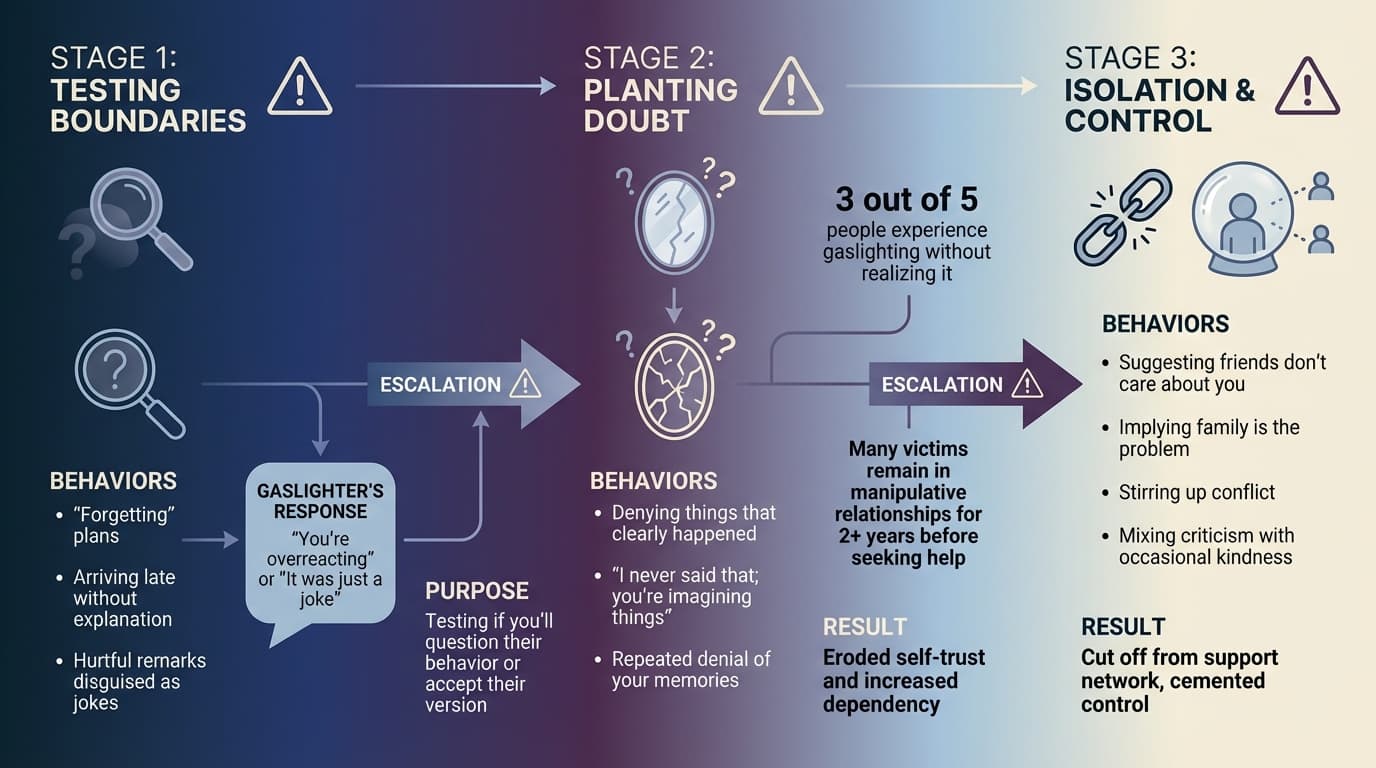
Gaslighting doesn’t happen all at once - it’s a gradual process that tightens the gaslighter's control over time. It starts with subtle invalidation and blame-shifting, but these behaviors escalate, distorting your sense of reality and isolating you from others. Understanding how this progression unfolds can help you recognize the warning signs before the situation becomes deeply damaging. Here’s how these stages typically develop:
Testing Boundaries and Watching Your Reactions
In the early stages, gaslighters subtly test your limits. They might "forget" plans you’ve made, arrive late without explanation, or make hurtful remarks disguised as jokes. When you express hurt or confusion, their response is often dismissive: "You’re overreacting" or "It was just a joke, relax."[1] These small acts aren’t random - they’re deliberate tests to see if you’ll question their behavior or accept their version of events. Your reaction helps them gauge how much they can push your boundaries.
Planting Doubt and Creating Dependency
Once they sense your boundaries are flexible, gaslighters shift gears, working to distort your perception of reality. They may flat-out deny things you know happened, saying, "I never said that; you’re imagining things."[1] Over time, this repeated denial chips away at your confidence in your own memory and judgment. Research reveals that three out of five people have experienced gaslighting without realizing it, and many victims remain in these manipulative relationships for over two years before seeking help.[1] As your self-trust erodes, you begin to lean on the gaslighter’s version of reality, becoming increasingly dependent on them to define what’s true.
Isolating You and Strengthening Their Control
In the final stage, the gaslighter works to cut you off from outside influences. They may suggest that your friends don’t truly care about you or imply that your family members are the source of your problems. By stirring up conflict and using guilt, they gradually isolate you from your support network. This isolation leaves you without the external reality checks that could counter their manipulation. To make matters worse, they mix criticism with occasional moments of kindness, creating a cycle of unpredictability that keeps you hoping for change. This combination of isolation and emotional manipulation cements their control, leaving you feeling stuck and doubting whether anyone else would believe or support you.
Using Technology to Detect Gaslighting Patterns
Gaslighting can leave you questioning your own reality, making it hard to trust your instincts. That’s where technology can step in - not to replace your judgment, but to provide an unbiased perspective. AI-powered tools are designed to analyze conversations and identify manipulation tactics that are often hidden in plain sight, especially when emotions run high. These tools scan for specific phrases and patterns that gradually undermine your confidence. This is the idea behind Gaslighting Check, which turns vague doubts into measurable evidence.
How Gaslighting Check Can Help

Gaslighting Check builds on the manipulation patterns mentioned earlier, offering clarity through advanced analysis. Using machine learning, the platform examines both text and voice for signs of manipulation. You can upload a text conversation for immediate insights or even record audio in real-time. The voice analysis digs deeper, picking up on tonal changes and stress markers that might indicate sarcasm, false innocence, or other deceptive behaviors often tied to tactics like blame-shifting or minimizing concerns.
The tool generates detailed reports that include timestamps, severity ratings, and progression maps of manipulation. For instance, it can highlight phrases like, "If you hadn’t done X, I wouldn’t have Y", showing how blame is being redirected. A conversation history feature tracks interactions over time, making it easier to spot patterns of ongoing manipulation. Dr. Stephanie A. Sarkis, a recognized authority on gaslighting, emphasizes:
"Identifying gaslighting patterns is crucial for recovery. When you can recognize manipulation tactics in real-time, you regain your power and can begin to trust your own experiences again." [1]
Privacy and Data Security
Since gaslighting often erodes trust, safeguarding your information is critical. Gaslighting Check prioritizes your privacy with end-to-end encryption, ensuring your data remains secure from the moment it’s entered until processing is complete. All information is anonymized, making it impossible to link data back to you. Additionally, the platform has an automatic deletion policy, removing your data after a set period, and guarantees that your information will never be sold, shared, or used for commercial purposes. This privacy-first design allows you to document and analyze manipulation without the risk of creating another vulnerability that a gaslighter could exploit.
Conclusion: Protecting Yourself from Emotional Exploitation
Gaslighting works by making you question your own sense of reality [6][8]. Gaslighters often target vulnerabilities like low self-esteem, fear of abandonment, or unresolved trauma. Recognizing these patterns allows you to shift the blame away from yourself and focus on safeguarding your well-being.
Awareness is your most effective shield. By documenting interactions - whether through journaling, saving messages, or using tools for analysis - you create a reliable record to counter any attempts to twist your memory. Setting clear boundaries is equally important. For instance, you can choose to step away from conversations where your emotions are dismissed or avoid revisiting arguments designed to confuse or manipulate you. These steps can help you regain trust in your own perceptions.
Healing doesn’t happen overnight, so it’s crucial to lean on support systems. Reach out to licensed therapists, trusted friends, or community organizations that understand the challenges of gaslighting. In the U.S., resources like community mental health centers, domestic violence shelters, and national hotlines offer free or affordable counseling, safety planning, and peer support to help you through the process.
When emotions cloud your judgment, technology can be a useful ally. Tools like Gaslighting Check provide objective insights to validate your experiences while ensuring your privacy with features like end-to-end encryption and automatic data deletion.
FAQs
How can I tell if someone is gaslighting me in a relationship?
Gaslighting is a subtle yet powerful form of manipulation that can leave you feeling confused, doubting your memory, or questioning your perception of reality. Some common red flags include frequently second-guessing yourself, being told you're "too sensitive" or "making things up", and having your experiences either dismissed or twisted to fit someone else's narrative. Gaslighters often shift blame, invalidate your feelings, or even rewrite past events to suit their version of the truth.
It's important to pay close attention to recurring patterns in how someone communicates with you and how those interactions leave you feeling. If you often find yourself unsure of your own judgment or feeling unsettled, it could point to gaslighting. Recognizing these behaviors is the first step toward safeguarding your emotional health.
How can I protect myself from gaslighting?
To safeguard yourself from gaslighting, start by identifying patterns of manipulation in conversations and keeping a record of specific incidents. Trust what you’ve experienced and how you feel - don’t let someone else make you second-guess your reality. Establishing firm boundaries can also reduce the gaslighter's ability to influence you.
Additionally, reaching out to trusted friends, family members, or professionals for an unbiased perspective can be incredibly helpful. Focus on your mental well-being by connecting with supportive groups or resources that make you feel stronger and more confident. There are also tools available that can help you recognize manipulation tactics, giving you the awareness you need to maintain control.
How does Gaslighting Check identify emotional manipulation?
Gaslighting Check leverages cutting-edge tools to examine text and audio conversations, identifying even the most subtle signs of emotional manipulation. It delivers detailed insights, helping you pinpoint gaslighting tactics and offering impartial validation to affirm your experiences.
Equipped with real-time analysis and conversation history tracking, it allows users to detect manipulation as it unfolds. Plus, your privacy is safeguarded with encrypted data and automatic deletion protocols, ensuring your information stays secure.