
Study: Emotional Recovery Metrics for Gaslighting Survivors
Gaslighting survivors often face self-doubt, confusion, and mistrust after abuse. Tools like the Gaslighting in Relationships Scale (GRS) and Gaslighting Relationship Exposure Inventory (GREI) help measure the impact of manipulation. Recovery is marked by reduced shame, fear, and anger, as well as improved self-worth and resilience. Metrics such as the Connor-Davidson Resilience Scale (CD-RISC) and Positive and Negative Affect Schedule (PANAS) track emotional progress. Rebuilding trust involves setting boundaries, engaging in supportive relationships, and using tools like Gaslighting Check to validate experiences. These tools empower survivors to measure healing and recovery and regain control over their lives.
Core Emotional Metrics in Recovery
Shame, Fear, and Anger as Recovery Indicators
Survivors of gaslighting often report feeling profoundly diminished, describing a deep sense of worthlessness. This feeling stems from the abuser's tendency to shift blame onto their target, eroding the survivor's sense of self-worth [4][3]. The damage goes beyond emotional pain, affecting what researchers call epistemic competence - the ability to trust one's own perceptions and judgments [1][4].
Fear frequently shows up as chronic guardedness and ongoing anxiety. Sometimes referred to as "dyadic dread", this fear reflects a lingering concern that others might attempt to undermine one's self-expression [1][3]. This heightened vigilance can lead survivors to act with extreme caution, even long after the abusive relationship has ended [7][8].
Anger, on the other hand, plays a pivotal role in the healing process. For individuals who are naturally calm or deeply empathetic, expressing anger can signify a step toward reclaiming their authenticity [6]. When survivors begin to set boundaries and challenge the distorted narratives imposed by their abuser, anger - free from accompanying shame - often marks a significant milestone in their recovery journey [9][5].
Measuring Self-Worth and Emotional Resilience
Recovery is also marked by the restoration of self-worth, as survivors move from feelings of worthlessness to a more grounded and confident sense of self [1][4]. Studies involving 65 survivors emphasize the importance of rebuilding interoceptive awareness - the ability to recognize and interpret internal signals like heart rate or physical discomfort [1][4].
Clinicians rely on specific tools to measure these changes. The Connor-Davidson Resilience Scale (CD-RISC) evaluates adaptability and the ability to recover from adversity, while the Brief Resilience Scale (BRS) focuses on stress recovery [10][11]. Another tool, the Positive and Negative Affect Schedule (PANAS), tracks the balance between positive and negative emotional states. A quicker return to positive emotions often indicates stronger resilience [10]. Interestingly, while 50% to 80% of people experience trauma, only 7% to 15% develop psychiatric disorders. This difference is often linked to resilience, which acts as a kind of "psychological immune system" [11].
Detect Manipulation in Conversations
Use AI-powered tools to analyze text and audio for gaslighting and manipulation patterns. Gain clarity, actionable insights, and support to navigate challenging relationships.
Start Analyzing NowRebuilding Trust and Social Connections
Separating from Abusers and Building Healthy Relationships
Breaking away from an abusive relationship is a vital step in the healing process. A qualitative study involving 65 survivors highlighted that ending the relationship with the abuser often resulted in an immediate boost in self-confidence and a restored sense of identity [1][4].
However, leaving is only the beginning. Survivors frequently struggle with self-doubt, questioning their memories and judgments. The lingering effects of the abuser's criticism can make it hard for survivors to trust themselves, let alone others. This often leads to a pervasive fear that future relationships might threaten their sense of self or repeat past patterns.
Rebuilding trust starts with surrounding oneself with people who affirm the survivor's experiences rather than dismiss or challenge them. Participating in supportive social activities can provide a sense of belonging and security. As Michelle Palu, Manager of Adult Clinical Programs at Diversus Health, explains:
"focusing on building mindfulness skills and emotion regulation skills can increase your ability to check the facts, validate yourself, and communicate healthy boundaries" [13].
These foundational steps are crucial for tackling deeper issues of mistrust and paving the way for personal growth after trauma.
Reducing Mistrust and Post-Traumatic Growth
Relational betrayal often leaves survivors grappling with severe emotional scars. Research shows that 60.89% of survivors meet the criteria for PTSD, with many describing the trauma as severe [12]. But recovery isn't just about alleviating symptoms - it’s also about finding growth amid the pain.
Physical activities like yoga, meditation, and sports have been shown to help reduce mistrust by fostering a stronger connection with the body. These practices enhance the ability to recognize and trust internal cues, which is essential for rebuilding a stable sense of self [1]. As survivors rebuild social connections, they often experience what’s known as post-traumatic growth. This includes developing greater emotional resilience, discovering personal strength, and gaining a clearer understanding of healthy relationship boundaries.
While this growth doesn’t erase the pain of the past, it helps survivors redefine what healthy relationships look like and strengthens their ability to protect their well-being moving forward [12].
A Roadmap to Healing from Gaslighting and Trusting Yourself Again
Boundary and Empowerment Assessment Tools
::: @figure
Using the EBA for Gaslighting Survivors
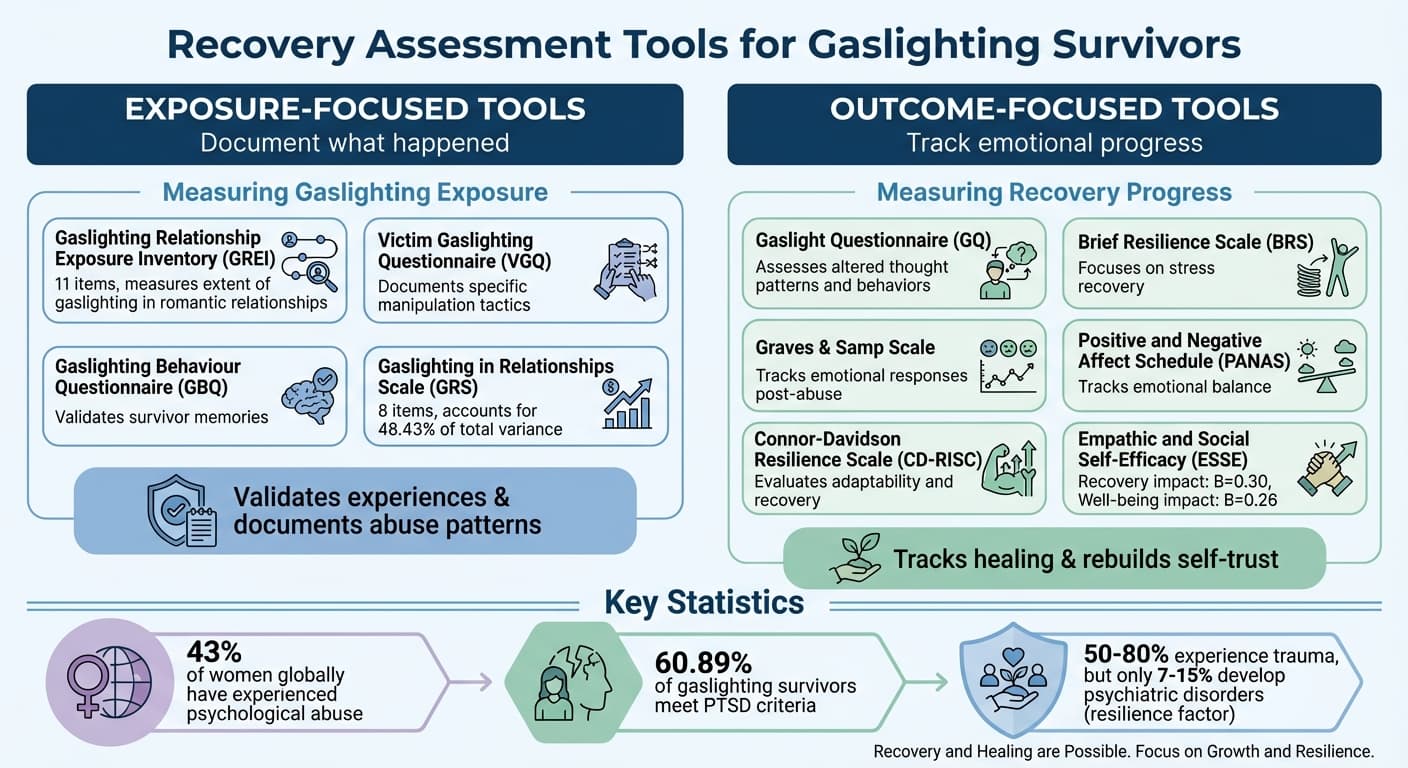
Researchers have created several tools to help survivors of gaslighting regain control and establish healthier boundaries. One notable example is the Gaslighting Relationship Exposure Inventory (GREI), an 11-item tool designed to measure the extent of gaslighting in romantic relationships [3]. This inventory provides survivors with a way to quantify the manipulation they endured.
In addition to exposure-focused tools, empowerment metrics like the Empathic and Social Self-Efficacy (ESSE) are key to recovery. ESSE evaluates a survivor's confidence in social interactions, and research shows its direct impact on recovery (B = 0.30) and psychological well-being (B = 0.26). Interestingly, these effects are more pronounced than the indirect benefits of social support alone [14]. In other words, rebuilding social confidence plays a bigger role in healing than simply having a support network.
The PAR Scale offers another layer of insight by helping survivors categorize abusive behaviors and assess their emotional impact. It distinguishes between feelings like being "scared" versus "controlled", shedding light on the nuanced ways gaslighting affects individuals [15]. With global data indicating that 43% of women have experienced psychological abuse [15], tools like these are essential for tracking recovery and understanding the emotional toll of gaslighting.
By measuring both the extent of exposure and the journey toward empowerment, these tools provide survivors with a clear framework for recovery. They also allow for meaningful comparisons with broader outcomes, making them invaluable in the healing process.
Comparing EBA with Other Recovery Metrics
When examining recovery tools, it’s important to separate those that focus on exposure from those that track internal progress. Exposure-focused tools - such as the GREI, Victim Gaslighting Questionnaire (VGQ), and Gaslighting Behaviour Questionnaire (GBQ) - are designed to document the specific tactics survivors experienced [3]. These tools help validate survivors' memories, which is particularly important since gaslighting often leaves individuals doubting their own reality.
On the other hand, outcome-focused tools measure the emotional and psychological changes that follow abuse. Instruments like the Gaslight Questionnaire (GQ) and the Graves & Samp scale assess how gaslighting has altered a survivor's thought patterns, emotional responses, and behaviors [3]. These tools not only validate the survivor's experiences but also track progress in rebuilding emotional stability and tools to trust yourself again. For example, the Gaslighting in Relationships Scale (GRS) uses an 8-item structure that accounts for 48.43% of total variance in identifying gaslighting tactics [2]. This makes it particularly effective in capturing the full range of manipulative behaviors.
Choosing the right tool depends on where you are in your recovery. Exposure-focused assessments can help you process what happened, while outcome-focused tools are better for tracking emotional and psychological growth. By using these targeted metrics, survivors can monitor their progress more effectively, avoiding generic mental health measures that might overlook the specific harm caused by gaslighting.
Using Technology for Emotional Recovery
How Gaslighting Check Supports Recovery

Recovering from gaslighting often requires tangible proof to challenge the warped reality created by manipulation. Gaslighting Check steps in with a 22-dimension affective signature that examines emotional subtleties, far surpassing simple keyword detection. The platform’s AI has achieved an accuracy rate of 85% in distinguishing gaslighting from non-gaslighting texts, with sensitivity at 72.6% and specificity at 78.1% [16].
Using real-time analysis, Gaslighting Check helps survivors detect emotional abuse warning signs as they unfold. Whether through live audio recordings or uploaded text, the tool identifies complex behaviors like DARVO (Deny, Attack, and Reverse Victim and Offender), blame-shifting, projection, deflection, and emotional invalidation. It even evaluates vocal cues - such as pitch and tone - to spot condescension and emotional inconsistencies. This instant feedback reinforces survivors’ instincts, offering an objective reality check when self-doubt sets in.
For those seeking deeper insights, the Premium Plan ($9.99/month) monitors conversation patterns over time, pinpointing recurring abuse cycles like "love-bombing" or "future faking" that might otherwise go unnoticed in isolated moments. Users can generate detailed, exportable PDF reports to share with therapists or use as legal evidence. These features not only complement therapy sessions but also provide survivors with a reliable tool to document their experiences securely.
Privacy and Security in Recovery Tools
When it comes to tools for emotional recovery, safeguarding personal data is non-negotiable. Survivors discussing manipulation and abuse need absolute assurance that their information is secure. Gaslighting Check prioritizes this by using end-to-end encryption for all data transmissions, ensuring that real-time audio and text analyses remain protected from interception. Additionally, raw data is automatically erased after analysis, reducing the chance of unauthorized access. This commitment to security is especially vital, as web searches for "gaslighting" skyrocketed by 1,740% in 2022 [17], highlighting both increased awareness and the demand for trustworthy tools.
Users retain full control over their data with flexible storage options. You can decide which conversation logs to save for evidence, set retention periods that suit your needs, and delete data whenever you choose. The platform guarantees confidentiality by not sharing data with third parties, ensuring that your recovery journey remains private and secure. This user-first approach allows survivors to decide what to document, what to erase, and who can access their analysis reports, empowering them every step of the way.
Conclusion: Measuring Progress and Supporting Survivors
Tracking emotional recovery helps you regain a sense of reality and rebuild self-trust. Studies indicate that psychological resilience plays a key role in mitigating the effects of gaslighting on overall life satisfaction [5]. Signs like reduced self-doubt, stronger boundaries, and improved well-being are clear markers of progress.
By focusing on observable changes, survivors can validate their healing journey. These metrics often uncover patterns that might otherwise go unnoticed. For example, noticing that you question your sanity less frequently can be an important sign of progress [3][4]. Incorporating physical activities and mindfulness practices can also highlight recovery milestones [1][4]. These measurable changes confirm forward movement, even when the process feels slow or challenging.
Objective tools can further strengthen this journey. Resources like Gaslighting Check provide validation during moments of doubt. By documenting interactions and generating detailed reports, this tool acts as a reality anchor - offering concrete evidence to counteract the lingering effects of manipulation. Such tools make the recovery process both personal and verifiable.
The journey from diminished self-worth to a stronger sense of self is rarely straightforward, but tracking progress reveals tangible improvement. Whether it's setting healthier boundaries, becoming more comfortable with solitude, or experiencing fewer moments of confusion, each indicator marks a step toward growth after trauma [1]. Recognizing your own resilience transforms the healing process from something abstract into something measurable and empowering. These metrics provide the clarity survivors need to rebuild relationships and reconnect with their communities.
FAQs
Which recovery metrics should I track first after gaslighting?
After experiencing gaslighting, it's important to focus on key areas that support recovery, such as self-trust, emotional validation, and boundary-setting. Rebuilding self-trust can involve practices like journaling or self-reflection to help you regain confidence in your own perceptions and instincts. Emotional validation - acknowledging and accepting your feelings without judgment - creates a sense of safety and stability. Meanwhile, tracking your progress in setting and maintaining boundaries reflects growth in resilience and self-advocacy. These practices work together to support emotional healing and help you reconnect with others in a healthier way.
How do I know if my anger is a healthy sign of healing?
Healthy anger during recovery from gaslighting can be a sign of growth, as it allows you to process your feelings and rebuild your identity. This type of anger often fuels the drive to establish boundaries and prioritize your well-being. When your anger feels energizing and inspires productive steps forward, it’s usually a good indicator of healing. On the other hand, if your anger becomes overpowering or lingers for too long, it might point to deeper unresolved emotions that could benefit from extra support or guidance from a professional.
How can I use Gaslighting Check safely without risking my privacy?
Gaslighting Check prioritizes your privacy by using encrypted data and automatic deletion policies. To ensure you're using it securely, turn on privacy settings, limit the personal details you share, and read through the platform's privacy policy. This way, you can stay informed about how your data is managed while confidently using its tools to identify emotional manipulation.