AI Micro-Expression Analysis for Trauma Recovery

AI Micro-Expression Analysis for Trauma Recovery
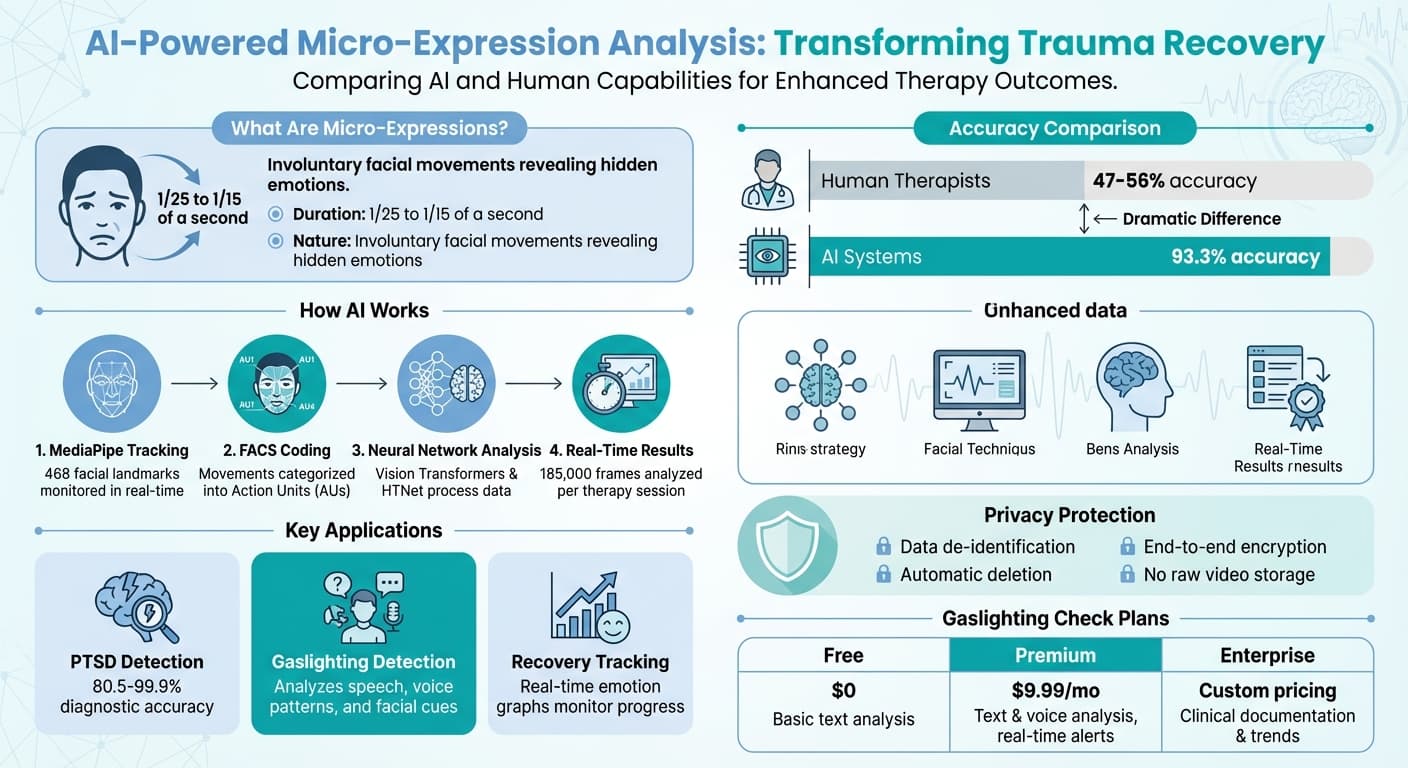
AI is now being used to analyze micro-expressions - brief, involuntary facial movements that reveal hidden emotions. These tools are transforming trauma therapy by identifying subtle emotional cues that therapists might miss. Here's what you need to know:
- Micro-Expressions: These fleeting facial movements (lasting 1/25 to 1/15 of a second) can expose suppressed emotions like fear or sadness.
- AI Accuracy: While therapists detect about 56% of emotional signals, AI systems achieve up to 93.3% accuracy using tools like MediaPipe and advanced neural networks.
- Trauma Therapy: AI helps therapists understand emotional states in real time, aiding in PTSD treatment and detecting emotional manipulation.
- Privacy: Strict safeguards ensure patient data remains secure, with anonymization and encryption built into these systems.
- Gaslighting Check: AI tools analyze speech and facial cues to detect emotional manipulation, offering actionable insights for trauma survivors.
AI-powered tools are giving therapists new ways to support recovery, offering clarity and emotional insights that can make therapy more effective.
::: @figure
What Micro-Expressions Reveal About Trauma
How Micro-Expressions Work
Micro-expressions are those tiny, involuntary facial movements that slip out before we even realize it. They’re like emotional “tells,” revealing what’s going on beneath the surface, even when someone is trying to mask their feelings. These signals appear because the brain processes emotions at a subconscious level, and they’re almost impossible to control intentionally. That’s why they’re such a reliable glimpse into someone’s true emotional state [1][3].
Scientists have even mapped these movements using the Facial Action Coding System (FACS). This system categorizes specific muscle movements into "Action Units" (AUs). For instance, AU4 (brow lowering) and AU15 (lip corner depression) are two examples that might point to emotional distress. These small movements, though subtle, can speak volumes [1].
Micro-Expressions in Trauma Recovery
For trauma survivors, these fleeting facial cues can reveal emotions they might not even be aware of - or might actively try to suppress. Survivors of PTSD or those who’ve experienced gaslighting, for example, often develop strategies to hide their feelings as a way to protect themselves, often requiring specific science-backed trauma processing techniques to overcome. But when faced with a trigger, their face might briefly show fear or disgust before they regain control. That split-second flash can be incredibly telling [1][3].
What makes micro-expressions so useful in therapy is their speed. They happen so quickly that even the person experiencing them can’t intervene to hide them. For therapists, this creates an opportunity to pick up on internal conflicts that might not come through in conversation. Imagine a patient saying they feel fine, but their face briefly shows AU20 (lip stretching) combined with AU1 and AU2 (brow raising) - a classic sign of fear. These subtle discrepancies can help uncover triggers or emotions the patient might not consciously recognize or feel ready to share [1].
Detect Manipulation in Conversations
Use AI-powered tools to analyze text and audio for gaslighting and manipulation patterns. Gain clarity, actionable insights, and support to navigate challenging relationships.
Start Analyzing NowHow AI Detects and Analyzes Micro-Expressions
AI Methods for Micro-Expression Detection
AI systems rely on a mix of computer vision and advanced language models to identify fleeting facial movements, often referred to as micro-expressions. At the heart of this process is MediaPipe, a tool that tracks an impressive 468 facial landmarks in real-time. This allows the system to monitor even the smallest changes in areas like the eyebrows, lips, and cheeks. These movements are then categorized using the Facial Action Coding System (FACS), which breaks down facial muscle activity into what are called Action Units (AUs). For instance, AU9 (nose wrinkling) often indicates disgust, while AU12 (lip corner pulling) is associated with happiness [1].
One standout technique in this area is "weak signal amplification." This approach magnifies extremely subtle facial movements, even those that people may be trying to suppress. Modern systems incorporate Vision Transformers (ViT) and Hierarchical Transformer Networks (HTNet) to analyze facial features comprehensively, which has proven especially useful in trauma-related work [1][5].
A hybrid AI system combining MediaPipe with GPT-3.5 for interpreting emotions has achieved an impressive 93.30% accuracy on the CASME II dataset - a key benchmark in micro-expression research. To put that into perspective, human evaluators, even with professional training, typically reach only 47–50% accuracy [1][4]. This level of precision is a game-changer for therapists, enabling them to pinpoint trauma triggers quickly and effectively during therapy sessions.
Real-Time Analysis and Trigger Detection
AI systems analyze facial data frame by frame in real-time, which is critical for capturing micro-expressions that last just 1/25 to 1/15 of a second. To handle this, the technology processes video at incredibly high speeds - sometimes analyzing up to 185,000 frames during a single therapy session [1][6].
In July 2025, a team of researchers at the University of South Florida, led by Professor Alison Salloum and Associate Professor Shaun Canavan, developed an AI system designed to detect PTSD in children. The system reviewed over 100 minutes of video per child, identifying subtle facial muscle movements that revealed underlying trauma. Their findings, published in Pattern Recognition Letters, showed that children's facial expressions during sessions with clinicians were far more telling than those observed in parent-child interactions [6][7].
"Even when they weren't saying much, you could see what they were going through on their faces. That's when I talked to Shaun about whether AI could help detect that in a structured way." - Alison Salloum, Professor, USF School of Social Work [6]
This real-time analysis provides therapists with objective, actionable data during sessions. It’s especially valuable for trauma survivors who may struggle to put their emotional experiences into words. By identifying specific triggers as they happen, therapists can tailor their approach more effectively. However, this level of analysis also requires strong privacy safeguards to protect sensitive patient information.
Privacy Protection in AI Analysis
Privacy is a top priority in trauma recovery, and modern AI systems are designed with strict safeguards. A key method is de-identification, where raw video footage is not stored. Instead, the system retains only anonymized data - such as facial movement patterns, angles, and timing [6][7].
"We don't use raw video. We completely get rid of the subject identification and only keep data about facial movement." - Shaun Canavan, Associate Professor, USF Bellini College of Artificial Intelligence [6]
This anonymized data resembles a mathematical graph rather than a recognizable image, making it nearly impossible to reconstruct an individual’s identity. At the same time, it preserves the emotional cues therapists need for their analysis [6][2]. These robust privacy measures help build trust, ensuring that sensitive emotional data remains secure while supporting effective trauma recovery monitoring.
Using AI for Trauma Recovery
AI for PTSD Detection and Therapy
AI is changing the way therapists detect and treat PTSD by analyzing subtle facial micro-expressions that patients might not even realize they're showing. Using advanced tools like convolutional neural networks (CNNs) and hybrid deep learning models, these systems achieve diagnostic accuracies ranging from 80.5% to 99.9%, with an average of about 93%. They also report F1-scores between 0.87 and 0.99 and AUC values above 0.90[8]. This precision allows clinicians to identify fleeting emotions - think of a quick smile concealing distress or a subtle flash of disgust - that could easily go unnoticed by the human eye.
Some AI systems go a step further by integrating facial analysis with voice and EEG data, achieving over 95% accuracy. In comparison, single-mode systems typically hit accuracy levels between 85% and 95%[8]. For example, if AI detects patterns of suppressed despair through micro-expressions, therapists can adapt cognitive behavioral therapy techniques to address specific emotional triggers. Tools like CNN-LSTM models bring high sensitivity to the table, enabling therapists to fine-tune sessions based on each patient’s unique recovery needs[8][10].
These methods are also being tailored for pediatric PTSD, offering real-time feedback that helps refine therapeutic strategies for younger patients[11]. Beyond individual therapy, these detection capabilities are valuable for broader applications, such as identifying emotional manipulation.
Gaslighting Check: Detecting Emotional Manipulation

Gaslighting Check uses AI to uncover subtle emotional manipulation during conversations. By analyzing real-time audio, text, and voice patterns, it identifies tactics like reality distortion, blame shifting, and emotional invalidation. The system flags manipulation cues such as changes in voice pitch, uneven speech delivery, or dismissive language.
| Manipulation Tactic | AI Detection Method | Common Indicators |
|---|---|---|
| Reality Distortion | NLP & Context Analysis | "That never happened", "You're imagining things" |
| Blame Shifting | Semantic Analysis | Deflecting responsibility, accusatory language |
| Emotional Invalidation | Sentiment Analysis | "You're too sensitive", "You're overreacting" |
| Vocal Stress | Voice Pattern Analysis | Higher pitch, shaky voice, flat delivery, rapid speech |
The platform generates detailed reports that highlight hidden manipulation triggers, helping therapists address trauma linked to gaslighting. It also tracks conversation history, allowing patients and therapists to monitor patterns over time. To ensure privacy, all data is encrypted and automatically deleted after use. These insights not only aid in recovery but also help measure therapeutic progress.
Tracking Recovery Through Emotion Analysis
AI-generated emotion graphs provide a clear picture of recovery by mapping changes in micro-expressions throughout therapy. Using spatial and temporal CNNs, these graphs visualize trends in emotional responses, achieving near real-time accuracy of about 67.7%[9][10]. This is especially helpful for PTSD patients who might struggle to express their feelings verbally.
Therapists can rely on these graphs to track progress, catch early signs of setbacks, and confirm when a patient is ready to conclude treatment[11][12]. Real-time emotional feedback during sessions also allows for adjustments in exposure techniques or coping strategies, keeping interventions aligned with the patient’s current emotional state. By offering this kind of objective, data-driven insight, AI ensures that trauma therapy remains personalized and effective[12].
Adding AI Tools to Trauma Therapy
How to Use AI Tools in Therapy
Therapists can use AI tools like Gaslighting Check to establish a baseline of a patient’s behavior during initial sessions. This baseline helps track emotional shifts over time, making it easier to differentiate between normal emotional changes and patterns that might signal deeper concerns requiring intervention.
AI-generated reports can also serve as reliable clinical documentation. These reports objectively log and analyze emotional manipulation tactics found in conversations, offering concrete evidence. For trauma survivors, this kind of validation can break the cycle of self-doubt, such as the recurring thought of "maybe I imagined it", which often delays recovery.
Real-time alerts are another key feature. These alerts notify therapists when risk thresholds are met - high (≥0.9), medium (≥0.7), or low (≥0.5) - allowing for immediate therapeutic adjustments. This kind of monitoring ensures timely interventions, especially when patients encounter manipulation outside therapy sessions.
To address privacy concerns, all data is secured with end-to-end encryption and automatic deletion. Patients maintain full control over their data through consent settings, fostering trust between therapists and clients. These features make it possible to create recovery plans tailored to individual needs.
Gaslighting Check: Plans and Features
Gaslighting Check provides three subscription options to cater to different user needs.
The Free Plan offers basic text analysis with standard encryption and auto-delete features, making it a good starting point for individuals who suspect they might be experiencing manipulation.
The Premium Plan, priced at $9.99 per month, includes both text and voice analysis, detailed annotated reports, conversation history tracking, and real-time alerts. This plan is ideal for those actively working through trauma and seeking more in-depth support.
For professional use, the Enterprise Plan offers custom pricing and is tailored to clinical settings. It includes features like clinician notifications, secure archiving of therapy records, and advanced trend analysis. This plan is particularly suited for therapists managing multiple patients and requiring comprehensive documentation.
| Plan | Price | Analysis Types | Reporting | Real-Time Alerts | Data Retention | Best For |
|---|---|---|---|---|---|---|
| Free | $0 | Basic Text Analysis | Summary Reports | No | Auto-delete | Occasional users exploring the platform |
| Premium | $9.99/mo | Text & Voice Analysis | Detailed Annotated Reports & History Tracking | Yes (High/Med/Low Risk) | User-controlled storage | Regular users seeking comprehensive recovery support |
| Enterprise | Custom | Full Text & Voice Suite | Clinical Documentation, Trends & History Tracking | Yes, with clinician notifications | Secure Archive for Therapy | Organizations or therapists with specific clinical needs |
All plans prioritize privacy, with higher-tier options offering enhanced security and storage features tailored to professional therapy standards.
What if AI knows how you feel before you do? | John Kilmer | TEDxKamionek Salon
This technology mirrors emerging AI tools for detecting gaslighting that analyze communication patterns to validate a survivor's reality.
Conclusion
AI-powered micro-expression analysis is transforming how trauma survivors regain emotional clarity and rebuild self-trust. By offering objective insights into emotional states, these tools help counteract the self-doubt and distorted reality often caused by gaslighting and trauma. When individuals question their own perceptions, AI steps in with solid evidence of their experiences, reinforcing their sense of reality. This objective validation works hand in hand with the real-time detection tools discussed earlier.
Real-time feedback plays a critical role in this process. Tools like Gaslighting Check allow users to identify gaslighting vs manipulation as it happens, enabling them to set boundaries immediately and prevent further harm. This instant awareness cuts through the confusion and fosters more decisive responses. As Shaun Canavan from the University of South Florida explains:
"AI is absolutely another tool for health care providers... It doesn't replace the other methods of asking questions, conversations and interviews... It's really a tool" [13].
Privacy-focused features ensure these technologies remain safe for vulnerable users. With end-to-end encryption and automatic data deletion, sensitive emotional data stays protected, fostering the trust necessary for trauma survivors to engage with these tools. This secure design enables users to document patterns of manipulation without fear of exposure, creating a safe space for recovery.
The integration of text and voice analysis helps uncover manipulation tactics that might otherwise go unnoticed. For example, vocal shifts in tone or signs of stress reveal emotional abuse that text alone might miss. By tracking these subtle patterns over time, AI provides measurable progress indicators, offering both individuals and therapists a clearer picture of recovery.
Whether choosing the Free Plan for initial use or the Premium Plan at $9.99 per month for more in-depth support, Gaslighting Check offers accessible tools to help users regain emotional control. These technologies complement human intuition and professional therapy, equipping individuals with the insights they need to overcome manipulation and move forward with confidence.
FAQs
Can AI misread my facial expressions?
AI systems can sometimes misinterpret facial expressions due to challenges in accuracy and understanding. That said, many of these tools are quite effective at identifying emotions, with some reaching accuracy rates as high as 81%. Still, no system is perfect, and subtle or intricate expressions can occasionally lead to errors in interpretation.
Will my video or audio be stored?
Your video or audio might be stored briefly for analysis purposes. However, tools like Gaslighting Check are built with privacy in mind, offering features such as end-to-end encryption and automatic data deletion to keep your information safe and secure.
How can AI help prove gaslighting patterns?
AI can spot gaslighting behaviors by using natural language processing (NLP) and machine learning to analyze communication. It identifies tactics such as denial, dismissiveness, and emotional invalidation. For instance, tools like Gaslighting Check examine text and audio for shifts in tone, vague phrasing, and repetitive patterns. These systems generate objective evidence and detailed reports, offering valuable insights for victims and therapists to better understand and address emotional manipulation.