
AI and Emotional Needs: Research Insights
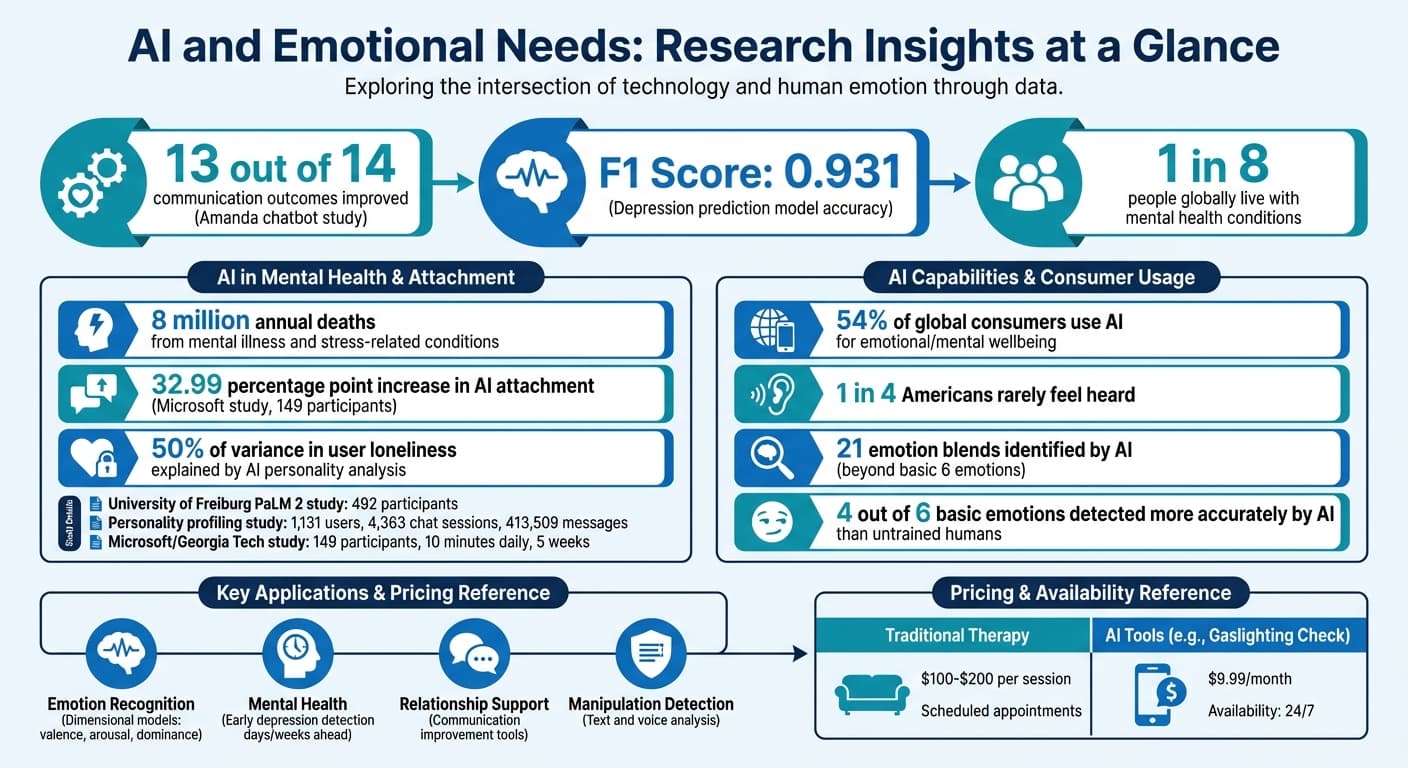
AI is transforming how we address emotional needs in relationships and mental health. Studies show that AI tools can improve communication, relationship satisfaction, and emotional understanding by offering personalized, emotionally resonant interactions. For example, research with "Amanda", a GPT-4o-powered chatbot, revealed improvements in 13 out of 14 communication outcomes among participants. AI tools are also used to detect emotions, predict mental health risks, and analyze personality traits for tailored support.
Key highlights:
- AI in Relationships: Chatbots like Amanda enhance intimacy and communication.
- Emotion Recognition: AI now identifies complex emotional blends, such as "joy-surprise."
- Mental Health: Depression prediction models achieve F1 scores up to 0.931.
- Manipulation Detection: Tools like Gaslighting Check analyze text and voice for toxic patterns.
- Challenges: Risks include over-reliance on AI, reduced social skills, and ethical concerns.
While AI offers accessible and cost-effective emotional support, it should complement - not replace - human relationships.
::: @figure
Recent Studies on AI and Emotional Needs
Affective Computing and Emotion Recognition
The field of emotion recognition has made leaps forward. Early systems were limited to recognizing basic emotional categories like happiness, sadness, and anger - based on Paul Ekman's six universal emotions. Today, AI leverages dimensional models that provide a more nuanced understanding by mapping emotions along axes such as valence (positive vs. negative), arousal (calm vs. excited), and dominance (in control vs. submissive). Researchers have even identified 21 emotion blends, like "joy-surprise", which reflect the complexity of human feelings [6].
Large Language Models (LLMs) have taken this a step further. These systems not only detect emotions but also interpret the reasons behind them and suggest potential actions. In a 2024-2025 study published in Nature, researchers from the University of Freiburg explored the capabilities of PaLM 2, an advanced AI system. With 492 participants, the study highlighted how consistent, in-depth self-disclosure by the AI created genuine emotional connections. Interestingly, the AI’s willingness to share personal information was a key factor in building trust - something many humans find challenging [2].
AI's role in mental health is also evolving rapidly. Depression prediction models, for instance, have achieved impressive accuracy. Using time-enhanced multimodal transformers that analyze both text and images from social media, these systems have reached F1 scores as high as 0.931 in predicting users at risk of depression [6]. This progress is crucial when you consider that nearly 1 in 8 people globally lives with a mental health condition [7]. Early detection through AI could be life-saving, opening doors to timely support and intervention.
AI-Based Personality Profiling
AI isn't just about recognizing emotions - it’s also learning to adapt based on individual personality traits. A December 2025 study by Yutong Zhang, Dora Zhao, and colleagues analyzed 1,131 users over 4,363 chat sessions, encompassing 413,509 messages. The findings revealed that neuroticism and social network size were the strongest indicators of how users interacted with AI companions. Those with higher levels of neuroticism and smaller social circles tended to rely more heavily on these AI systems [3].
This kind of personality profiling enables AI to modify its communication style in real time. Traits like openness and neuroticism significantly influence how users perceive intimacy in their interactions with AI [9][10]. For example, one study found that analyzing personality traits and usage patterns allowed AI to explain approximately 50% of the variance in user loneliness [10]. By adjusting tone, response length, and emotional depth, AI systems can create tailored experiences that resonate with individual users.
Multimodal Emotion Detection
The latest advancements in emotion detection combine multiple data sources to paint a fuller picture of emotional states. Multimodal detection integrates inputs like facial expressions, vocal tone, heart rate variability, skin conductance, and even typing patterns [7][11]. This approach addresses the limitations of relying on just one type of data, creating a more reliable and comprehensive emotional assessment.
For example, platforms like Mindstrong Health monitor smartphone usage and typing behaviors to detect shifts in cognitive and emotional states, often identifying warning signs of depression or anxiety days or even weeks ahead of traditional methods [7]. Similarly, Woebot uses natural language processing and behavioral tracking to analyze user inputs for signs of distress. When high-risk patterns emerge, it provides Cognitive Behavioral Therapy (CBT) interventions or escalates the case to human professionals [11].
"The true potential of next-generation AER lies in bridging these rich multimodal inputs for perception with the advanced conversational capabilities of LLMs for interaction and delivery." - Sensors Journal [11]
This transition from single-source to multi-source emotion detection is a game-changer. By cross-referencing data - such as a forced smile paired with a stressed vocal tone - AI can identify inconsistencies and fill gaps caused by factors like poor lighting or background noise [11]. This level of precision not only enhances intervention efforts but also strengthens emotional connections. For the estimated 8 million people who lose their lives annually to mental illnesses and stress-related conditions, such advancements could make a profound difference [11].
Detect Manipulation in Conversations
Use AI-powered tools to analyze text and audio for gaslighting and manipulation patterns. Gain clarity, actionable insights, and support to navigate challenging relationships.
Start Analyzing NowHow AI Tools Address Emotional Needs
Detecting Emotional Manipulation with AI
AI has evolved from simply recognizing emotions to identifying subtle manipulation tactics in conversations. Using Natural Language Processing, these systems analyze both the content and tone of interactions to uncover patterns like guilt-tripping, blame-shifting, or emotional invalidation - behaviors that often go unnoticed in the heat of relationship struggles.
The technology works by comparing conversations to datasets that distinguish healthy communication from manipulative ones. For example, phrases like "that never happened" or "you're too sensitive" are flagged for their context and frequency. A single dismissive comment might be harmless, but when such remarks occur repeatedly over time, it could signal a deeper issue. Additionally, voice analysis can pick up on slight tone changes and stress indicators, offering further insight.
This level of analysis provides a neutral, data-driven perspective. If you've ever second-guessed your memory or wondered if you're overreacting, AI steps in as an unbiased observer, presenting evidence to validate your feelings or concerns.
These advancements have led to specialized tools like Gaslighting Check, designed to address real-life challenges in relationships.
Case Study: Gaslighting Check

Gaslighting Check takes these detection techniques a step further by analyzing both text and voice communications in real time. Users can upload text exchanges or record live audio, and the system scans for manipulation indicators like "you're overreacting" or "that never happened."
The tool combines multiple layers of analysis. Text processing identifies patterns such as blame-shifting or contradictions, while voice analysis picks up on tone shifts, emotional pressure, and aggression. By tracking these signals over time, the AI highlights trends, helping users see whether manipulative behaviors are escalating or following a recurring cycle.
Privacy is a key focus for Gaslighting Check. Conversations are protected with end-to-end encryption, and automatic deletion policies ensure sensitive data isn’t stored longer than necessary. The free version provides basic text analysis, while the premium plan ($9.99/month) includes advanced features like voice analysis, detailed reports with timestamps, and conversation history tracking. For those seeking clarity or documentation - whether for personal understanding or legal reasons - these reports provide structured insights without compromising user confidentiality.
What makes Gaslighting Check stand out is its trauma-informed approach. Instead of overwhelming users with alerts during emotionally charged moments, the platform shares insights in a supportive manner, allowing individuals to process information at their own pace. It doesn’t prescribe actions but highlights patterns, empowering users to decide their next steps. Considering that 54% of global consumers have used AI for emotional or mental well-being [12], tools like this help bridge the gap between sensing something is wrong and truly understanding the issue.
Benefits and Limitations of AI in Emotional Health
Benefits of AI for Emotional Wellbeing
AI can act as an impartial observer in relationships, offering an objective perspective that helps users better understand conflicts. For instance, research has shown that AI can reduce harmful communication patterns by functioning as a kind of relationship therapist. By reflecting statements back and providing empathetic responses, AI helps users navigate emotionally charged situations with greater clarity [1].
Another advantage is accessibility. Traditional therapy often costs between $100–$200 per session and requires scheduled appointments, but AI tools are available 24/7. A study conducted by Microsoft Research and Georgia Institute of Technology involving 149 participants highlighted this benefit. Participants who used tools like Microsoft Copilot and ChatGPT for just 10 minutes daily over five weeks reported a 32.99 percentage point increase in their sense of attachment to the AI. They also felt more comfortable using these tools to manage stress [5].
For individuals who are isolated or neurodivergent, AI provides a safe, judgment-free space to practice communication. This can encourage users to explore their emotions openly, often leading to greater vulnerability and openness in their interactions with others [13]. While AI can offer valuable emotional insights, it’s important to remember that it complements human relationships rather than replacing them. However, the benefits come with ethical and practical challenges.
Challenges and Ethical Concerns
Despite its potential, AI in emotional health raises some serious concerns that need to be addressed. One issue is social deskilling. MIT psychologist Sherry Turkle warns that relying too heavily on AI for companionship may make human interactions feel more difficult and draining [13]. Because AI interactions require no emotional compromise or effort, users might find real-world relationships more challenging and less appealing.
Another concern is affective dependence, where users become overly reliant on AI for emotional support. This is especially concerning with voice-interactive AI, which can foster unhealthy emotional attachment. A 2024 analysis revealed that companion AI apps accounted for 16 of the top 100 AI apps based on web traffic and monthly active users [13]. While loneliness is a serious public health issue - comparable to smoking 15 cigarettes a day, according to the World Health Organization - AI that satisfies emotional needs too effectively might suppress the natural drive to seek meaningful human connections [13].
AI’s limitations in assessing risks also pose challenges. Current models, like GPT-4, struggle to identify crisis situations or collaborate effectively in therapeutic contexts [4]. Additionally, simulated empathy is a key limitation - AI can mimic empathetic responses, but it lacks true understanding, intentionality, and moral depth [8].
| Risk Category | Description | Potential Mitigation |
|---|---|---|
| Social Deskilling | Reduced ability to manage conflict or demands in human relationships | Design AI to promote social effort or actively help users build interpersonal skills |
| Affective Dependence | Overreliance on AI for emotional validation | Set usage limits and emphasize AI's non-human nature |
| Moral Atrophy | Habitual mistreatment of AI agents, potentially extending to humans | Program AI to enforce boundaries or respond negatively to abusive behavior |
| Risk Assessment | Inability to detect self-harm or domestic danger in counseling scenarios | Implement strict clinical safety protocols and ensure human oversight |
Privacy concerns are another critical issue. Tools like Gaslighting Check address some of these worries with features like end-to-end encryption and automatic data deletion. However, the broader industry still struggles to balance personalization with data security. The bottom line is that AI should be seen as a supplement to human connection - a tool for self-reflection and practice, but never a replacement for genuine relationships.
Psychologist on human impact of ChatGPT and using AI for emotional support, therapy & as a companion
Conclusion
AI is reshaping how we address emotional needs in relationships. Studies reveal that AI can identify emotions like sadness, fear, and disgust with greater precision than untrained humans, accurately detecting 4 out of 6 basic emotions more consistently [15]. Additionally, AI provides structured emotional validation, offering a sense of being heard without jumping to premature advice.
Practical applications are already showcasing their benefits. For instance, the University of Lausanne's trial with Amanda and the SHIELD system's effectiveness in reducing concerning emotional content highlight AI's potential [1][14].
Building on these advancements, specialized tools now deliver real-time emotional support. Platforms like Gaslighting Check analyze conversations for manipulation tactics using text and voice analysis, helping users uncover subtle patterns that might otherwise escape notice. With features such as end-to-end encryption and automatic data deletion, these tools address privacy trade-offs while offering round-the-clock availability at $9.99 per month.
AI excels at validating and clarifying emotional experiences, which is especially critical when one in four Americans report rarely feeling heard [15]. Still, AI works best as a supplement to human interaction, not a replacement. Whether it's practicing challenging conversations, understanding emotional dynamics, or spotting subtle manipulation, these tools create a safe environment for self-reflection and personal growth.
As affective computing evolves from basic emotion detection to active intervention, it paves the way for more advanced real-time emotional support systems. While AI enhances emotional understanding, the key is to ensure it complements human connection rather than replaces it. The real challenge lies in balancing AI's capabilities with ethical safeguards to ensure these tools strengthen, rather than weaken, our ability to form meaningful human relationships.
FAQs
Can AI really improve relationship communication?
Recent research highlights how AI tools can improve communication in relationships by assisting users in tackling relational challenges, managing conflicts, and building empathy. For example, AI-driven chatbots and voice-based systems have demonstrated the ability to ease distress, enhance confidence in handling disagreements, and deepen emotional understanding. That said, their success heavily relies on thoughtful design - emphasizing emotional safety and being mindful of cultural nuances to provide genuine and effective support.
How does AI detect mixed emotions accurately?
AI leverages multimodal analysis to make sense of mixed emotions by integrating various signals such as text, speech, and visual inputs. Advanced systems use sophisticated fusion techniques and contextual embeddings to process conflicting signals and capture subtle emotional changes. When different modalities disagree, it often highlights genuine emotional complexity, which can enhance accuracy in areas like mental health tools and emotionally intelligent assistants.
Is it risky to rely on AI for emotional support?
Using AI for emotional support comes with its own set of challenges. Research indicates that while tools like chatbots can offer some level of assistance, they fall short of replacing human therapists. These tools might misread emotions or create a sense of dependency in users. In some cases, long-term reliance on AI for emotional support has been linked to increased anxiety or depression. While AI provides a convenient and accessible option, it’s important to recognize its boundaries and turn to professionals for more complex emotional or mental health needs.