
AI-Based Behavioral Modeling for Gaslighting
Gaslighting is a form of manipulation that causes individuals to question their reality, often leading to emotional distress. AI-based tools now provide a structured way to detect these behaviors by analyzing communication patterns in texts, emails, and voice calls. Here's what you need to know:
- Gaslighting Tactics: Common strategies include denial of facts, reframing narratives, and exploiting power dynamics.
- AI Detection: Advanced models analyze language, tone, and emotional cues to identify manipulation with up to 92% accuracy.
- Key Features: Tools like Gaslighting Check offer real-time alerts, behavior reports, and conversation history tracking to help users recognize and address manipulation.
- Privacy: Platforms prioritize user data security with encryption and local analysis options.
Gaslighting Check offers free basic features, while premium plans ($9.99/month) include voice analysis and detailed tracking. These tools empower individuals to identify and address gaslighting in relationships and workplaces effectively.
Gaslighting AI & Cyber Poltergeists | Nell Watson | TEDxUniversityofNicosia
Detect Manipulation in Conversations
Use AI-powered tools to analyze text and audio for gaslighting and manipulation patterns. Gain clarity, actionable insights, and support to navigate challenging relationships.
Start Analyzing NowMain Behavioral Patterns in Gaslighting
::: @figure
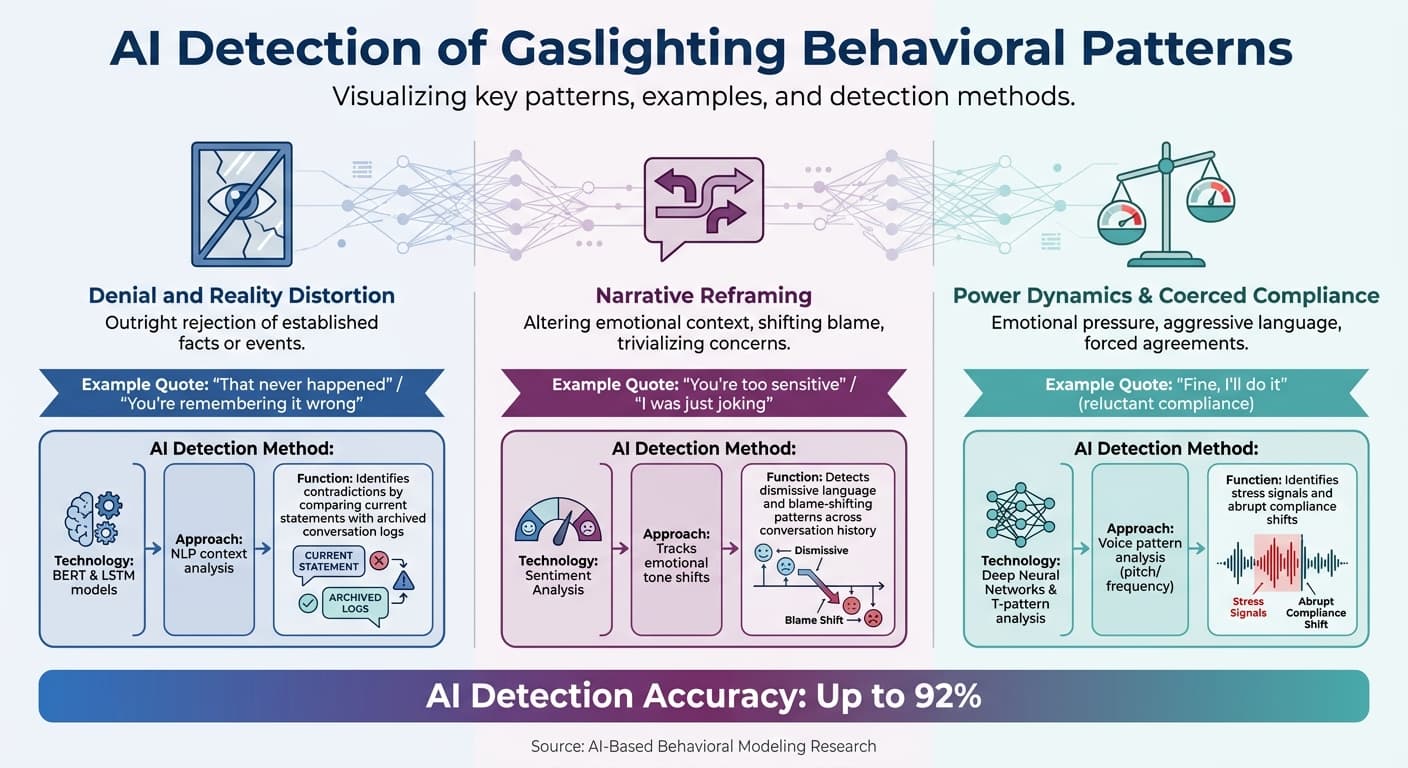
Gaslighting often operates through a mix of behavioral strategies, making it a particularly insidious form of manipulation. By breaking down conversation data, AI can pinpoint three primary patterns: denial and reality distortion, narrative reframing, and power dynamics with coerced compliance. These behaviors rarely act independently; instead, they intertwine, creating a complex and layered manipulation strategy that can be difficult to identify without an objective lens.
AI systems analyze these patterns by examining elements like word choice, sentence flow, shifts in sentiment, and even timestamps to create a chronological map of manipulation. When these behaviors repeatedly appear across multiple interactions, the system flags them with a high degree of confidence, often exposing manipulation that might otherwise go unnoticed. This interconnected nature of gaslighting behaviors allows AI to offer precise insights into their detection.
Denial and Reality Distortion
Denial involves outright rejection of established facts or events, often through statements like, "That never happened" or "You're remembering it wrong." The goal here is to replace the victim's memory of events with the manipulator's version. AI tools, powered by natural language processing models such as BERT and LSTM, are capable of identifying these denials by analyzing sentence context and structure. For instance, if someone claims, "I never said that," but earlier conversation logs clearly show otherwise, the system can spot this inconsistency immediately. These contradictions are significant red flags, and archived data plays a critical role in confirming them.
Narrative Reframing
This pattern involves altering the emotional context of events, shifting blame, or trivializing concerns. Phrases like, "You're too sensitive" or "I was just joking," are common examples. These tactics dismiss legitimate feelings while portraying the manipulator as rational or misunderstood. AI systems track these shifts by analyzing communication in real-time to detect changes in sentiment and emotional tone throughout conversations. When blame-shifting or dismissive language appears alongside other gaslighting tactics, AI assigns a higher likelihood to its detection. If vague or evasive responses arise, asking direct questions like, "What exactly do you mean?" can help challenge the narrative or expose avoidance.
Power Dynamics and Coerced Compliance
Power imbalances often manifest through emotional pressure, aggressive language, or sudden, unnatural agreements. For example, a manipulator might push someone into conceding a point they initially resisted. AI can detect these dynamics by analyzing vocal cues - like changes in pitch, rhythm, or frequency - that may signal stress or aggression. Additionally, T-pattern analysis helps identify deceptive behaviors and abrupt shifts in compliance, highlighting moments when someone reluctantly agrees under pressure.
| Behavioral Pattern | Communication Example | AI Detection Method |
|---|---|---|
| Reality Distortion | Denial of events ("That never happened") | NLP context analysis (BERT/LSTM) |
| Narrative Reframing | Blame-shifting or trivializing feelings ("You're overreacting") | Sentiment tracking across history |
| Power Dynamics | Emotional pressure or aggression | Voice patterns (pitch/frequency) |
| Coerced Compliance | Forced agreements ("Fine, I'll do it") | T-pattern analysis for behavior shifts |
AI Techniques for Behavioral Pattern Recognition
AI is making strides in detecting gaslighting by combining text and voice analysis. These tools process both the content of conversations and the way they’re delivered, creating a detailed timeline of manipulative behavior as it unfolds. The system continuously improves its accuracy through reinforcement learning techniques.
Text and Voice Analysis
Models like BERT and LSTM play a key role in analyzing shifts in meaning across conversations. They identify manipulative language and track changes in sentence structure or word choice that might indicate attempts to distort reality. A critical component of this process is Intent-Aware Prompting (IAP), which helps AI decode the motives behind messages.
Soroush Vosoughi, Assistant Professor of Computer Science at Dartmouth, highlights the challenge:
"Recognizing manipulative intent, especially when it is implicit, requires a level of social intelligence that current AI systems lack."
IAP addresses this by interpreting the underlying intent, significantly boosting detection capabilities. While text analysis uncovers the purpose of communication, voice analysis focuses on how AI detects vocal emotion across different interactions.
Deep Neural Networks (DNNs) analyze frequency and pitch to detect emotions, while Convolutional Neural Networks (CNNs) examine spectrograms of audio to identify six emotional states: joy, anger, sadness, fear, disgust, and neutral. These tools can pick up on subtle tonal shifts, like a calm voice becoming aggressive or pitch changes signaling stress during forced agreements.
| Technology | Primary Function | Key Method/Model |
|---|---|---|
| Text Analysis | Identifies manipulative language and phrases | BERT, LSTM, Intent-Aware Prompting |
| Voice Analysis | Detects emotional pressure and tonal shifts | Deep Neural Networks, CNN Spectrograms |
| Pattern Recognition | Tracks behavior over long-term interactions | T-pattern analysis, SELF-PERCEPT framework |
| Real-Time Alerts | Provides instant feedback on manipulation | 24/7 monitoring, Live notifications |
These tools power platforms like Gaslighting Check, offering private and effective ways to detect gaslighting in real time.
Reinforcement Learning from Human Feedback (RLHF)
Reinforcement Learning from Human Feedback (RLHF) is another crucial element. By training on annotated conversations, these systems adapt to new manipulation tactics, achieving an accuracy rate of 84.6%. This involves using data where human experts have flagged manipulative behavior, refining the model with each iteration.
Marwa Abdulhai from UC Berkeley emphasizes the importance of this approach:
"Deception in dialogue is a behavior that develops over an interaction history, its effective evaluation and mitigation necessitates moving beyond single-utterance analyses."
Rather than analyzing isolated messages, RLHF processes entire conversation histories, enabling the system to identify manipulation as it develops over time. Yuxin Wang, a PhD student at Dartmouth, underscores its practical value:
"LLM models trained to reliably recognize manipulation could be a valuable tool for early intervention, warning victims that the other party is trying to manipulate them."
Using AI-Based Detection with Gaslighting Check

Gaslighting Check takes advantage of advanced AI technology to turn detection into a practical tool. By using these methods, the platform provides real-time alerts for emotional manipulation, helping users identify potential issues as they happen.
Key Features of Gaslighting Check
Gaslighting Check is packed with tools designed to identify and document manipulation effectively. It employs IAP (Intent Analysis Processing) to interpret the motives behind messages, improving detection precision. By reviewing conversation history, the platform can also highlight recurring manipulation patterns.
Some standout features include:
- Real-time audio recording: This feature triggers instant AI alerts when manipulation tactics are detected during conversations.
- Detailed behavior reports: These reports break down specific manipulative behaviors identified in each interaction, offering clear insights.
- Conversation history tracking: Available for premium users, this feature stores past interactions and visualizes trends in manipulative behavior over time.
These tools are specifically designed to address patterns like denial, narrative reframing, and power dynamics, which are common in manipulative behavior.
Privacy and Security Measures
Gaslighting Check prioritizes user privacy with robust security protocols. All conversations are protected through end-to-end encryption, ensuring data security during both transmission and storage. Additionally, conversation data is anonymized and automatically deleted after 30 to 90 days unless users choose to keep it.
Users have full control over their data, with options to save specific conversations as evidence or delete them immediately. In some cases, the platform can analyze data locally on the user’s device, minimizing the need to transfer sensitive information to external servers.
These privacy measures are designed to work seamlessly alongside the platform’s flexible pricing options.
Gaslighting Check Plans Comparison
Gaslighting Check offers pricing plans tailored to different needs, ensuring accessibility without compromising on detection capabilities or security.
| Plan | Price | Key Features | Best For |
|---|---|---|---|
| Free | $0 | Basic text analysis, standard reports | Users exploring the platform with simple needs |
| Premium | $9.99/month | Text and voice analysis, detailed reports, trend tracking, real-time alerts | Individuals seeking in-depth, ongoing analysis |
| Enterprise | Custom | All premium features, role-based access control, admin dashboard, insights | Organizations tackling workplace manipulation |
The Free plan is ideal for basic text analysis and testing the platform. The Premium plan, at $9.99 per month, adds features like voice analysis, real-time alerts, and conversation history tracking for users who need more detailed insights. For businesses, the Enterprise plan offers tailored solutions with advanced tools like role-based access and organizational insights to address toxic environments effectively.
Conclusion: Using AI to Detect and Address Gaslighting
Gaslighting feeds on confusion and self-doubt, thriving in an environment where manipulation can go unnoticed. AI-based behavioral modeling helps bring these tactics into the open by analyzing denial, reality distortion, narrative reframing, and power dynamics through both text and voice analysis. These tools don't just highlight problematic language - they reveal the intent behind manipulative behavior, giving individuals the clarity they need to recognize patterns they may have long suspected but struggled to confirm. This newfound awareness becomes even more impactful when paired with practical tools.
Gaslighting Check turns AI insights into real-world support through features like real-time alerts, comprehensive reports, and secure data handling.
Recovery doesn’t have to be complicated. The Free plan offers basic text analysis for those just starting out, while the Premium plan, priced at $9.99 per month, includes advanced voice analysis and detailed tracking. These insights can be shared with professionals, such as therapists, to develop personalized recovery strategies tailored to the specific manipulation tactics you've encountered.
While AI can't replace human connection and support, it does provide an objective lens. By identifying subtle patterns that might otherwise go unnoticed, these tools help you set boundaries, rebuild trust in your perceptions, and break free from cycles of manipulation. Whether you're addressing challenges in personal relationships or workplace environments, AI-based detection offers a clear path from confusion to understanding - and ultimately, from manipulation to empowerment.
FAQs
Can AI confuse conflict with gaslighting?
AI can tell the difference between a regular conflict and gaslighting by analyzing patterns, contradictions, and manipulation tactics in conversations. Instead of just flagging disagreements or typical arguments, it zeroes in on signs of emotional manipulation, ensuring a more accurate understanding of behavior.
How does it spot manipulation across a whole conversation?
AI-powered behavioral models dive deep into conversations, examining patterns, intent, and emotional changes over time. These systems focus on linguistic details, emotional signals, and relationship dynamics to uncover subtle manipulation tactics like gaslighting or blame-shifting. By analyzing word choices, timing, and repeated behaviors, the AI pinpoints manipulation not as random incidents but as ongoing patterns, providing a clearer understanding of emotional manipulation.
What happens to my data and recordings?
Your data and recordings are kept secure with robust privacy protections, including encryption to shield your information. On top of that, automatic deletion policies ensure your data is only stored for as long as needed, helping to uphold both confidentiality and security.