Steps to Reconnect After Gaslighting Isolation

Steps to Reconnect After Gaslighting Isolation
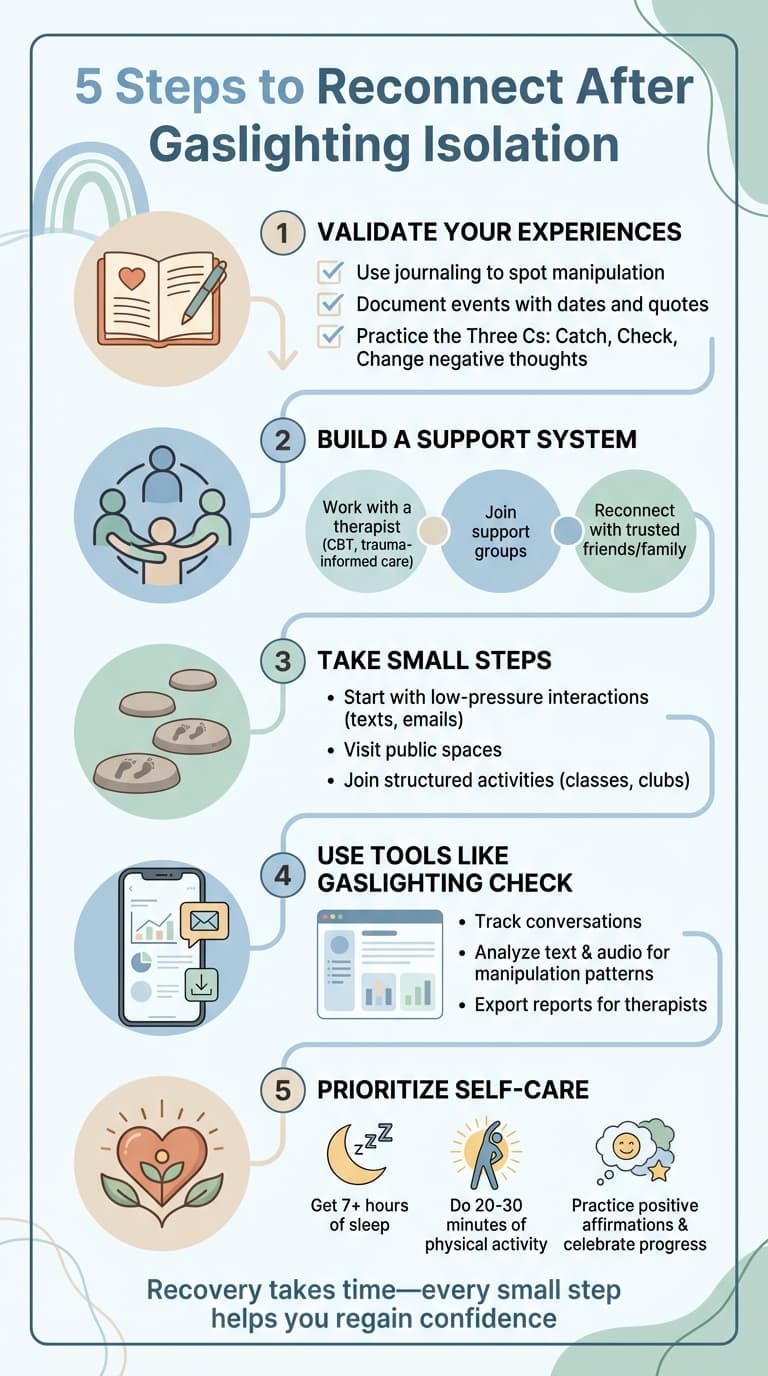
Gaslighting can leave you feeling isolated, doubting your reality, and disconnected from others. This guide offers practical steps to help you rebuild your sense of self and reconnect with supportive relationships:
- Validate Your Experiences: Journaling and self-reflection can help you recognize patterns of manipulation and rebuild trust in your instincts.
- Build a Support System: Work with therapists, join support groups, and reconnect with trusted friends or family members.
- Take Small Steps: Start with low-pressure interactions and gradually rebuild trust at your own pace.
- Use Tools Like Gaslighting Check: Track and analyze conversations to identify manipulation and regain confidence.
- Prioritize Self-Care: Focus on daily habits like sleep, physical activity, and positive affirmations to support emotional recovery.
Recovery takes time, but every small step helps you regain confidence and rebuild meaningful connections. You deserve relationships that respect and uplift you.
::: @figure
How to Combat GASLIGHTING: 10 Practical Tips
Acknowledge and Validate Your Experiences
Start by reconnecting with yourself. Gaslighting can shake your confidence in your own perceptions, leaving you unsure of what’s real. Trauma-informed therapist Amelia Kelley, Ph.D., explains:
"Gaslighting is most effective when it goes undetected, so awareness is key." [3]
This kind of manipulation can lead to what experts call "perspecticide" - a state where abuse makes you doubt your ability to trust your own thoughts and knowledge. When someone consistently denies your reality, it undermines your natural need for validation and chips away at your confidence. Over time, you might find yourself apologizing unnecessarily or struggling to make even simple decisions. Recognizing these patterns is the first step to rebuilding trust in your instincts.
A helpful way to regain clarity is by documenting your experiences in detail.
Use Journaling to Spot Manipulation
Keeping a journal can be a powerful tool. Write down events as they happen, including dates, times, and specific quotes from conversations. Using an "I said, they said" format can make it easier to track when your words are misrepresented or when the topic is suddenly shifted. Screenshots of texts and emails are also incredibly valuable - they provide concrete evidence you can refer back to when your memory is challenged. Additionally, note any moments when you felt particularly sensitive or triggered. Over time, these records can reveal patterns and help you identify manipulation tactics more clearly.
Stop Questioning Yourself
Beyond journaling, strengthening your internal dialogue is just as important. Your feelings are valid - they’re your mind’s way of signaling that something isn’t right. Jillian Williams, LISW-S, from Cleveland Clinic, describes the gaslighter’s intent:
"The goal is to make you feel responsible for what's happening... You begin to question your reality, who you are as a person and what you know to be true." [8]
To counter this, practice the "Three Cs": Catch negative thoughts, Check where they come from, and Change them into affirmations like, "My feelings are a natural response to being mistreated." When you feel the urge to seek validation from others, pause and trust your own instincts. If something doesn’t sit right with you, it probably isn’t. You don’t need anyone else’s approval to believe in your own experiences.
Create a Support System
As you work on reclaiming your sense of self, reconnecting with those who affirm your reality becomes essential. Gaslighting thrives in isolation. When you're cut off from friends and family, it becomes easier to rely solely on the abuser's version of reality:
"The more isolated you are from friends and family; the more effective gaslighting can feel." [1]
Breaking out of isolation isn't just about having company - it’s about reclaiming your independence and challenging the distorted truths gaslighting creates. Studies show that social support strengthens resilience, while isolation can lead to physical health issues like high blood pressure, weakened immunity, heart problems, and even cognitive decline [10].
Rebuilding connections doesn’t just provide comfort - it empowers you to regain confidence, rebuild self-worth, and face challenges with greater autonomy.
Work with a Therapist
Expanding your support network often starts with professional help. A therapist can act as an impartial guide, helping you navigate your options when you feel stuck. Stephanie A. Sarkis, Ph.D., highlights this role:
"MHPs are a neutral third-party that can help you see what options are available to you, especially when you feel 'stuck' after a breakup with a gaslighter/narcissist." [4]
Seek out therapists experienced in trauma, coercive control, or domestic abuse. Techniques like Cognitive Behavioral Therapy (CBT) and trauma-informed care are especially effective in addressing the anxiety and diminished self-esteem caused by prolonged gaslighting. If you feel your therapist downplays your experiences or lacks understanding of gaslighting dynamics, don’t hesitate to explore alternative providers. Online therapy platforms, with costs ranging from $40 to $90 per week, can also make professional help more accessible [9].
Join Support Groups
Finding others who’ve experienced gaslighting can be incredibly validating. Lisa Aronson Fontes, Ph.D., explains:
"Others who have experienced gaslighting will validate your experiences. People who have never experienced this form of abuse may brush it off as 'normal couple stuff.'" [5]
Support groups provide a safe environment to share coping strategies and learn about emotional and physical safety. Resources like GoodTherapy, 211, or Aunt Bertha can help you locate local or online groups focused on domestic violence. These peer connections are invaluable for countering "perspecticide" - the erosion of your ability to trust your own perceptions. As you engage with these groups, you’ll also find it easier to rebuild personal relationships.
Reconnect with Trusted Friends or Family
Use the clarity you’ve gained - perhaps through journaling or self-reflection - to identify the people in your life who consistently make you feel safe and valued. Think about past relationships that brought you comfort and authenticity. When you’re ready, reach out and share your experience honestly. Hotline advocate Eric explains:
"Expressing vulnerability, the feeling of being emotionally exposed, can bring you closer to others, and strengthen connections." [2]
Reach out however feels most comfortable - whether through a message, email, or letter - and let them know you want to reconnect. Even if they don’t fully understand the complexities of gaslighting, many loved ones will offer their support. Build a diverse support system by leaning on different people for different needs. At the same time, be cautious of "flying monkeys" - individuals who may unknowingly act on behalf of your abuser by relaying messages. Make it clear to your support network that you won’t accept any communication sent through intermediaries.
Rebuild Trust Through Gradual Reconnection
After enduring gaslighting, trusting others can feel like an uphill battle. It’s not because there’s anything wrong with you - it’s a natural response to protect yourself after being hurt. Rebuilding trust doesn’t mean diving into situations that make you uneasy. Instead, it’s about taking small, intentional steps in spaces where you feel secure. Gradual, positive experiences over time can help you regain confidence in your relationships. Now that you’ve reestablished a support network, you can focus on reconnecting with others in ways that feel manageable and safe.
Start with Small Interactions
Begin with brief, low-pressure interactions that let you set the pace. For instance, you could send a short text, email, or letter to someone you trust. A simple message like, "Just wanted to check in and say hi", opens the door without creating any expectations.
If one-on-one meetings feel overwhelming, consider spending time in public places where social pressure is minimal. You might visit a library, sit at a coffee shop, or attend a local event where you can be around others without the need for direct engagement. Another option is to join a structured activity, like a pottery class or a book club. These settings provide a shared focus, making it easier to connect with others in a relaxed way.
The goal is to take small, manageable steps while respecting your own boundaries. These gradual efforts allow you to rebuild trust at your own pace, helping you reconnect with others in a way that feels right for you.
Detect Manipulation in Conversations
Use AI-powered tools to analyze text and audio for gaslighting and manipulation patterns. Gain clarity, actionable insights, and support to navigate challenging relationships.
Start Analyzing NowUse Gaslighting Check to Build Confidence

Rebuilding trust in yourself can be challenging, but tools like Gaslighting Check are designed to help you validate your experiences and track your progress. By offering objective analysis of your interactions, this tool allows you to move forward with greater clarity and confidence. Here’s how Gaslighting Check can support your recovery journey.
Analyze Conversations with Gaslighting Check
Gaslighting Check uses AI to examine both text and audio for subtle manipulation tactics like reality distortion, blame-shifting, and emotional invalidation. You can paste emails or text messages directly into the tool to uncover patterns you may not have noticed. For audio, the platform analyzes tone and speech, identifying signs of manipulation that are easy to miss in the moment.
The real-time audio recording feature provides a verifiable account of your interactions, allowing you to compare your recollection with the analysis. Detailed reports highlight techniques such as denial, deflection, and projection, helping you recognize these tactics as they happen. You can also export these reports as PDFs to share with a therapist or counselor, integrating your insights into professional support.
Track Your Progress with Conversation History
With the Premium Plan ($9.99/month), you can access a conversation history tracking feature that helps you monitor recurring patterns over time. This tool allows you to see your progress - whether it’s through setting stronger boundaries, making healthier choices, or simply recognizing manipulation more quickly. Even when progress feels slow, tracking these changes offers reassurance that you’re moving in the right direction. It’s a bridge between self-awareness and professional guidance.
Your Privacy and Security Are Protected
Gaslighting Check prioritizes your privacy with end-to-end encryption and automatic data deletion policies. This ensures your sensitive information remains secure and inaccessible to anyone who might misuse it. Every feature is designed with privacy in mind, giving you a safe and secure environment to regain your confidence and control over your interactions.
Practice Self-Care to Support Emotional Recovery
Rebuilding social connections after experiencing gaslighting requires a strong foundation of personal well-being. When your self-worth has been eroded, reestablishing routines that nurture your recovery is not a luxury - it’s an essential step toward healing and regaining trust in yourself.
Build Healthy Daily Habits
Your physical health plays a key role in emotional recovery. Start with sleep - aim for at least 7 hours every night to support clear thinking and emotional balance [11]. To improve sleep quality, consider turning off electronic devices at least an hour before bedtime and creating a relaxing nighttime routine. Setting boundaries, like avoiding emails or messages late at night, can also help reduce anxiety [5].
Incorporating physical activity into your day is another powerful tool for recovery. Even 20 to 30 minutes of movement, like stretching, walking, or dancing, can make a difference. Activities like these help regulate mood by influencing neurotransmitters like serotonin and oxytocin [11][6]. You don’t need to hit the gym - simple, enjoyable activities are just as effective. Engaging in hobbies can also uplift your mood, with research linking them to reduced depression and even longer life spans [12].
To counteract negative self-talk, revisit the "Three Cs" method and turn harmful thoughts into positive affirmations. For example, remind yourself, “I am regaining my trust in myself” [5]. Create a "psychological first-aid kit" with go-to activities that recharge you, like taking a walk, practicing deep breathing, or calling a trusted friend. Use these tools whenever you feel triggered [7].
As you build these habits, take time to acknowledge your daily achievements - no matter how small.
Celebrate Your Progress
Every small step you take toward reconnecting is a milestone worth celebrating. Whether it’s sending a text to an old friend, making a virtual call, or simply stepping out for a coffee, these actions are meaningful strides in your recovery [2][6]. Eric, a Hotline Advocate at The National Domestic Violence Hotline, emphasizes:
"Every step towards limiting your isolation is a success - and should be treated as such" [2].
Consider keeping a gratitude journal where, once a week, you jot down specific people, places, or moments you’re thankful for [11]. Beyond documenting manipulation patterns, use this space to reflect on what you’ve gained through your journey - such as greater empathy, inner strength, or the ability to support others in similar situations [7].
Reconnecting with hobbies purely for the joy they bring can also help you rediscover your authentic self [4][7]. Additionally, volunteering for causes you care about can remind you of your value and the meaningful contributions you can make to your community [4].
Conclusion
Rebuilding your life after the isolating effects of gaslighting is a journey - one that unfolds gradually, not all at once. Along the way, you've discovered how tools like journaling can help validate your reality, how to rebuild trust with supportive people, how to set firm boundaries, and how self-care can nurture your emotional recovery. These steps are all about reclaiming the parts of yourself that may have felt lost.
Healing from gaslighting is rarely a straight line. It's perfectly normal to feel a mix of emotions as you move forward [4][5]. What truly counts is the effort you're making, no matter how small it may seem. Simple actions, like reaching out to an old friend, attending a support group, or even just acknowledging that the manipulation wasn’t your fault, are meaningful steps toward recovery. The goal is no longer convincing others of your truth - it's about trusting your own perceptions and surrounding yourself with people who value and uplift you. By doing this, and by maintaining clear boundaries, you're creating a space where genuine reconnection can thrive.
Patience and self-compassion will be your greatest allies on this path. As Lisa Aronson Fontes Ph.D. wisely puts it:
"Un-gaslighting takes time, patience, and self-compassion" [5].
The emotional habits and triggers left behind by gaslighting won't disappear overnight. But with every step forward, you're building the strength to recognize manipulation and protect your peace.
You are worthy of relationships that honor who you truly are. Take that first step today.
FAQs
How does journaling help identify gaslighting behaviors?
Journaling can be an incredibly effective way to recognize and understand gaslighting. It helps you keep track of your experiences, making it easier to spot patterns of emotional manipulation that might otherwise slip by unnoticed.
Start by jotting down conversations or incidents as soon as they happen. Include details like what was said, the tone of the interaction, and how it made you feel in the moment. Be as specific as possible - highlight contradictions, dismissive remarks, or instances that made you second-guess yourself. Over time, as you review your entries, you may notice recurring strategies such as denial, shifting blame, or attempts to make you doubt your memories or feelings.
This practice of documenting can bring clarity, helping you better identify gaslighting behaviors. It can also strengthen your confidence, empowering you to establish boundaries or seek the support you need.
What should I look for when trying to rebuild trust after gaslighting?
Rebuilding trust after experiencing gaslighting is a gradual process, but there are key behaviors that can signal progress:
- Acknowledging the past: Both individuals openly address the betrayal, discussing it honestly rather than avoiding or downplaying it.
- Encouraging open communication: Conversations become a safe space where both sides can share feelings, ask questions, and feel truly heard - without fear of blame or judgment.
- Taking responsibility with sincerity: The person who caused harm owns up to their actions, offers heartfelt apologies, and demonstrates a genuine effort to make meaningful changes.
When these actions are consistently present, they can be a sign that trust is slowly being rebuilt, paving the way for healthier and more supportive relationships.
How can Gaslighting Check help me recover from emotional manipulation?
Gaslighting Check can play a key role in your healing journey by helping you spot and understand patterns of emotional manipulation in your interactions. It offers clear insights that make it easier to identify gaslighting behaviors, rebuild trust in your instincts, and take meaningful steps toward reclaiming control over your life.
With tools like real-time conversation analysis and in-depth reports, Gaslighting Check equips you to collect evidence, strengthen your support system, and boost your confidence. Plus, its strong focus on privacy ensures that your personal data stays secure as you work through the recovery process.