10 Signs You Need Therapy After Gaslighting

10 Signs You Need Therapy After Gaslighting
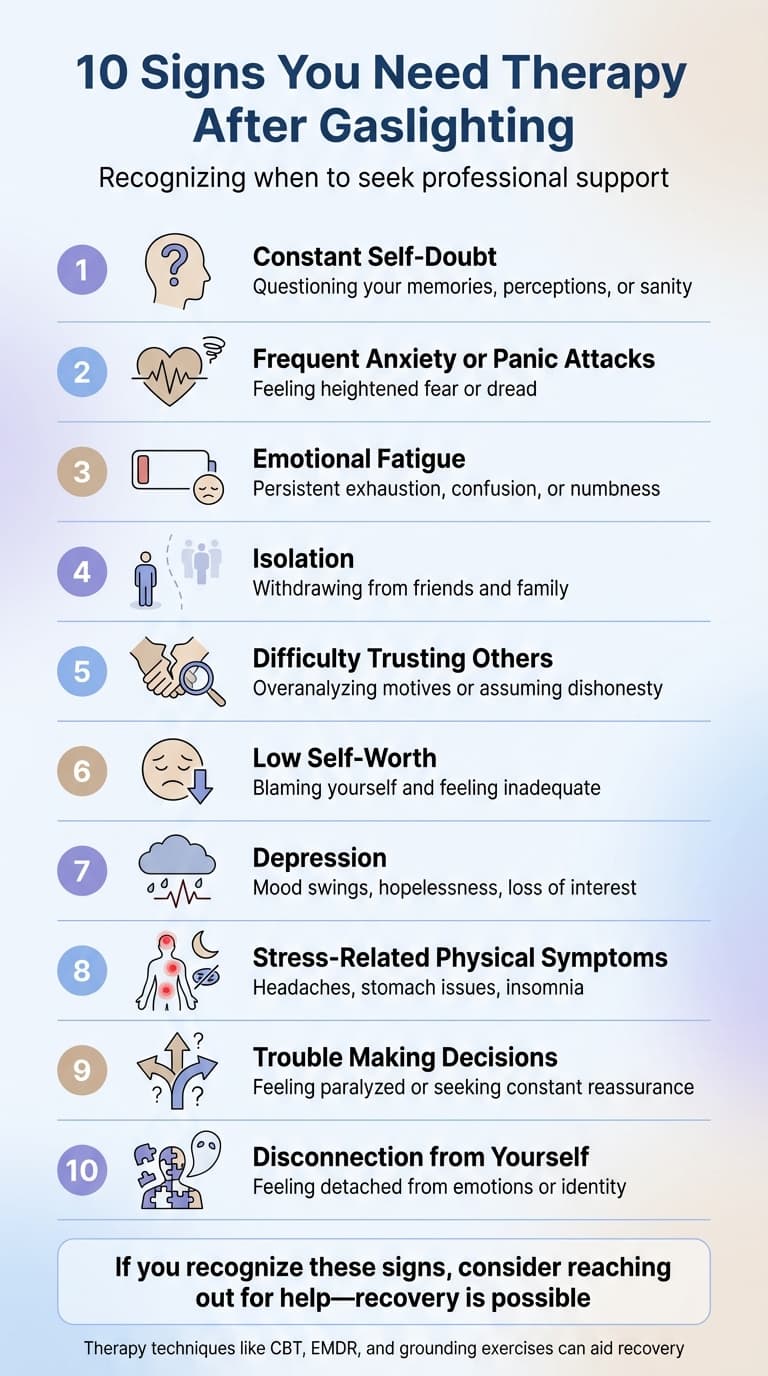
Gaslighting can deeply affect your mental health, leaving you doubting your reality and struggling with emotional wounds. Therapy is often necessary to help rebuild confidence, process trauma, and regain control over your life. Here are 10 key signs that suggest you might benefit from professional support:
- Constant Self-Doubt: Questioning your memories, perceptions, or sanity.
- Frequent Anxiety or Panic Attacks: Feeling heightened fear or dread.
- Emotional Fatigue: Persistent exhaustion, confusion, or numbness.
- Isolation: Withdrawing from friends and family due to shame or confusion.
- Difficulty Trusting Others: Overanalyzing motives or assuming dishonesty.
- Low Self-Worth: Blaming yourself for problems and feeling inadequate.
- Depression: Mood swings, hopelessness, or loss of interest in activities.
- Stress-Related Physical Symptoms: Headaches, stomach issues, or insomnia.
- Trouble Making Decisions: Feeling paralyzed or constantly seeking reassurance.
- Disconnection from Yourself: Feeling detached from your emotions or identity.
Therapy helps address these challenges by rebuilding self-trust, challenging distorted thoughts, and setting boundaries. Techniques like CBT, EMDR, and grounding exercises can aid recovery. Tools like Gaslighting Check can also support your healing by documenting manipulation and validating your experiences. If you recognize these signs, consider reaching out for help - recovery is possible.
::: @figure
How Can You Heal the Effects of Gaslighting with Dr. Kate Truitt
10 Signs You Need Therapy After Gaslighting
Understanding when to seek professional help is a vital step in the healing process. Gaslighting can leave profound psychological scars, and according to the American Psychological Association, therapy becomes essential when distressing issues dominate your thoughts weekly or disrupt your daily life [8].
The following signs highlight the emotional and mental toll gaslighting can take. If you recognize several of these in yourself, reaching out to a mental health professional can help you rebuild your confidence and regain control over your reality.
Sign 1: Constant Self-Doubt
You might find yourself questioning everything - your memories, perceptions, and even your sanity. This persistent self-doubt is a hallmark of gaslighting, often leading to "hazy memories" of conflicts or conversations because manipulation erodes your trust in your own recollection [3][10].
Dr. Peggy Loo explains this erosion of self-trust:
"When someone experiences gaslighting over time, they learn to mistrust or ignore their instincts, feelings and senses as valuable tools to use in their lives." [10]
This loss of self-trust develops gradually, making it harder to recognize until it feels overwhelming.
Sign 2: Frequent Anxiety or Panic Attacks
Long-term manipulation can heighten your alertness to threats, triggering chronic anxiety and even panic attacks [10]. You might feel a constant sense of dread or experience overwhelming fear in situations that remind you of the abuse. These feelings often stem from cognitive dissonance - trying to reconcile contradictory beliefs like "I know what happened" and "Maybe I imagined it" [2][6].
Sign 3: Feeling Emotionally Drained
The stress of gaslighting can leave you emotionally and physically exhausted. You may feel confused, isolated, or perpetually tired, even after sleeping well. Symptoms like headaches, nausea, and insomnia often accompany this state of emotional burnout [2][9][10]. Over time, you might feel emotionally numb or as if you're just going through the motions of life.
Sign 4: Withdrawing from Friends and Family
Gaslighting often leads victims to isolate themselves, either out of shame or because they don't know how to explain what they're experiencing. This withdrawal cuts off external validation, intensifying feelings of loneliness and confusion [3][9].
Sign 5: Trouble Trusting People
After enduring manipulation, trusting others can feel impossible. You might question people's motives, overanalyze conversations, or assume dishonesty even when there's no evidence. Psychotherapist Niro Feliciano describes this dynamic:
"Victims then begin to look to the abuser to confirm their perceptions." [6]
This cycle of seeking validation from the abuser can make it difficult to rebuild trust in yourself and others. Therapy can help distinguish between healthy skepticism and trauma-driven hypervigilance.
Sign 6: Low Self-Worth and Self-Blame
Gaslighting often leaves victims feeling flawed, overly sensitive, or even worthless [2][3]. You might find yourself taking responsibility for problems in the relationship while the abuser avoids accountability. This self-blame can persist long after the abuse ends, but therapy can help separate these distorted beliefs from your true sense of self-worth.
Sign 7: Depression and Unstable Moods
Prolonged gaslighting can lead to mood swings, hopelessness, and a loss of interest in things you once enjoyed. In severe cases, untreated depression can escalate to thoughts of self-harm or suicide [9]. Changes in sleep, appetite, or concentration are additional warning signs that professional help may be necessary.
Sign 8: Stress-Related Physical Symptoms
Chronic stress from gaslighting often shows up in physical ways. You might experience headaches, stomach problems, high blood pressure, or other unexplained symptoms [1][9]. Sleep disturbances and digestive issues are also common, fueled by a constant sense of unease [3][10]. Therapy can address these physical and psychological effects, helping your body and mind find balance again.
Sign 9: Difficulty Making Decisions
Gaslighting undermines your confidence in your own judgment, making even small decisions feel daunting. You might constantly seek reassurance, spend hours deliberating minor choices, or feel paralyzed by uncertainty [3][10]. Regaining trust in your decision-making is a critical part of recovery.
Sign 10: Feeling Disconnected from Yourself
Over time, gaslighting can leave you feeling detached from your emotions, instincts, and even your identity [10]. You might feel like you're watching your life from the outside or struggle to recognize the person you once were. Dr. Adrianna Holness captures this experience:
"Gaslighting is a form of psychological manipulation and emotional abuse where one person causes another to question their own reality, memory or perceptions." [10]
This disconnection is a sign of deep emotional harm. Therapy offers a safe space to reconnect with your feelings and rebuild the internal compass that gaslighting disrupts. Recognizing these signs is a powerful step toward reclaiming your sense of self and finding stability again.
How Therapy Helps with Gaslighting Recovery
Therapy plays a crucial role in helping individuals recover from gaslighting by replacing distorted narratives with a stronger sense of self. Isaac Smith, LMFT and Founder of Whole Wellness Therapy, explains, "Rebuilding trust, identity, and self-worth is a structured recovery process that requires conscious effort to replace the abuser's narratives with your own authentic voice" [11]. In therapy, you gain a safe and objective space to rebuild trust in your own perceptions. By challenging the manipulated stories planted by the abuser, therapy helps you reconstruct your reality on your terms.
Changing Distorted Thought Patterns
Gaslighting often leaves behind a trail of negative and distorted thought patterns, but therapy directly addresses these. Cognitive Behavioral Therapy (CBT) is particularly effective in targeting harmful beliefs such as "I am incompetent" or "I am unlovable." Through CBT, you learn to replace these damaging thoughts with more balanced and truthful self-assessments. A practical tool often used is thought-stopping, where you actively interrupt negative self-talk - like the internalized voice of your abuser - with a firm counter-statement, such as "Stop." Over time, this process helps rebuild your confidence and reveals how manipulation distorted your thinking.
Body-Based Trauma Processing
Gaslighting doesn’t just affect your mind - it impacts your body too. Techniques like Eye Movement Desensitization and Reprocessing (EMDR) help reprocess traumatic memories, reducing both their emotional and physical toll. Additionally, grounding techniques such as breathwork or focusing on sensory details can be incredibly helpful when you feel overwhelmed or disconnected, often described as feeling "crazy" [1][4]. These approaches work on trauma in ways that traditional talk therapy might not fully address, helping you reconnect with the present moment.
Learning to Set Boundaries
Gaslighting often erodes personal boundaries, but therapy can help restore them. Techniques from Dialectical Behavior Therapy (DBT) teach you how to assertively communicate and enforce healthy limits. For instance, you might practice responses like "I know what I experienced" or "My emotions are not up for debate" [12]. As Brené Brown wisely puts it, "Compassionate people ask for what they need. They say no when they need to, and when they say yes, they mean it" [13]. Learning to make decisions rooted in your values becomes a powerful step in protecting your emotional well-being and regaining control over your life.
Detect Manipulation in Conversations
Use AI-powered tools to analyze text and audio for gaslighting and manipulation patterns. Gain clarity, actionable insights, and support to navigate challenging relationships.
Start Analyzing NowUsing Gaslighting Check Alongside Therapy

Therapy offers structured support to help you heal from the effects of gaslighting, but combining it with documenting your experiences can significantly strengthen your recovery. That’s where Gaslighting Check comes in. It complements your therapy by providing a way to record and validate instances of manipulation. As trauma-informed therapist Amelia Kelley, Ph.D., explains, "Documentation can help ground your sense of reality and aid future decision-making about the relationship" [4]. When you find yourself doubting what happened or wondering if you’re "overreacting", having clear, tangible records can help you reconnect with your truth. This bridge between personal reflection and therapy reinforces your healing journey.
What Gaslighting Check Offers
Gaslighting Check is packed with tools designed to document manipulation in real time. For example, it enables real-time audio recording of conversations, giving you concrete evidence if someone later denies what was said. The platform also analyzes voice tone and text for potential manipulative tactics, generating detailed reports that highlight recurring patterns. Robin Stern, Ph.D., Co-founder of the Yale Center for Emotional Intelligence, emphasizes that "Sorting out the truth from the distortion can be a helpful step in turning off the gas" [5].
For those using the Premium Plan ($9.99/month), the conversation history tracking feature helps you spot recurring triggers and patterns over time. This kind of evidence can make it much harder for manipulation to go unnoticed or be dismissed [5].
How Gaslighting Check Enhances Therapy
Having documented evidence can make your therapy sessions more effective by providing concrete examples of manipulation, rather than relying solely on your memory, which may feel foggy or uncertain. The National Domestic Violence Hotline highlights the importance of proof, noting that "Seeing proof that it happened, validates your experience, challenges the effects of your partner's abuse, and can help you determine reality" [15].
Therapists can use these records to identify specific tactics of manipulation that may be difficult to articulate when you're overwhelmed. Cynthia Catchings, LCSW-S, points out that "The guidance of a therapist can accelerate the recovery process" [7]. Having detailed data about your relationship dynamics can make that guidance even more impactful [14][16]. Plus, with end-to-end encryption and automatic data deletion policies, Gaslighting Check ensures your information remains private and secure.
Conclusion: Starting Your Healing Journey
If you're grappling with persistent self-doubt, anxiety, emotional fatigue, or any of the other red flags we've discussed, reaching out for professional help is a crucial step toward reclaiming your sense of self. Gaslighting can leave deep psychological scars, making therapy an invaluable part of the healing process. Recognizing these signs is the first step to breaking free from the distorted narratives that may have clouded your reality. A therapist can offer a safe, supportive space to help you untangle your own thoughts from the manipulative ones imposed on you.
This isn’t an end - it’s the beginning of a journey toward rediscovering your inner strength. Recovery takes time because gaslighting often unfolds slowly, chipping away at your confidence over months or even years [2][17]. Therapy can help you rebuild your sense of self and silence the cycle of self-criticism.
In addition to therapy, tools like Gaslighting Check can be a powerful ally in your recovery. By providing tangible evidence - such as real-time audio recordings and detailed reports - these tools act as a reality anchor, especially when you find yourself doubting your experiences. The National Domestic Violence Hotline highlights the importance of this, stating: "Recovering from gaslighting... can be difficult to do; seeing proof that it happened, validates your experience, challenges the effects of your partner's abuse, and can help you determine reality" [15].
The first step is to acknowledge what you’ve been through and honor your feelings. Whether you choose to start with therapy, use Gaslighting Check to document your experiences, or combine both strategies, what matters most is taking that first step. Recovery is within your reach, and you deserve to trust yourself again. Begin now - seek therapy, document your experiences, and take back your truth.
FAQs
How does therapy help in recovering from the effects of gaslighting?
Therapy offers a supportive environment to unpack the emotional toll of gaslighting. Working with a skilled therapist, you can begin to identify and validate the manipulation you've endured - a crucial first step in the healing process. They can help you spot recurring patterns like self-doubt, guilt, or confusion, and reassure you that these reactions are normal responses to emotional abuse.
Beyond validation, therapy provides practical tools to aid your recovery. Techniques such as grounding exercises, strategies for managing emotions, and setting healthy boundaries can help you rebuild your confidence and safeguard against future manipulation. Evidence-based methods like cognitive-behavioral therapy (CBT) are particularly effective in reshaping negative thought patterns, easing anxiety, and reducing self-doubt. Combined with resources like Gaslighting Check, therapy can help you regain clarity, emotional stability, and a renewed sense of self.
How can Gaslighting Check support my therapy journey?
Using Gaslighting Check alongside therapy can provide powerful support in your healing journey. This platform lets you record and review conversations, helping you uncover patterns of emotional manipulation. By identifying these patterns, you gain validation for your experiences, while also equipping your therapist with clearer insights to offer more focused and effective guidance.
The platform's features, like detailed reports and conversation tracking, can shape the direction of therapy sessions and help you measure progress over time. With its commitment to privacy - using encrypted data and automatic deletion - you can feel safe documenting your experiences. Pairing therapy with this tool can help you rebuild confidence, restore trust in yourself, and take meaningful steps toward recovery.
What types of therapy can help you recover from gaslighting?
Recovering from gaslighting requires a focus on rebuilding your sense of self, emotional security, and understanding of reality. One effective approach is trauma-informed individual therapy, such as Cognitive Behavioral Therapy (CBT). This method helps challenge distorted thoughts while supporting the creation of healthier boundaries. Another option, trauma-focused therapies like Eye Movement Desensitization and Reprocessing (EMDR), can aid in processing and releasing lingering emotional stress.
In addition to individual therapy, group therapy or support groups offer a supportive environment where you can share your experiences, receive validation from peers, and explore healthier coping strategies. Choosing a licensed therapist who specializes in trauma or recovery from narcissistic abuse ensures that your treatment plan is tailored to your specific needs.