10 Signs of Cultural Gaslighting

10 Signs of Cultural Gaslighting
Gaslighting isn’t just personal - it can happen on a larger scale, affecting entire communities. Cultural gaslighting manipulates groups into doubting their shared experiences to maintain power and control. From dismissing emotions to rewriting history, these tactics are designed to undermine trust and reinforce systemic inequalities.
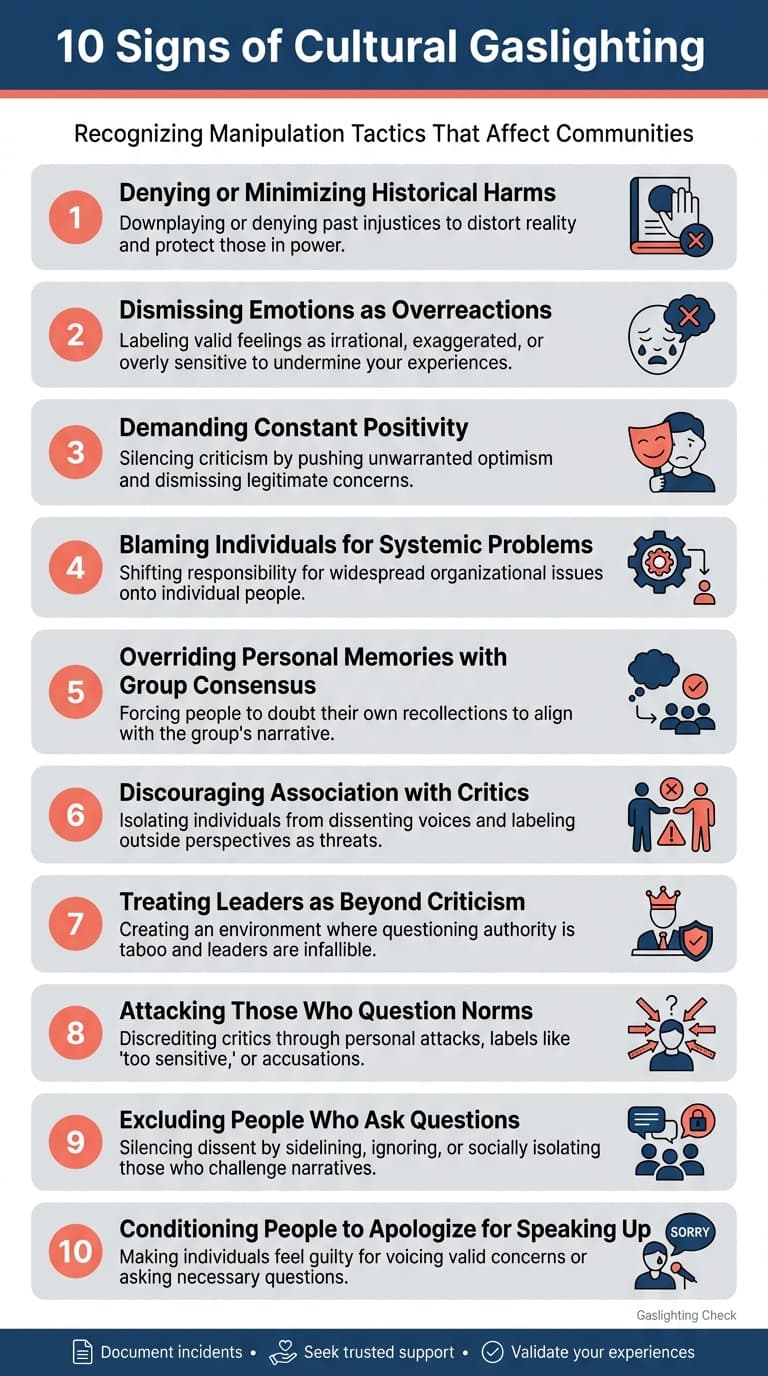
Here are 10 common signs of cultural gaslighting:
- Denying or minimizing historical harms: Downplaying or denying past injustices to distort reality.
- Dismissing emotions as overreactions: Labeling valid feelings as irrational or exaggerated.
- Demanding constant positivity: Silencing criticism by pushing unwarranted optimism.
- Blaming individuals for systemic problems: Shifting responsibility for widespread issues onto individuals.
- Overriding personal memories with group consensus: Forcing people to doubt their own recollections to align with the group.
- Discouraging association with critics: Isolating individuals from dissenting voices.
- Treating leaders as beyond criticism: Creating an environment where questioning authority is taboo.
- Attacking those who question norms: Discrediting critics through personal attacks or accusations.
- Excluding people who ask questions: Silencing dissent by sidelining those who challenge the narrative.
- Conditioning people to apologize for speaking up: Making individuals feel guilty for voicing concerns.
These behaviors erode confidence, distort reality, and protect those in power. To counteract them, document incidents, seek support from trusted individuals, and focus on validating your own experiences. Tools like Gaslighting Check can help identify patterns and provide evidence to challenge manipulative tactics. Protecting your perspective starts with recognizing these signs and trusting your instincts.
::: @figure
The roles of gaslighting and narcissism in racism
1. Denying or Minimizing Historical Harms
One of the most harmful forms of societal manipulation is when historical harms are downplayed or denied altogether. This tactic, often referred to as cultural gaslighting, creates collective doubt about well-documented events, ultimately serving the interests of those in positions of power. It shows up in both major public incidents and policy-making decisions.
Take the death of George Floyd in May 2020 as a clear example. Despite bystander footage showing an officer kneeling on Floyd’s neck for over nine minutes, some officials initially described his death as a "medical incident" or an accident, blatantly contradicting what millions had witnessed firsthand[6].
This same pattern extends beyond individual incidents to broader policy decisions. For instance, in September 2020, a U.S. executive order prohibited certain diversity training programs, dismissing discussions of systemic racism as "false beliefs" and "anti-American." Scholars Angelique Davis and Rose Ernst have identified such moves as deliberate attempts to deny well-documented truths about structural oppression[6]. These actions stand in stark contrast to public opinion: while 86% of Black Americans believe there hasn’t been enough progress toward racial equality, only 39% of white Americans share that view[6].
"Racial gaslighting is a process of distorting, minimizing or outright denying the racialized experiences of people of color to undermine their validity and shift the burden of responsibility to them." - Alice Ragland, Assistant Professor of Liberal Arts, Columbus College of Art and Design[7]
2. Dismissing Emotions as Overreactions
One common tactic in the broader strategy of cultural gaslighting is dismissing emotions as overreactions. Phrases like "You're too sensitive" or "You're overreacting" are often used to undermine your emotional experiences. By doing this, the gaslighter positions themselves as calm and rational while painting you as overly emotional or unstable. This shifts attention away from their harmful behavior and redirects it toward your reaction.
You might also hear comments like "Just let it go," "It's not that bad - other people have it so much harder than you," or "I was just kidding; you can't take a joke." These remarks are designed to make you question your feelings and instincts. Dr. Chivonna Childs, a psychologist at Cleveland Clinic, explains that this kind of manipulation leads you to "feel as if your feelings aren't valid, or that what you think is happening isn't really happening" [1].
Over time, repeated dismissal of your emotions can result in self-doubt and a tendency to invalidate your own experiences. Studies reveal that 74% of female domestic violence survivors report experiencing this type of emotional manipulation [4].
Gaslighters often disguise their dismissiveness as "rationality" or "common sense," implying that emotional responses are baseless or exaggerated. This tactic frequently exploits stereotypes, such as the outdated idea that femininity is inherently irrational, to reinforce power imbalances. Robin Stern, PhD, author of The Gaslight Effect, highlights the long-term impact of this behavior:
"Over time, you begin to believe that there is something wrong with you because one of the most important people in your life is telling you this" [4].
This behavior is a clear marker of cultural gaslighting, revealing how deeply ingrained and damaging these tactics can be.
To challenge this pattern, keep a record of specific incidents, noting details like dates, times, and the exact words used. When someone dismisses your feelings, address it directly by saying, "I am not being too sensitive; I am expressing a valid concern." Shift the focus to their actions instead of accepting empty apologies. Most importantly, remind yourself that your emotions are valid and do not require anyone else's approval. Recognizing and addressing this tactic is a crucial step in resisting cultural gaslighting.
3. Demanding Constant Positivity
Relentless positivity often serves as a mask for cultural gaslighting. When you speak up about discrimination, workplace misconduct, or systemic harm, you might encounter dismissive phrases like, "Why is everything so complicated with you?" or "Just be happy with what you have." These responses minimize your concerns, subtly shifting the blame onto you. This tactic not only invalidates your experiences but also deflects attention away from harmful behaviors, tying into larger systemic patterns.
In workplaces and medical environments, this forced optimism becomes a tool to silence valid grievances. For instance, whistle-blowers in toxic workplaces might be told they are "misinterpreting" situations or "overreacting" when reporting harassment or misconduct. Similarly, in medical settings, patients - particularly women and people of color - are often told they are "worrying too much" or that their symptoms are merely the result of stress or anxiety. Such dismissals can delay proper treatment. Physician and bioethicist Alyssa Burgart explains:
"If you're quickly diagnosed with anxiety, stress or another mental health condition, this may be gaslighting." [8]
Psychologist Heather Lyons highlights the broader impact:
"It's a denial of systems of oppression that turns the conversation from creating change to creating exhaustion." [10]
Writer and organizer Kris Nelson adds:
"It's our abusive and oppressive society that tries its best to steal our imagination from us so that we can't dream of something better." [9]
These insights reveal how enforced positivity stifles legitimate critiques and maintains harmful systems.
Over time, the demand for constant positivity can lead to self-doubt, making you question the validity of your concerns. This internalized doubt works to uphold the status quo, as you may begin to view your reality as less credible or even shameful.
To push back against this pattern, keep a record of specific instances where your concerns are dismissed. Note dates, exact phrases, and the context of these interactions. When faced with dismissive comments like "just be happy", try redirecting the conversation with a firm response, such as, "I'm raising a concern that needs to be addressed." Discuss your experiences with trusted peers who can provide objective support. Remember, constructive criticism is a vital tool for identifying and addressing real issues.
4. Blaming Individuals for System-Wide Problems
When institutions encounter systemic problems, they often shift the blame onto individuals instead of addressing the root causes. This tactic, known as blame-shifting gaslighting, serves to protect the organization's image and authority by making individuals feel solely responsible for widespread issues [4]. A common example is workplace burnout. Instead of tackling toxic leadership or unmanageable workloads, companies often offer "resilience training", subtly framing the problem as a lack of personal strength rather than an organizational failure [12]. This strategy not only deflects accountability but also lays the groundwork for further personal gaslighting.
In such environments, whistle-blowers frequently face accusations of "overreacting" or "misremembering" when they report serious issues like sexual harassment or misconduct [4]. To further discredit individuals, organizations sometimes collaborate with media outlets to cast those who speak out as troublemakers, diverting attention from the institution's flaws. Meghan, Duchess of Sussex, described her experience poignantly:
"I wasn't being thrown to the wolves. I was being fed to the wolves" [11].
These practices not only shield the institution but also chip away at an individual's confidence and sense of reality.
Repeatedly being blamed for systemic issues can wear down self-trust. Robin Stern, PhD, explains:
"Over time, you begin to believe that there is something wrong with you because one of the most important people in your life is telling you this" [13].
This erosion of self-belief often leads to chronic anxiety, depression, and a sense of alienation in one's workplace or community [13][14].
To counteract this, document specific incidents, noting dates and details. When faced with someone reframing a systemic issue as your personal shortcoming, respond assertively: "This is a structural concern that impacts many people." Seek out trusted colleagues for support. As Chivonna Childs, PhD, a psychologist at Cleveland Clinic, emphasizes:
"Gaslighting is a form of projection, particularly when the perpetrator is called out on their actions. This allows them to deflect and blame others" [1].
5. Overriding Personal Memories with Group Consensus
When your own memories clash with the group's version of events, you're left with a tough decision: do you trust yourself or the collective? This phenomenon, where personal recollections are overridden by group consensus, is a key strategy in cultural gaslighting. It’s designed to enforce conformity and submission. The internal conflict this creates often leads to cognitive dissonance, compelling individuals to align with the group's reality instead of their own [2]. In tightly controlled settings, members are trained to "reality-check upwards", meaning they defer to leaders for the "correct" version of events. This ensures that the leader’s narrative always dominates [15]. Such group dynamics pave the way for even deeper manipulation, as we’ll see in the following example.
In January 2025, Daniel Barban Levin shared his harrowing experience in the so-called "Sarah Lawrence Cult", led by Larry Ray. Despite initially believing he was resistant to manipulation, Levin recounted how the group dynamic steadily dismantled his ability to trust his own judgment. It wasn’t until he left that he fully grasped the depth of the manipulation he had endured [15]. Robin Stern, PhD, Co-founder of the Yale Center for Emotional Intelligence, sheds light on this process:
"Gaslighting is the glue, the interpersonal dynamic that underpins cults as well as many other systems in which one person seeks to control others" [15].
Over time, this kind of pressure can lead you to question and dismiss your own instincts before any external interference even occurs [2]. Groups often go a step further by isolating you from neutral voices, like family or friends, labeling them as "biased" or accusing them of "putting ideas in your head." This isolation strips away the external validation you need to trust your own memories [2][16]. Research underscores the prevalence of these tactics: over 85% of survivors of intimate partner violence report encountering gaslighting behaviors [18]. In fact, interest in understanding gaslighting surged, with web searches for the term increasing by 1,740% in 2022 [17].
So, how can you protect yourself in such situations? Start by documenting everything. Write down details as soon as possible to counter the "maybe I imagined it" doubt [2]. Save screenshots of messages and emails to create an undeniable record of events. It’s also crucial to stay connected with someone outside the group - a therapist or a long-term friend - who can help you validate your experiences [16]. These steps are vital in reclaiming your sense of reality when facing cultural gaslighting.
Pay attention to physical cues during group interactions as well. Signs like a racing heart, tense stomach, or trembling hands might indicate that your reality is being tampered with [2]. As Keeley Teemsma, LCSW, MA, emphasizes:
"The antidote to gaslighting isn't just leaving the relationship - it's rebuilding your sense of what's true" [2].
6. Discouraging Association with Critics
When a group or system actively works to isolate you from dissenting voices, it could be a case of cultural gaslighting. This manipulation strategy thrives on separating you from people who might offer alternative perspectives or help you recognize what's really happening. Critics are often labeled as threats to the existing power structure, leading to their voices being discredited or outright ignored. These tactics become more evident when examining the specific methods gaslighters use.
Gaslighters often resort to moves like accusing your friends or family of "putting ideas in your head" or spreading rumors designed to create distrust. These actions divert attention away from their behavior. In more extreme cases, they might give you the "cold shoulder", issue threats, or even enforce social exclusion as punishment for associating with outsiders.
Robin Stern, Ph.D., Co-founder of the Yale Center for Emotional Intelligence, sheds light on this dynamic:
"If you have friends, loved ones, or colleagues who are in the same position as you and with the same level of power, ask them if they feel safe - if their experience is similar to yours. This is not the same as reality-checking upwards." [15]
In tightly controlled systems, individuals are often conditioned to seek truth only from leaders (vertical checking) rather than from peers (lateral checking). This approach discourages dissent and reinforces conformity. If someone pressures you to cut ties with trusted friends or family, it’s a sign to hold onto those relationships firmly. Research supports this, showing that 74% of women who have experienced domestic violence report being gaslighted by their partner or ex-partner, frequently through isolation tactics [4]. Any enforced separation from loved ones or an inability to disengage should be seen as a glaring red flag.
Detect Manipulation in Conversations
Use AI-powered tools to analyze text and audio for gaslighting and manipulation patterns. Gain clarity, actionable insights, and support to navigate challenging relationships.
Start Analyzing Now7. Treating Leaders as Beyond Criticism
When leaders present themselves as infallible, they create an atmosphere where questioning their authority or perspective becomes taboo. This behavior is a defining feature of cultural gaslighting, a tactic used to maintain tight control over how reality is perceived within a group or organization.
By projecting absolute certainty, these leaders effectively dictate the group's reality, leaving followers doubting their own observations and instincts [20]. Apologies for mistakes are rare, if they happen at all. Instead, such leaders often rewrite past events to shift blame onto those who challenge them [1]. When confronted, they use deflection strategies to divert attention away from their actions, redirecting scrutiny elsewhere [1]. This deflection doesn’t just affect individuals - it ripples out to shape organizational culture, undermining accountability on a larger scale.
The consequences of this behavior are stark and quantifiable. Leaders under intense performance pressure are 40% more likely to manipulate or deny past communications to retain control [22]. In organizations where employees hesitate to challenge leadership - so-called "low-voice" cultures - turnover rates can be as much as 20% higher [22]. Additionally, gaslighting behaviors are linked to a 30% rise in employee disengagement, which contributes to an estimated $450–550 billion in lost productivity annually in the U.S. [22].
Psychological experts shed light on the dynamics at play. Meaghan Rice, Doctor of Psychology (PsyD.), explains:
"Gaslighting, historically, is used to establish dominance. This is a key feature of someone who struggles with narcissistic personality disorder because the security of their lens depends on the other party being wrong" [21].
Robin Stern, Ph.D., from the Yale Center for Emotional Intelligence, offers a similar perspective:
"The gaslighter needs to be right to preserve their own sense of self and to keep a sense of power in the relationship" [20].
If you find yourself in such an environment, one way to push back against this power imbalance is to document your interactions meticulously. Keep notes with dates and screenshots, and seek validation from peers instead of relying on the leader’s inner circle. This approach can help you maintain clarity and protect yourself from manipulative tactics [1][15].
8. Attacking Those Who Question Norms
When someone challenges the status quo, the response often bypasses thoughtful discussion and shifts straight to personal attacks. Critics are quickly dismissed as being "too sensitive", "irrational", or "overreacting", effectively minimizing their valid concerns and undermining their credibility [4]. These tactics can range from subtle to outright aggressive.
The methods vary. Some may subtly suggest that you're "misremembering" or "misinterpreting" events. Others might confront you with statements like, "Why would you even question this? I wouldn't lie to you!" [19]. The underlying aim is clear: to plant seeds of self-doubt and discourage further questioning.
Paige L. Sweet, a researcher at Harvard, sheds light on the dynamics at play:
"Gaslighting could not exist without inequities in the distribution of social, political, and economic power" [4].
Psychologist Chivonna Childs offers an analogy for these tactics:
"It's like a magic trick: They make you look to the left so you don't see what's going on to the right" [1].
This pattern is particularly evident in how dominant groups discredit dissent. Critics are often labeled as "crazy", "delusional", or "abnormal", a tactic designed to silence opposition [6]. Sophie Williams, an author and activist, highlights how this plays out in racial contexts:
"Racial gaslighting is a way of maintaining a pro‑white/anti‑black balance in society by labelling those that challenge acts of racism as psychologically abnormal" [6].
Similarly, stereotypes about women being "overly emotional" are frequently weaponized to dismiss their valid feelings and lived experiences [6].
If you find yourself on the receiving end of such attacks, take proactive steps to protect your perspective. Document interactions with specific dates and details, cross-check the facts with trusted sources, and focus on the behavior of the person attacking rather than their words [4].
9. Excluding People Who Ask Questions
Ever notice how asking tough questions can leave you feeling sidelined? Instead of addressing your concerns, the group might start ignoring your comments, engaging with you less, or even cutting back on invitations - all without a clear explanation.
This kind of exclusion shows up in different ways. In online spaces, it might look like shadowbanning. In conversations, it could mean dismissing your experiences by questioning their validity - what's known as epistemic injustice. Or, maybe people abruptly change the subject, leaving you unheard and sidelined [23]. This isolation isn't random; it's a way to discourage questioning and keep you aligned with the group's narrative. It ties back to the broader patterns of gaslighting we've discussed, creating a dynamic where you're left dependent on the group's version of reality.
Robin Stern, Ph.D., Co-founder of the Yale Center for Emotional Intelligence, sums it up perfectly:
"Gaslighting is the glue, the interpersonal dynamic that underpins cults as well as many other systems in which one person seeks to control others." [15]
The goal of this isolation is clear: dependency. Groups often discourage "lateral reality-checking", meaning they don't want you comparing notes with peers. Instead, they push the idea that all truth comes from leadership [15]. A striking example of this was the UK Post Office scandal. Postmasters were deliberately isolated to hide systemic software failures. The fallout was devastating - 67% of those wrongfully accused reported PTSD symptoms, and 60% experienced depression [23].
To protect yourself, stay connected with people who can offer objective perspectives, like friends, family, or trusted peers [5][15]. Pay attention to patterns of exclusion. Are your questions being ignored? Have invitations suddenly stopped? Do conversations veer away from your concerns? [1] If you're being penalized for asking honest questions, that's a reflection of the group - not you.
10. Conditioning People to Apologize for Speaking Up
Conditioning people to apologize for speaking up is a subtle yet deeply ingrained tactic. Cultural gaslighting often pushes individuals to feel guilty for voicing valid concerns or asking necessary questions. This manipulative approach reframes dissent as a breach of etiquette, making an apology feel like the "right" thing to do, even when the situation calls for open, honest dialogue.
When you express a concern, you might be labeled as "too sensitive", "dramatic", or "not a team player." These labels shift the focus away from the issue itself and onto your character. Over time, this can lead to a troubling habit: apologizing before you even speak. This preemptive apology is often a trauma response, a way to maintain peace in an environment that feels emotionally unsafe [24].
"Over-apologizing isn't a personal flaw. It's often a trauma response. If work has made you feel like you're always in trouble - or always almost in trouble - it makes total sense that your nervous system would default to keeping the peace." [24]
This behavior doesn't just chip away at your confidence; it reinforces unhealthy coping mechanisms. Dr. Daniel S. Lobel, a clinical psychologist, explains the damaging cycle:
"Frequent apologizing is a coping mechanism developed to avoid punishment or gaslighting by taking the blame without protest. While the proactive taking of blame might mitigate punishment in some circumstances, it does so at the cost of retraumatization." [25]
This pattern can also lead to what Keeley Teemsma, LCSW, refers to as internalizing gaslighting. This occurs when you start to self-censor and doubt your own emotions [2]. On top of that, you might encounter dismissive or insincere apologies like, "I'm sorry you feel that way", which subtly imply that your feelings - not the other person's behavior - are the real issue [3].
To break free from this cycle, start by auditing your apologies. Keep track of how often you say "sorry" unnecessarily and work on replacing those apologies with neutral, assertive statements. For example, instead of apologizing, you could say, "I remember it differently; let's review the details" [24][25]. Keeping a log of conversations can also help preserve your perspective. If someone dismisses your valid concerns as "emotional" while framing their own as "rational", document those moments [2]. This kind of documentation is a powerful tool for recognizing and countering cultural gaslighting in the long run.
How Gaslighting Check Identifies These Patterns

Gaslighting Check leverages advanced technology to uncover manipulative behaviors, complementing the 10 signs of cultural gaslighting mentioned earlier. By combining text analysis, voice analysis, and real-time recording, the platform identifies subtle patterns that are often overlooked or dismissed. This approach transforms subjective experiences into objective evidence, addressing a key challenge in understanding cultural gaslighting.
The platform's text analysis uses sophisticated language models to spot tactics like reality distortion, shifting blame, and phrases such as "You're too sensitive" or "Everyone else understands this..." It also identifies strategies rooted in group dynamics, such as appeals to consensus or exploiting social hierarchies. When ambiguous language is used to pressure compliance, the system flags these manipulative techniques, especially those that limit your choices to misleading or false options.
Voice analysis adds another layer by examining pitch and frequency through neural networks. This reveals emotions like anger, fear, or disgust, which can expose vocal discrediting - when someone's tone undermines their words or subtly attacks your credibility during a conversation.
The platform generates detailed reports that validate your experiences with concrete evidence. These reports break down coercive language, track recurring behaviors, and highlight systemic patterns of manipulation. This documentation is invaluable when setting boundaries or presenting evidence to HR or trusted individuals. By linking these findings to the 10 signs of gaslighting, the reports help you recognize and address manipulative behaviors as they happen.
To ensure your privacy, Gaslighting Check uses end-to-end encryption and automatic data deletion. This secure documentation process empowers you to confront cultural gaslighting confidently and reclaim control over your reality.
Conclusion: Protecting Yourself from Cultural Gaslighting
Cultural gaslighting operates through tactics like denying historical wrongs, invalidating emotions, forcing unwarranted positivity, blaming individuals for systemic problems, rewriting personal memories, discouraging dissent, shielding authority figures, attacking critics, excluding curious voices, and pressuring apologies for speaking out. These behaviors undermine self-trust and help maintain harmful systems.
The key to protecting yourself starts with awareness. If you're constantly doubting yourself or second-guessing your experiences, it’s not a personal flaw - it’s often a sign of manipulation. As Dr. Chivonna Childs from Cleveland Clinic explains:
"Gaslighting is a form of emotional manipulation to make you feel as if your feelings aren't valid, or that what you think is happening isn't really happening" [1].
Take note if you find yourself apologizing unnecessarily - this can be a warning sign of external manipulation.
One practical step is to document your reality. Keep a secure, password-protected log of dates, conversations, and events, and save screenshots of relevant digital communications. This creates a record that can help counter attempts to distort the truth.
For additional support, tools like Gaslighting Check can help. By analyzing text and voice patterns, it identifies gaslighting behaviors and provides detailed reports. These insights can help you establish boundaries or seek assistance when needed.
Another crucial strategy is building a network of trusted individuals. Share your experiences with friends, family, or colleagues who can affirm your perspective. Having others validate your feelings helps resist the pressure to conform to manipulated narratives. As author Allison Fallon reminds us:
"No one gets to decide what your experience or your feelings are to a certain situation" [26].
Ultimately, trusting your own perceptions is essential for safeguarding your mental well-being and maintaining your sense of autonomy.
FAQs
What are the signs that I might be experiencing cultural gaslighting?
Cultural gaslighting happens when societal systems, institutions, or dominant groups deny or distort the realities of marginalized communities. You might recognize it in patterns like dismissing historical wrongs, misrepresenting your group’s experiences in media or data, or making you doubt your own memories because the larger culture insists events "never happened" or were "blown out of proportion."
This form of gaslighting works much like the individual kind - it can make you question your feelings or even your sanity. For instance, you might start doubting your own recollection of events, feel like your emotions are "too much", or hear so-called experts downplay systemic problems while shifting blame onto marginalized groups. When these behaviors show up consistently across institutions - whether in schools, workplaces, media, or public policies - they point to a clear case of cultural gaslighting.
One way to push back is by documenting specific examples and comparing them to the larger cultural narratives. This process can help you spot the patterns and reclaim your perspective and truth.
What are the best ways to recognize and respond to cultural gaslighting?
To push back against cultural gaslighting, the first step is to trust your own experiences. Start by keeping a detailed record of important conversations, dates, and events - this can serve as a solid reference if someone tries to deny or twist the truth. Establish firm boundaries about behaviors you won’t accept, and make sure to back them up with consistent actions. It’s also helpful to lean on trusted friends, mentors, or mental health professionals who can affirm your experiences and provide support.
On a broader level, cultural gaslighting is often rooted in systemic power imbalances. Raising awareness is crucial - this might involve community education, hosting workshops, or launching public campaigns to shed light on these patterns. Advocating for policy changes, like stronger workplace protections or fairer resource allocation, can also target the deeper issues at play. By combining personal efforts with collective action, it’s possible to challenge manipulation and encourage cultural environments that are healthier and more inclusive.
Why is it important to keep a record of cultural gaslighting incidents?
Keeping a record of cultural gaslighting incidents is essential because it provides a reliable account of events, countering attempts to twist or deny the truth. Whether through written notes, audio recordings, or other methods, documenting these experiences helps affirm your memories and guards against accusations that you're exaggerating or misremembering. This can be particularly valuable when seeking support, reporting abuse, or taking legal action.
On a larger scale, tracking these patterns sheds light on the systemic nature of cultural gaslighting. Sharing personal stories can make it easier to illustrate how societal systems marginalize specific groups, such as women of color or Indigenous communities. This kind of evidence is critical for driving meaningful policy reform and addressing the underlying causes of these harmful practices.
Tools like Gaslighting Check make this process more accessible by offering features like real-time audio recording, text and voice analysis, and secure storage. These tools not only help gather reliable evidence but also protect your privacy, giving you the power to challenge manipulation and reclaim your story.