
How to Respond to Guilt-Inducing Manipulation
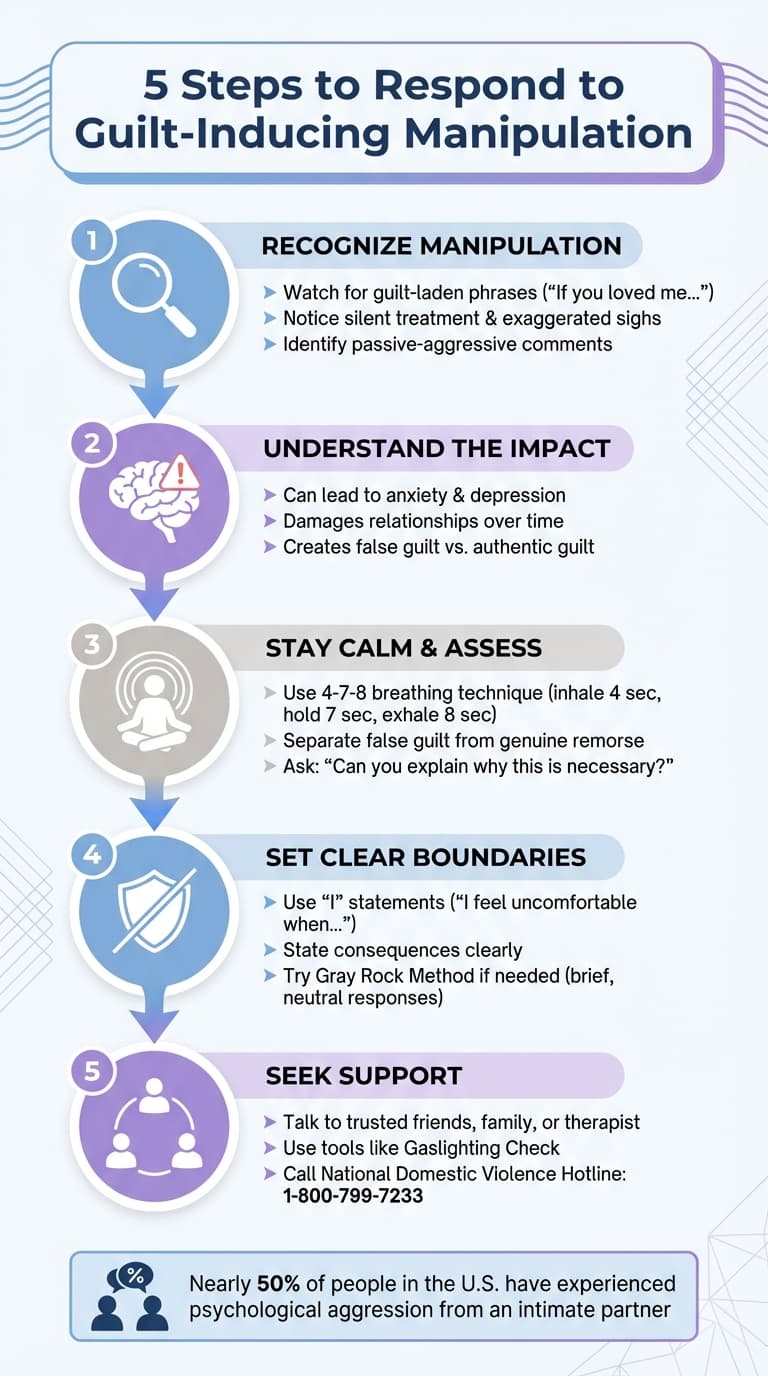
Dealing with guilt-inducing manipulation can be emotionally draining and harmful to your mental health. This type of manipulation, often called guilt-tripping, works by provoking feelings of shame, regret, or responsibility to control your actions. It’s common in relationships, workplaces, and family dynamics, often hidden behind passive-aggressive comments or non-verbal cues. Here’s how to handle it effectively:
- Recognize Manipulation: Look for red flags like guilt-laden phrases (“If you loved me, you’d do this”) or behaviors like silent treatment and exaggerated sighs.
- Understand the Impact: Long-term guilt manipulation can lead to anxiety, depression, and strained relationships.
- Respond Strategically: Stay calm, assess the situation, and separate false guilt from genuine remorse. Use breathing techniques to regain control.
- Set Boundaries: Use clear “I” statements to express your discomfort and outline consequences if manipulation continues.
- Seek Support: Turn to trusted friends, family, or therapists to validate your feelings and gain perspective.
Tools like Gaslighting Check can help you identify manipulation in real-time, offering insights and actionable advice. Remember, setting boundaries and prioritizing your well-being is key to maintaining healthy relationships.
::: @figure
How to Spot a GUILT TRIP! - 6 Signs of Emotional Manipulation & Guilt Tripping (& how to stop it)
What Is Guilt-Inducing Manipulation?
Guilt-inducing manipulation - commonly referred to as a "guilt trip" - is a tactic where someone manipulates another's emotions to provoke guilt, remorse, or shame, ultimately steering their behavior or decisions. Liza Gold, Social Worker and Founder/Director of Gold Therapy NYC, explains:
A guilt trip is best defined as the intentional manipulation of another person's emotions to induce feelings of guilt [4].
This approach preys on our natural dislike for guilt and fear of letting others down, often making us feel responsible for someone else's happiness. It’s frequently linked to passive-aggressive tendencies, especially in people who struggle to express their needs openly or grew up in environments where direct communication was discouraged. Over time, constant guilt can worsen anxiety, depression, and obsessive thoughts. Repeated guilt-tripping not only damages intimacy but can also lead to deeper emotional harm. When guilt morphs into shame, it can erode self-esteem and foster social withdrawal [4].
Common Signs to Watch For
Understanding guilt manipulation makes it easier to spot the warning signs. Pay attention to phrases like, "If you really loved me, you’d do this" or "After everything I’ve done for you, you can’t do this one thing?" Manipulators often bring up unrelated past mistakes to gain leverage or claim moral superiority. Non-verbal cues - such as the silent treatment, exaggerated sighs, crossed arms, or glaring - can signal manipulation disguised as communication. You might also hear remarks like, "I guess I’ll just do it myself since no one else will." Additionally, sweeping statements like "You always..." or "You never..." can distort reality, leaving you feeling inadequate or at fault.
Examples in Relationships and Workplaces
Guilt trips can show up in many areas of life, but they are particularly common in personal relationships and professional environments.
In romantic relationships, guilt might be used to sway decisions. For example, if you cancel plans, a partner might say, "I know you’re always too busy for me. I guess I’ll just eat alone," turning a legitimate boundary into a guilt-inducing comment.
Family dynamics are another common setting for guilt manipulation. A parent might say, "After everything I’ve done for you, you can’t do this one small thing for me?" Or an uncle might quip, "Did you forget where we live?" These remarks avoid direct communication and instead pressure you into compliance.
Workplaces are not immune to guilt tactics either. A colleague might imply you owe them a favor to get you to stay late, or a manager might suggest, "Because I provide you with a paycheck, you should take on this extra task," even if it falls outside your role. Even subtle actions - like a teammate’s frequent sighs or eye rubbing - can be attempts to make you feel guilty. These examples highlight how guilt manipulation can creep into all kinds of relationships.
Relationship therapist Amelia Kelley, PhD, offers a critical insight:
The narcissists and emotional abusers will use guilt as a gaslighting tactic to make their target take responsibility even if they are not at fault [1].
How to Recognize Guilt-Inducing Tactics
Warning Signs to Watch For
The first step in protecting yourself from manipulation is learning to spot it in real time. Passive-aggressive communication is a major red flag. This might show up as sarcastic comments, a disapproving tone, glaring looks, or exaggerated sighs that signal dissatisfaction without direct confrontation [1][4][6]. Another common tactic is the silent treatment, where someone deliberately ignores you to create anxiety and pressure you into apologizing [1][9].
Look out for behaviors like playing the victim or martyr. Manipulators often act wounded, suggesting they are the only ones suffering. Phrases like "I'll just do it myself" are designed to make you feel guilty and neglectful [5][6][9]. Similarly, reminders of past favors can be used to exploit your sense of obligation, leaving you feeling indebted [1][4][5].
A helpful way to distinguish manipulation from genuine disappointment is by focusing on the communication style. Authentic disappointment is often expressed through direct "I" statements, such as, "I feel sad we missed our dinner." Manipulation, on the other hand, tends to be indirect, with comments like, "I guess I'm just not a priority to you" [6]. Genuine expressions also respect your ability to set boundaries, while manipulative responses may punish you with emotional withdrawal or silence when you assert yourself [1][3].
Recognizing these behaviors is essential, as they not only disrupt communication but can also take a serious emotional toll.
The Emotional Impact on You
Once you identify these manipulative tactics, their effects on your well-being become clearer. Guilt-based manipulation can significantly harm both your mental and physical health. It often fosters feelings of inadequacy and self-doubt, which can lead to heightened anxiety or even depression [1][4][10]. A 2010 study highlighted how prolonged, manufactured guilt can worsen symptoms of depression, anxiety, and obsessive-compulsive disorder (OCD) [1][4].
The stress might also manifest physically, with symptoms like a sinking feeling in your stomach, tension in your neck, or overwhelming fatigue [3][10]. Positive Psychology Coach Valorie Burton explains:
False guilt is the feeling you've done something wrong even though you haven't actually done something wrong [3].
These emotional and physical responses can cause you to over-apologize, constantly justify your actions, or even avoid the manipulator entirely. Over time, this behavior chips away at your self-esteem. Understanding these impacts highlights why setting firm boundaries is so important - a topic we’ll delve into in the next section.
How to Respond Effectively
Stay Calm and Assess the Situation
When someone uses guilt to manipulate you, the first step is to pause and take a moment before reacting. Building on the idea of recognizing manipulation, this brief pause allows you to regain control of your emotions. A helpful technique is the 4-7-8 breathing exercise: inhale for 4 seconds, hold for 7 seconds, and exhale for 8 seconds. This practice engages your parasympathetic nervous system, helping you avoid an emotional overreaction.
Pay attention to physical signs of stress - tight shoulders, a racing heart, or a sinking feeling in your stomach. These signals are your body’s way of telling you to take a step back. You can even request time to think by saying something like, "I need a moment to process this." This creates space to evaluate the situation with a clear head, ensuring you don’t make a hasty decision you’ll regret later.
It’s also important to differentiate between authentic guilt and false guilt. Positive Psychology Coach Valorie Burton explains:
Authentic guilt is an inner compass. When we use it wisely, it helps us make choices we won't regret later [3].
If you haven’t done anything wrong, what you’re feeling might be false guilt - a tactic often used to control behavior. To clarify the situation, ask questions like, "Can you explain why this is necessary?" This encourages the other person to justify their request, which might reveal their intentions. Recognizing these dynamics helps you separate your self-worth from manipulative guilt.
Separate the Guilt from Yourself
It’s crucial to remember that the guilt being directed at you says more about the other person’s communication style than it does about you. Liza Gold, a social worker and founder of Gold Therapy NYC, explains:
Guilt-tripping is a natural form of passive-aggression that people resort to when they don't have the skills or language to assertively communicate their needs or feelings [4].
Understanding this allows you to see manipulation for what it is - a reflection of their limitations, not your flaws.
Treat your feelings as signals rather than definitive judgments. Just because you feel guilty doesn’t mean you’ve done something wrong. To gain perspective, imagine what advice you’d give a friend in your situation. Journaling can also help validate your experiences and make sense of your emotions.
It’s equally important to remind yourself that you’re not responsible for fixing other people’s emotions. While you can acknowledge and empathize with their feelings, you don’t need to take ownership of them. Your self-worth isn’t tied to their approval, and maintaining emotional independence means recognizing where your responsibilities end and theirs begin.
Set Clear Boundaries
Establishing boundaries is essential, and it doesn’t require a lengthy explanation. Use "I" statements to express your feelings, such as, "I feel uncomfortable when guilt is used to influence me." Clearly outline the consequences if this behavior continues. For example, you could say, "I won’t be able to help you if you bring up past sacrifices to persuade me. If that happens, I’ll have to end the conversation" [2]. This approach keeps the focus on your feelings without attacking the other person.
If the manipulation persists despite your boundaries, consider using the Gray Rock Method. This involves responding with brief, factual, and emotionally neutral replies, which often discourages further attempts at manipulation.
Respond with Understanding but Stay Firm
Once you’ve set boundaries, it’s possible to acknowledge the other person’s feelings without compromising your stance. For instance, you might say, "I understand that you’re upset, but I need my decision to be respected" [6] [2]. This approach validates their emotions while reinforcing your limits.
Another option is to ask for a "rewind", encouraging the person to restate their needs directly, without resorting to criticism or guilt [3]. If you can’t meet their request, consider offering a compromise that works on your terms, such as suggesting an alternative time or solution [6] [4].
Research shows that guilt trips are rarely effective in creating lasting change and often harm trust in relationships [3]. In fact, giving in to guilt can lead to resentment and strain the relationship over time [2]. As Valorie Burton wisely notes:
I don't like to do things out of guilt because it makes me feel resentful. I like to do things because I feel led to it and I know it is what I'm supposed to do [3].
Standing firm isn’t selfish - it’s a necessary step in building relationships based on respect and authenticity.
Detect Manipulation in Conversations
Use AI-powered tools to analyze text and audio for gaslighting and manipulation patterns. Gain clarity, actionable insights, and support to navigate challenging relationships.
Start Analyzing NowUsing Tools to Detect and Address Manipulation
Building on the earlier discussion about recognizing guilt-inducing tactics, technology like Gaslighting Check offers a way to identify and address manipulative behaviors as they happen.
How Gaslighting Check Works

When faced with guilt-inducing manipulation, it’s easy to start questioning your own judgment. Gaslighting Check uses AI to analyze conversations, pinpointing behaviors like blame-shifting, emotional invalidation, and memory distortion. It provides clear, measurable evidence of these manipulation tactics, helping you regain confidence in your perceptions.
The tool’s voice and tone analysis is particularly insightful. By examining pitch and speech patterns, it identifies subtle changes, such as shifts from calm to condescending or intimidating tones. This feature provides concrete evidence of these tonal shifts. Additionally, the real-time audio recording function allows you to record live conversations and receive instant feedback.
Beyond detection, the detailed reporting system breaks down how each manipulation tactic works and offers suggestions for setting boundaries. As Stephanie A. Sarkis, Ph.D., author of Healing from Toxic Relationships, explains:
Identifying gaslighting patterns is crucial for recovery. When you can recognize manipulation tactics in real-time, you regain your power and can begin to trust your own experiences again [11].
For those looking to track long-term patterns, the conversation history tracking feature (included in the Premium plan) integrates with reports, making it easier to document recurring behaviors. This feature is particularly useful for working with a therapist or sharing evidence with others. Choose a plan that aligns with your needs to access these tools.
Plans and Pricing Overview
Gaslighting Check offers several pricing options to suit different needs and levels of commitment.
- Free Plan ($0): Offers basic text analysis with limited insights, ideal for trying out the platform.
- Premium Plan ($9.99/month): Unlocks the full range of features, including text and voice analysis, detailed reports with actionable advice, and conversation history tracking.
- Enterprise Plan (custom pricing): Designed for organizations, therapists, or support groups, this plan includes all Premium features plus professional customization.
| Plan | Monthly Cost | Key Features | Best For |
|---|---|---|---|
| Free | $0 | Basic text analysis, limited insights | Testing the platform and basic text checks |
| Premium | $9.99 | Text & voice analysis, detailed reports, conversation history, journaling | Individuals seeking comprehensive protection |
| Enterprise | Custom | All Premium features plus professional customization | Organizations, therapists, and support groups |
All plans prioritize user privacy with end-to-end encryption and automatic data deletion policies. Starting in 2026, the platform has also introduced a private journaling feature to help users track their emotional progress. A dedicated mobile app for iOS and Android is set to launch in Q2 2026 [11].
Getting Support and Building Better Communication
Reach Out to Your Support Network
Dealing with guilt-inducing manipulation on your own can skew your sense of reality. In fact, nearly 50% of people in the U.S. have experienced psychological aggression from an intimate partner [7]. That’s why turning to trusted individuals - friends, family, or a therapist - can provide fresh perspectives and help you see manipulative behaviors more clearly.
Hearing outside viewpoints can make a world of difference. Therapist Sharie Stines explains:
People in toxic relationships need counterpoints to break the assumption that these interactions are normal [5].
A therapist, in particular, offers an unbiased lens, validating your experiences and helping you trust your own perceptions again. Psychiatrist Dr. Harold Hong emphasizes:
As early as possible, try to remove yourself from the situation and reach out for help from a trusted friend, family member, therapist, or hotline [8].
When sharing your experiences with your support network, use “I” statements to express your feelings clearly. For example, you might say, “I feel unappreciated when I don’t receive help” [6]. If your safety is at risk, contact the National Domestic Violence Hotline at 1-800-799-7233 or text "START" to 88788.
By leaning on your support system, you not only gain clarity but also set an example of open communication that can inspire others.
Help Others Communicate Better
Guilt-tripping often stems from a lack of communication skills. Licensed social worker Liza Gold explains it as:
a natural form of passive-aggression that people resort to when they don’t have the skills or language to assertively communicate their needs or feelings [4].
You can help break this cycle by modeling direct communication and encouraging openness. When you notice passive-aggressive behavior, try asking open-ended questions like, “You seem upset. What’s going on?” or “What would you like me to do?” These questions can encourage more honest discussions. At the same time, validate their feelings without giving in to manipulative requests. For instance, you could say, “I understand you’re feeling lonely, but I can’t come over tonight.”
When someone expresses their needs directly, offering positive reinforcement can encourage them to continue using healthier communication methods. Licensed professional counselor Kara Nassour notes:
The more comfortable you are with direct communication, the easier it is to spot manipulation from others [8].
Conclusion
Manipulative tactics like guilt-inducing behavior often rely on fear, obligation, and guilt to control others [5]. Being able to recognize these strategies is essential to protecting yourself. While genuine guilt can guide us toward making amends, false guilt is often a tool for manipulation and control [3].
To respond effectively, focus on staying calm, establishing clear boundaries, and practicing the principle of "observing, not absorbing." This approach helps you maintain emotional distance, allowing you to assess the situation rationally and respond thoughtfully [5]. These strategies equip you with the tools needed to handle such situations with clarity.
For a more structured approach, tools like Gaslighting Check can be invaluable. This service uses text and voice analysis, detailed reporting, and history tracking to identify manipulative behaviors [12]. Their Premium Plan, available for $9.99 per month, offers extensive support to help you navigate and improve communication dynamics.
Above all, prioritize your well-being. Trust your instincts when something feels off, lean on your support network for objective perspectives, and seek professional help if needed. If you're in an unsafe situation, the National Domestic Violence Hotline (1-800-799-7233) is always available to provide assistance.
Healthy relationships thrive on direct communication and mutual respect. By setting firm boundaries and practicing assertive communication, you not only safeguard your own well-being but also encourage others to adopt healthier ways of expressing their needs.
FAQs
How can I tell the difference between feeling genuine guilt and being manipulated into guilt?
Genuine guilt is an internal response, tied to specific actions or values you feel you’ve violated. It has a steady presence and often pushes you toward taking responsibility or seeking ways to make things right. In contrast, manipulative guilt is a tool others use to shift blame onto you for something that isn’t truly your fault. This often involves vague accusations, exaggerated claims, or constant blame-shifting.
You can spot manipulative guilt through certain patterns: it focuses more on making you feel bad than resolving the issue, dredges up past mistakes that were already addressed, or uses controlling tactics like isolation or the silent treatment. If these behaviors sound familiar, tools like Gaslighting Check can help. By analyzing text, voice, and other cues, it sheds light on potential emotional manipulation in conversations.
What are the best ways to set boundaries with someone who uses guilt to manipulate you?
Setting boundaries with someone who uses guilt to manipulate can feel challenging, but it starts with recognizing the behavior that makes you feel pressured. Pinpointing and naming the tactic can help take away some of its power. When addressing it, use calm, assertive "I" statements to express your limits. For example, you might say, "I need to focus on my priorities right now, so I can’t take this on." If they push back, calmly restating your boundary reinforces your position.
Should the person continue to disregard your limits, it’s important to follow through with consequences. This could mean ending the conversation or reducing how often you interact with them. To protect your emotional space, you might also consider switching to less direct communication methods, like email, to create some distance. Tools like Gaslighting Check can help you identify manipulation, giving you more confidence in your decisions.
After handling the situation, make time for self-care to recharge and reflect on what worked well. Consistently using these strategies can help you maintain control and safeguard your mental and emotional well-being.
How can Gaslighting Check help identify emotional manipulation?
Gaslighting Check is a tool built to identify emotional manipulation, including tactics like guilt-tripping, by examining conversations for subtle signs of control or influence. It leverages cutting-edge features such as real-time audio recording, text and voice analysis, and detailed reports to help you better understand and navigate potentially harmful interactions.
Your privacy is a top priority. The platform ensures your data stays secure through encrypted storage and automatic deletion policies, giving you peace of mind while empowering you to address manipulation with clarity and confidence.