Repeated Denial: Why Gaslighters Use It

Repeated Denial: Why Gaslighters Use It
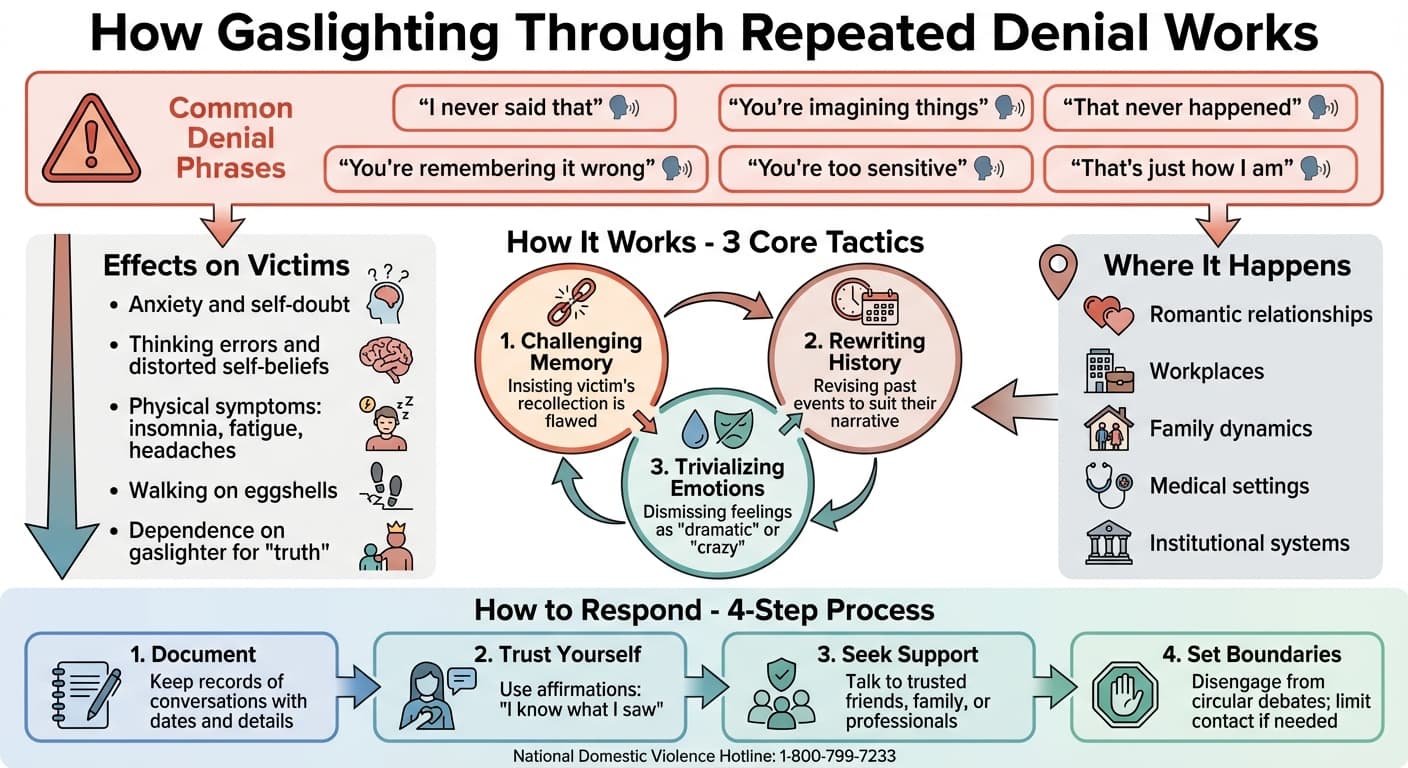
Gaslighting thrives on repeated denial, a tactic where manipulators deny clear, verifiable events to make you doubt your reality. Common phrases like "I never said that" or "You're imagining things" serve to confuse and control. This method erodes self-confidence, disrupts memory, and fosters dependence on the gaslighter for "truth."
Key points:
- How it works: Denying events outright, rewriting history, and trivializing emotions.
- Effects on victims: Anxiety, self-doubt, and physical symptoms like insomnia or fatigue.
- Where it happens: Relationships, workplaces, family, medical settings, and institutions.
- Why it's used: To maintain control, avoid accountability, and perpetuate manipulation cycles.
Recognizing patterns of denial is the first step to regaining control. Document interactions, trust your perception, and seek support from others. Tools like Gaslighting Check can help identify manipulation patterns, while setting boundaries and disengaging from circular debates can protect your emotional well-being. Remember, no one has the right to distort your reality.
::: @figure
Recognising Gaslighting Tactics, Phrases and Stages
How Repeated Denial Works as a Gaslighting Tactic
Repeated denial functions by outright rejecting clear and verifiable events rather than twisting them. A gaslighter doesn't just manipulate the truth - they flat-out deny it. They’ll say things like, "That never happened" or "I never said that", even when there’s evidence to prove otherwise. This tactic creates a foundation for deeper manipulation, leaving victims questioning their own reality.
The process often begins subtly. A gaslighter might deny a small comment or minimize a minor incident. Over time, these repeated denials accumulate, making it increasingly difficult for the victim to separate truth from falsehood. This gradual erosion of trust in their own perception delays the victim's ability to recognize the pattern, deepening the psychological damage.
Common Tactics of Repeated Denial
Gaslighters use several specific techniques to reinforce denial, each designed to chip away at a victim’s confidence in their own memory and perception.
One common method is challenging memory. The abuser insists that the victim’s recollection is flawed, causing them to doubt their cognitive abilities. Phrases like, "You’re remembering it wrong" or "That’s not how it happened at all", are often used to undermine the victim's trust in their own mind.
Another tactic is rewriting history, where the gaslighter revises past events to suit their narrative. This often involves denying previous commitments or casting themselves as the victim. For example, in a workplace, a manager might deny ever agreeing to a project deadline, leaving the employee questioning whether the conversation even happened.
Trivializing emotions is another powerful tool. By dismissing the victim's feelings as "too sensitive", "crazy", or "dramatic", the gaslighter avoids accountability while invalidating the victim’s emotional response.
A striking example of manipulation through denial comes from a 1977 case in the British Journal of Psychiatry. In this instance, retirement home staff fabricated symptoms of psychosis in an elderly woman with a long history of paranoia. They used her medical record to justify repeated involuntary commitments. Interestingly, her symptoms disappeared immediately upon admission, revealing the manipulation at play [5].
Psychological Effects on Victims
When a person’s memory and perception are constantly called into question, the psychological toll is profound. Victims often experience intense anxiety, which can lead them to accept the gaslighter’s version of events - even when it directly contradicts their own experiences [1].
"The brain, desperate for stability, may even start to rely on the abuser for 'truth.'"
– Science News Today [1]
This ongoing mental strain can cause "thinking errors", where victims develop distorted beliefs about themselves. They may feel undeserving of respect, doubt their own worth, or question their ability to perceive reality. The chronic stress from repeated denial can also manifest physically, contributing to headaches, fatigue, insomnia, and a weakened immune system [1].
"Gaslighting preys on emotions, mood, and self-perceptions. It often starts small, to poke holes in a victim's confidence in their reality, before gradually building to a distortion of reality."
– Jamie Cannon, MS, LPC, Psychology Today [7]
Over time, victims may find themselves "walking on eggshells", constantly editing their thoughts and words to avoid conflict. This hyper-vigilance further disconnects them from their sense of self and reality [6].
Where Repeated Denial Typically Happens
The damaging effects of repeated denial extend far beyond personal relationships, infiltrating various areas of daily life.
Romantic relationships are one of the most common settings for this tactic. Abusers exploit the trust and emotional vulnerability inherent in intimate connections. Victims may overlook harmful behavior or dismiss warning signs due to attachment or fear.
In workplaces, gaslighting can occur when managers deny prior agreements or when colleagues withhold critical information. This can leave employees doubting their competence and second-guessing their abilities.
Family dynamics often provide fertile ground for gaslighting as well. Parents, for instance, may dismiss a child’s feelings or perceptions to maintain control, a behavior that can carry over into the child’s adult relationships.
Medical settings are another area where repeated denial can have serious consequences. Some healthcare providers dismiss legitimate physical symptoms, telling patients it’s "all in their head." This phenomenon, known as medical gaslighting, disproportionately affects women and can delay critical diagnoses.
Even institutional systems can deploy repeated denial tactics. For example, during the 1970s and 1980s, the East German state security service (Stasi) used psychological harassment, known as "decomposition" (Zersetzung), to systematically undermine individuals’ sense of reality. This allowed the government to avoid international scrutiny for wrongful imprisonment while effectively silencing dissent [5].
Why Gaslighters Use Repeated Denial
Gaslighters rely on repeated denial as a tool to maintain control and distort their victim's sense of reality. This tactic serves multiple purposes, all designed to consolidate their power while undermining the victim's confidence in their own perception of the truth.
Maintaining Control and Power
When gaslighters repeatedly deny events with statements like "that never happened", they aren't just disagreeing - they're asserting control over what is considered real. This tactic creates a power imbalance, positioning the gaslighter as the ultimate authority on reality.
"A gaslighter... needs to be right to preserve their own sense of self and to keep a sense of power in the world."
– Robin Stern, Ph.D., Co-founder of the Yale Center for Emotional Intelligence
Over time, this repeated denial can wear down the victim's confidence in their own memory or judgment. As a result, the victim may begin to rely on the gaslighter's version of events, further deepening the imbalance of power.
Avoiding Accountability
Denial also serves as a way for gaslighters to dodge responsibility for their actions. A 2023 study involving 65 gaslighting victims, conducted by researchers from McGill University and the University of Toronto, highlighted that avoiding accountability is a core motivation behind gaslighting. The study found that infidelity was a frequent trigger for this behavior.
"Gaslighters are primarily motivated by avoidance of accountability and the desire to control others."
– Dan Mager, MSW, LCSW
By refusing to acknowledge their wrongdoing, gaslighters maintain an image of being "right" or "strong." Even when confronted with evidence, they dismiss it as exaggerated, fabricated, or irrelevant. Dr. Chivonna Childs from Cleveland Clinic describes this tactic as sleight of hand:
"It's like a magic trick: They make you look to the left so you don't see what's going on to the right."
This deflection not only shields the gaslighter from blame but also shifts the focus onto the victim, making them question their own memory or actions. The result is a deeper entrenchment of the manipulative dynamic.
Reinforcing the Gaslighting Cycle
Repeated denial doesn’t just confuse the victim - it also reinforces the cycle of manipulation. Each instance of denial chips away at the victim's mental defenses, making them increasingly dependent on the gaslighter for their sense of reality.
"Gaslighting is always a creation and interplay of two people: A gaslighter, who needs to be right to preserve their own sense of self and to keep a sense of power in the world; and a gaslightee, who is manipulated into allowing the gaslighter to define their sense of reality."
– Robin Stern, Ph.D., Co-founder of the Yale Center for Emotional Intelligence
This cycle often includes projection, where the gaslighter blames the victim for their own faults. Over time, the victim may become isolated from supportive relationships, doubting their own experiences and finding it increasingly difficult to escape the abusive situation.
Detect Manipulation in Conversations
Use AI-powered tools to analyze text and audio for gaslighting and manipulation patterns. Gain clarity, actionable insights, and support to navigate challenging relationships.
Start Analyzing NowHow to Recognize Patterns of Repeated Denial
Spotting repeated denial involves identifying consistent behaviors and responses over time.
Warning Signs of Repeated Denial
Certain phrases can reveal denial being used as a manipulation tool. Be alert for comments like "I never said that," "You're imagining things," "That's just how I am," or "You're too sensitive." These phrases often aim to dismiss or invalidate your concerns.
Another common tactic is deflection, where the focus shifts away from the issue at hand. For instance, when you voice a concern, the response might be "What about my feelings?" or "Well, what about the time you did X?" This strategy redirects attention, leaving you defending yourself instead of addressing their behavior.
Gaslighters may also derail conversations through nitpicking or pedantry. They might argue over word choices, saying things like "Don't say I NEVER do that" - turning the discussion into a debate about semantics rather than the actual problem. Similarly, they might engage in "future-faking", making promises to address issues later - like "after the holidays" or "next month" - only to let those deadlines slip repeatedly.
Tracking and Documenting Conversations
Keeping detailed records of interactions can help you maintain clarity when events are later denied or distorted. Dr. Robin Stern, Co-founder of the Yale Center for Emotional Intelligence, suggests a straightforward method:
"Write down, 'I said, he said, I said, he said' to observe how your gaslighter distorts events." [8]
Save text messages, take screenshots, and maintain a journal with specific dates and details. Trauma-informed therapist Amelia Kelley, Ph.D., emphasizes that these records are not meant to confront the gaslighter, as they could misuse the evidence. Instead, the purpose is to ground yourself in reality by focusing on objective details - what was said and done - rather than emotional interpretations.
This practice can also prepare you to leverage technological tools that help identify manipulation patterns.
Using AI Tools Like Gaslighting Check

AI tools can be incredibly useful for spotting patterns that might be hard to discern on your own. Platforms like Gaslighting Check use natural language processing to analyze text and voice data, identifying recurring denial and deflection tactics. The tool assigns a risk score to conversations and provides real-time alerts when manipulation patterns are detected.
Gaslighting Check offers features like text and voice analysis, detailed behavioral trend reports, and conversation history tracking. For US users, the premium plan costs $9.99/month and includes tools to monitor how denial patterns evolve across multiple interactions. To ensure privacy, all data is encrypted end-to-end, and automatic deletion policies are in place. These insights provide concrete evidence of manipulation, helping you validate your experiences and better understand your interactions.
How to Address Repeated Denial
Dealing with repeated denial can feel disorienting, but there are ways to reclaim your sense of reality and protect your emotional well-being.
Personal Strategies for Self-Validation
One of the most effective ways to counter gaslighting is to trust your own perception. When someone denies something you know to be true, remind yourself of what you experienced. Affirmations like "I know what I saw", "I trust my memory", or "We remember this differently, and that's okay" can help you stay grounded in your reality.
Dr. Robin Stern, a psychoanalyst and expert on gaslighting, offers this key insight:
"As soon as you understand that it doesn't matter how right you are, the closer you will be to freedom."
Rather than trying to convince the gaslighter or win the argument, focus on preserving your peace. Psychologist Chivonna Childs advises:
"A fire cannot burn if there's no fuel. They can't fight if there's no one to fight with."
If a conversation becomes circular or emotionally draining, step away. Phrases like "This isn't productive for me" or "I'm not going to keep debating this" can help set boundaries. You might also need to physically remove yourself from the situation. Pay attention to how you feel during these interactions - if you sense confusion or self-doubt creeping in, it could be a sign to disengage.
In moments of tension, grounding techniques can help you regain clarity. Try deep breathing, counting, or focusing on an object in the room. Silently reminding yourself, "I am not crazy, I am being manipulated", can also interrupt self-doubt and re-center your perspective.
Once you've established self-validation, seeking external support can strengthen your efforts.
Getting Support from Others
You don't have to face gaslighting alone. Share your experiences with trusted friends or family members and ask for their perspective. A simple question like "Does this sound off to you?" can provide much-needed reassurance and validation.
Consulting a mental health professional who understands manipulative behaviors can also be incredibly helpful. If the denial escalates to abusive behavior or you feel unsafe, don't hesitate to reach out to emergency services or contact the National Domestic Violence Hotline at 1-800-799-7233 for confidential, 24/7 support.
Reducing exposure to toxic interactions is another critical step. Dr. Chivonna Childs highlights the importance of calling out gaslighting behavior:
"Calling out gaslighting behaviors helps set boundaries and change the power dynamic. It puts the other person on notice that you will no longer accept this type of treatment."
In some cases, limiting contact or even ending the relationship may be the healthiest decision, especially if the pattern of denial continues despite your efforts.
Using Technology for Detection and Support
Technology can also play a role in addressing gaslighting. Tools like Gaslighting Check analyze communication patterns to identify manipulative tactics. For more details on how these tools work and their features, refer to the earlier section on AI tools.
As trauma-informed therapist Dr. Amelia Kelley points out:
"Documentation can help ground your sense of reality and aid future decision-making about the relationship."
Keeping records of conversations or incidents can provide clarity and reinforce your confidence as you navigate challenging interactions.
Conclusion: Breaking Free from Gaslighting Through Awareness
Gaslighting thrives on repeated denial, leaving you disoriented and questioning your own reality. Recognizing this pattern is a powerful first step toward reclaiming your confidence. Research highlights that gaslighting isn't an isolated event - it’s a deliberate, ongoing behavior meant to undermine your trust in yourself and make you reliant on someone else's distorted narrative [4][3].
Breaking free starts with self-validation and creating a clear record of events. Tools like journaling, taking screenshots, or even recording interactions can serve as anchors to your reality. Grounding techniques and affirmations can also help you stay centered and reinforce your trust in your own perceptions [9][2].
For a more tech-savvy approach, platforms like Gaslighting Check analyze conversations to identify manipulative patterns, offering objective insights. Combine these tools with the support of trusted friends, family, or mental health professionals to rebuild your confidence and regain control.
Awareness is a game-changer. Calling out gaslighting when it happens and refusing to engage in endless, circular debates can weaken its grip. Recognizing repeated denial is crucial to dismantling the manipulator’s hold. Trust your instincts, establish firm boundaries, and, if necessary, walk away to safeguard your well-being.
The journey to freedom begins by trusting what you know to be true and standing firm against anyone who tries to shake that foundation.
FAQs
How can I recognize if someone is using repeated denial to gaslight me?
Repeated denial is a classic gaslighting tactic where someone invalidates your reality by insisting that events, statements, or emotions you clearly recall either "never happened" or were "misunderstood." They might say things like, "I never said that," "You’re remembering it wrong," or "You’re overreacting." These denials often come paired with behaviors like shifting blame, downplaying your emotions, or distorting past events to make you doubt your memory and perception.
Here are some signs to help you spot repeated denial:
- Contradicting themselves: They frequently change their story and deny what they previously said.
- Dismissing evidence: Even when presented with proof, they may claim it’s "irrelevant" or "taken out of context."
- Invalidating your feelings: They might accuse you of being "too sensitive" or "dramatic" to divert attention from their actions.
If these patterns feel familiar, start documenting incidents with details like dates, times, and specific interactions. Keeping a record can help you identify recurring behaviors and bring clarity if you decide to confront the situation or seek help. There are also tools available that can assist in tracking and analyzing manipulative interactions more effectively.
How can I protect myself from gaslighting in a relationship?
Gaslighting is a manipulative tactic where someone causes you to question your own memories or perceptions. Protecting yourself starts with recognizing the red flags - things like constant denial of events, shifting blame, or dismissing your feelings as overreactions. These behaviors are designed to make you doubt yourself.
Once you spot these patterns, it’s important to establish clear boundaries. Calmly communicate what behaviors you won’t tolerate and outline the consequences if those lines are crossed. This step helps you reclaim control and assert your emotional needs.
Another effective strategy is to keep a record of incidents. Writing down details of manipulative interactions or even recording conversations (where legally permissible) can provide clarity and reaffirm your reality. Surrounding yourself with trusted friends, family, or a therapist can also offer much-needed validation and support. They can help you process your experiences and, if necessary, create a plan to ensure your emotional safety. Additionally, tools like conversation analysis can help you identify manipulation early, giving you the confidence to address it head-on and protect your well-being.
How does repeated denial from gaslighters affect my mental and physical health?
Repeated denial, a tactic often used in gaslighting, can have profound effects on both your mental and physical health. Mentally, it fuels constant stress and anxiety, which may spiral into depression, diminished self-worth, and a sense of powerlessness. Over time, these feelings can make it harder to reach out for help, leaving issues like chronic stress or mood disorders to deepen unchecked.
On the physical side, the stress triggered by repeated denial can activate your body’s "fight-or-flight" response, flooding it with hormones like cortisol and adrenaline. If this state persists, it can lead to elevated blood pressure, digestive issues, and a weakened immune system. You might also notice physical symptoms such as headaches, muscle tension, fatigue, or trouble sleeping. Spotting these warning signs is an essential step toward seeking help, breaking the cycle, and prioritizing your well-being.