How Recovery Tracking Supports Gaslighting Survivors

How Recovery Tracking Supports Gaslighting Survivors
Gaslighting survivors often struggle with self-doubt, memory distrust, and emotional confusion. Recovery tracking tools provide a way to rebuild trust in your perceptions by documenting interactions and identifying manipulation patterns.
Key insights:
- Gaslighting's effects: Survivors experience confusion, anxiety, and even physical brain changes from prolonged manipulation.
- Challenges in recovery: Self-doubt and "conditioned self-gaslighting" make traditional methods like journaling or seeking external validation less effective.
- Recovery tracking tools: Platforms like Gaslighting Check use secure logs, real-time analysis, and physical reaction tracking to clarify events and support healing.
- Features and pricing: For $9.99/month, premium tools offer voice analysis, interaction history, and detailed reports to track progress and validate experiences.
Takeaway: Recovery tracking tools help you document reality, identify manipulation, and rebuild confidence in your instincts - an essential step toward healing from gaslighting.
::: @figure
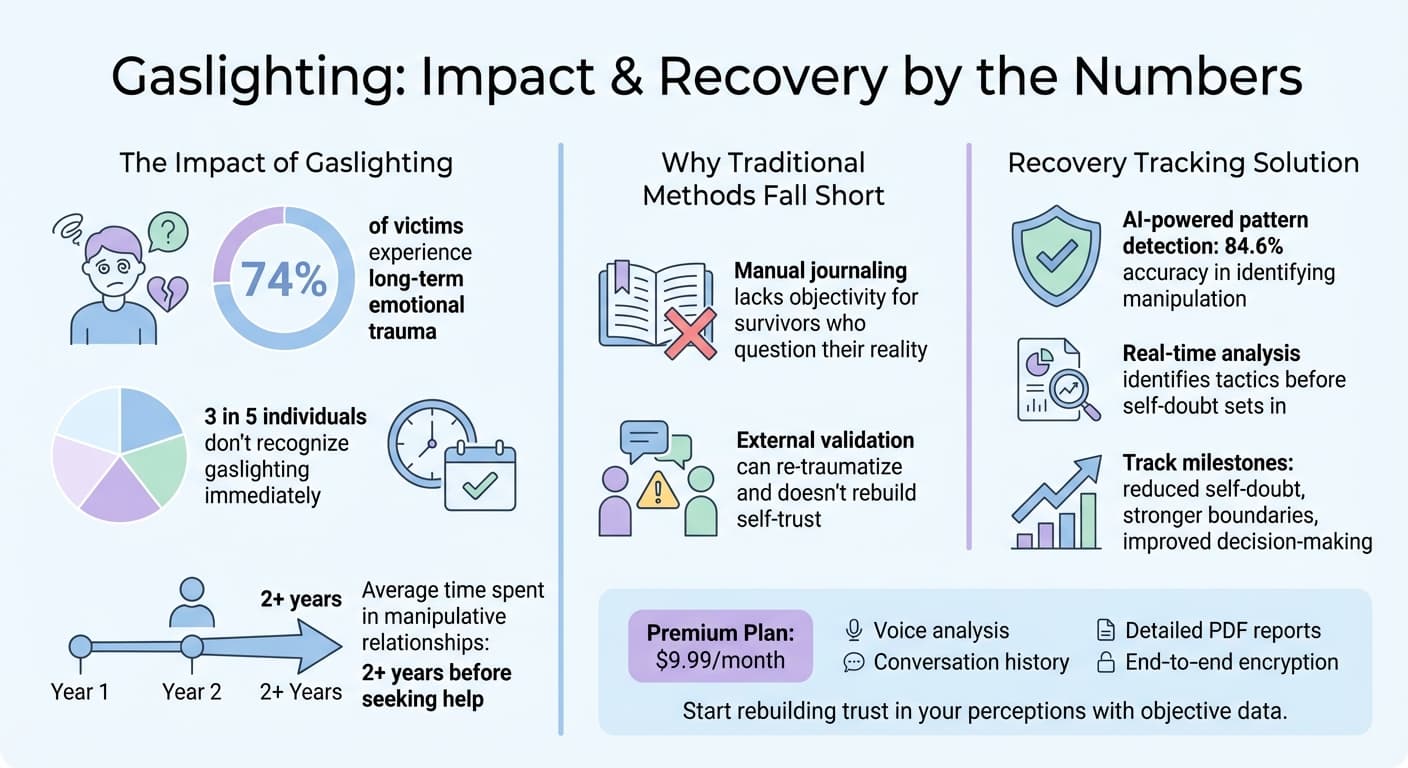
Why Traditional Recovery Methods Often Fall Short
The Limitations of Journaling
Manual journaling often falls short for gaslighting survivors because it lacks the objectivity they desperately need. When you've been conditioned to question your own reality, simply writing down your thoughts doesn’t necessarily validate them. Survivors frequently dismiss their recorded feelings, telling themselves they’re "overreacting" or being "irrational" [3].
Gaslighting creates what experts describe as a "fog of confusion" - a mental state where survivors struggle to articulate their experiences and make sense of interactions, even if they’re typically clear-headed in other areas of life [2]. In this haze, journal entries can unintentionally reflect the distorted thinking caused by the abuse. Without clear, objective markers, it’s incredibly difficult to separate genuine memories from those warped by gaslighting tactics.
Another major limitation of manual journaling is its inability to track manipulation patterns across multiple interactions. While you might document isolated incidents, identifying recurring tactics like "love bombing", blame-shifting, or denial loops requires analyzing a large volume of interactions. Traditional pen-and-paper methods simply aren’t equipped to handle this level of complexity.
And it’s not just journaling that falls short - seeking external validation is also fraught with challenges.
The Problems with Relying on External Validation
Turning to friends and family for validation can be risky and, in some cases, even harmful. As author Emma Rose B explains, trying to articulate covert abuse to others "can re-traumatize survivors" [4]. Gaslighting doesn’t leave visible scars or dramatic evidence, making it harder for outsiders to recognize as abusive behavior [4].
Well-meaning loved ones may unintentionally minimize your experience, comparing it to normal relationship conflicts with comments like, "Oh, my partner does that too" [4]. Compounding the issue, abusers often maintain a charming public image, which can mislead even those you trust for support.
The bigger problem is that external validation doesn’t address the core damage caused by gaslighting: the erosion of self-trust. As Emma Rose B points out, "validation should not primarily come from others accepting that the relationship was abusive, but that it should be in the form of self-validation" [4]. Gaslighting is designed to chip away at your self-esteem until you no longer trust your own instincts. While seeking reassurance from others might feel comforting in the moment, it doesn’t rebuild the internal confidence needed to truly heal.
This is where interactive recovery tools step in, offering objective insights that help survivors rebuild trust in their own perceptions.
Gaslighting Part 2: How to Escape the Abusive Cycle
How Recovery Tracking Tools Support Gaslighting Survivors
Recovery tracking tools help survivors regain confidence in their perceptions. By offering objective insights, these tools separate fact from manipulation. Instead of relying solely on memory or seeking external validation, they provide a clear, concrete record of interactions. This allows survivors to review events without second-guessing themselves.
Statistics reveal the deep impact of gaslighting: 74% of victims experience long-term emotional trauma, and three in five individuals don’t recognize gaslighting immediately. This form of manipulation distorts reality and undermines self-trust [5]. Recovery tracking tools cut through the confusion by documenting events as they occur, preserving the truth before self-doubt can cloud it.
Using Data to Rebuild Trust in Your Perception
Secure conversation logs act as a kind of internal guide, breaking the cycle of self-doubt that often leads to thoughts like, "Maybe I overreacted." These logs capture what was said, when it was said, and your emotional response at the time - before your mind has a chance to rationalize or downplay the experience.
"The act of writing things down, seeing patterns, and validating your truth is healing in itself. It's not about revenge. It's about repair." - Keeley Teemsma, LCSW, Refresh Psychotherapy [7]
These tools become even more powerful when they include physical indicators alongside conversations. For instance, a racing heart, stomach tension, or sudden anxiety aren’t signs of being "too sensitive" - they’re your body’s way of signaling that something feels wrong [6][7]. Tools like Gaslighting Check let you document these physical reactions in real-time through features like audio recording and text analysis, giving you a fuller picture of your experiences. This clarity helps you better understand your emotions and reactions, free from later distortions.
Real-Time Analysis for Emotional Clarity
While journaling helps you reflect on the past, real-time analysis provides immediate clarity. Traditional journaling often happens after the fact, when memories may already be clouded by self-doubt. In contrast, real-time tools analyze interactions as they occur or shortly afterward, identifying manipulation tactics like deflection, blame-shifting, or emotional dismissal before your mind has time to rationalize them [7].
Gaslighting Check’s voice analysis, for example, detects subtle cues in tone and speech [5]. A gaslighter might say "I love you", but their tone could reveal contempt, or they might claim they’re "just joking" while their voice carries hostility. These nuances can be hard to catch in the moment but become obvious when analyzed objectively.
"Identifying gaslighting patterns is crucial for recovery. When you can recognize manipulation tactics in real-time, you regain your power and can begin to trust your own experiences again." - Stephanie A. Sarkis, Ph.D., Author of Healing from Toxic Relationships [5]
Timing is critical. On average, people spend over two years in manipulative relationships before seeking help [5]. Real-time analysis can shorten this period by helping individuals recognize harmful patterns early, before they become deeply ingrained.
Tracking Milestones to Measure Progress
Recovery tracking tools also allow you to measure your progress over time. Gaslighting can create a sense of stagnation, making it hard to see growth. Digital tools offer tangible markers of improvement, countering the distorted perceptions that gaslighting often leaves behind [1].
For example, Gaslighting Check’s conversation history tracking (included in the Premium Plan for $9.99/month) allows you to review past interactions and see how your responses have changed. Perhaps a few months ago, you automatically apologized when faced with blame-shifting. Now, you recognize the tactic and hold your ground. These milestones - like reduced self-doubt, stronger boundaries, and improved decision-making - become clear when supported by data.
"The sensations you feel in your body are the first clue that something is not right, and it's important to be in touch with them." - Kate Balestrieri, Psy.D., Licensed Psychologist [1]
Detailed reports turn raw data into actionable insights, creating recovery roadmaps. Instead of wondering if you’re improving, you can track exactly which manipulation tactics you’ve started identifying, how your physical stress responses have decreased, and where you might still need support. This kind of feedback helps rebuild the self-trust that gaslighting erodes, one documented interaction at a time.
Detect Manipulation in Conversations
Use AI-powered tools to analyze text and audio for gaslighting and manipulation patterns. Gain clarity, actionable insights, and support to navigate challenging relationships.
Start Analyzing NowKey Features of Gaslighting Check for Recovery Support

Gaslighting Check provides tools designed to document interactions, reveal manipulation patterns, and rebuild self-trust, making it a valuable resource for those recovering from gaslighting.
Conversation History Tracking and Analysis
For $9.99/month, the Premium Plan includes conversation history tracking, which creates a continuous record of your interactions. This feature can help you identify subtle manipulation patterns over time, such as recurring blame-shifting or distorted narratives.
Using AI-powered pattern recognition, the platform analyzes both text and audio to detect tactics like reality distortion, memory manipulation, and emotional invalidation. This creates a clear, documented timeline of what was said and when, offering a concrete reference point.
The platform also generates detailed reports that highlight specific manipulation techniques, assigning severity scores for better understanding. Robert P., a survivor rebuilding trust after a toxic relationship, described these reports as providing "a therapist's insight on demand" [5].
Studies indicate that AI systems can detect deceptive behavior with up to 84.6% accuracy through long-term pattern analysis [8]. This level of precision helps cut through the confusion and emotional fog gaslighting often causes. Plus, the platform ensures user privacy with robust security measures.
Privacy and Data Security
Gaslighting Check takes privacy seriously, using end-to-end encryption to protect all data from the moment it’s uploaded. Information is stored with complete anonymization, meaning your personal details remain untraceable [5].
For users on the Free Plan, data is automatically deleted after analysis. Those on the Premium Plan can choose to retain their conversation history for ongoing tracking. Both plans maintain the same high encryption standards. Considering that healthcare-related data breaches in the U.S. cost an average of $10.93 million in 2023 [8], this level of security ensures your recovery process stays confidential.
Affordable and Accessible Plans
The Free Plan offers basic text analysis at no cost, allowing you to explore the platform without any financial commitment. It provides enough insights to start identifying manipulation tactics and understanding your experiences.
For $9.99/month, the Premium Plan unlocks additional features like voice analysis, conversation history tracking, and comprehensive reports. This pricing makes it accessible to many survivors, especially since 74% of gaslighting victims report experiencing long-term emotional trauma [5].
Emily R., a survivor, shared that the tool "helped her recognize patterns she couldn't see before, validating her experiences and giving her the confidence to set boundaries" [5].
How to Use Recovery Tracking in Your Daily Life
Incorporating recovery tracking into your routine can feel like a big step, but Gaslighting Check makes it manageable with its tools. Here’s how you can ease it into your daily life:
Start with the Basics
Kick things off by exploring Gaslighting Check’s Free Plan. This plan allows you to get comfortable with text analysis by documenting confusing or unclear messages. It’s a simple way to start identifying manipulation tactics without spending a dime. These basic insights can help you recognize patterns of manipulation early on.
Unlock Advanced Features for Deeper Insights
When you’re ready to take it further, consider upgrading to the Premium Plan for $9.99 per month. This plan offers advanced tools like voice analysis and conversation tracking. With the real-time audio feature, you can record phone calls or face-to-face conversations, capturing tone and verbal cues that text alone might miss. Plus, you’ll receive detailed PDF reports packed with actionable insights - perfect for validating your experiences and building self-awareness.
Make Time for Weekly Reviews
Consistency is key. Set aside 15–20 minutes each week to review your reports and conversation history. Look for recurring patterns, triggers, and any shifts in how you respond. As Kate Balestrieri, Psy.D., explains:
"The sensations you feel in your body are the first clue that something is not right and it's important to be in touch with them" [1].
During these reviews, connect your physical sensations - those gut feelings - with the documented patterns in your interactions. This reflection can help you strengthen your self-trust and stay on track in your recovery journey.
Conclusion
Recovering from gaslighting isn't just about moving forward - it's about reclaiming your confidence in your own reality with evidence that supports your experiences. With 74% of gaslighting victims reporting long-term emotional trauma [5], having the right tools can be a game-changer in your healing process.
Objective data plays a powerful role in turning uncertainty into decisive action. Through AI-powered analysis, the platform identifies manipulation tactics like blame-shifting and DARVO - those subtle, often undetectable patterns of control. By documenting your interactions objectively, you can begin to rebuild trust in your perceptions and rewire the mental pathways affected by gaslighting.
Gaslighting Check takes these insights a step further by organizing your progress into clear, actionable data. Its combination of text and voice analysis, encrypted storage, and detailed reporting transforms raw information into clarity. Whether you choose the free basic plan or the Premium Plan at $9.99/month for more advanced features, you're equipping yourself with tools to move from survival to genuine recovery.
Instead of constantly second-guessing your experiences, you gain clarity backed by data. Rather than feeling isolated, you have documented proof that validates your reality. And instead of relying solely on memory, you have a secure record that can support therapy or even legal actions if necessary.
Start small - document one conversation. Each recorded interaction strengthens your confidence and reinforces your truth.
FAQs
How can recovery tracking tools help gaslighting survivors trust their memories?
Recovery tracking tools offer survivors a dependable way to document events with precision, providing a time-stamped record that helps distinguish between authentic memories and those influenced by manipulation. By capturing details such as exact quotes, timestamps, and even the tone of interactions, these tools transform subjective memories into objective records that can be revisited and verified later. This process helps combat the self-doubt that gaslighting often instills.
Some tools take it a step further with advanced features like AI-driven analysis. These can uncover patterns of manipulation, such as contradictions or denial tactics, offering survivors deeper insights into their experiences. Beyond rebuilding self-trust, these records can be shared with therapists or legal professionals, serving as valuable evidence. By reinforcing accurate memory recall, these tools help survivors break free from distorted narratives and regain confidence in their own experiences.
How do recovery tracking tools benefit survivors of gaslighting compared to traditional journaling?
Recovery tracking tools bring a modern, data-focused approach to documenting and understanding personal experiences, offering much more than traditional journaling. These tools let survivors record emotions, incidents, and symptoms while presenting the information through easy-to-read charts and reports, making progress more tangible and straightforward to follow.
Some tools even incorporate AI to analyze text and voice recordings, uncovering manipulation patterns in real time. This can be incredibly helpful for survivors who might feel uncertain or overwhelmed. On top of that, features like encrypted storage and automatic data deletion ensure that privacy is maintained, while still allowing users to securely share reports with therapists or legal professionals when needed.
By blending advanced analytics with privacy-focused designs and meaningful insights, recovery tracking tools give survivors a sense of control and clarity that traditional journaling often lacks.
How does Gaslighting Check protect my privacy and keep my data secure?
Gaslighting Check places a strong emphasis on protecting your privacy. All user data is encrypted, ensuring it stays secure and out of reach from unauthorized access. To add another layer of protection, the platform automatically deletes your information after a set period, giving you greater control over your personal data.
These safeguards are in place to deliver comprehensive security while respecting the confidentiality essential for your recovery process.