Rebuilding Autonomy After Gaslighting

Rebuilding Autonomy After Gaslighting
Gaslighting erodes your ability to trust yourself, leaving you doubting your decisions, emotions, and even memories. Over time, this manipulation can make you feel isolated and dependent on others for validation. To regain control, focus on these key steps:
- Recognize manipulation: Learn to spot gaslighting tactics like denial, blame-shifting, and trivializing your feelings.
- Rebuild self-trust: Start with small decisions, use tools like journaling to track your experiences, and challenge self-doubt with facts.
- Set boundaries: Protect your mental and emotional energy by limiting contact with manipulators and disengaging from unhealthy conversations.
- Use tools for clarity: Platforms like Gaslighting Check can help identify patterns of manipulation in conversations for $9.99/month with privacy safeguards.
A Roadmap to Healing from Gaslighting and Trusting Yourself Again
How Gaslighting Damages Your Autonomy
Gaslighting undermines your sense of trust by consistently distorting reality, making you question even your most basic perceptions. Over time, this steady erosion of self-trust can sneak up on you, leaving you unsure of your ability to make decisions.
What Gaslighting Does to Your Decision-Making
One of the most harmful effects of gaslighting is its ability to paralyze your decision-making. When your thoughts and emotions are continually dismissed or invalidated, you start doubting every choice - whether it’s a small, everyday decision or a life-changing one. This uncertainty often pushes you to rely on the gaslighter’s opinions rather than trusting your own instincts.
Robin Stern, Ph.D., Co-founder of the Yale Center for Emotional Intelligence, describes the dynamic:
"A gaslighter - the more powerful person in a relationship - tries to convince you that you're misremembering, misunderstanding, or misinterpreting your own behavior or motivations, thus creating doubt in your mind that leaves you vulnerable and confused." [4]
Gaslighting often starts with love-bombing - an intense display of affection designed to build trust quickly. Once that trust is established, the gaslighter manipulates it to reshape how you see yourself and the world around you. This manipulation can cause you to lose sight of your own needs, values, and identity. In fact, between 2021 and 2022, searches for the term "gaslighting" surged by 1,740%, highlighting the growing awareness of this behavior [8].
As your ability to make decisions diminishes, the emotional and behavioral toll becomes increasingly apparent.
Emotional and Behavioral Signs After Gaslighting
When gaslighting takes hold, emotional and behavioral changes often follow. You might notice yourself apologizing excessively or justifying the manipulator’s actions, even when you’ve done nothing wrong. Decisions that once came naturally can feel overwhelming because you’ve been conditioned to distrust your instincts.
You may also feel unusually anxious or on edge around the person who gaslighted you. This heightened stress can lead to withdrawing from activities you once loved, leaving you isolated and at risk of depression.
Willis Klein, a psychologist at McGill University, explains:
"The sense of feeling diminished, uncertain and like a shell of yourself is the outcome that requires the most attention." [8]
Dr. Chivonna Childs, a psychologist at Cleveland Clinic, adds:
"The person who's doing the gaslighting may or may not realize they're doing it. But either way, when you're on the receiving end, it can feel confusing and be very damaging." [1]
In many cases, gaslighting is accompanied by financial control, which is present in 98% of abusive relationships [7]. This financial dependency further erodes your autonomy and makes it even harder to regain control over your life.
Accepting What Happened and Letting Go of Self-Blame
::: @figure
Reclaiming your sense of control starts with identifying gaslighting for what it is. Pinpointing tactics like blame-shifting and distortion helps to clear the fog of self-doubt and brings clarity to your experience [10][11].
It’s crucial to understand that skilled manipulators intentionally create self-doubt - it’s not a reflection of your value or intelligence [11]. As the Psychowellness Center highlights, recognizing manipulation is a key step in regaining your sense of self [11]. This acknowledgment lays the foundation for separating fact from fiction.
Recognizing Manipulation and Taking Back Your Story
Once you’ve identified the manipulation, the next step is to untangle the truth from the distortions. One effective method is keeping a "Truth Record." Write down conversations in an "I said, they said" format as soon as possible [4]. This simple habit makes it easier to spot patterns, like how a manipulator changes topics or twists facts [4].
Robin Stern, Ph.D., Co-founder of the Yale Center for Emotional Intelligence, offers this insight:
"As soon as you understand that it doesn't matter how right you are, the closer you will be to freedom" [4].
Instead of engaging in endless debates about who’s right, pay attention to how the interaction makes you feel. Feelings of confusion, fear, or being attacked during conversations can be solid indicators of manipulation [4].
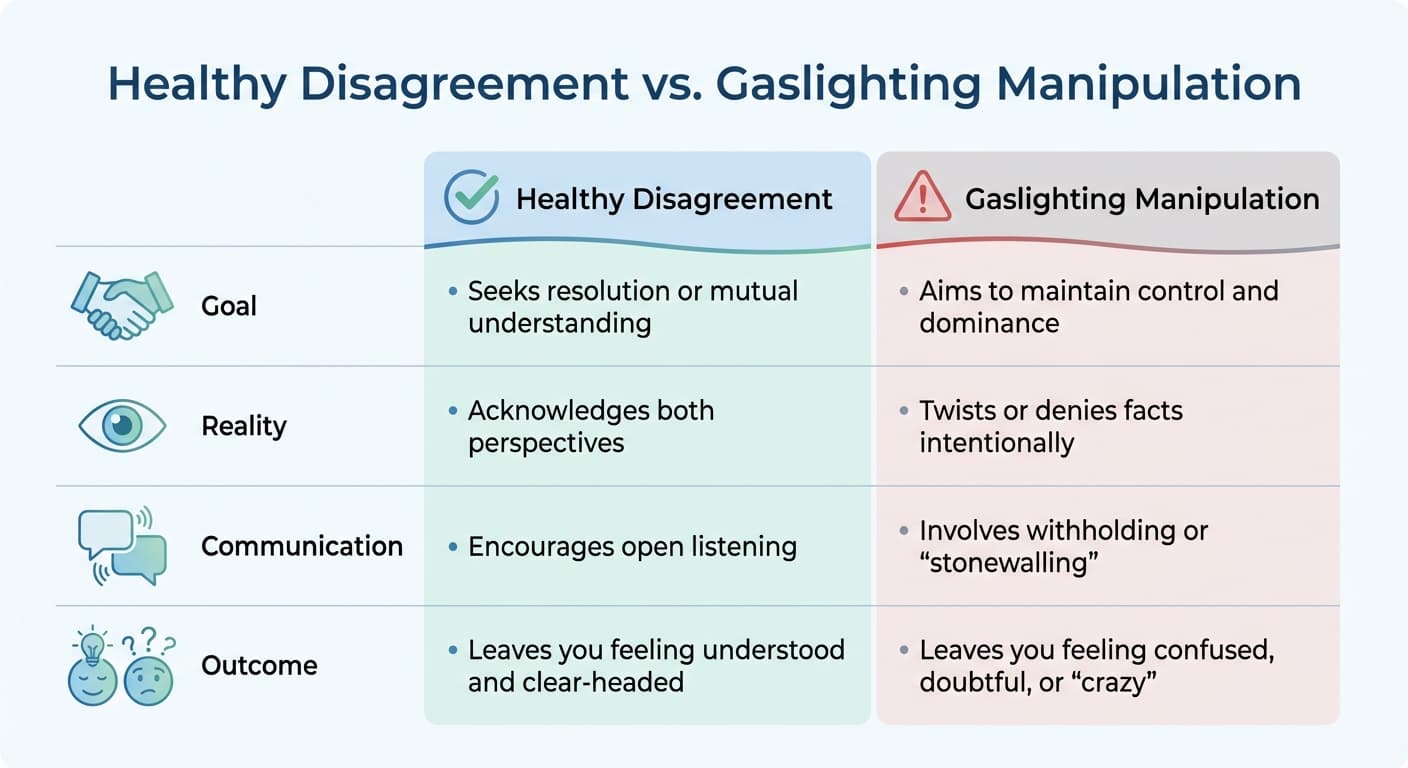
To better understand the difference between a normal disagreement and gaslighting, consider their outcomes:
| Feature | Healthy Disagreement | Gaslighting Manipulation |
|---|---|---|
| Goal | Seeks resolution or mutual understanding [4][9] | Aims to maintain control and dominance [4][9] |
| Reality | Acknowledges both perspectives [9] | Twists or denies facts intentionally [10][9] |
| Communication | Encourages open listening [4] | Involves withholding or "stonewalling" [10] |
| Outcome | Leaves you feeling understood and clear-headed [12] | Leaves you feeling confused, doubtful, or "crazy" [12] |
By recognizing these differences, you can better validate your experiences and protect your mental well-being.
Using Gaslighting Check to Confirm Your Experience

Evidence can be a powerful tool in reclaiming your narrative. Gaslighting Check is a platform designed to analyze both text and voice conversations, identifying manipulative behaviors and highlighting specific patterns of emotional manipulation.
The tool includes features like real-time audio recording and text analysis, which make it possible to uncover tactics that might go unnoticed in the moment. For $9.99/month, the Premium Plan even tracks conversation history to reveal recurring patterns of manipulation.
Your data is safe, too - everything is encrypted end-to-end, with automatic deletion policies to ensure privacy. Whether you stick with the free plan for basic text analysis or opt for the premium version with voice analysis, Gaslighting Check gives you the evidence you need to trust your own perceptions and regain control of your story.
Detect Manipulation in Conversations
Use AI-powered tools to analyze text and audio for gaslighting and manipulation patterns. Gain clarity, actionable insights, and support to navigate challenging relationships.
Start Analyzing NowRestoring Autonomy Through Boundaries and Self-Trust
Once you've recognized gaslighting tactics, the next step is reclaiming your sense of control. This involves setting firm boundaries and rebuilding trust in your own judgment. These two approaches are key to breaking free from the cycle of self-doubt that gaslighting often creates.
Setting Boundaries to Protect Your Independence
Boundaries are your first line of defense, safeguarding both your emotional energy and mental well-being. By establishing clear limits, you can avoid falling back into the exhausting dynamic of seeking the manipulator's approval [4][13].
One of the most powerful boundaries you can set is disengagement. If a discussion turns into a heated argument over who's "right", step away. You’re not obligated to justify your need to protect your reality. In extreme situations, the "No Contact" rule - completely cutting off communication by blocking phone numbers and social media accounts - can provide the mental space needed for healing [6].
It's also important to identify your specific triggers. For instance, conversations about money or family might consistently lead to manipulation. Once you know what sparks these cycles, make a conscious effort to disengage when those topics come up [4]. To support yourself in these moments, create a Psychological First-Aid Kit - a collection of grounding activities like taking a walk, practicing deep breathing, or calling a trusted friend. Turn to this toolkit whenever you feel overwhelmed or triggered [6].
Stephanie A. Sarkis, Ph.D., sheds light on the role of forgiveness in this process:
"Forgiveness is about giving up the hope that the past could be any different... you're forgiving the gaslighter for your own well-being." [6]
Once you've established boundaries, the next step is to rebuild trust in your own ability to make decisions.
Rebuilding Trust in Your Own Judgment
Gaslighting often leaves you doubting your every choice. Rebuilding self-trust starts with small, manageable steps that remind you of your reliability. Begin by making simple decisions - like choosing what to eat or wear - and following through.
Try the "Catch it, Check it, Change it" method to challenge self-doubt. For example, if you catch yourself thinking, "I'm too sensitive", pause and check whether this thought aligns with reality. Then, reframe it to something empowering, like, "My emotions are valid and reflect my needs." Set "99% Success" goals - small, achievable commitments, such as drinking a glass of water in the morning. Each success reinforces your confidence in your ability to follow through.
When communicating your needs, use "I" statements to assert yourself clearly. For instance, say, "I need to finish my thoughts before hearing your response." Additionally, keep a journal or digital notes to document your experiences. This creates a factual record that can counter any distorted narratives imposed by others.
Finally, learn to differentiate intuition from fear. Intuition feels calm and grounded, often tied to curiosity and growth, while fear tends to feel anxious or avoidant. When faced with decisions, take a moment to assess whether your feelings stem from intuition or past trauma. This practice can help you trust your instincts without letting previous manipulation cloud your judgment.
Learning to Spot Manipulation Tactics
Understanding how gaslighters operate equips you to recognize and resist manipulation. Spotting these behaviors can help break the cycle of confusion and self-doubt that keeps you feeling trapped.
Recognizing Common Manipulative Behaviors
Gaslighters tend to rely on predictable tactics to distort your sense of reality. One of their most common tools is denial - they’ll outright reject events or statements, even when you have clear evidence to the contrary [18]. When confronted, they often shift the blame, making you feel like you’re at fault for their actions [18]. If you express hurt or concern, they might dismiss your feelings using trivialization, calling you "too sensitive" or accusing you of "overreacting" [14][18].
Another tactic is contradiction, where they present conflicting information to make you question your memory [18]. They may also use moving goalposts, constantly changing expectations so you never feel like you can succeed [18]. In group settings, gaslighters often employ triangulation, using third parties to create mistrust or distance between you and others [15].
Beyond these strategies, gaslighters often manipulate through specific patterns of behavior. Love bombing - lavishing you with excessive attention, compliments, or gifts - can create dependency or serve as an apology after abusive episodes [14]. When they feel their control slipping, angry outbursts can shut down discussions [14]. They might also play the victim, twisting situations to make you feel guilty or responsible for their mistakes [14]. After a breakup, they may engage in hoovering, attempting to draw you back into the relationship for their own emotional gain [6].
Robin Stern, Ph.D., Co-founder of the Yale Center for Emotional Intelligence, offers an important distinction:
"Gaslighting is often used in an accusatory way when somebody may just be insistent on something, or somebody may be trying to influence you. That's not what gaslighting is." [17]
The difference lies in pattern versus incident. Gaslighting is a repeated pattern of manipulation over time, while healthy disagreements are isolated events where both parties respect reality [1][9]. In genuine conversations, both individuals listen and address concerns [4]. In power struggles, one person demands to be right while the other becomes desperate to gain their approval [4].
Understanding these external tactics is the first step in protecting yourself from internalized self-doubt.
Avoiding Self-Gaslighting Through Awareness
Recognizing manipulation tactics externally can help you avoid self-gaslighting - the tendency to adopt a manipulator’s distorted narrative [14][15]. Studies suggest that between 50% and 80% of adults experience emotional abuse in intimate relationships [15], and many people internalize these distortions long after the relationship ends.
Be mindful of warning signs in your own behavior. These may include constant self-doubt, confusion, excessive apologizing, difficulty making simple decisions, justifying someone’s harmful actions to others, or avoiding certain topics to escape “reality twists” [14][16][5]. These patterns suggest you may be internalizing manipulation.
When you catch yourself doubting your perception, name the behavior to yourself. Labeling what’s happening as "manipulation" or "gaslighting" can interrupt the cycle of self-blame [3]. Trauma-informed therapist Amelia Kelley, Ph.D., explains:
"Gaslighting is most effective when it goes undetected, so awareness is key." [3]
Trust your emotions over disputed facts. If an interaction leaves you feeling confused, attacked, or unsettled, step away - even if you can’t pinpoint why [4]. Your emotional response is valid and offers important insights. Learning to trust these signals can help protect you from both external manipulation and internal self-doubt.
Conclusion: Moving Forward With Restored Autonomy
Reclaiming your sense of autonomy starts with validating your own experiences and establishing firm boundaries. Your feelings, thoughts, and memories are legitimate - even if someone tried to make you doubt them. Moving forward means learning to trust your instincts, setting clear limits on how others interact with you, and spotting manipulation tactics before they take hold.
Digital tools like Gaslighting Check can help by providing AI-driven analysis of conversations, giving you an objective way to validate your experiences and identify patterns of manipulation. However, reclaiming autonomy also happens in the small, everyday decisions. Start with simple boundaries - like deciding not to reply to messages after 9:00 PM. When doubts creep in, try the "Catch it, Check it, Change it" approach to rebuild your confidence step by step.
As Stephanie Sarkis, Ph.D., wisely puts it:
"Forgiveness is giving up the hope that the past can be changed" [2].
Taking back your autonomy means acknowledging what has happened while refusing to let it dictate your future. Autonomy isn’t something permanently lost - it’s something you’re reclaiming, one choice at a time.
Focus on nurturing your emotional well-being and trusting your ability to make decisions. Enforce your boundaries consistently and give yourself grace as you rebuild. Every small step you take strengthens your path toward reclaiming your autonomy and shaping a future on your own terms.
FAQs
How can I rebuild self-trust after being gaslighted?
Rebuilding self-trust after experiencing gaslighting begins with acknowledging and validating your experience. Recognize the manipulation for what it was and allow yourself to feel the emotions tied to it. This acknowledgment is key to breaking the cycle of self-doubt that gaslighting often creates. Writing in a journal or using a secure app to document conversations and events can help you identify patterns and reinforce your sense of reality.
Start small by making decisions that carry little risk, like picking what to eat for dinner or setting a simple goal for the day. When you follow through on these choices without seeking outside approval, you begin to rebuild confidence in your own instincts. Alongside this, practice self-compassion. Replace harsh self-criticism with supportive, positive thoughts, treating yourself with the same kindness you’d offer a close friend.
It’s just as important to surround yourself with people who validate your experiences and respect your boundaries. Trusted friends or family members can provide a supportive environment as you take these steps. Over time, as your confidence grows, you can tackle bigger decisions, celebrating each success - no matter how small. With patience, kindness to yourself, and the right support, you can regain both self-trust and a sense of personal autonomy.
How can I set healthy boundaries with someone who is gaslighting me?
Setting boundaries with a gaslighter is crucial for safeguarding your mental and emotional health. Begin by calmly but firmly stating what behavior you won’t accept. For example, you might say, “I won’t accept being told that my memory is wrong.” Make sure to pair this with a clear consequence, like ending the conversation or walking away if the behavior persists. The key is to remain consistent and assertive - restate your boundary as often as necessary without getting drawn into arguments.
To strengthen your boundaries, keep a record of incidents. Write down dates, times, and specific details about what was said or done. This not only validates your experience but also helps you stay grounded in your reality. You might even use tools like Gaslighting Check, which can analyze conversations and provide reports while keeping your privacy intact.
Lastly, don’t go it alone. Reach out to trusted friends, a therapist, or a support group for support and guidance. A strong support system can help you stay empowered as you enforce your boundaries and reclaim your sense of control.
How does Gaslighting Check identify emotional manipulation?
Gaslighting Check leverages cutting-edge analysis tools to examine recorded conversations and text messages, pinpointing tactics such as invalidation, blame-shifting, and control. The platform generates detailed reports that outline recurring patterns, giving users valuable insights into these behaviors within their interactions.
Equipped with features like real-time audio recording, voice and text analysis, and conversation history tracking, Gaslighting Check helps individuals regain a sense of clarity and confidence. Plus, it prioritizes user privacy with encrypted data and automatic deletion policies, ensuring sensitive information stays secure.